
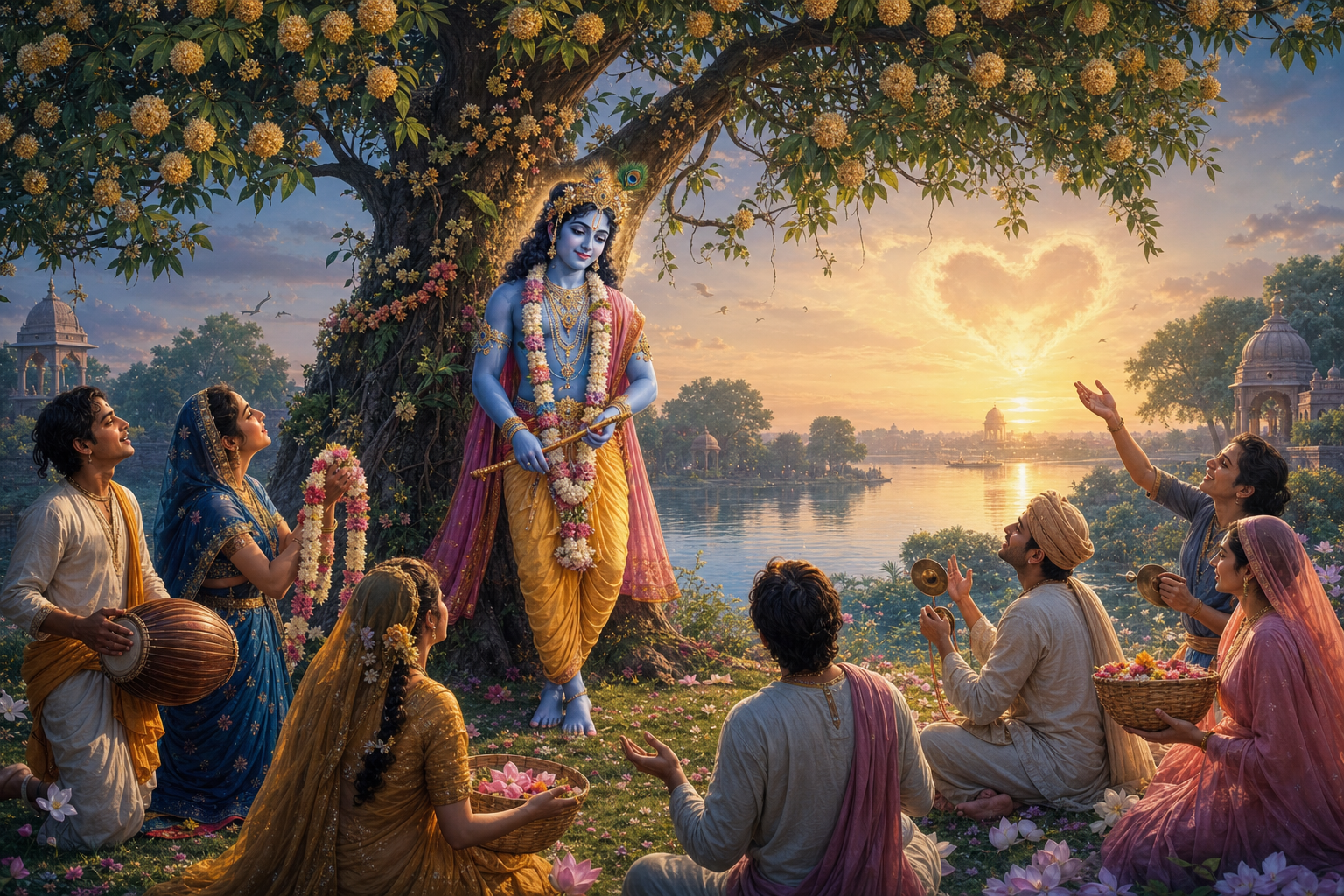
Krishna bhakti becomes clearest when it is understood as neither emotion alone nor activity alone. Across four devotional accounts, it emerges as one continuous movement: the heart turns toward Krishna without bargaining, ordinary life becomes a field of divine relationship, and that inward orientation acquires durable form through remembrance, chanting and service.
This synthesis connects theological principle, bhakti rasa, Krishna’s playful intimacy and the frequently invisible work of sankirtana devotees. Together, these perspectives show how devotional love is cultivated, expressed and distinguished from sentiment, spectacle or institutional prominence.
Devotion as the purpose that gives dharma its direction
The DharmaRenaissance discussion of supreme dharma begins with the Srimad Bhagavatham’s description of devotion to Adhokṣaja as ahaitukī and apratihatā: without material motive and unobstructed by circumstance. The reported result, expressed as yayātmā suprasīdati, is the deep satisfaction of the self. This definition establishes bhakti as the orienting purpose of religious life rather than one religious activity among many.
That hierarchy does not make duty, ethics, ritual or knowledge irrelevant. In the source’s reading, they become spiritually complete when they refine consciousness toward truthfulness, humility, self-control and loving surrender. The Bhagavad Gita’s treatment of Arjuna likewise places purified consciousness within responsible action, while its teaching about offering a leaf, flower, fruit or water emphasizes the devotion behind an offering rather than its economic value.
The other accounts give this theological principle concrete texture. The meditation on Sri Radha’s tears describes love freed from self-centred possession; the account of Krishna as the butter thief interprets surrender through intimate divine play; and the reflection on unknown sankirtana devotees locates the same principle in service performed without public recognition. Their settings differ, but all treat the loosening of egoic ownership as central to devotion.
One devotional centre, several relational languages
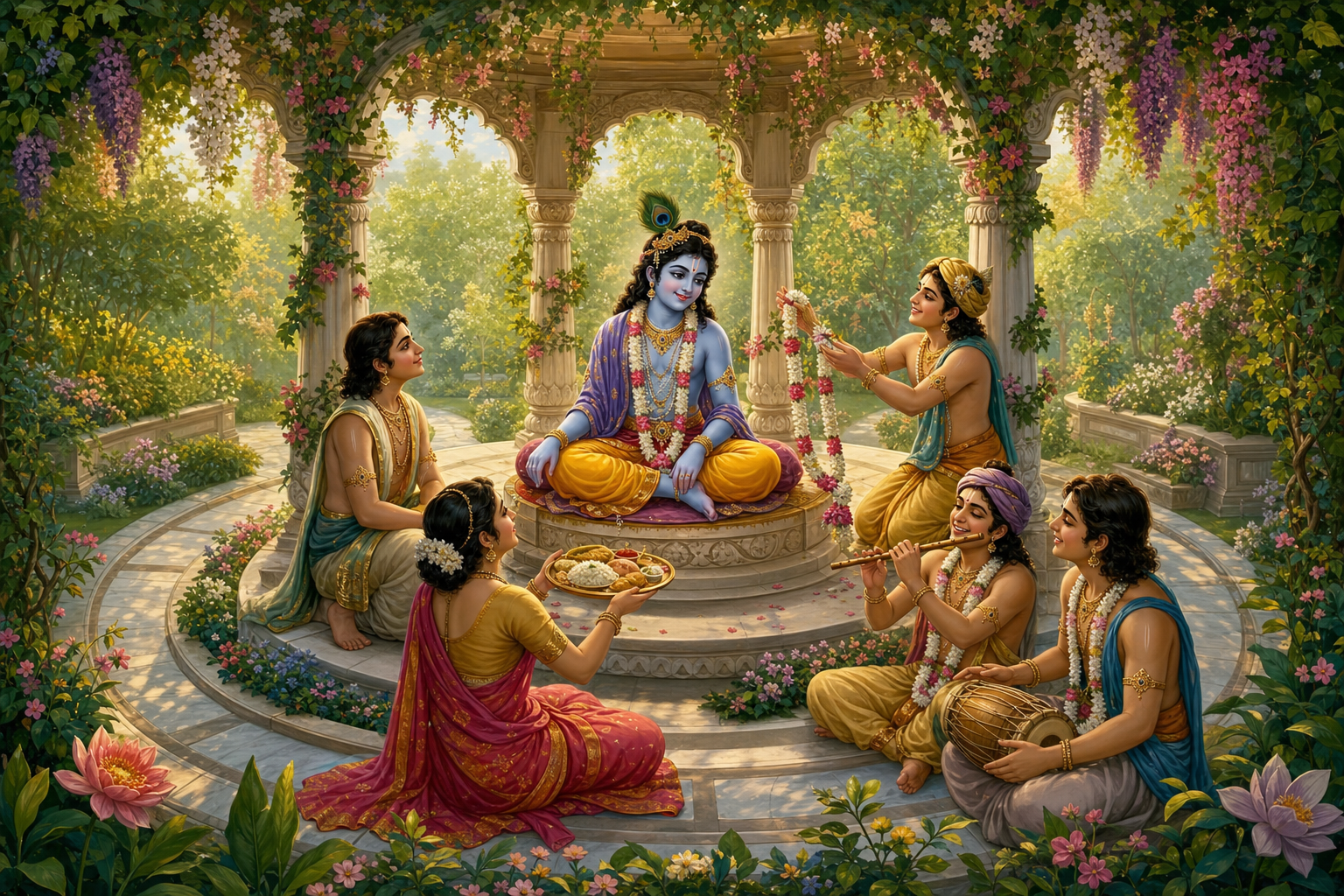
Krishna bhakti does not require every devotee to exhibit the same emotional tone. The Radha meditation presents mādhurya-rasa, the intimate sweetness of divine love, through longing and separation. It distinguishes bhāva, the awakening of deep devotional emotion, from prema, its ripened form, and describes tears and other involuntary transformations as sāttvika-bhāvas. Sri Radha’s viraha is therefore not mere absence: separation concentrates remembrance until the beloved occupies consciousness with heightened intensity.
The butter-theft narrative works in another register. Krishna’s childhood play places theology among milk, curd, suspended pots, neighbours and Yashoda’s maternal care. The source interprets butter as the refined essence produced when the heart is patiently “churned” through discipline and remembrance. Krishna as Makhan Chor, the butter thief, consequently becomes Chit Chor, the thief of the heart—not one who impoverishes the devotee, but one who unsettles possessiveness.
Yashoda’s attempt to bind Krishna expresses vātsalya-rasa, parental affection for the Divine. In the source’s interpretation, material measurement cannot contain the infinite, yet love is permitted to bind him. The gopis’ complaints work similarly: apparent reproach keeps attention fixed on Krishna and becomes another form of remembrance. These stories portray intimacy without erasing the distinction between God and devotee.
Read together, Radha’s separation and Krishna’s childhood play reveal two movements of the same relational theology. In one, love makes absence spiritually intense; in the other, divine presence breaks into guarded domestic life. Both displace the assumption that the sacred can be controlled through possession, calculation or status. The butter story nevertheless preserves an ethical boundary explicitly noted by its source: divine līlā is not permission for ordinary theft or other conduct contrary to dharma.
Practice carries inner orientation into shared life
The supreme-dharma account describes bhakti as a disciplined mode of knowing, loving and serving. Hearing sacred teachings, chanting Krishna’s names, remembering him, worshipping, praying, serving, cultivating friendship and surrendering the self train attention rather than merely decorate an existing identity. In this framework, devotion becomes uninterrupted not because a practitioner feels emotionally elevated at every moment, but because changing circumstances do not ultimately replace Krishna as the centre.
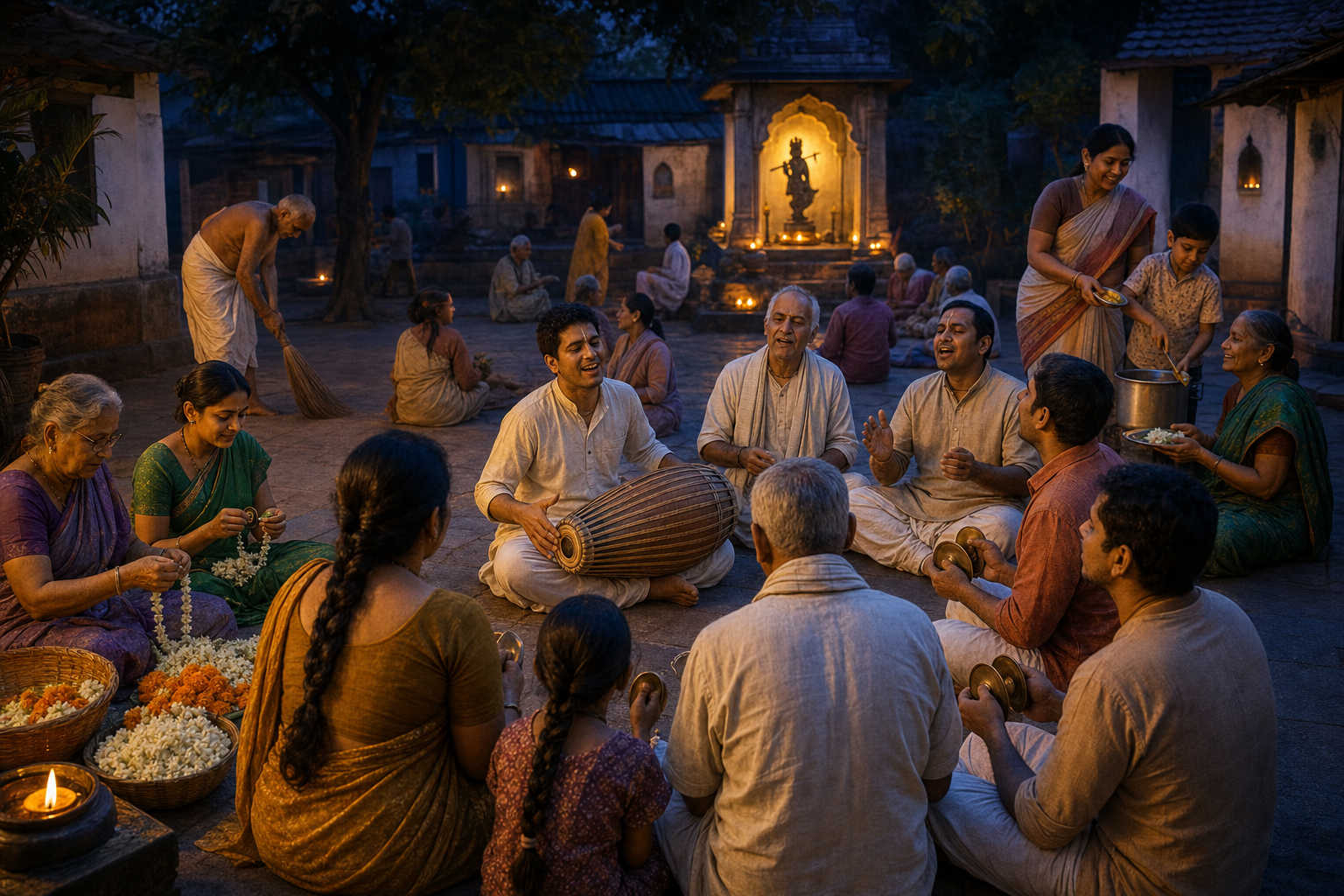
Sankirtana gives that orientation a communal and public form. The Dandavats account presents congregational glorification through sacred sound as both devotional practice and social transmission. It associates the modern Hare Krishna movement’s outreach with public chanting, sacred literature, teaching and prasadam, while emphasizing that each visible encounter may depend on less visible labour: printing, packing, transporting, translating, organizing, cooking, cleaning or quietly encouraging another person.
This widens the meaning of devotional service. The singer heard in public, the person distributing a book and the devotee preparing the conditions for both participate in the same offering. Sankirtana is therefore not only a platform for conspicuous performers. It is an ecology of interdependent service in which attention to Krishna circulates through sound, food, literature, hospitality and human relationships.
The butter-pot image sharpens that social insight. According to its source, Krishna reaches the suspended pots with the cooperation of friends, breaks the container and shares what had been stored. As devotional symbolism, the scene suggests that spiritual life is not entirely solitary: community can help reach guarded depths, while a heart released from possessiveness becomes capable of generosity. The inward refinement represented by butter thus finds an outward counterpart in shared seva.
Transformation, not display, is the test of devotion
The sources repeatedly caution against mistaking visible intensity for spiritual maturity. The Radha meditation says that tears and bodily transformations should not be manufactured or imitated. Their meaning depends upon purified consciousness, and genuine devotion should appear in compassion, steadiness, truthfulness, humility, ethical restraint and service. Sacred emotion is treated as consequential because it changes character, not because it attracts an audience.
The terms ahaitukī and apratihatā supply two further tests. The first asks whether service remains an offering when it brings no material reward, status or desired outcome. The second asks whether devotional orientation can persist through fatigue, grief, doubt, household responsibility or changing social conditions. Neither test demands theatrical certainty; both concern the direction and resilience of the practitioner’s life.
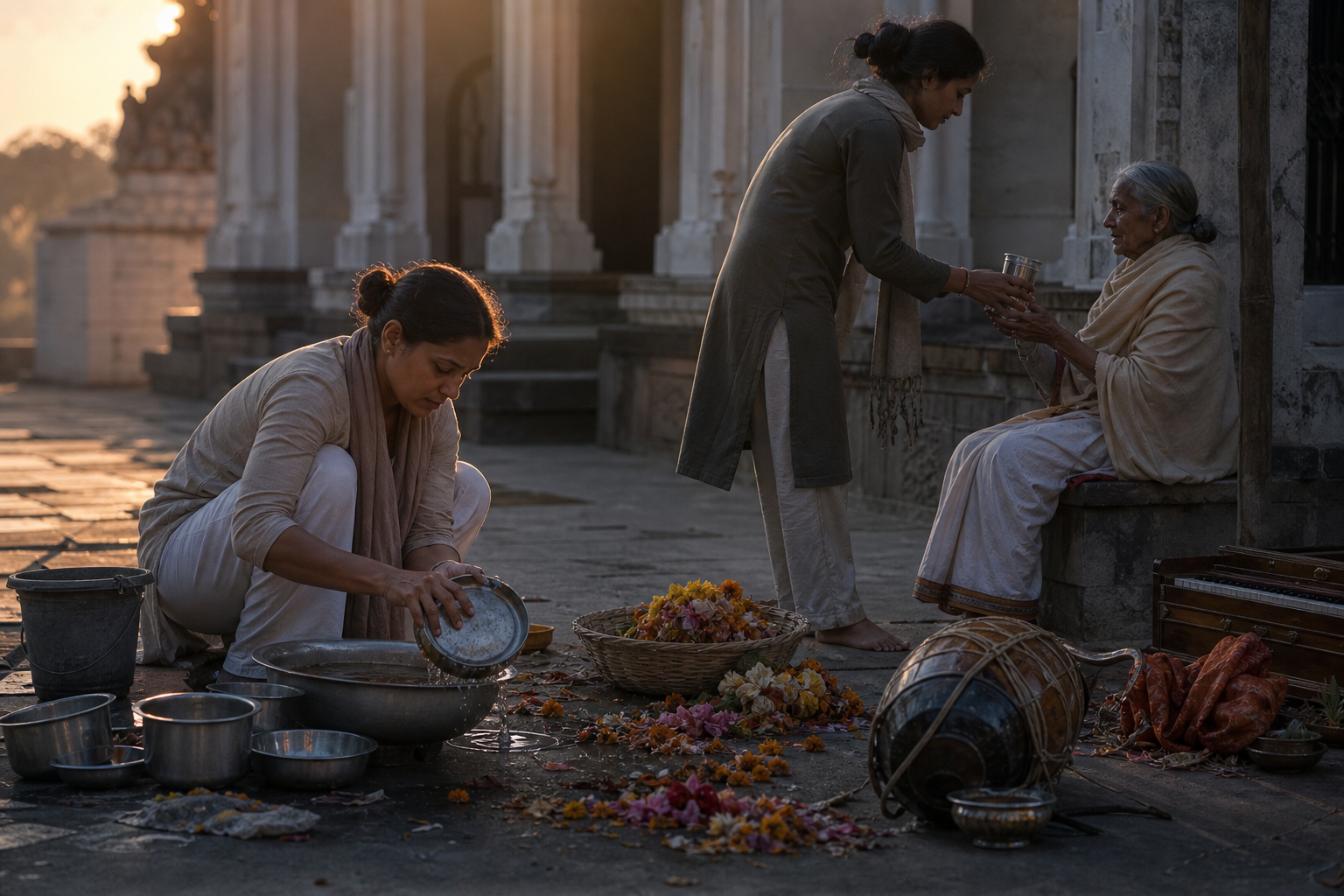
The unknown sankirtana devotee embodies these criteria at the communal level. The Dandavats source contrasts bhakti’s measure of sincerity with a culture of visibility, branding and metrics. A conversation may affect someone without being recorded, and a distributed book may become significant only much later. At the same time, the article argues for preserving oral histories, photographs, letters and community memories so that humility does not become institutional forgetfulness. Anonymity may reveal selfless service, but communities can still honour the people whose labour sustained their devotional inheritance.
These perspectives produce a balanced standard: devotional experience is not dismissed, public outreach is not reduced to numbers, and hidden service is not romanticized into neglect. Bhakti is credible when inward absorption, ethical formation and practical care reinforce one another.
Key takeaways
- Krishna bhakti is presented as supreme dharma when love is free from material bargaining and remains oriented toward Krishna through changing circumstances.
- Bhakti rasa gives devotion several relational languages: Sri Radha’s longing expresses intimate love, while Yashoda’s care reveals parental affection.
- Chanting, remembrance, worship, offering and service turn theological conviction into a sustained discipline of attention.
- Sankirtana depends upon an ecology of visible and hidden work, so devotional value cannot be measured solely by prominence or immediate results.
- Emotion and activity become spiritually meaningful when they soften ego, strengthen ethical character and expand the capacity to serve.
The continuing vitality of Krishna bhakti will depend on communities that can cultivate deep feeling without imitation, carry sacred sound into shared life without reducing outreach to metrics, and remember humble servants without converting remembrance into a search for status. Such a culture allows theology, rasa and seva to remain parts of one living discipline.
References
- DharmaRenaissance Blog — Sri Radha’s Tears: A Powerful Meditation on Ecstatic Love and Bhakti Rasa
- DharmaRenaissance Blog — Supreme Dharma Revealed: The Transforming Power of Unbroken Krishna Bhakti
- DharmaRenaissance Blog — Krishna as Divine Thief: Powerful Symbolism of Butter, Love and Liberation
- Dandavats — Forgotten Sankirtana Devotees: Powerful Lessons from Humble Seva and Samadhi