
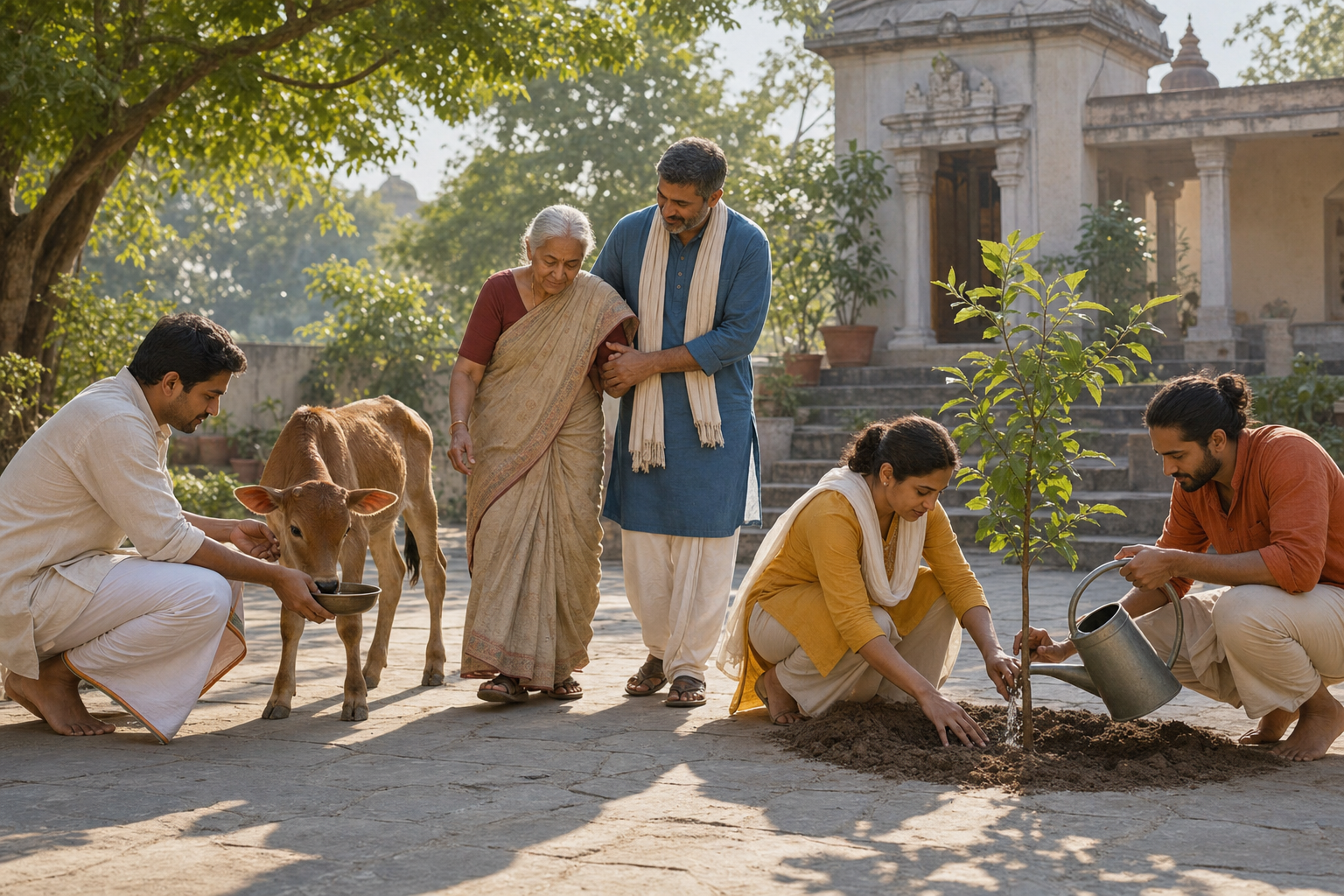
Hindu Blog’s brief source passage places compassion near the center of Hindu spiritual life. It presents kindness and empathy toward all living beings as signs of spiritual maturity, connecting that ideal with both ancient sages and modern teachers.
The supplied passage ends before developing its argument. A careful reading must therefore separate what the source actually reports from the broader ethical implications: how compassion becomes disciplined conduct, why its scope extends beyond human relationships, and how it can strengthen solidarity among distinct Dharmic traditions.
What the source establishes
The source advances an ethical thesis rather than a detailed doctrinal survey. It treats compassion as a quality by which spiritual growth can be recognized, not merely as an attractive sentiment. This shifts attention from what a person claims to believe toward how that person responds to vulnerable life.
No scripture, teacher, sect, historical episode, or formal definition appears in the available fragment. It would therefore be misleading to attach the passage to a particular authority or to claim that every Hindu school explains compassion identically. Its defensible core is simpler: concern for others belongs to mature religious life.
Compassion must become disciplined conduct
Empathy recognizes another being’s distress; compassion adds a disposition to respond responsibly. That response may take the form of patient listening, restraint in speech, practical assistance, protection from harm, or service offered without seeking status. Compassion becomes a spiritual discipline when it survives inconvenience, disagreement, and the absence of recognition.
This does not require passive agreement with every demand. Duties can conflict, and care sometimes requires firm boundaries. A Dharmic approach asks whether action is guided by clarity and responsibility rather than cruelty, indifference, or ego. In that sense, compassion and discernment support one another: feeling without judgment can become ineffective, while judgment without fellow-feeling can become harsh.
Concern for living beings widens the moral horizon
By explicitly extending compassion to living beings, the Hindu Blog passage reaches beyond interpersonal politeness. The principle invites reflection on the treatment of animals, the use of natural resources, and the effects of ordinary choices on people who possess less power. It does not supply a ready-made policy for every dilemma, but it offers a demanding question: can avoidable suffering be reduced while other legitimate duties are still honored?
Ahimsa is useful here as an ethical orientation toward reducing needless harm. It does not erase the complexity of life or pretend that every difficult choice is harmless. Instead, it encourages awareness of consequences and resistance to casual cruelty. Compassion is therefore not withdrawal from the world; it is a more attentive way of acting within it.
A common ethic without erasing Dharmic differences
Hinduism’s many sampradayas, along with Buddhism, Jainism, and Sikhism, retain distinct teachings, practices, and understandings of spiritual liberation. Unity should not be built by flattening those differences. It can grow through recognizable ethical meeting points expressed through non-harm, compassionate awareness, seva, self-restraint, and responsibility toward the wider community.
For a Dharma renaissance, this shared ground has practical value. Hindu civilizational confidence is most persuasive when it produces service, protection of the vulnerable, respect among Dharmic communities, and care for life. Solidarity then becomes more than a slogan: it becomes cooperation rooted in character while each tradition preserves its own voice.
Key takeaways
- The supplied Hindu Blog passage presents kindness and empathy as evidence of spiritual maturity.
- Compassion joins awareness of suffering with responsible action, restraint, and discernment.
- Concern for living beings broadens ethics beyond personal relationships without resolving every difficult duty automatically.
- Dharmic unity can grow through shared compassionate conduct while respecting genuine doctrinal differences.
A durable Dharmic renewal will be measured not only by the traditions it preserves, but also by the quality of care those traditions inspire in families, communities, institutions, and public life.
Inspired by this post on Hindu Blog.
