
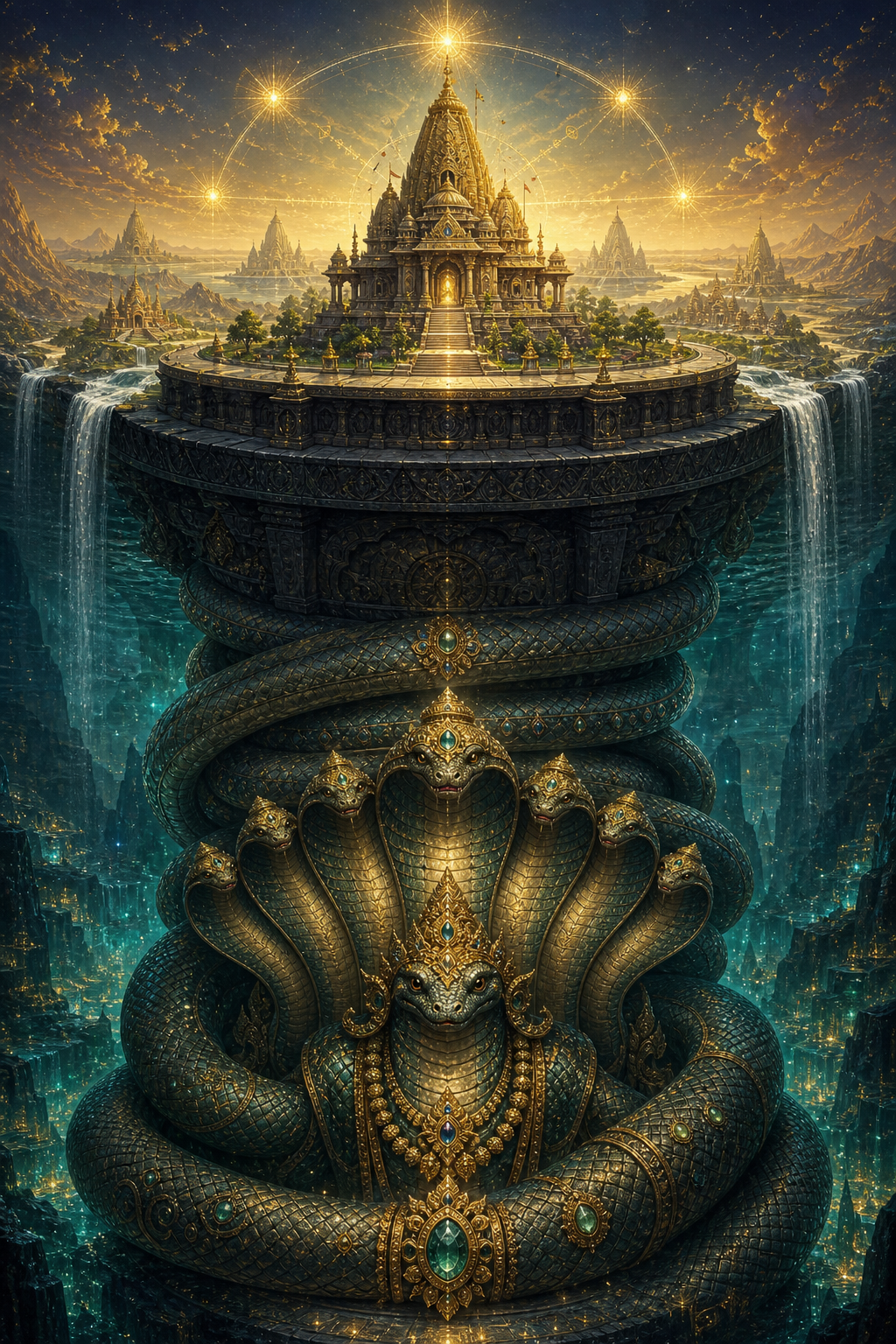
Vasuki’s place in the Dikpala tradition is best understood as an expansion of sacred geography, not as a replacement for the familiar eight directional guardians. In the supplied account, the Naga king belongs to a vertical vision of the cosmos in which the direction below has its own guardian significance.
Reading this association through cosmology, mythology, temple symbolism, ecology, and inner discipline reveals a consistent principle: visible order depends on foundations that remain largely unseen. The same reading also requires caution, because the source acknowledges that Hindu traditions do not assign the lower direction to a single figure uniformly.
How Vasuki enters an expanded directional map
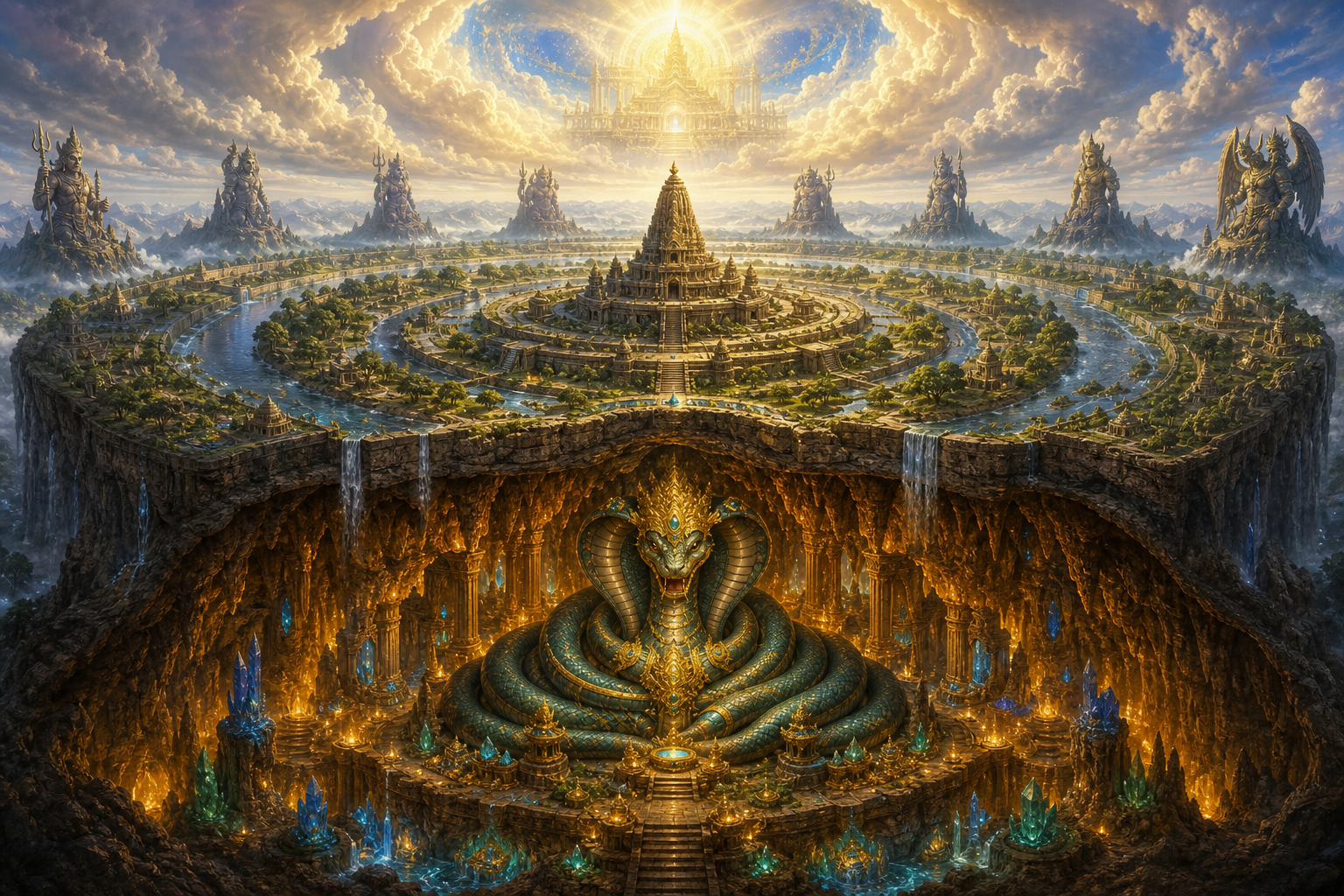
The Dikpala system treats orientation as part of a meaningful cosmic order. The supplied DharmaRenaissance account presents the familiar Ashta Dikpala arrangement as Indra in the east, Agni in the southeast, Yama in the south, Nirrti in the southwest, Varuna in the west, Vayu in the northwest, Kubera in the north, and Ishana in the northeast. These deities guard more than compass points: their placement connects ritual orientation, sacred architecture, and the ordering of space through dharma.
Vasuki becomes relevant when this horizontal arrangement is extended vertically to include the directions above and below. His association is with adho-dik, the direction beneath. He therefore should not be treated as a substitute for one of the eight familiar guardians. His role belongs to a broader cosmological scheme concerned with the depths beneath the visible world.
This qualification is essential. The source reports that some expanded schemes associate the lower direction with Ananta, Shesha, or another subterranean divine form, while others connect the lower realm more generally with the Nagas and place Vasuki within that field. The variations are better read as different symbolic mappings than forced into a single universal list. On the evidence supplied, calling Vasuki a Dikpala is defensible within particular expanded traditions, but it should not be presented as the uncontested arrangement everywhere.
The direction below signifies support, not simple evil
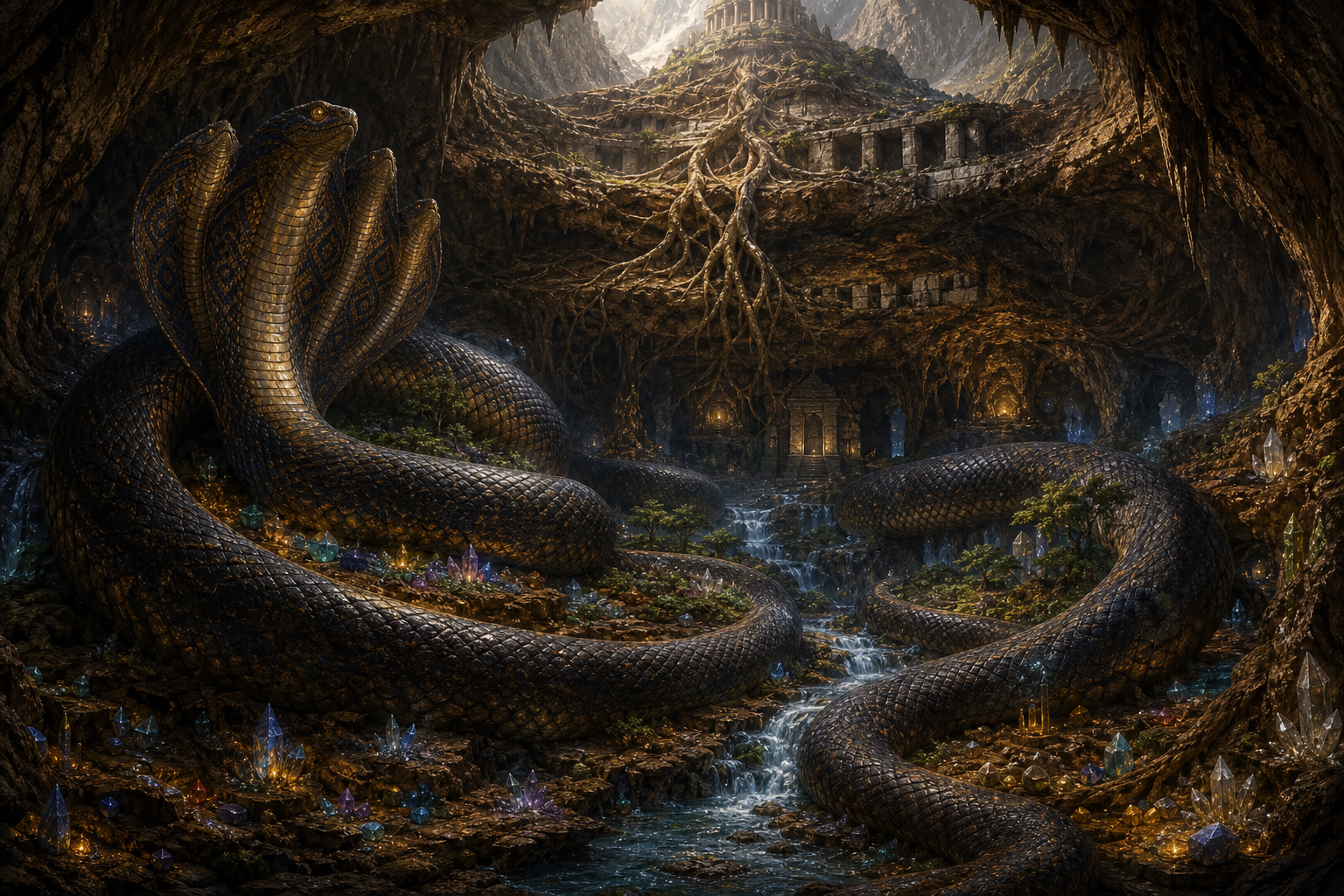
The lower direction carries several related meanings in the source account. Cosmologically, it points toward subterranean regions and Naga realms. Materially, it evokes soil, roots, underground water, minerals, and other concealed supports of life. Psychologically and spiritually, it suggests memory, instinct, latent strength, and aspects of experience that remain below ordinary awareness.
This layered reading resists a simple equation of height with goodness and depth with wickedness. Elevation may symbolize illumination, but depth can represent foundation, preservation, fertility, secrecy, and unrealized potential. The source associates the Naga world with water, rain, hidden wealth, medicine, and esoteric knowledge, presenting it as a reservoir of life as well as a mysterious realm.
Vasuki’s guardianship follows from that logic. What lies beneath is powerful because it sustains what appears above. A guardian of the depths protects sources and foundations while also warning against careless intrusion. The image encourages humility toward forces that cannot always be seen but upon which visible life depends.
Myth explains why a serpent king can guard cosmic order
The account’s central mythic example is the Samudra Manthan, or churning of the ocean. In that episode, devas and asuras use Mount Mandara as the churning rod and Vasuki as the rope. Vasuki binds opposing parties to a shared cosmic undertaking and withstands the tension through which concealed treasures emerge.
Seen alongside his directional role, the episode presents endurance as a form of guardianship. Vasuki does not merely occupy a lower region; he holds together forces whose conflict must be contained long enough for transformation to occur. The serpent’s strength, restraint, and capacity to remain under tension make the myth relevant to the protection of unstable boundaries and hidden powers.
The source also connects Vasuki with Shiva, noting that the serpent around Shiva’s neck is often identified as Vasuki. In the account’s interpretation, this image concerns mastery over fear, poison, time, death, and instinctive energy. Read with the emergence of halahala during the ocean churning, the symbolism emphasizes containment: danger is neither ignored nor allowed to spread without limit.
Comparable serpent imagery appears elsewhere in the Dharmic world. The source points to Mucalinda sheltering the Buddha and to serpent protection associated with Parshvanatha in Jain tradition. These figures should not be collapsed into one identity, but their juxtaposition shows how serpent symbolism can communicate reverence, vigilance, shelter, and protection rather than threat alone.
From temple foundations to disciplined self-knowledge

Temple symbolism gives the directional idea a physical setting. The supplied account describes the Hindu temple as a representation of the ordered cosmos in which orientation, enclosure, thresholds, elevation, axis, and sanctum all matter. Dikpalas may appear within architectural and sculptural programs to establish guarded sacred space.
The source does not claim that Vasuki is installed as a directional deity in every temple. Instead, it observes that serpent imagery may occur around thresholds, water points, protective zones, or places carrying subterranean and fertility associations. The broader architectural principle is that sacred space must be secured at its foundations as well as at its visible entrances.
The same principle permits a psychological reading. Human attention gravitates toward visible achievement and intellectual clarity, while fear, grief, desire, inherited impressions, and unexamined capacities remain less visible. Vasuki as guardian of the depths can therefore symbolize disciplined engagement with the foundations of character. Descent in this sense is not failure; it is an inquiry into what supports or unsettles spiritual development.
Serpent imagery also resonates with Yogic and Tantric language about latent, coiled power. The source appropriately cautions against simply equating Vasuki with Kundalini. The more careful connection is symbolic: both images can concern concentrated potential that should be approached through preparation, restraint, and proper guidance rather than impulsive experimentation.
Key takeaways
- Vasuki belongs to an expanded vertical model of sacred space and does not displace any member of the familiar eightfold Dikpala arrangement.
- His association with the lower direction is meaningful but not universal; the supplied source also records traditions involving Ananta, Shesha, or the Naga realm collectively.
- The Samudra Manthan and Vasuki’s connection with Shiva frame serpent power as endurance, containment, vigilance, and transformation.
- Cosmological depth becomes a practical symbol for ecological humility, protected foundations, temple order, and disciplined self-knowledge.
Further study can compare regional texts, temple programs, and living ritual traditions before treating any one directional assignment as standard. Vasuki’s interpretive value lies precisely in the questions he raises about how a tradition protects the concealed sources of visible life.
References
Source note: The supplied material contained one article. This synthesis connects and evaluates themes within that account but does not claim independent corroboration across multiple publications.