

Placed side by side, four accounts of Gaudiya Vaishnava life reveal a continuous path from personal practice to public responsibility. One examines attentive chanting, another remembers a forceful yet affectionate missionary leader, a third interprets worship and instruction through Caitanya-caritamrta, and a fourth presents ecstatic dance as embodied service.
Their combined value lies in showing that practice, service, and leadership are not separate departments of devotional life. Chanting supplies the center, disciplined service tests its depth, association sustains it, and responsible leadership helps transmit it without allowing organization, performance, or personality to displace devotion.
Key takeaways
- Gaudiya Vaishnava leadership begins with the ability to return one’s own attention to Krishna through regular hearing and chanting.
- Service becomes sustainable when visible work is supported by spiritual friendship, honest counsel, shared worship, and opportunities for renewal.
- Standards and compassion belong together: correction should preserve the purpose of practice while helping the practitioner mature.
- Voice, body, food, ritual, study, and administration can all become forms of seva when they remain directed toward remembrance and loving offering.
- Authority is healthiest when it transparently connects people to guru, scripture, practice, community, and the wider disciplic tradition.
The inner sequence: hearing, remembrance, and service

The account of chanting associated with HG Vaisesika Dasa presents the Hare Krishna maha-mantra as both prayer and meditation. Its description of japa joins physical practice, the repeated recovery of attention, devotional appeal, and ethical change. The tongue speaks, the ears receive, distraction is noticed, and the practitioner returns to the sound. Under this model, a completed number of rounds has value, but completion alone is not the whole practice.
The same source explains the divine name according to the Gaudiya understanding that Krishna is present in His name. That claim gives chanting a purpose beyond relaxation or concentration. Psychological steadiness may accompany the practice, but its devotional aim is restored relationship and a growing desire to serve. The first test of practice is therefore not an unusual experience; it is whether attention, speech, habits, and relationships are gradually reordered around remembrance.
The commentary on Caitanya-caritamrta Adi-lila 14.34-37 contributes an important safeguard against confusing devotion with vague idealism. In its reading of child Nimai’s dirt-eating argument, mother Saci recognizes that grain and dirt may share a material origin while still having different functions. The source draws from this exchange a principle of practical discrimination: spiritual unity does not abolish appropriate distinctions, procedures, or consequences.
That principle also appears in the source’s treatment of the visiting brahmana whose offering is eaten three times by Nimai. Ritual order matters because the food is being prepared and offered for Vishnu, yet the narrative ultimately discloses divine acceptance within what first looks like disruption. Together, the two episodes resist opposite errors. Form should not be dismissed as meaningless, but form should not obscure the loving purpose it is meant to serve.
This balance is directly relevant to leadership. A leader formed by chanting must be able to preserve meaningful standards without treating procedures as ends in themselves. Attention to Krishna provides the center; practical discernment determines how that center should shape conduct. Without the first, rules can become bureaucratic. Without the second, devotional language can become an excuse for disorder.
Association is part of the infrastructure of service
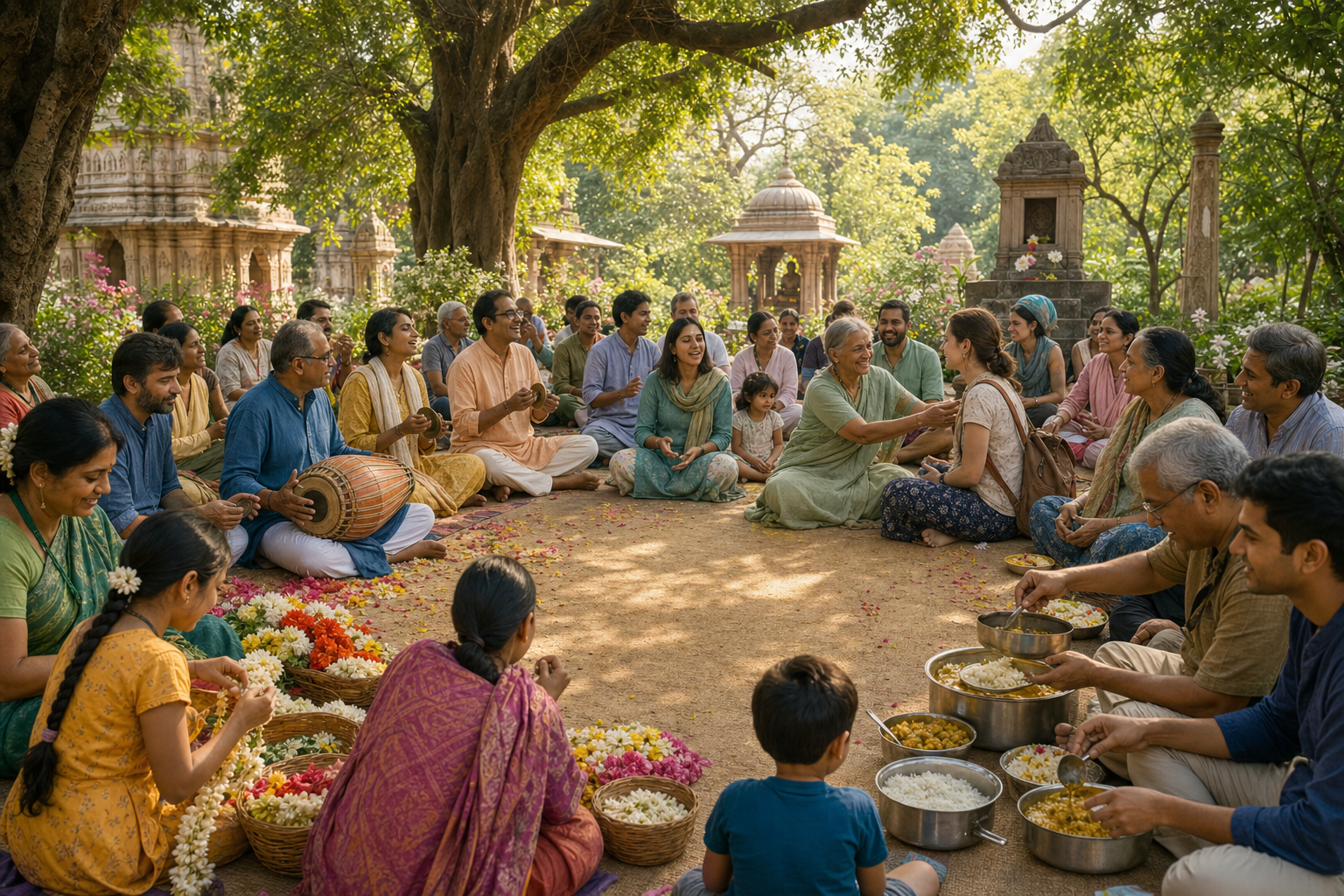
The tribute to Tamal Krishna Goswami places unusual emphasis on association behind the visible history of preaching and administration. It recalls mid-1970s visits to Rishikesh during which a small group of godbrothers read Srila Prabhupada’s books, chanted, bathed in the Ganges, and held intimate kirtans. According to the tribute, these intervals allowed relationships to be renewed outside the pressure of titles and organizational duties.
The same remembrance presents missed invitations to serve together as a lasting lesson. It reports that Tamal Krishna Goswami proposed a traveling partnership at the 1980 Los Angeles Ratha-yatra, combining kirtan and speaking, and that similar opportunities arose later. The retrospective regret is instructive because it challenges the assumption that association may always be postponed until urgent work is finished. In devotional service, the relationship that nourishes the worker is itself part of the work.
The account of Vakresvara Pandita shows the communal counterpart of that principle. It locates his dance within the chanting, music, drama, and intimate exchanges associated with the home of Srivasa Pandita. The source reports the traditional description that Vakresvara Pandita could dance for twenty-four prahara, calculated there as seventy-two hours. Whether approached devotionally as an extraordinary sign of absorption or academically as hagiography communicating a spiritual ideal, the account portrays sacred joy as something embodied and shared.
These portraits operate at different historical and devotional levels, but they converge on one organizational insight: community is not merely an audience for preaching or a workforce for projects. It is an ecology of reciprocal nourishment. Reading together, kirtan, meals, pilgrimage, candid conversation, teaching, and friendship help keep demanding service connected to its spiritual purpose.
This does not diminish measurable responsibilities such as instruction, festivals, publication, outreach, or administration. It clarifies what sustains them. A community that schedules output but leaves no protected space for association may become efficient while its members grow isolated. A community that cultivates warmth without dependable service may remain pleasant but lose direction. Mature leadership has to hold both concerns at once.
Authority becomes credible through correction and care

The Caitanya-caritamrta commentary interprets Guru Puja as honor offered to a transparent representative of divine grace rather than celebration of an isolated personality. In that account, guru reverence is valid insofar as it strengthens connection to scripture, regulated practice, seva, and parampara. Authority is therefore relational and referential: it points beyond the teacher while making guidance personally accessible.
Mother Saci’s instruction supplies a domestic image of this principle. She does not defeat cleverness merely by asserting power; she explains why a functional distinction matters, and the episode concludes in restored affection. The source reads Nimai’s return to his mother’s lap as a movement from argument toward loving dependence. Correction succeeds because truth and relationship are preserved together.
The Tamal Krishna Goswami tribute offers a modern leadership parallel. It recalls a 1978 Gaura-purnima conversation in which a young preacher expected a severe examination about accepting sannyasa. According to the account, Tamal Krishna Goswami instead asked a few focused questions about determination to preach and explained the responsibilities of the renounced order with practical encouragement. The episode is presented as evidence that demanding standards need not be communicated through intimidation.
The tribute also holds together traits that are sometimes separated in leadership discussions. Tamal Krishna Goswami is remembered as disciplined, organizationally capable, committed to book distribution and preaching, and formidable to newer devotees. Yet the same source emphasizes affection for devotees, appreciation of godbrother association, scriptural teaching, and an increasingly visible longing for Vrindavan. Its portrait suggests that tenderness need not weaken missionary resolve; it can purify its motive and manner.
Vakresvara Pandita’s profile adds transmission to this picture of authority. It reports his association with disciples in Orissa, including Sri Gopalaguru and, through him, Sri Dhyanacandra Gosvami. The significance is not personal brilliance alone but the continuation of devotional discipline across people and regions. Leadership proves durable when practice can be received, embodied, and passed forward rather than remaining dependent on one charismatic figure.
A practical framework for devotional communities
Anchor responsibility in personal practice
Before directing others, a practitioner needs a dependable way to recover attention. The chanting account suggests a useful standard: practice should engage hearing, intention, repetition, and conduct. Leadership development can therefore ask not only whether a person knows the philosophy or completes assignments, but whether devotional practice is producing steadiness, humility, and greater readiness to serve.
Protect association as essential work
The memories of Rishikesh and missed opportunities for shared service indicate that association should not depend entirely on spare time. Communities can treat study, kirtan, mentoring, and unhurried conversation as part of their service architecture. The aim is neither withdrawal from responsibility nor social activity for its own sake, but renewal of the relationships through which responsibility becomes spiritually sustainable.
Explain the purpose behind standards
Mother Saci’s practical reasoning and the account of the brahmana’s offering both show that form and purpose must be interpreted together. Leaders should be able to explain what a rule protects, distinguish serious principles from personal preference, and recognize when an apparent disruption requires deeper understanding. This makes accountability intelligible rather than arbitrary.
Make room for more than one form of contribution
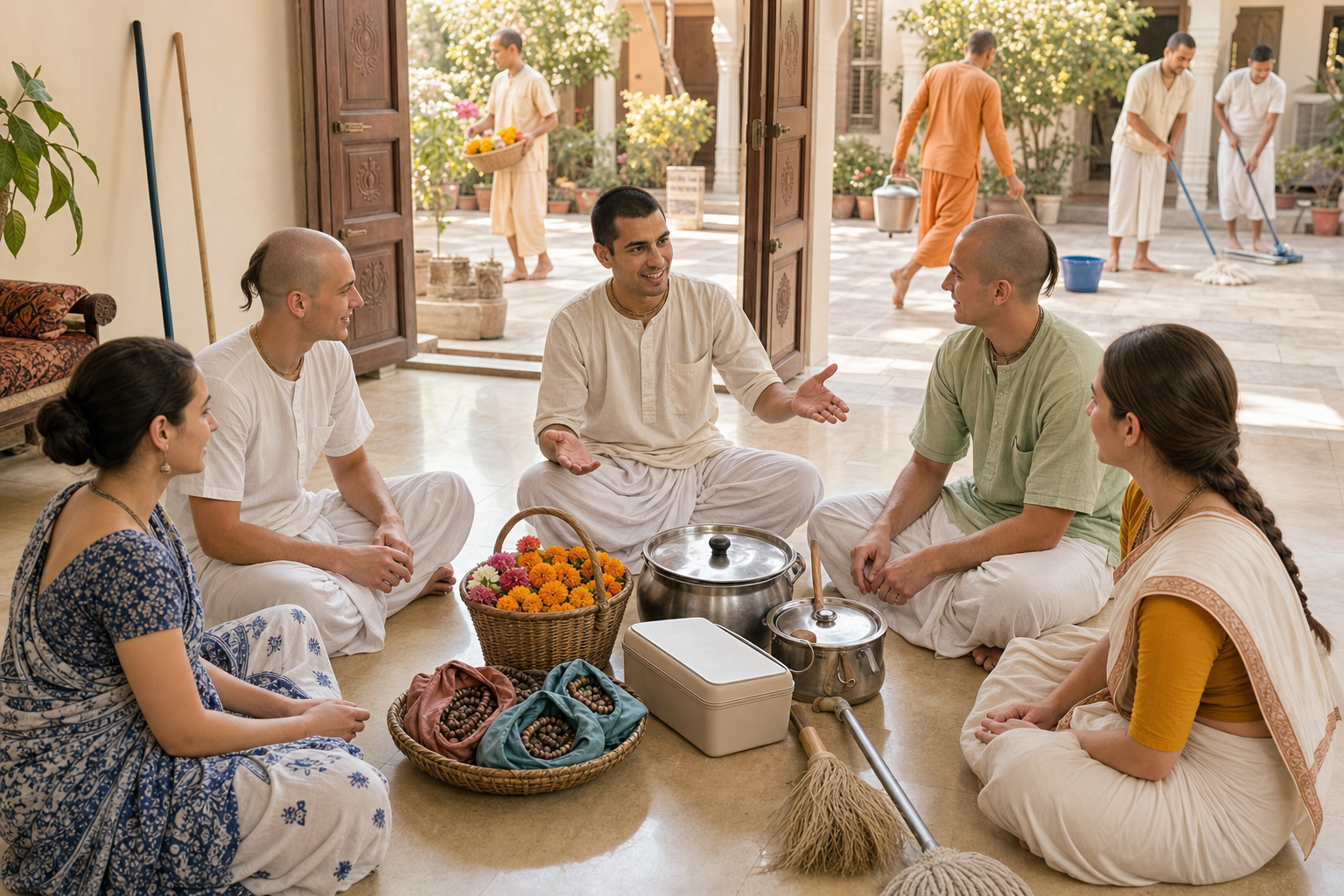
The sources honor chanting, teaching, administration, pilgrimage, cooking and offering food, scriptural exposition, music, and dance. Taken together, they discourage a narrow model in which only public speaking or formal office counts as leadership. A healthy service culture recognizes those who clarify philosophy, organize dependable work, care for relationships, preserve worship, and give visible form to devotional joy.
Judge leadership by what it connects and transmits
The most useful evaluative question is not simply whether a leader attracts followers or expands activity. It is whether people are being connected more deeply to the holy name, scripture, Srila Prabhupada’s mission, responsible service, trustworthy association, and the disciplic tradition. This standard joins inner formation with institutional consequence.
As Gaudiya Vaishnava communities face new settings and responsibilities, their strongest leadership will grow from this continuity: practitioners who can hear before directing, associate while serving, correct without humiliating, and build forms of service that continue beyond themselves.
References
- DharmaRenaissance Blog – Make the Call Home: The Transformative Power of Chanting Hare Krishna
- DharmaRenaissance Blog – Tamal Krishna Goswami’s Enduring Legacy: A Powerful Tribute to Devotional Leadership
- DharmaRenaissance Blog – Powerful Lessons from Guru Puja and Caitanya-caritamrta Adi-lila 14.34-37
- DharmaRenaissance Blog – Vakresvara Pandita’s Ecstatic Dance: Powerful Lessons in Bhakti, Seva, and Unity