
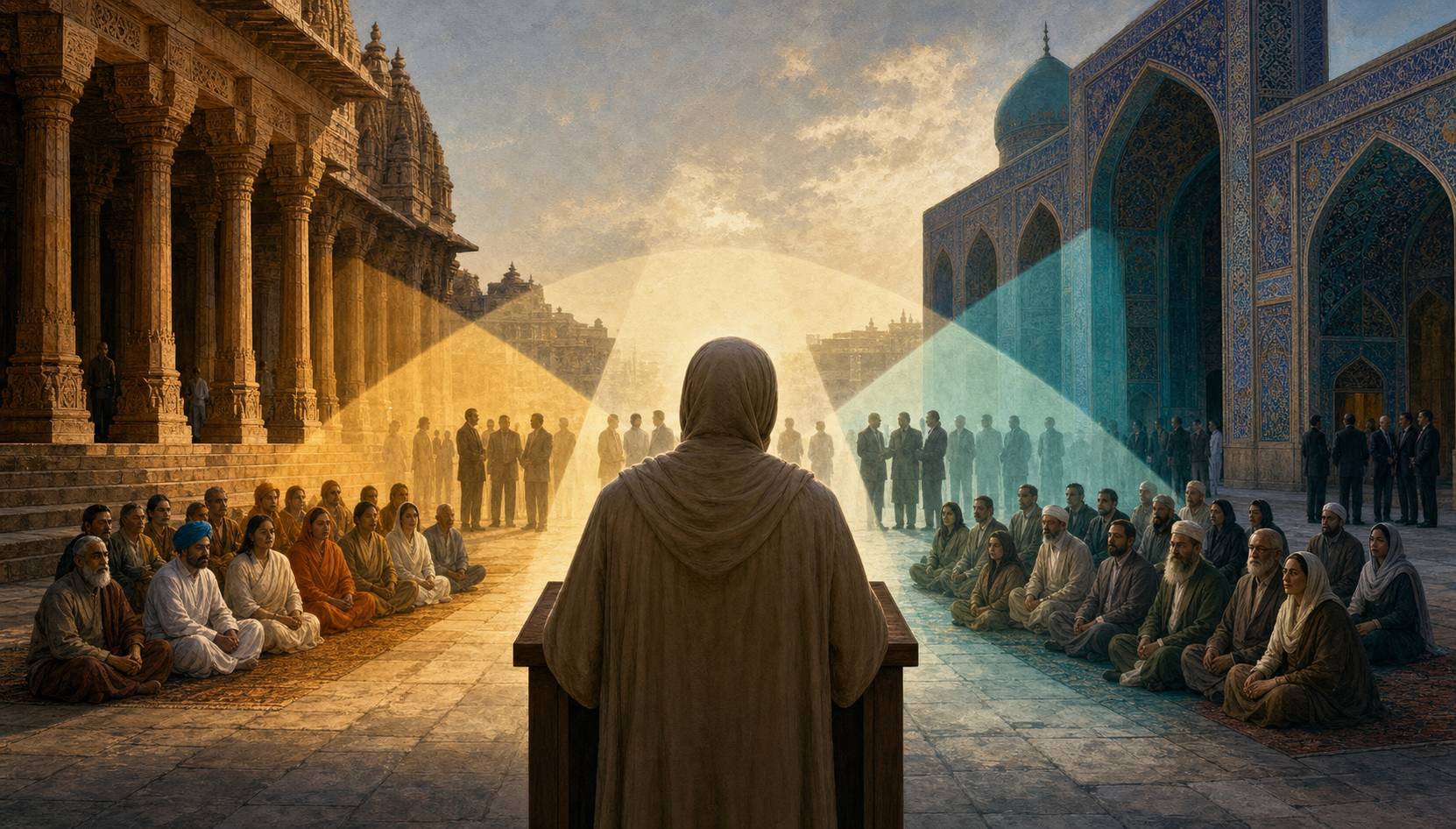
Religious speech becomes geopolitically consequential when a faith representative appears on a politically charged international platform. The controversy surrounding Pandit Vijay Kumar Sharma’s reported remarks in Iran therefore raises a larger question: how should audiences distinguish personal conviction, interfaith symbolism and India’s national interests?
The supplied material contains one published account, so none of its event-specific claims can be treated here as independently corroborated. What it does provide is a useful case study in how religious identity can lend moral force to geopolitical rhetoric while social media collapses important distinctions between a speaker, a delegation and a country.
Key takeaways
- Sharma’s reported comments express an individual’s political position; they do not by themselves represent India, Hindu society or a shared Dharmic view.
- The Quds Day setting matters because the source describes it as an explicitly political platform associated with Palestinian solidarity and opposition to Israeli, American and wider Western policies.
- India’s relationships with Iran, Israel, the United States and Gulf countries cannot be reduced to the loyalties implied by a viral speech.
- Interfaith participation gains credibility when it acknowledges suffering consistently and does not grant any state or leader immunity from ethical scrutiny.
- Claims about the delegation’s purpose, status and contacts require verification beyond the single account supplied.
One appearance carries three different meanings

The DharmaRenaissance Blog article reports that Sharma praised Iran’s resistance to Western pressure, criticised the United States and placed Ayatollah Ali Khamenei within a narrative of anti-Western defiance. It also describes the occasion as an International Quds Day event involving an Indian multi-faith delegation. These elements are related, but they are not interchangeable.
At the first level is the speaker. A religious title may give Sharma’s words cultural visibility, but it does not turn his political judgement into a doctrine binding on other Hindus. India’s religious public sphere includes divergent views shaped by theology, ideology, historical memory and contemporary political sympathies.
At the second level is the platform. A statement made at a Quds Day gathering enters a setting whose symbols and expectations already favour a particular geopolitical narrative. The host context can amplify the statement, select the passages that travel online and present the speaker as evidence of international or interfaith support.
At the third level is India. A citizen or religious delegate can participate in international advocacy without speaking for the Indian government. Treating such an appearance as proof of India’s alignment confuses social participation with official diplomacy and converts a plural society into a single political voice.
The surrounding account also demands caution. The source says the video was framed online around a delegation that reportedly travelled to pay respects following Khamenei’s death and later interacted with circles associated with Mojtaba Khamenei. No supporting documentation or second report is included in the supplied material. Those claims should therefore remain attributed to the source and should not be repeated as established facts.
Religious identity can legitimise a geopolitical narrative
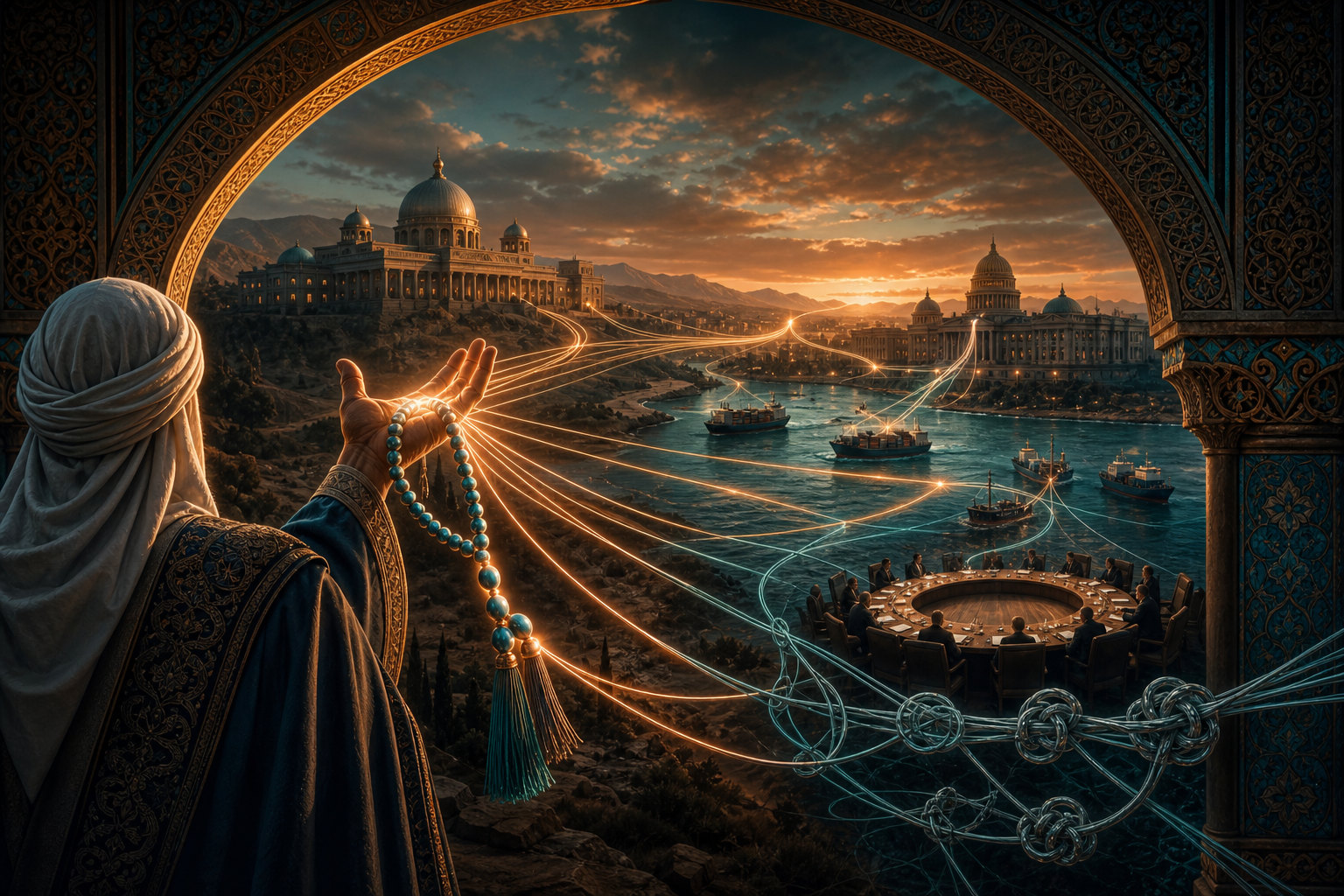
According to the source, the Islamic Republic established International Quds Day in 1979 and observes it on the last Friday of Ramadan. Iran presents the occasion as solidarity with Palestinians, while its public messaging also features strong criticism of Israel, American policy in West Asia and Western influence. A speech at such an event is consequently part of a political performance as well as an expression of personal belief.
The presence of a Hindu pandit in a multi-faith delegation can serve several symbolic purposes. It can suggest that opposition to Western dominance crosses religious boundaries, give a state-sponsored narrative civilisational breadth and redirect attention from a government’s sectarian identity toward a broader language of justice and resistance. These effects can arise even when a participant intends only dialogue or solidarity.
That symbolism explains why both admiration and alarm can outrun the speech itself. The source interprets Sharma’s reference to putting the United States “on its knees” as reflecting anger about sanctions, interventions and unequal global power. Such grievances may resonate in societies carrying memories of colonial domination. Yet religious language can transform a contestable political analysis into a moral binary: resistance becomes righteous, while criticism of the resisting state appears disloyal to the oppressed.
The source itself points toward a more demanding assessment. It presents Iran as a country subjected to long-running external pressure while also noting criticism concerning repression, civil liberties, regional militancy and ideological control. These two ledgers should not cancel each other. Opposing coercion from abroad does not settle how a government treats its citizens, and condemning domestic abuses does not make external coercion just.
India’s strategic autonomy resists camp politics

The viral framing also sits uneasily with the foreign-policy picture described by the source. It characterises India as maintaining relations with Iran while deepening cooperation with the United States, Israel and Gulf partners. The article links those relationships to energy, diaspora protection, the Chabahar project, defence and agricultural cooperation with Israel, and technology and security ties with the United States.
This pattern is commonly described as strategic autonomy or multi-vector diplomacy. Its purpose is not to distribute moral approval equally among partners. It allows a state to pursue different interests with different countries without accepting that cooperation in one field requires ideological submission in every other field.
Religious rhetoric tends to obscure this complexity because it speaks in the language of solidarity, betrayal, courage and oppression. Statecraft instead operates through overlapping interests, constrained choices and relationships that may coexist despite serious disagreements. Sharma’s reported praise for Iranian resistance can therefore be understood as one current within Indian public debate, but not as a reliable guide to India’s diplomatic posture.
This distinction also protects legitimate civic speech. A private religious figure need not reproduce official policy, and disagreement with that figure need not become an accusation against an entire religious community. Clear attribution prevents both the speaker’s symbolic elevation into a national envoy and the collective blame that often follows controversial remarks.
A Dharmic standard must resist selective compassion

The source invokes ahimsa, satya, viveka, karuna and seva as disciplines relevant to political judgement. Applied rigorously, these ideas do not predetermine allegiance to Iran, Israel, Palestine or the United States. They require attention to violence, truthfulness, discernment, compassion and service regardless of which side benefits from the scrutiny.
Anekantavada, the Jain emphasis on the partial character of individual perspectives, adds a useful caution without implying that every claim is equally valid. Several experiences can require recognition at once: Palestinian suffering, Israeli security fears, Iranian national anxieties and the exposure of civilians throughout the region. A many-sided view should widen the evidence considered, not dissolve responsibility into moral vagueness.
Interfaith diplomacy should consequently be judged by more than the diversity visible on a stage. Its credibility depends on transparency about sponsorship and representative status, consistent concern for civilians and minorities, and a willingness to criticise both external domination and internal abuse. Solidarity with a population should not become an unrestricted endorsement of its rulers.
Future religious delegations can contribute to India-Iran dialogue if they clarify whom they represent and preserve ethical independence from their hosts. That discipline would allow faith to broaden diplomatic imagination without turning sacred identity into geopolitical certification.