
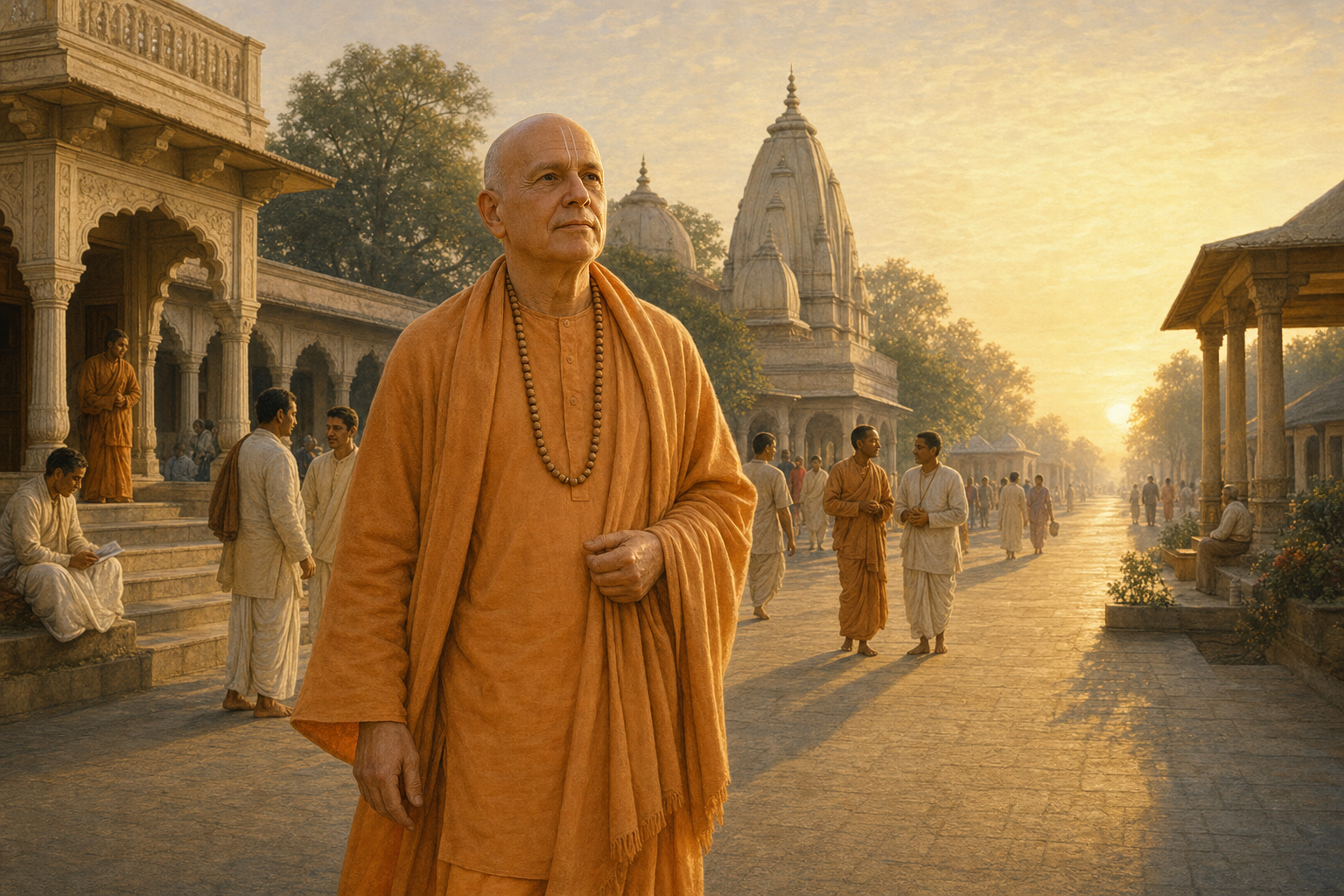
Tamal Krishna Goswami’s life becomes most intelligible when three identities are considered together: the institution-builder who helped expand ISKCON, the disciple whose greatest successes remained subject to his guru’s direction, and the brother known to his family as Tommy. The three source articles illuminate different parts of that life, but their real value emerges in combination.
Together, they present leadership not as uninterrupted ascent but as a relationship among initiative, accountability, surrender, and care. That perspective helps explain both Tamal Krishna Goswami’s influence and the tensions that accompanied service in a rapidly growing spiritual movement.
From a family identity to a demanding spiritual vocation

The family remembrance identifies Tamal Krishna Goswami as Thomas G. Herzig, affectionately called Tommy by his relatives. Bhakti Charu Swami’s tribute locates his entrance into Srila Prabhupada’s movement in 1968, following an encounter associated with a community of young seekers near the redwood forests outside San Francisco. According to that tribute, he left the commune and accompanied Prabhupada to San Francisco.
Bhakti Charu Swami situated this decision within the wider discontent of the American counterculture. Material prosperity had not satisfied every need for meaning, belonging, or love, and some young people were searching for alternatives to conventional society. Krishna consciousness offered more than an oppositional identity: it required scriptural study, chanting, regulated conduct, communal discipline, and service.
This context clarifies the scale of Tamal Krishna Goswami’s transformation. He did not merely adopt new beliefs; he entered a tradition that reorganized his responsibilities and eventually gave him public authority. Yet the family account prevents that transformation from being treated as the disappearance of Thomas Herzig. The religious leader and the older brother remained parts of the same person, even through long periods of separation from his relatives.
Turning spiritual vision into durable institutions
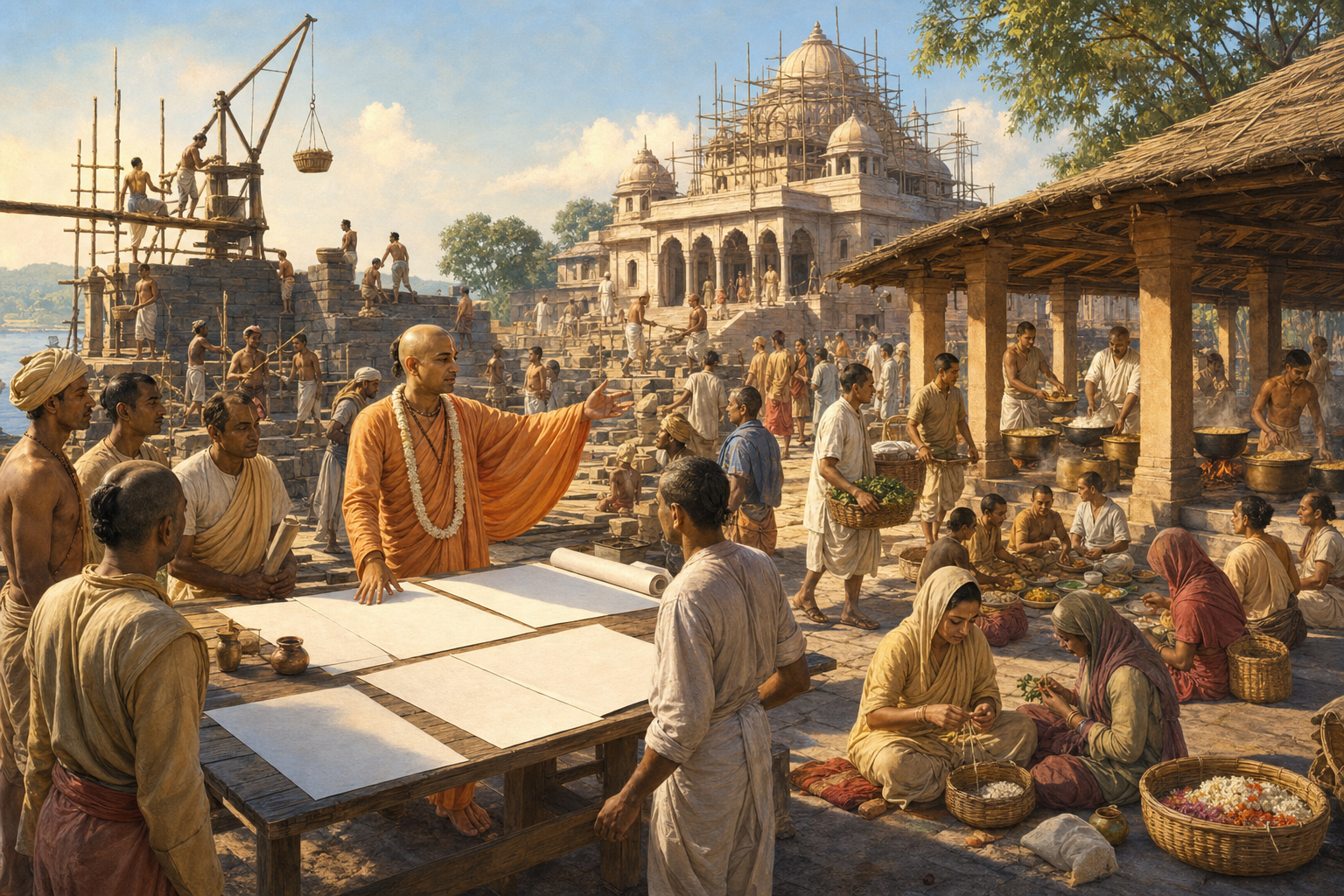
Bhakti Charu Swami’s tribute portrays Tamal Krishna Goswami as a leader repeatedly entrusted with assignments requiring organization as well as conviction. It reports that Srila Prabhupada selected him to serve as president of the important Los Angeles temple. In Europe, his task was not limited to cultivating the public interest generated by George Harrison and the Beatles. The tribute says he was sent to strengthen sankirtana, book distribution, and organized preaching in London, Paris, and Frankfurt.
The same account credits him with completing the acquisition of ISKCON’s land in Mayapur after earlier attempts had encountered opposition. It describes him arriving with a lawyer and finalizing the agreement beneath a roadside banyan tree. When he returned to Calcutta around midnight with the deed, Srila Prabhupada was reportedly still awake and waiting. In this episode, administrative competence was itself a form of guru-seva: legal paperwork and negotiation enabled a sacred project to take physical form.
The article about the Radha Damodar party shows his organizational ability at a different scale. It reports that the traveling party became responsible, within a year, for 40 percent of total Bhaktivedanta Book Trust proceeds. During the 1975 Christmas marathon, the article says the party contributed $195,000 to the book fund while distributing a quarter of a million Back to Godhead magazines and 60,000 large books. These figures come from that source’s account rather than independent verification, but they convey why the party appeared indispensable to those leading it.
Across these assignments, a consistent pattern appears. Tamal Krishna Goswami translated missionary purpose into centers, agreements, teams, distribution systems, and disciplined routines. His contribution was therefore not only inspirational. He helped give repeatable institutional form to practices that a growing international community needed to sustain.
The China instruction exposed the limits of visible success

The Radha Damodar party’s productivity also generated conflict. According to the China-command account, some brahmacharis were leaving established temples for traveling parties led by sannyasis. Temple presidents raised concerns that this movement of personnel was weakening local communities, while the Radha Damodar party arrived in Mayapur with approximately ninety brahmacharis. The dispute placed two legitimate needs in tension: mobile outreach and stable temple life.
In that article’s telling, Tamal Krishna Goswami sensed that a direct conversation with Prabhupada was necessary. After he mentioned China as a possible destination, Prabhupada summoned him the following morning and gave the unambiguous instruction, “I want you to go to China.” Tamal Krishna Goswami initially argued that the party needed him. Prabhupada answered, “Don’t worry about the Party,” and ultimately told him that the existing service was being withdrawn: he could accept the China assignment or remain in Mayapur and chant.
The refusal of another devotee’s offer to go in his place made the personal character of the instruction especially clear. This was not simply an effort to recruit someone for a difficult territory. As the source interprets the exchange, Prabhupada was addressing Tamal Krishna Goswami’s attachment to a successful service and restoring institutional balance at the same time.
The turning point came when Tamal Krishna Goswami recognized that the party existed for Prabhupada’s pleasure rather than as an extension of its leader’s identity. He accepted the direction, and Prabhupada then publicly announced the China mission as a positive new service. That response is significant: the correction established a firm boundary without turning the disciple into a public example of failure.
The episode complicates any simple equation between leadership and measurable results. Within a guru-disciple framework, achievement did not create ownership of a role or immunity from reassignment. Surrender had an institutional dimension: it required the willingness to relinquish even a productive position when the larger mission and the guru’s judgment demanded it.
Firm authority coexisted with intimate responsibility
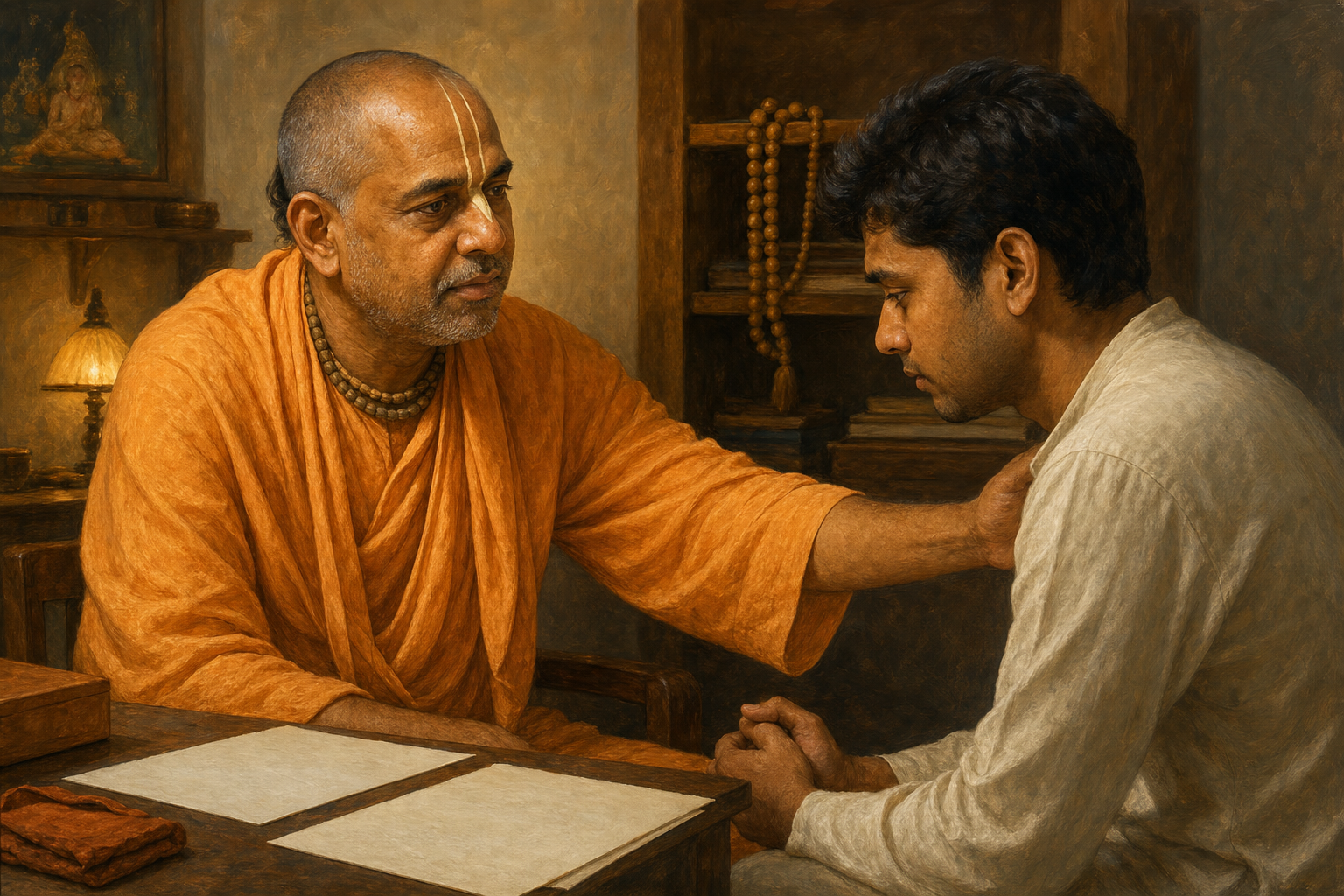
The family remembrance supplies a perspective that institutional history cannot. It recalls a brother and uncle whose affection appeared through embraces, reassuring gestures, laughter with children, and availability during difficult moments. Relatives regarded him as someone to call when a problem felt unmanageable. That kind of reliance suggests that his decisiveness was experienced not only as command but also as protection.
One childhood memory describes an older brother guiding a younger sibling up a slide and then hurrying to the bottom to catch him. Later, after years apart, the brothers reconnected in the mid-1990s and walked together through Vrindavan and the forests of Vraja. The remembrance says their bond resumed without feeling erased by the intervening separation. These details do not merely soften the portrait of a demanding leader; they identify trust as a continuity running through both his familial and spiritual relationships.
Bhakti Charu Swami’s tribute offers a parallel form of relational authority. It recalls an immediate sense of respect upon first seeing Tamal Krishna Goswami in Mayapur and reports that, by 1977, he was serving as Srila Prabhupada’s secretary. The family source similarly describes the combination of sternness and deep affection. Taken together, the accounts suggest that his authority depended on intensity, competence, and the conviction that he would remain present when responsibility became difficult.
His sudden death in a car crash in India, as reported by the family remembrance, therefore created more than an organizational vacancy. It deprived relatives, disciples, and associates of a person they had expected to consult. The source presents grief as an enduring relationship with his memory, showing why a spiritual legacy cannot be assessed solely through offices held, projects completed, or books distributed.
Key takeaways
- Tamal Krishna Goswami’s influence rested on execution as well as preaching: the sources associate him with temple leadership, European expansion, the Mayapur land agreement, and large-scale book distribution.
- The Radha Damodar episode shows that exceptional results did not remove a leader’s obligation to accept correction or consider effects on the wider institution.
- Srila Prabhupada’s China instruction combined a non-negotiable boundary with a new field of honorable service, preserving both organizational order and the disciple’s dignity.
- Family testimony broadens the measure of spiritual leadership by showing how firmness, dependability, affection, and grief belonged to the same human legacy.
Future assessments of Tamal Krishna Goswami will be most useful when they continue to hold these dimensions together. Institutional accomplishment deserves documentation, but its deeper meaning lies in how power was redirected, relationships were sustained, and service remained accountable to a purpose beyond the leader.
References
- DharmaRenaissance Blog — Srila Prabhupada’s China Command: A Powerful Lesson in Surrender and Leadership
- DharmaRenaissance Blog — Remembering Tamal Krishna Goswami: A Powerful Portrait of Love, Loss, and Bhakti
- DharmaRenaissance Blog — Tamal Krishna Goswami’s Powerful Legacy: Bhakti Charu Swami’s Moving Tribute