
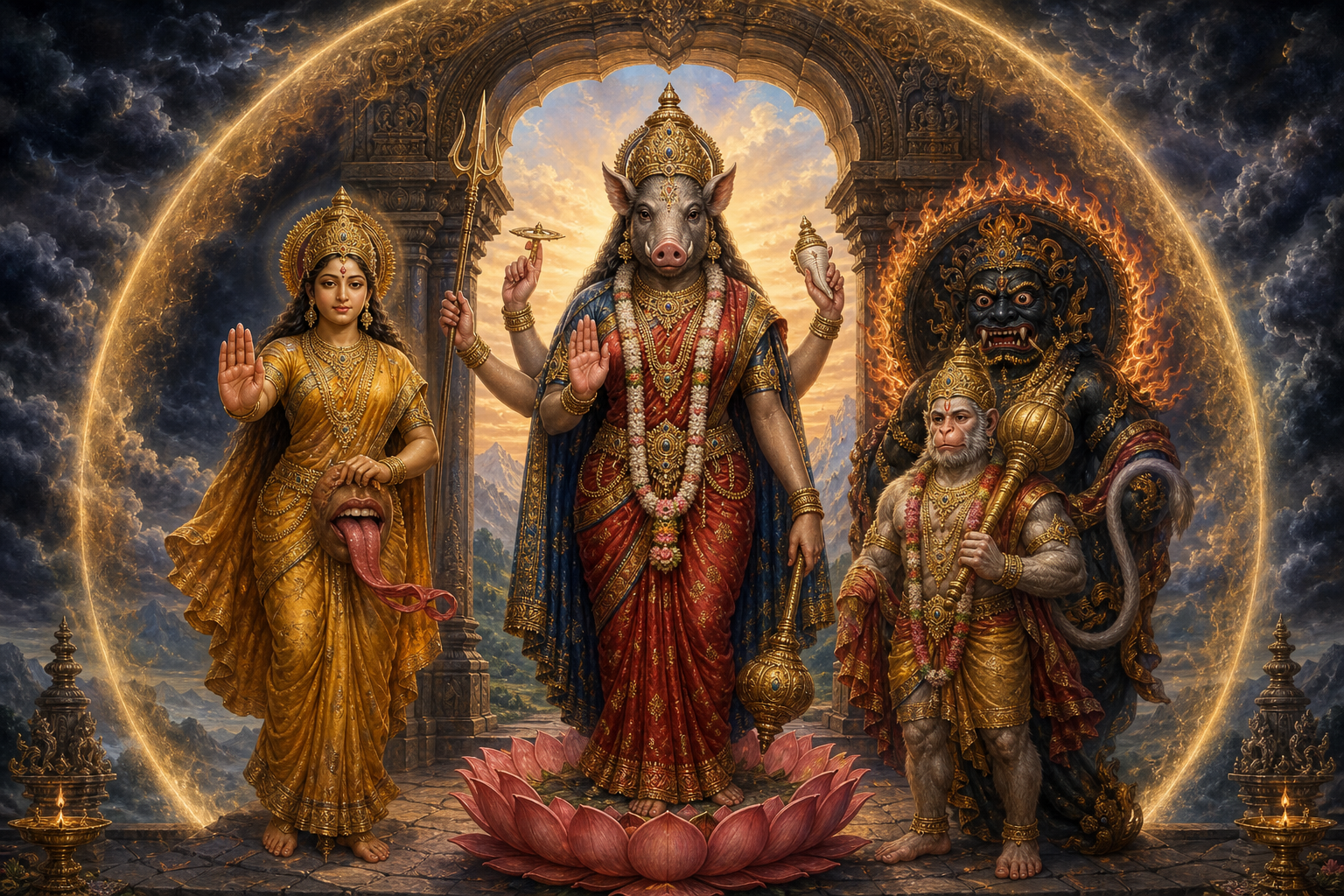
A boar-faced goddess, a deity restraining a tongue, and a composite guardian bearing the signs of devotion and terror can appear unrelated. Read together, however, Varahi, Bagalamukhi and Hanubhairav disclose a shared symbolic question: how can sacred power confront danger without becoming an image of uncontrolled aggression?
The two source accounts answer through complementary models of protection: restoring order, stopping harm, guarding boundaries and submitting strength to devotion. Their comparison yields a practical interpretive framework while preserving the important differences between established deity traditions and a less standardized composite form.
Fierceness protects order; it does not license aggression
Across both source articles, frightening imagery is presented as morally directed rather than self-justifying. The account of Varahi and Bagalamukhi interprets their fierceness as corrective intelligence responding to disorder, harmful speech, fear and threats to spiritual stability. The Hanubhairav article likewise describes sacred force as legitimate only when joined to service, humility and dharma.
This agreement supplies the central rule for interpreting fierce protective forms: intensity alone is not holiness. Protective power must recognize a real disorder, apply an appropriate response and remain governed by something beyond personal anger. Varahi’s authority is connected to restored order; Bagalamukhi’s restraint is directed toward destructive momentum; and Hanubhairav’s force is anchored in Hanuman’s devotional service and Bhairava’s guardianship.
The comparison is symbolic and functional, not genealogical. The sources do not establish a single historical lineage or common cult uniting these forms. Instead, they show how distinct streams of Shakta, Shaiva and Rama-centered devotional thought can address the ethics of force through different sacred images.
Three protective strategies: restoration, arrest and guardianship
| Form | Protective strategy in the source | Disorder addressed | Moral restraint |
|---|---|---|---|
| Varahi | Enters the field of disorder and restores stability | Forces that bury, destabilize or violate sacred order | Authority exercised in service of dharmic alignment |
| Bagalamukhi | Arrests harmful movement, intention and speech | Falsehood, malicious rhetoric and escalating hostility | Restraint and clarity rather than retaliatory cruelty |
| Hanubhairav | Joins devoted service to fierce boundary protection | Fear, pride, exploitation and violations of sacred thresholds | Strength subordinated to bhakti, discipline and humility |
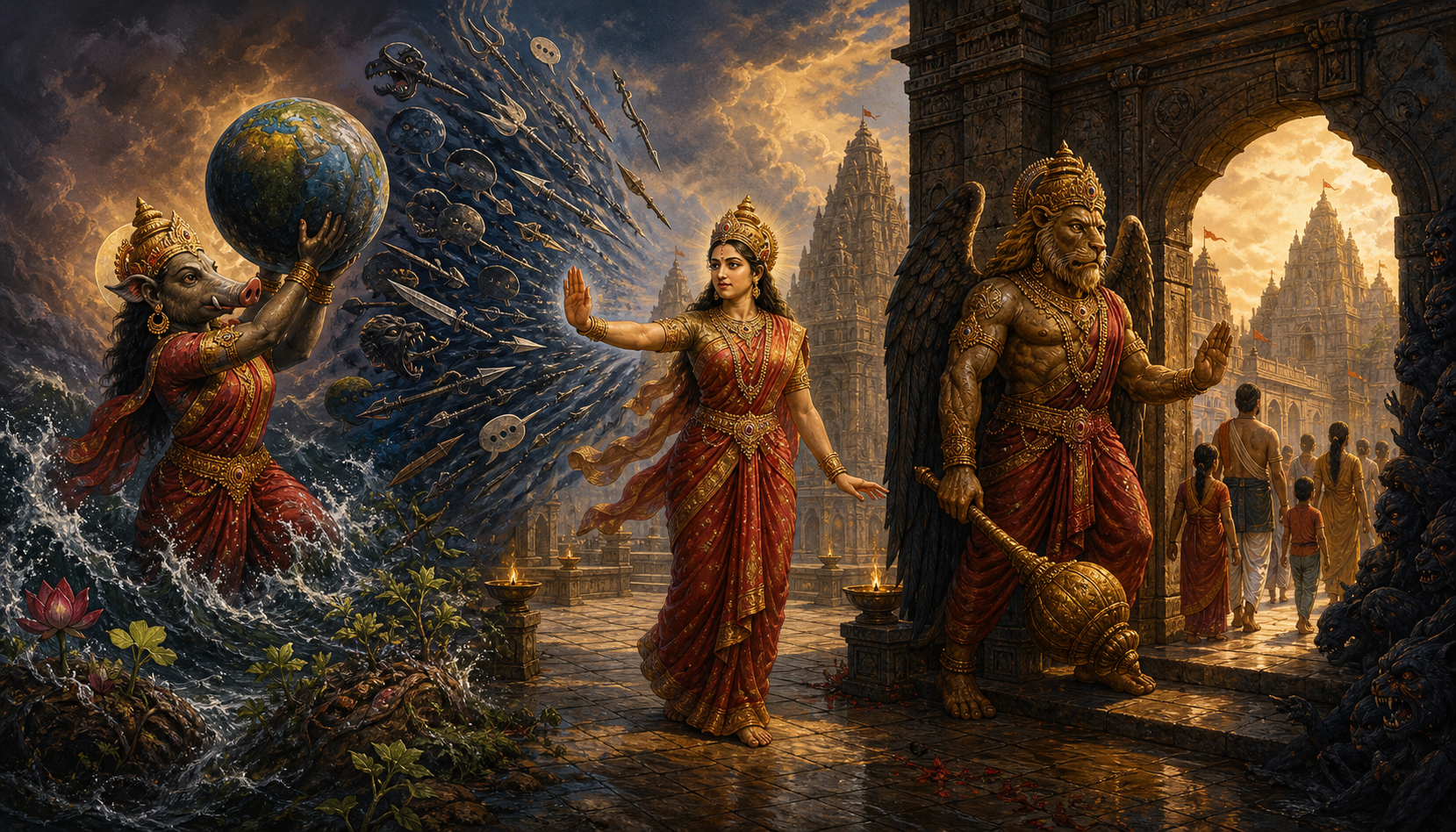
Varahi and Bagalamukhi therefore represent two different tempos of protection. In the first source’s formulation, Varahi acts like a commander who clears a disturbed field, whereas Bagalamukhi stops the disturbance before it can spread. One recovers what has been submerged or displaced; the other interrupts the mechanism of injury.
Hanubhairav adds a third question: what kind of person or consciousness should wield protective force? The second source presents the composite as a bridge between Hanuman’s selfless service and Bhairava’s threshold-guarding severity. Its answer is not simply greater power, but power made trustworthy through surrender. Courage without devotion may become egoistic, while devotion without courage may fail to defend what it values.
Iconography makes the ethics of power visible

According to the Varahi-Bagalamukhi article, Varahi’s boar face evokes the capacity to penetrate beneath surfaces and recover what has been buried. Her reported weapons and vehicles vary among textual, regional and tantric settings, so no single attribute should be made to carry her entire meaning. Her role as Dandanayika or Dandanatha in certain Sri Vidya and Shakta traditions is especially instructive: the danda signifies command, discipline and justice, placing martial energy within a structure of sacred governance.
Bagalamukhi’s best-known gesture concentrates the same ethical problem in the tongue. The source interprets the tongue as a sign of speech, desire, argument, influence and mantra, while her act of restraint represents stambhana, the stopping of destructive momentum. Her yellow garments, ornaments and offerings are associated in that account with radiance, auspiciousness and focused intelligence. The image thus joins prohibition to discernment: the purpose of silence is not suppression for its own sake, but the prevention of speech from becoming an instrument of harm.
Hanubhairav requires a different level of caution. The second source explicitly describes it as a composite devotional-tantric idea rather than a universally codified avatara with one authoritative narrative or a widely standardized pan-Indian iconography. Its suggested combination of Hanuman’s vanara form or gada with signs associated with Bhairava is therefore contemplative rather than a fixed iconographic formula. That distinction prevents a modern symbolic synthesis from being misrepresented as a uniform historical tradition.
The enduring battlefield lies within conduct

Both articles redirect the language of enemies away from a simplistic fixation on human opponents. The first names enduring inner adversaries such as delusion, arrogance, uncontrolled anger, fear, harmful speech and fragmentation. The second describes Hanuman and Bhairava as complementary agents of ego-transcendence: surrender dissolves the claim to personal greatness, while fierce insight severs pride.
This inward turn does not make protection passive. It makes response more discriminating. Bagalamukhi’s symbolism asks whether an impulse should be spoken or stopped. Varahi’s asks whether buried disorder requires decisive engagement and restored ground. Hanubhairav’s asks whether courage remains accountable to service when a boundary must be defended. Each form associates a type of danger with a corresponding discipline rather than treating ferocity as a universal solution.
The sources also place these forms within traditions involving mantra, ritual discipline and, in tantric contexts, demanding forms of practice. The Hanubhairav account specifically associates authentic tantra with initiation, concentration and purity of intent. An ethical reading of the imagery can illuminate ordinary conduct, but it should not be confused with ritual instruction or used to turn sacred symbolism into a promise of power over personal adversaries.
Key takeaways
- Fierce appearance signifies bounded corrective power in both source accounts, not cruelty without moral limits.
- Varahi restores violated order, Bagalamukhi interrupts harmful momentum, and Hanubhairav joins guardianship to devotional service.
- Weapons, animal features, restrained speech and threshold imagery function as instructions about authority, self-command and discernment.
- The deepest enemies identified by the sources are recurring inner disorders, including pride, fear, harmful speech and undisciplined anger.
Keeping protective symbolism answerable to dharma
As communication accelerates and boundaries become harder to defend without hostility, these symbols invite a more exacting model of strength: knowing when to act, when to stop, what to protect and which motive must first be restrained. Their continuing value will depend on preserving that moral precision rather than detaching fierce imagery from the disciplines that make it protective.
References
- DharmaRenaissance Blog — Varahi and Bagalamukhi: Fierce Shakti Goddesses of Protection and Inner Power
- DharmaRenaissance Blog — Hanubhairav: Powerful Symbolism of Hanuman and Bhairava’s Fierce Sacred Unity