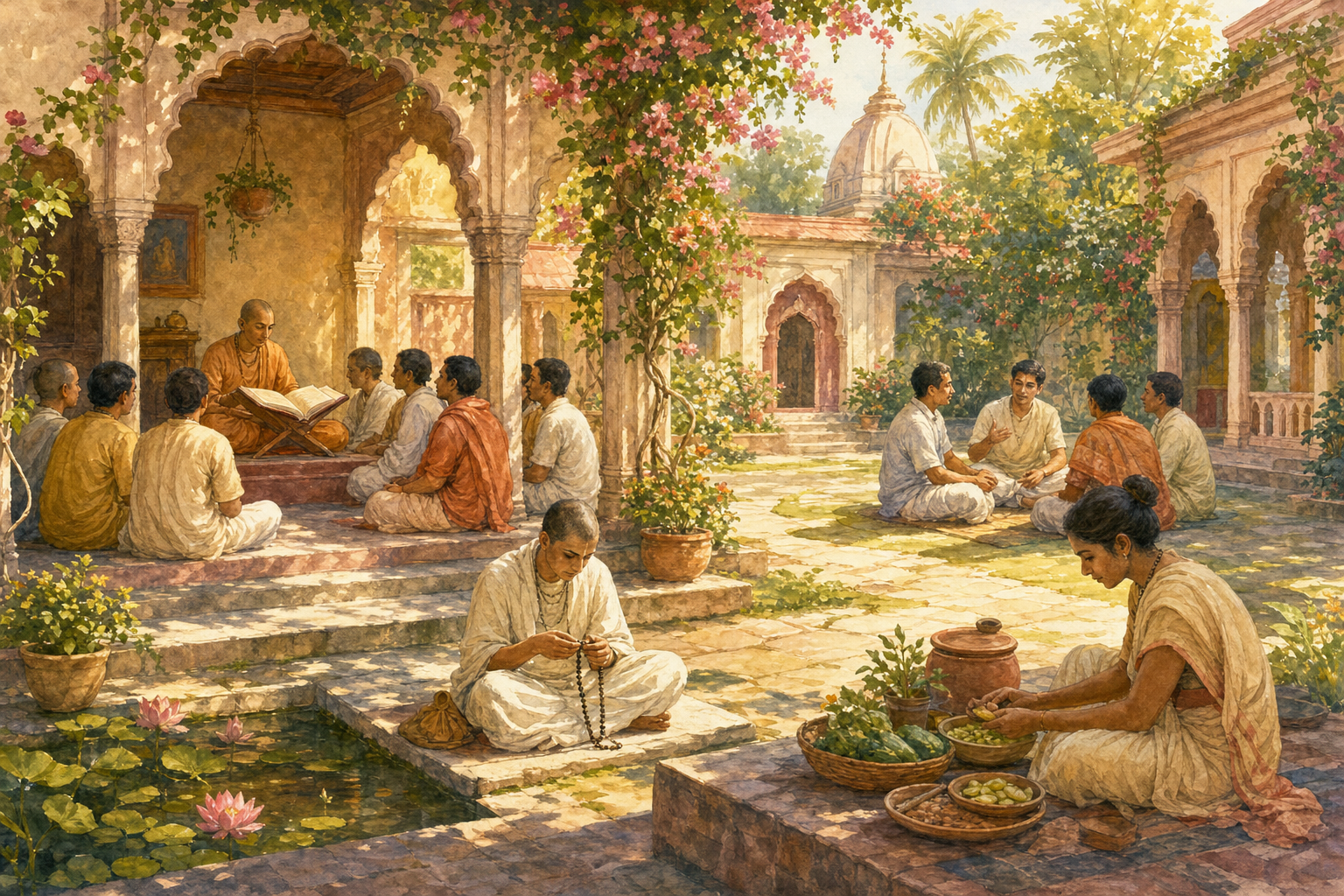
Gaudiya Vaishnava learning is most useful when scripture, disciplined interpretation, sacred observance, remembrance, and ethical reflection reinforce one another. The supplied DharmaRenaissance Blog article illustrates this relationship through its account of a July 8, 2026 teaching archive rather than through a single systematic course.
Read as a whole, the archive offers a practical framework for approaching bhakti: hear from foundational texts, interpret them within a tradition, embody their priorities through observance, remember exemplary devotees, and examine the habits that compete with spiritual attention.
A devotional curriculum hidden in a weekly archive
The source reports a varied collection of Srimad Bhagavatam classes, a Caitanya Caritamrita session, an explanation of Yogini Ekadashi, a remembrance of Srivasa Pandit, and reflections titled “You Bet Your Life” and “What is essential anyway?” These items were not presented as a formal syllabus, yet their combination reveals several interdependent dimensions of Gaudiya Vaishnava formation.
Key takeaways
- Scriptural hearing supplies the theological and narrative foundation of practice.
- Sound methodology protects verses from being detached from context, commentary, and devotional purpose.
- Ekadashi gives bodily and practical form to the redirection of attention.
- Remembrance of devotees connects inherited teachings with observable models of service.
- Ethical reflection tests whether study is changing the use of time, desire, and responsibility.
This arrangement matters because religious study can become unbalanced when any one element is isolated. Textual knowledge without practice can remain abstract; observance without understanding can become mechanical; inspiration without method can encourage selective quotation. The archive instead suggests a cycle in which learning informs conduct and conduct sends the practitioner back to the texts with more serious questions.
Two scriptures joined by one interpretive discipline
According to the source, the archive includes Bhagavatam teachings on SB 3.16.22, SB 11.3.22, SB 3.24.13, and verses 4.23.19-39. It also records a class by Rupa Raghunath das on Caitanya Caritamrita, Madhya-lila 5.114-133. Their presence together shows two complementary directions of study: the Bhagavatam provides an expansive field of theology, narrative, philosophy, and devotional instruction, while Caitanya Caritamrita presents bhakti through the life, teachings, relationships, and movement associated with Lord Caitanya.
The source characterizes the Third Canto as containing cosmology, divine manifestation, and theological dialogue, and it associates the Eleventh Canto with renunciation, spiritual intelligence, devotion, and the qualities of a sincere seeker. These descriptions indicate why a class cannot be reduced to extracting an appealing sentence. A passage may carry a narrative setting, technical vocabulary, philosophical claims, ethical implications, and devotional mood at the same time.
The reported class by Bhakti Vijnana Goswami on SB 3.24.13 is especially significant because its title, “Correct methodology,” makes the means of interpretation an explicit subject. The source argues for attention to context, linguistic care, lineage, commentary, teacher-guided reflection, and the willingness to let scripture challenge prior assumptions. That approach offers a useful answer to a contemporary problem: access to more verses does not necessarily produce deeper understanding when those verses circulate as fragments.
Methodology is therefore not separate from devotion. It disciplines the impulse to make a text confirm whatever the reader already thinks. Within a living teaching tradition, careful interpretation can be understood as a form of receptivity: meaning is sought through sustained hearing and inquiry rather than through rapid consumption.
Ekadashi turns spiritual attention into an embodied choice
The archive’s treatment of Yogini Ekadashi moves the discussion from interpretation to observance. As summarized by the source, Ekadashi is the eleventh lunar day and is observed in many Vaishnava communities through fasting, prayer, remembrance of Krishna, and increased devotional service. The article associates Yogini Ekadashi particularly with purification and mercy.
The central principle in that account is not restriction for its own sake. Voluntary simplification interrupts ordinary patterns of consumption so that attention can be redirected. This gives the calendar a pedagogical function: instead of leaving spiritual priorities at the level of intention, the observance asks the practitioner to reorganize a particular day around them.
That distinction also prevents Ekadashi from being treated merely as a lifestyle technique. The source frames fasting in relation to prayer, gratitude, dependence on grace, and service. Its meaning therefore comes from the devotional orientation surrounding the restraint, not simply from abstention. Study clarifies why the observance is undertaken, while the observance exposes how strongly habit governs attention.
Saintly memory and ethical inquiry test what is essential
The source reports a presentation by Ramai Swami commemorating the disappearance of Srivasa Pandit, whom it identifies as an intimate associate of Lord Caitanya and a central figure in the early sankirtana movement. It also describes Srivasa Angan, his home, as a revered setting for congregational chanting. In the source’s explanation, a disappearance observance is not treated as an ordinary death anniversary; it joins gratitude for a devotee’s life with renewed attention to that devotee’s service and teachings.
Such remembrance contributes something that textual propositions alone cannot supply: a human image of commitments lived over time. The saint is not remembered solely as a historical personality but as an exemplar through whom the community considers what devotion looks like in relationships, hospitality, courage, worship, and collective practice.
The archive’s practical reflections add a different kind of examination. The source presents “You Bet Your Life” as a warning that gambling can place truthfulness, time, and spiritual progress at risk, while “What is essential anyway?” raises the broader question of what deserves a person’s limited energy and attention. These pieces connect moral choices with the same discipline cultivated in study and fasting: learning to distinguish a passing demand from an enduring priority.
This is where the archive’s apparently separate subjects converge. Scripture names the goal and refines understanding; observance reveals attachments; remembrance shows the tradition embodied; ethical inquiry asks whether daily decisions correspond to what has been heard.
Digital access can support continuity without replacing guidance
The source interprets the archive as evidence that digital religious communities can operate as distributed learning networks. A single feed can connect geographically dispersed readers with classes, calendar observances, commemorations, and practical teaching. This is particularly valuable for people who are distant from a temple or regular study circle.
Yet the archive’s own emphasis on correct methodology points to the limitation of digital abundance. A feed can gather materials, but it cannot by itself create context, sequence, accountability, or careful application. Those depend on how the material is received. The same technology that preserves access can also encourage hurried sampling unless the practitioner establishes a coherent rhythm of hearing, reflection, observance, and service.
A sustainable approach need not treat every new item as equally urgent. One scriptural passage can remain the center of attention while a calendar observance supplies practical focus, a saintly commemoration provides an example, and an ethical question identifies an area for application. The value lies in integration rather than volume.
As Gaudiya Vaishnava teaching continues to circulate across platforms, the central challenge will be to make wider access serve deeper formation. Digital archives can help meet that challenge when they remain gateways to contextual study, intentional practice, and living communities of guidance.