
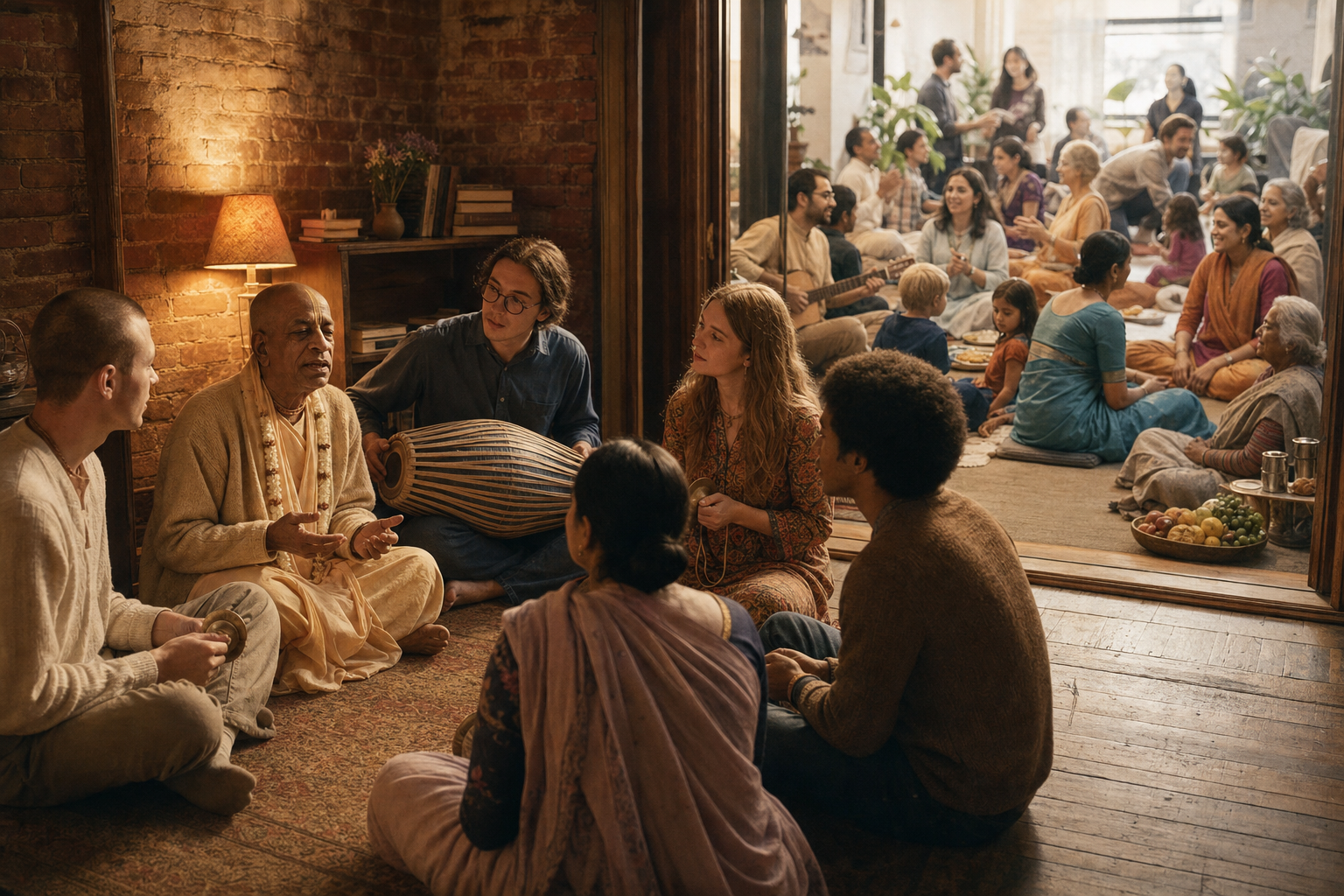
ISKCON’s sixtieth anniversary brings two questions into the same room: how did a small Lower East Side gathering become a durable international institution, and what must be preserved as responsibility passes to new generations? Reporting on the second and third days of the anniversary week suggests that the answer lies less in institutional scale than in the relationship among theology, repeated practice, community, memory, and leadership.
Read together, the two accounts present 26 Second Avenue as both an origin and a continuing standard. Its legacy is not simply that something large began there. It is that a specific form of devotional life became accessible without surrendering its theological identity.
Sixty years changes the meaning of an origin story
Both anniversary accounts place ISKCON’s formal establishment in New York City in 1966 under A.C. Bhaktivedanta Swami Prabhupada. The Day 3 account reports that the organization was legally incorporated on July 13, 1966, while the 2026 anniversary week ran from July 6 through July 13 and culminated on the incorporation date. The Day 2 account interprets the sixtieth anniversary as a passage from living memory into multigenerational history.
That transition changes what commemoration must accomplish. Some early participants may retain direct memories, while later generations encounter the founding period through books, recordings, photographs, temples, family accounts, and inherited practices, as the Day 2 article observes. The Day 3 recording, made at the movement’s first storefront, therefore serves two purposes at once: it is a devotional program and, as its accompanying article argues, a contemporary historical document.
The anniversary is consequently more than institutional arithmetic. It tests whether memory can be preserved accurately, interpreted responsibly, and connected to present practice. A movement can retain dates and artifacts while losing the habits that gave those facts meaning; conversely, practice without historical awareness can become detached from the choices and sacrifices that shaped it.
Key takeaways
- 26 Second Avenue matters because its modest scale reveals how sustained teaching, hospitality, and repeated practice can establish durable religious life.
- Kirtan, scriptural study, prasadam, service, and discipline turned theology into a participatory community rather than a collection of abstract ideas.
- The early movement combined cultural accessibility with an explicitly Krishna-centered identity.
- Preserving the legacy now requires documentation and sacred memory alongside accountable leadership and responsible succession.
The storefront joined accessibility to theological specificity
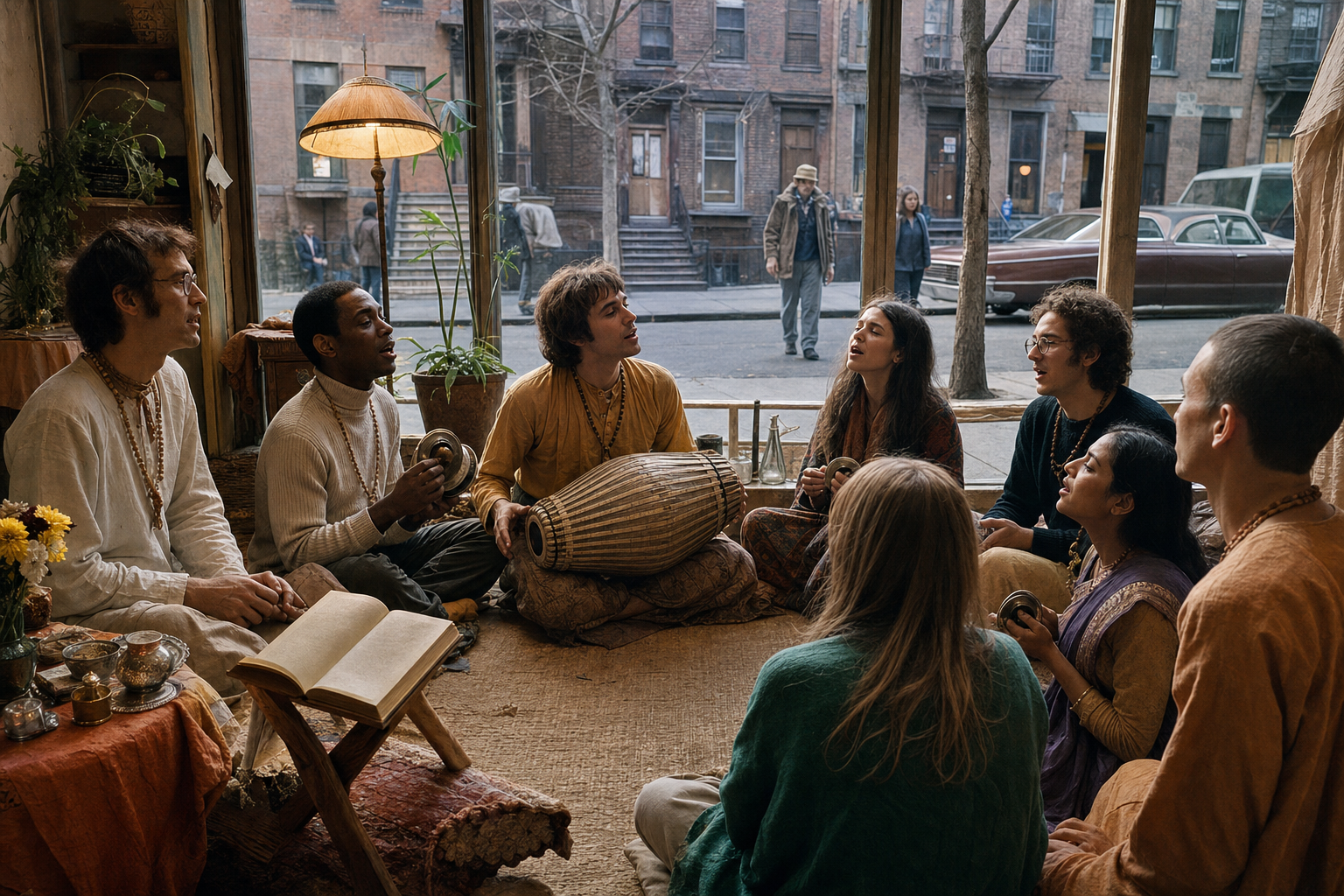
The two sources repeatedly return to the contrast between the storefront’s dimensions and the movement that followed. According to the Day 3 article, Prabhupada arrived in the United States in 1965 aboard the cargo ship Jaladuta at the age of sixty-nine, carrying early volumes of his English translation and commentary on the Srimad-Bhagavatam. After a period of uncertainty, the storefront and a nearby apartment provided a stable base for teaching, chanting, cooking, publication work, discussion, and personal instruction.
Regularity was one of the storefront’s quiet innovations. A fixed address allowed encounters to become a shared rhythm rather than a sequence of isolated events. People could return to hear Bhagavad-gita and Srimad-Bhagavatam teachings, participate in congregational chanting, ask questions, receive prasadam, and gradually accept responsibilities within an emerging community. The sources do not establish that any single activity caused ISKCON’s later expansion; together, however, they describe a repeatable pattern of formation that was not dependent on a grand building or a socially established congregation.
The inherited sign, “Matchless Gifts,” became an especially effective symbol. Both accounts report that the phrase came from an earlier business occupying the premises. In the devotional setting, it ceased to describe merchandise and came to evoke access to Krishna consciousness through sacred sound, teaching, food, and service. The name linked the material plainness of the location with the community’s understanding of the spiritual value being offered there.
Accessibility did not require theological vagueness. The Day 2 article situates ISKCON within the Gaudiya Vaishnava tradition associated with Sri Caitanya Mahaprabhu and describes bhakti as loving devotional service to Krishna, understood as the supreme personal reality. It also identifies acintya-bhedabheda-tattva – the inconceivable simultaneous oneness and difference between the Supreme and the Supreme’s energies – as a key philosophical formulation. The Day 3 account similarly emphasizes that Prabhupada translated concepts into accessible English and demonstrated practices without discarding the tradition’s central claims.
Kirtan illustrates this balance. Call-and-response chanting allowed a newcomer to listen and participate without prior command of Sanskrit or ritual procedure. Within the theology described by the sources, however, the divine name is not merely a musical device or symbol; chanting is itself a means of remembrance and engagement with the divine. Individual japa demands sustained attention, while collective kirtan makes participation communal. A low threshold for entry was thus paired with the possibility of deep and disciplined formation.
Prasadam carried the same double character. The Day 3 account presents food prepared and offered to Krishna as grace that could be shared without requiring social status or previous membership. Eating together combined theology, hospitality, nourishment, and social inclusion. Scriptural hearing, chanting, food, service, and ethical discipline reinforced one another, making the storefront not only a venue but a compact model of devotional community.
Historical preservation meets the demands of mature leadership
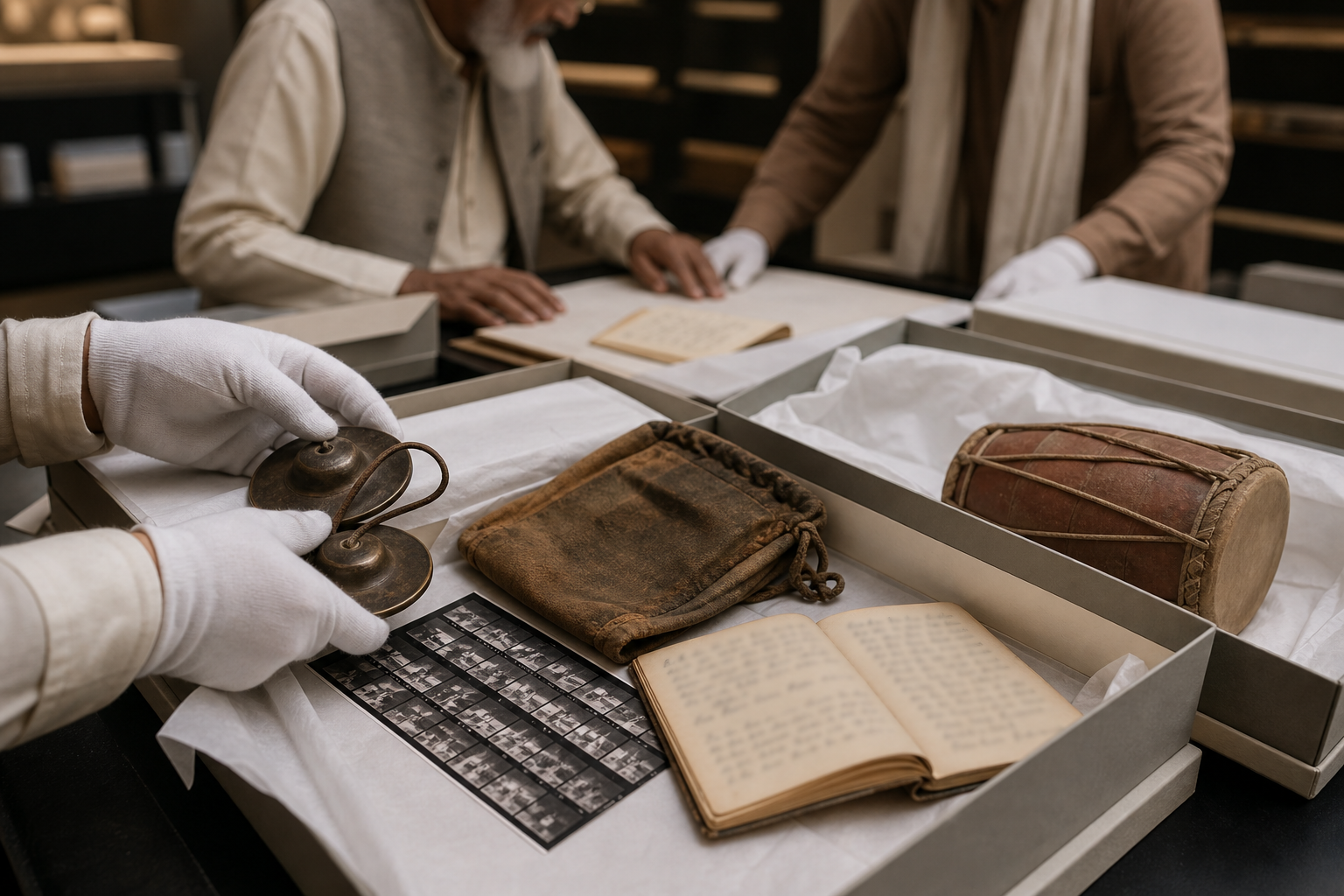
The sources illuminate two different sides of institutional continuity. The Day 3 article concentrates on place, incorporation, public practice, and the preservation of voices connected with the movement’s history. It characterizes ISKCON’s seven incorporation purposes as an early framework embracing religious teaching, education, community, sacred places, ecological concerns, and publishing. It also notes the significance of retaining “Krishna” in the society’s name rather than adopting a more generalized identity.
The Day 2 article shifts the emphasis from inherited structures to the conduct needed to sustain them. It identifies HG Anuttama Prabhu with service in leadership development, communications, and interreligious engagement, and uses his participation in the anniversary week to frame the responsibilities facing an established global movement. Administrative ability matters in this account, but it is not sufficient. Leadership is interpreted through seva: authority should express service, character, spiritual discipline, listening, transparency, and accountability.
Succession makes those principles concrete. The Day 2 source reports that Prabhupada created the Governing Body Commission in 1970 and that the period following his physical departure in 1977 required the community to distinguish the founder-acharya’s unique position from the duties of later teachers and governors. It describes the resulting history as one involving learning, correction, and continuing discussion about authority, standards, pastoral care, and accountability.
These perspectives are complementary. Buildings, documents, photographs, and recordings preserve the external record of a tradition. Governance, teaching, pastoral responsibility, and personal practice carry its internal commitments forward. Historical memory without self-examination can become nostalgia, while institutional criticism without a clear memory of founding principles can lose the criteria by which reform should be judged.
The storefront offers a useful measure here. Its story directs attention away from prestige and toward purpose, consistency, trust, and service. Institutional maturity would therefore be demonstrated not only by preserving the first temple or celebrating later growth, but also by asking whether leadership remains answerable to the devotional purposes for which the institution was created.
The next chapter depends on practiced, not merely remembered, heritage
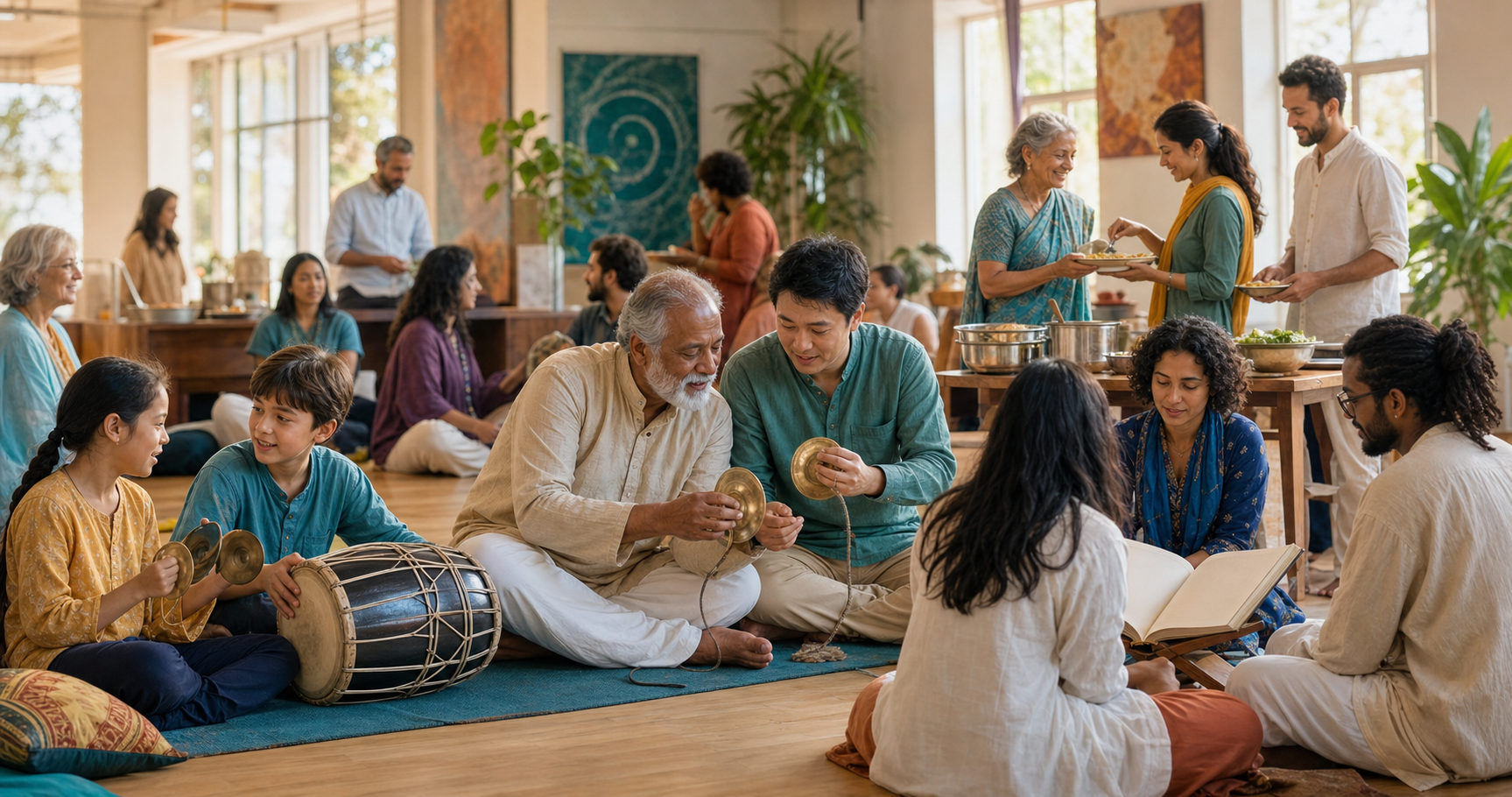
The Day 3 source reports that the anniversary program combined kirtan, classes, historical recollections, harinama in surrounding streets, visits to nearby sacred sites, and the sharing of prasadam. That combination is significant because it did not treat heritage as passive observation. Participants encountered history through the same broad categories of sound, teaching, place, food, and community that shaped the early storefront.
The two articles do not provide a comprehensive assessment of ISKCON’s six decades or outcome measures for its current institutions. Their narrower value is to identify a productive set of questions. Can historical testimony be preserved before direct memory recedes? Can inherited teachings remain intelligible across cultures without becoming generic? Can newcomers participate easily while still being invited into disciplined practice? Can authority remain visibly connected to service and accountability?
On this reading, 26 Second Avenue is neither only a shrine to the past nor simply the first entry in a chronology of expansion. It is a continuing proposition: clear teaching, sacred sound, shared food, disciplined service, and human-scale relationships can give religious ideas a durable social form. If future commemorations keep those practices connected to careful documentation and responsible leadership, Matchless Gifts will remain a living inheritance rather than a preserved slogan.
References
- DharmaRenaissance Blog – Where It All Began: Why ISKCON’s Day 3 at 26 Second Avenue Still Matters After 60 Years
- DharmaRenaissance Blog – ISKCON at 60, Day 2: HG Anuttama Prabhu on Living Krishna Consciousness