

The Lakshmana Rekha and Vibhandaka’s seclusion of Rishyasringa begin with a shared promise: danger can be kept away by carefully regulating contact with the world. Yet the two stories lead to a more demanding question. Does a boundary prepare someone to recognize danger, or does it merely make that person dependent on whoever controls the boundary?
Read together, these narratives distinguish protective restraint from coercive control. They also show why textual context, informed participation, reciprocal obligations and accountability matter more than the mere existence of a line or wall.
Before interpreting the boundary, identify what the texts contain
The two familiar images do not possess the same textual status. The source article reports that Valmiki’s Ramayana does not describe Lakshmana drawing a protective line in Aranya Kanda 45. That passage instead ends with Lakshmana taking leave of Sita and looking back as he goes toward Rama. The boundary motif became prominent through later Sanskrit, regional, oral, theatrical and visual retellings.
According to the article, versions of the motif have been traced to works including the Mahanataka and the Ranganatha Ramayana, with the latter presenting multiple lines. The familiar episode is also absent from the Ramcharitmanas, although that work invokes the expression elsewhere. The Lakshmana Rekha is therefore best approached as an influential product of the Ramayana’s continuing reception, not as an episode uniformly present in every telling.
Vibhandaka’s wall requires a different clarification. In the accounts discussed from the Mahabharata’s Vana Parva and the Ramayana’s Bala Kanda, it is not a physical fortification. It is an interpretive description of the controlled environment in which Rishyasringa is raised: isolation, restricted experience and paternal authority form the barrier. One image is a later narrative symbol; the other is a metaphor for a condition explicitly created through seclusion. Keeping that distinction visible prevents cultural memory from being mistaken for textual uniformity.
Two protective strategies, and two different concentrations of power
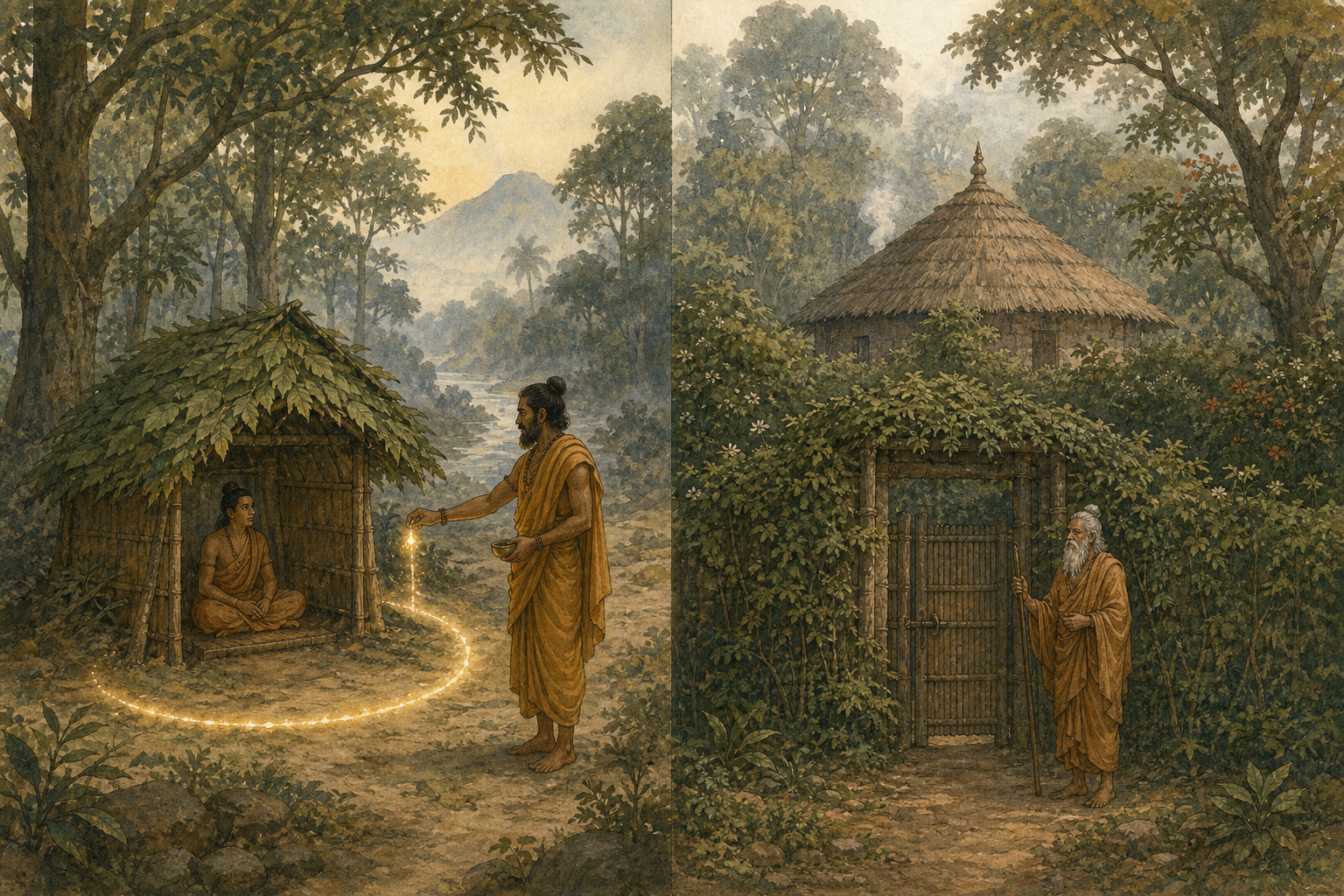
The source presents both arrangements as responses to perceived danger, but their structures differ sharply. In the Lakshmana Rekha tradition, Lakshmana acts during the crisis at Panchavati. Maricha, appearing as a golden deer, draws Rama away and later imitates Rama’s voice. Sita urgently asks Lakshmana to go to Rama, while Lakshmana suspects deception and faces incompatible demands: Rama’s instruction to protect Sita and Sita’s insistence that he leave. Later retellings turn his final precaution into a visible line.
Vibhandaka’s arrangement is not an emergency response. It shapes Rishyasringa’s entire field of experience in the name of tapas, discipline and brahmacharya. The source article emphasizes that these ascetic ideals are not themselves the problem. The ethical difficulty lies in treating ignorance as if it were discernment. Rishyasringa receives spiritual and ritual formation but lacks ordinary social knowledge through which to interpret unfamiliar people, attractions and intentions.
| Question | Lakshmana Rekha tradition | Vibhandaka’s seclusion |
|---|---|---|
| Form of boundary | A visible line in later retellings | An environment controlled through isolation |
| Immediate purpose | Safety during a sudden crisis | Preservation of ascetic discipline |
| Location of authority | A temporary precaution left by a protector who must depart | Long-term control by a parent and teacher |
| Central limitation | The line cannot expose a convincing disguise | Seclusion cannot permanently suppress curiosity or supply social judgment |
| Primary ethical risk | Turning a warning into a reason to blame the victim | Turning formation and discipline into enforced dependence |
Knowledge determines whether separation produces safety
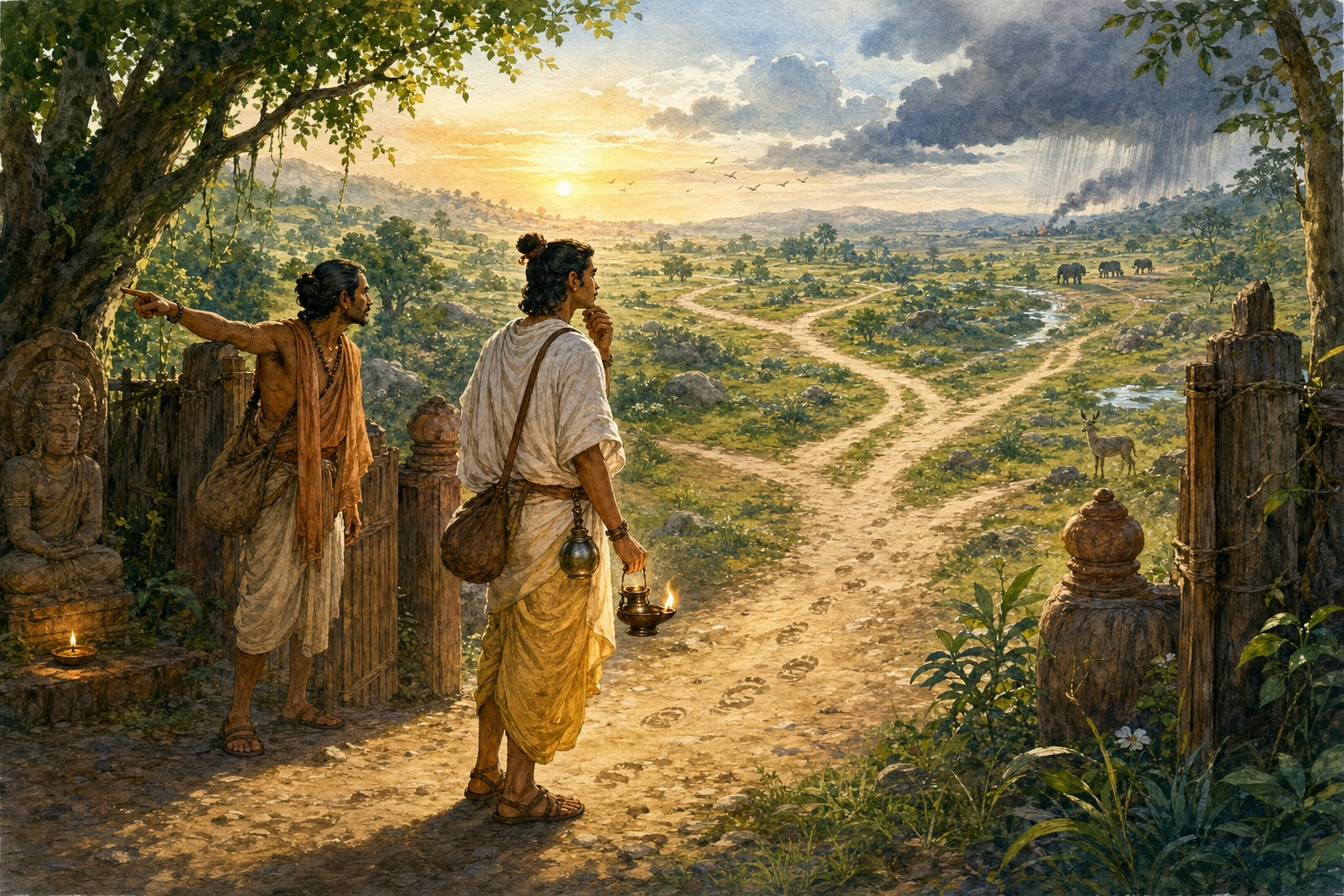
Neither story presents danger as a simple invasion that a stronger barrier would necessarily stop. Ravana succeeds through disguise and the manipulation of religious hospitality. Sita does not knowingly select danger; a predator places generosity and caution in conflict. The decisive asymmetry is informational: Ravana knows the identity he is concealing, while Sita must respond to the appearance of a mendicant.
Rishyasringa’s vulnerability grows from a different informational imbalance. The source reports that he has no experience of ordinary social life beyond the hermitage. When the kingdom of Anga suffers drought, King Lomapada’s advisers say that Rishyasringa’s arrival will restore rain. The court then sends courtesans to gain the inexperienced ascetic’s confidence and bring him to the kingdom. Seclusion has kept encounters away, but it has not equipped him to understand one when it occurs.
The comparison exposes the weakness of safety based entirely on exclusion. A fixed boundary can mark where caution is required, but it cannot identify every deceptive appearance. Isolation can reduce exposure for a time, but it can also prevent the accumulation of judgment. Effective protection therefore needs an educational dimension: the person facing risk must be able to ask questions, recognize manipulation and participate in decisions about the limits governing that person’s life.
Maryada must restrain protectors and predators as well

The source interprets the Lakshmana Rekha through maryada: limit, propriety, norm and ethical restraint. On this reading, maryada cannot mean that only vulnerable people must stay within boundaries established by others. It must also restrict what rulers, teachers, relatives, ascetics and other holders of authority may do. A limit becomes reciprocal when it safeguards dignity and trust while also preventing power from exploiting dependence.
This reciprocity clarifies responsibility at Panchavati. Whatever significance a later retelling gives the line, crossing or misunderstanding it cannot transfer culpability to Sita. Ravana plans the deception, adopts a false identity, exploits hospitality and carries out the abduction. The moral focus belongs on the deliberate aggressor, not on whether the person deceived perfectly followed a precaution.
The Rishyasringa narrative distributes ethical scrutiny more widely. Vibhandaka seeks to preserve an honored discipline, but his method withholds the experience needed for independent judgment. Lomapada’s court, meanwhile, responds to crisis with its own calculated deception. Protective intention does not automatically validate every means, just as public necessity does not erase questions about manipulation.
A useful boundary can consequently be assessed by four connected standards: whether it addresses a real danger, whether it is proportionate and revisable, whether the affected person can understand and participate in it, and whether it limits the protector’s power as seriously as it limits the protected person’s conduct. This is why the source connects maryada with consent, privacy, professional ethics and constitutional restraint. In each case, the boundary’s legitimacy depends on what it prevents power from doing, not only on what it forbids individuals to do.
Key takeaways
- The Lakshmana Rekha is culturally influential but should not be presented as a scene found in every Ramayana.
- Vibhandaka’s wall is a metaphor for controlled seclusion rather than a literal barrier in the core accounts discussed by the source.
- Temporary protection and long-term control may share good intentions while producing very different relationships of power.
- A boundary cannot replace the knowledge required to recognize disguise, manipulation and unfamiliar motives.
- Responsibility remains with those who deceive or harm; a precaution must never become a device for blaming the person it failed to protect.
- Dharmic restraint is reciprocal: it must govern authorities and protectors as well as those placed under their care.
The continuing relevance of these traditions lies in the design of future boundaries. Families, teachers and institutions can treat safety not as the indefinite management of another person’s world, but as the patient development of informed judgment, shared responsibility and limits on power.