
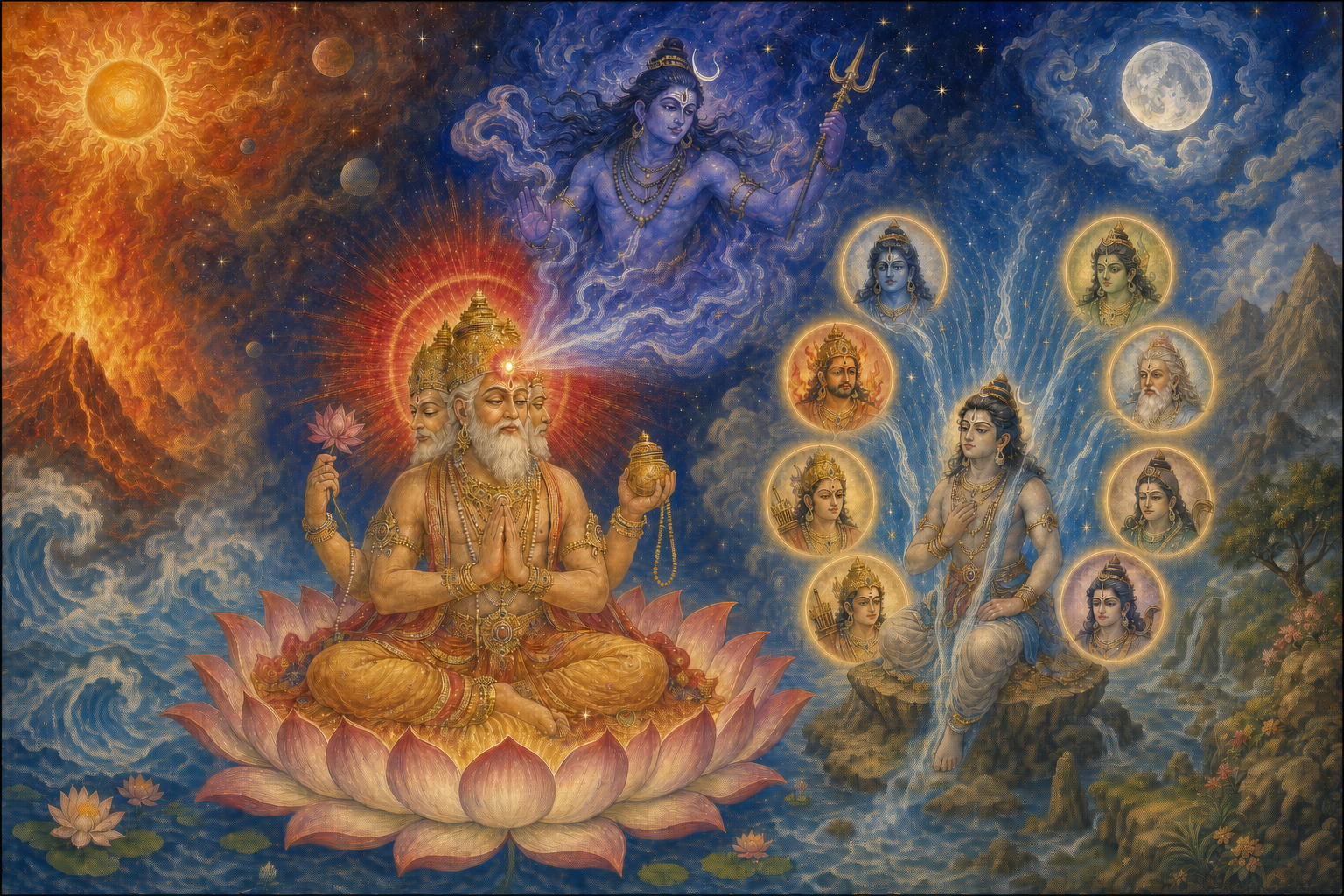
The Vishnu Purana does not confine Rudra to a single origin scene or a single numerical set of forms. As reported in a DharmaRenaissance reading of Book One, Chapters 7 and 8, one passage presents a formidable being born from Brahma’s anger, while the next depicts a crying child who receives eight names.
Reading these accounts together clarifies what each contributes. One explains how concentrated power becomes differentiated; the other shows how naming gives that power recognizable identities and cosmic relationships. Their different numbers serve different purposes and need not be forced into one biography.
Two manifestations at the threshold of creation
The source places both episodes at the opening of a kalpa, within a cosmology in which worlds repeatedly arise, endure, dissolve, and return. In that setting, a divine birth signifies the manifestation of a function needed for a new cycle. It is not simply a biological event or a claim that one deity exists only because another produced him at a particular historical moment.
In the Chapter 7 account, Brahma’s mind-born sons include figures such as Sanandana, whose knowledge and detachment leave them without a desire to participate in procreation. Their renunciation is not treated as wrongdoing, but it does frustrate the immediate expansion of the created world. According to the source, Brahma’s resulting wrath becomes a fire powerful enough to threaten the three worlds.
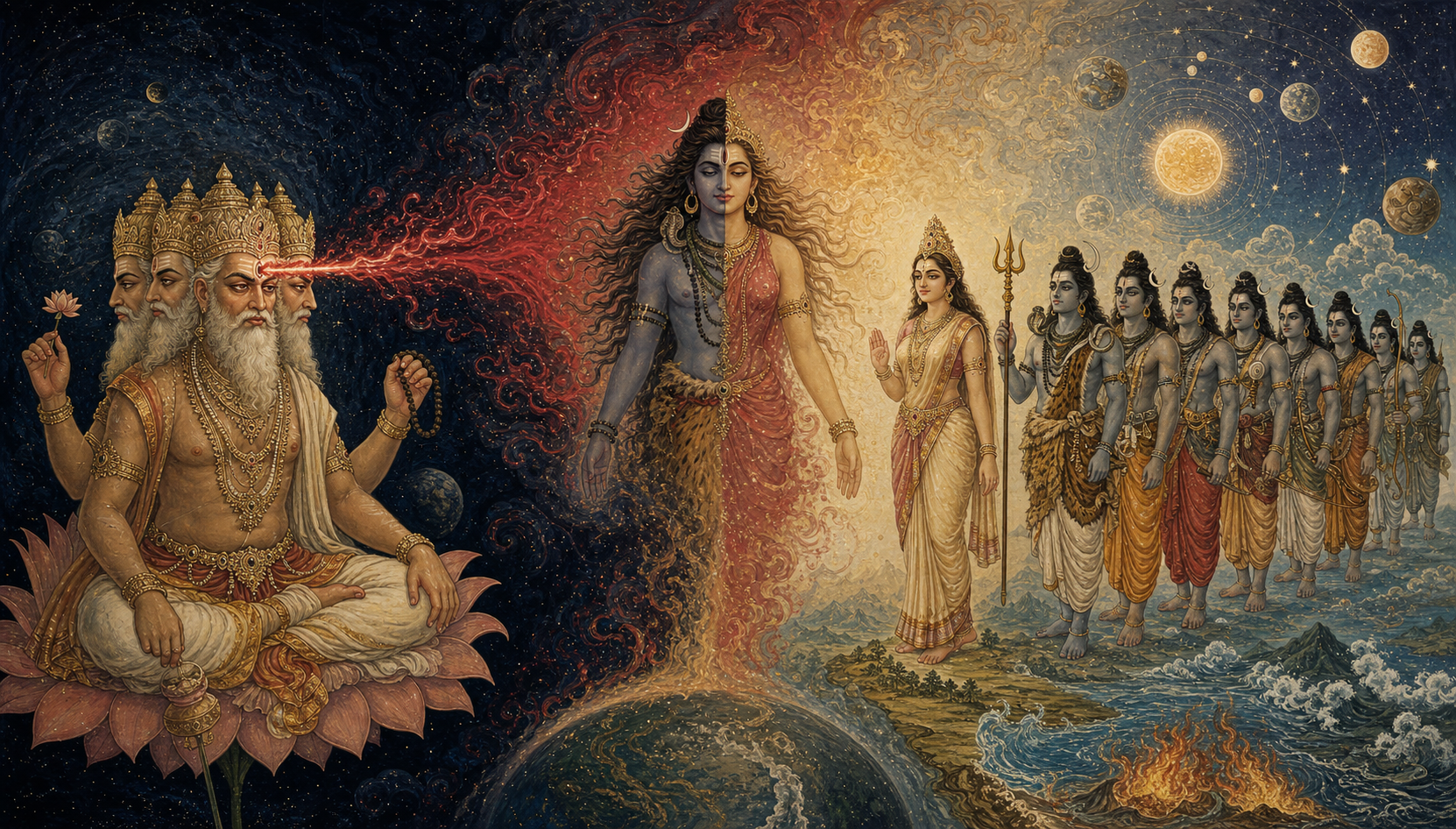
Rudra emerges from Brahma’s furrowed forehead amid this blazing intensity, radiant like the midday sun. His initial body is half male and half female, holding complementary creative powers together before their differentiation. At Brahma’s command, Rudra separates these dimensions. The male aspect becomes eleven forms, while the female aspect multiplies into numerous light- and dark-complexioned forms. The male manifestations themselves range from mild and pleasing to fierce and awe-inspiring.
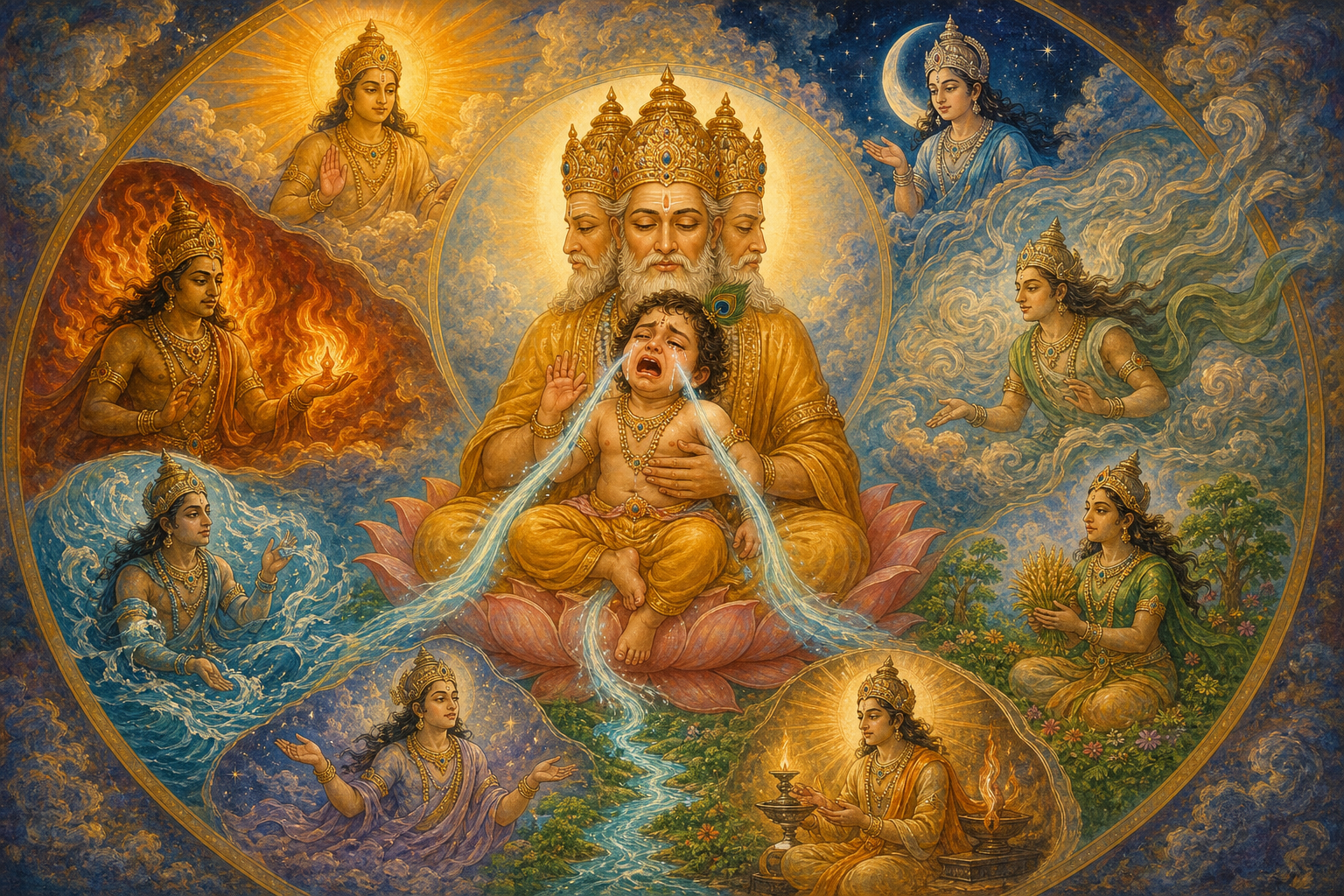
Chapter 8 changes the scale and emotional register. Brahma meditates upon a son equal to himself, and a blue-red or reddish-purple child appears in his lap. The source associates this colouring with the traditional designation Nilalohita. The child runs about crying, and when Brahma asks why, he says that he wants a name.
Anger and tears both become ordered power
The two episodes begin with emotion, but neither leaves that emotion in an uncontrolled state. In Chapter 7, anger intense enough to consume the worlds is embodied, divided, and assigned a role. The passage therefore need not be read as praise for rage. Its movement is from overwhelming energy to purposeful differentiation.
Chapter 8 makes a similar movement through tears. Brahma first names the child Rudra and asks him to become composed. The article connects this name narratively with the Sanskrit verbal root rud, associated with crying or wailing, while noting that such scriptural wordplay does not by itself settle every question about the historical development of a divine name.
The child cries seven more times, and each cry elicits another name. Distress thus becomes the occasion for articulation: what initially has no defined place receives identities through which its presence can be understood. In the Purana’s symbolic language, naming does more than attach labels. It distinguishes functions and situates divine power within an intelligible cosmos.
Eight names and eleven forms answer different questions
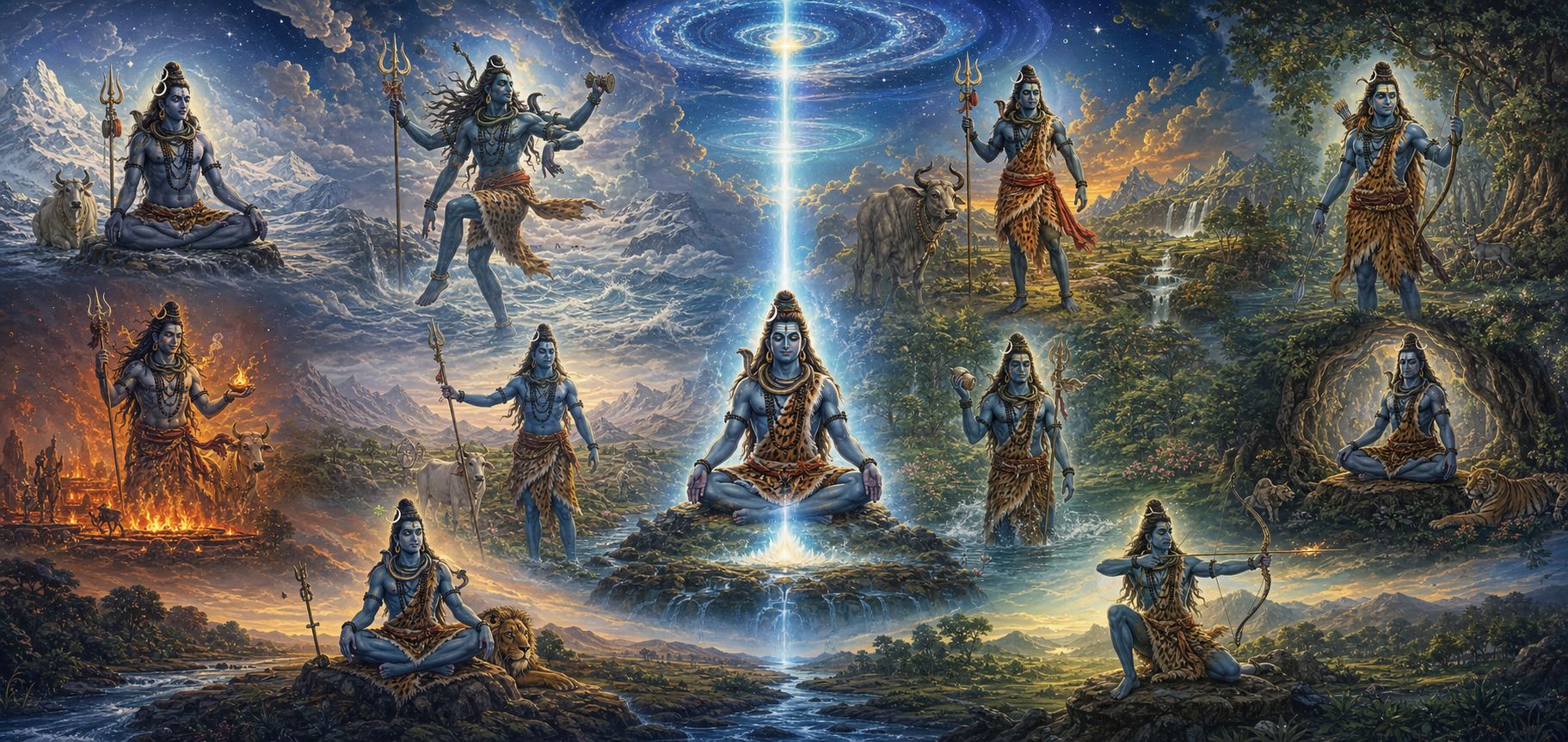
The Chapter 8 sequence produces eight names in all: Rudra, Bhava, Sarva, Isana, Pasupati, Bhima, Ugra, and Mahadeva. The source reports that each named manifestation receives a cosmic station, a wife, and a son. The scheme consequently organizes Rudra through identity, location, relationship, and descent.
The eleven forms in Chapter 7 belong to another arrangement. They arise when the initially unified, male-and-female Rudra divides after his fiery manifestation. That account emphasizes multiplication and the range from gentle to terrifying forms; it does not present the same naming sequence found in the following chapter.
The most careful reading therefore preserves the distinction. The eight Rudras should not be treated as an incomplete version of the eleven, nor should extra names be imported merely to make the totals match. The adjacent passages organize related theological material in two ways: an elevenfold division arising from cosmic anger and an eightfold identity produced through repeated cries and names.
This distinction also offers a practical rule for reading Puranic classifications. Before reconciling two lists, the reader should ask what each list is classifying. Different numbers may reflect different narrative settings, symbolic concerns, or relationships rather than a factual contradiction requiring correction.
Rudra’s range exceeds a single destructive role
The combined picture resists reducing Rudra to a deity of destruction alone. His forms include the mild as well as the fierce, and his first manifestation contains both male and female dimensions. He appears where creation encounters limits: beings refuse procreation, undirected wrath threatens the worlds, and a newborn power lacks a name and place. Rudra enables these tensions to become part of an ordered process.
Destruction, in this framework, is not an isolated divine specialty opposed to creation. Formed things must change, reach limits, and eventually give way if a cyclic cosmos is to continue. Rudra embodies the force that makes such transition possible, while his multiple appearances prevent that force from being represented as uniformly terrifying.
The source also highlights the wider theological frame supplied near the end of Chapter 7. Parashara explains that creation, preservation, and destruction operate through Vishnu, who abides in all beings. Read in that context, Brahma and Rudra remain meaningful divine agents, but their activities are not sealed off from the reality sustaining the entire cosmic process.
The passage consequently does not function as a simple contest of rank among deities. Its concern is relational: creative projection, preservation, limitation, dissolution, and renewal belong to an interconnected order. Rudra’s emergence from Brahma can express this relationship without exhausting Rudra’s identity, just as the eight names disclose forms without claiming that only eight descriptions are possible.
Key takeaways
- Book One, Chapters 7 and 8 present related but distinct accounts of Rudra’s manifestation.
- Chapter 7 connects Rudra with Brahma’s blazing anger, an initially male-and-female body, and an elevenfold male division.
- Chapter 8 portrays a crying blue-red child who receives Rudra and seven additional names.
- The eight named manifestations and the eleven divided forms are separate classificatory schemes, not interchangeable lists.
- The wider Vishnu Purana framework places creation, preservation, and dissolution within an encompassing divine unity.
Future study can build on this distinction by comparing the Vishnu Purana’s individual assignments for the eight names with other scriptural Rudra traditions, while continuing to identify precisely which text and passage supplies each classification.