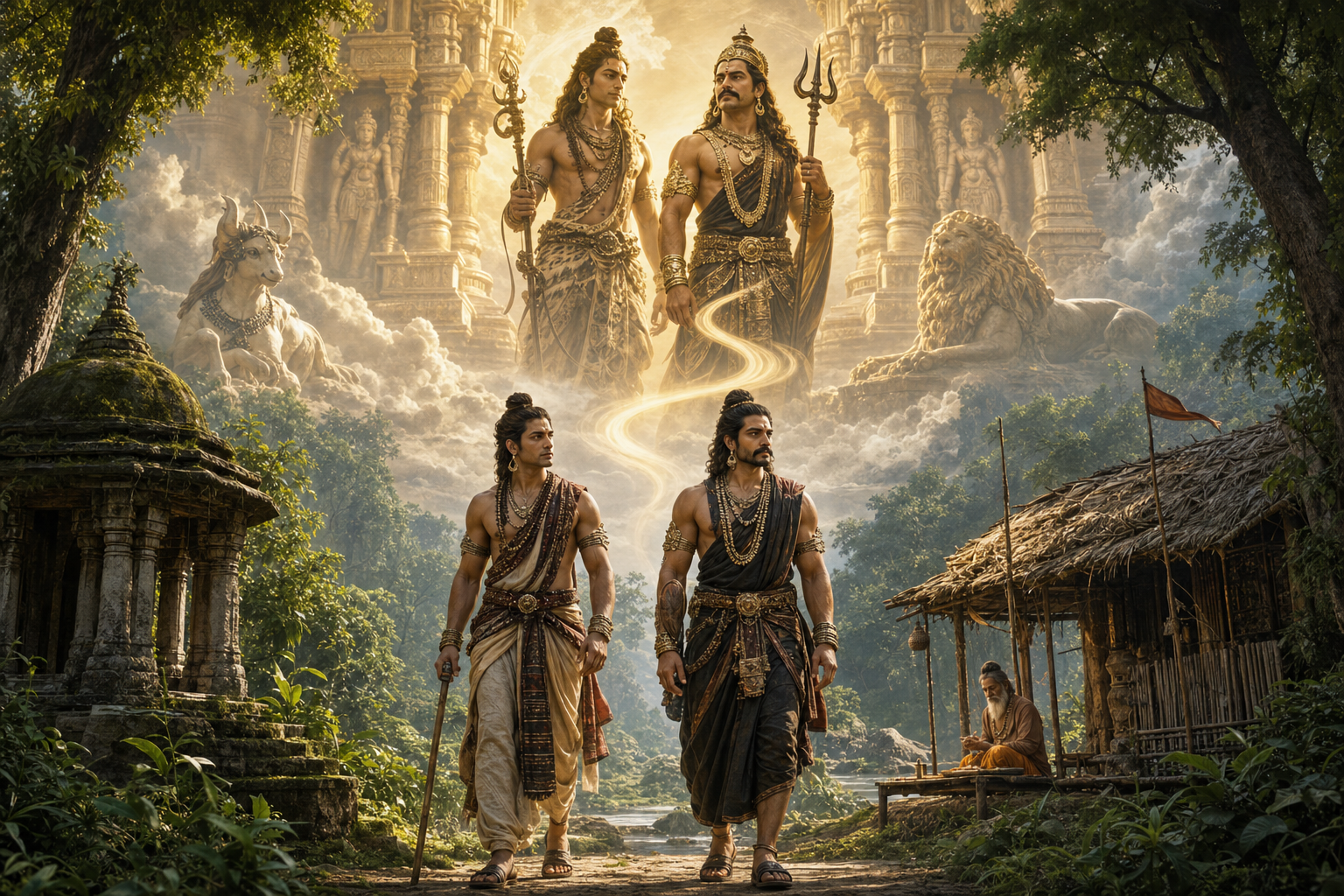
Betal is often approached through the riddle tales associated with King Vikramaditya, but the Kalika Purana account described by DharmaRenaissance presents a different figure: the mortal manifestation of Shiva’s attendant Bhringi and the companion of Bhairava.
Reading this narrative carefully requires more than retelling its unusual births and curses. Its larger value lies in how it connects divine identity, altered appearance, social exclusion and eventual restoration within the sacred world associated with Kamarupa.
Which Betal appears in the Kalika Purana?
The source article cautions against treating every Vetala or Betal in Indian literature as the same being. A name may designate a category of spirits in one setting, an individual mythological figure in another and a locally worshipped deity elsewhere. Context therefore determines identity.
In this particular narrative, Vetala is Bhringi in human form. His companion Bhairava embodies Mahakala. Both originate within Shiva’s divine household rather than as independent, malevolent spirits. Their unsettling mortal appearance is the effect of a curse, not proof of an evil nature.
The distinction also separates this account from the familiar Vetala who tests Vikramaditya with riddles. Similar names can connect literary and devotional traditions without making their characters interchangeable. The most reliable interpretive question is therefore not simply who Betal is, but which text, region and religious role define him in a given account.
A regional Purana frames Betal’s transformation
DharmaRenaissance associates the Kalika Purana with historical Kamarupa, corresponding broadly to present-day Assam and adjoining areas. It reports that scholars generally place the surviving work around the tenth or early eleventh century, while acknowledging continuing discussion about its date and textual layers.
The work gives particular prominence to Devi as Kalika, Mahamaya and Kamakhya, according to the source, yet its religious setting also incorporates Shaiva, Vaishnava and other Puranic traditions. Betal’s story exemplifies that interconnected world: a narrative centered on attendants of Shiva unfolds inside a text strongly associated with the Goddess.
The source locates the broader Bhairava-Vetala sequence from approximately chapter forty-seven onward, mainly across the late forties and early fifties. It also warns that chapter numbering may vary among editions and summaries. The human birth is placed around chapter fifty, with instruction, pilgrimage and worship following in subsequent chapters.
From Shiva’s threshold to human vulnerability
The narrative begins with two portions of Hara’s generative power, connected in the source’s account to the circumstances surrounding Skanda’s birth. After this energy falls upon the Himalaya, Mahakala and Bhringi arise and are regarded as sons of Hara, another name for Shiva.
Shiva appoints them as leaders among his ganas and stations them at an entrance while he and Parvati are in privacy. Their position is significant: guardians stand at the boundary between ordinary access and protected sacred space. Their authority is consequently inseparable from responsibility.
The turning point comes when they see Parvati emerge with her clothing disturbed. She understands the incident as a breach of the privacy they were meant to guard and curses them to be born as humans with simian faces. The source notes that retellings can emphasize the episode differently, presenting the attendants either as unfortunate witnesses protesting a severe punishment or more simply as beings who remain determined to have Shiva and Parvati as their mortal parents.
The curse changes their condition without extinguishing their origin. Mahakala and Bhringi move from divine office to embodied vulnerability, carrying an identity that remains hidden beneath a form likely to provoke fear. The episode thus uses physical transformation to create a test of recognition: will others perceive only the imposed appearance, or the being whose deeper identity survives it?
How two curse narratives converge in Bhairava and Vetala
For the attendants to be born to their chosen divine parents, Shiva and Parvati also enter mortal life. The source identifies Shiva’s human form as Prince Chandrashekhara, also associated with the name Tryambaka and described as the son of King Paushya. Parvati becomes Princess Taravati, daughter of King Kakutstha. They marry, and Chandrashekhara rules at Karavirapura in Brahmavarta.
A second chain of events involves the sage Kapota, who sees Taravati bathing in the Drishadvati and desires her. Taravati sends her sister Chitrangada in her place. The source describes Chitrangada as a daughter of Urvashi living under another curse; she bears Kapota two sons, Tumburu and Suvarchas. After discovering the substitution, Kapota threatens that Taravati will bear two monkey-faced sons fathered by an aged, unattractive, skull-bearing ascetic.
The account resolves the two curses through identity beneath disguise. Shiva assumes the appearance specified by Kapota while remaining Taravati’s divine husband. Mahakala and Bhringi can therefore be born as Bhairava and Vetala without severing their underlying relationship to Shiva and Parvati.
This convergence is the narrative’s structural hinge. Parvati’s curse determines the attendants’ human condition and appearance; Kapota’s curse supplies the circumstances through which their birth occurs. What looks like a second, unrelated threat becomes the means by which the first destiny is fulfilled.
Appearance, rejection and restoration
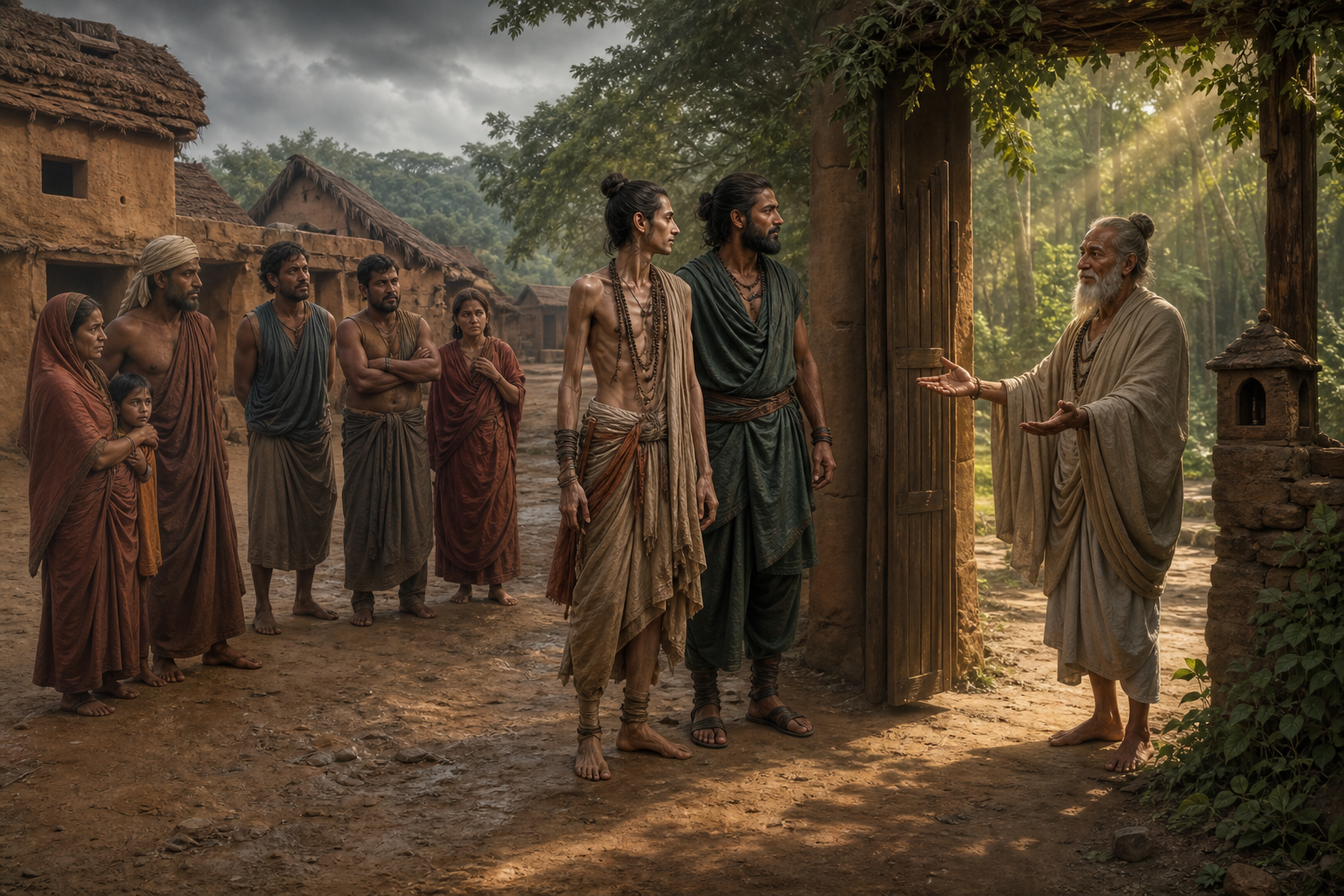
The source reports that Bhairava and Vetala are acknowledged as princes, yet their monkey-like faces cause unease. Chandrashekhara and his other sons do not give them the affection they need, and the two eventually leave the palace in sorrow. Royal status cannot protect them from judgment based on appearance.
The story’s treatment of Kapota and Taravati also calls for ethical care. As the source observes, this part of the narrative includes unequal power, sexual pressure, concealment and retaliatory anger. Describing those actions as elements in a Puranic chain of causation does not require treating them as moral ideals. Mythic figures may drive cosmic change through conduct that also produces suffering.
Against that difficult background, Betal’s wider trajectory moves from divine standing through curse, human embodiment and rejection toward pilgrimage, disciplined worship and restoration, as summarized by DharmaRenaissance. Restoration does not make the intervening pain unreal. Instead, it reveals that an externally imposed form never exhausted Betal’s identity.
Key takeaways
- The Kalika Purana’s Betal should not automatically be identified with the riddle-telling Vetala of the Vikramaditya stories.
- In the account reported by DharmaRenaissance, Bhringi becomes Vetala while Mahakala becomes his companion Bhairava.
- Two curse sequences converge to bring the divine attendants into human birth as the sons of Shiva and Parvati in mortal form.
- The princes’ frightening appearance signifies imposed embodiment rather than an innately evil character.
- The narrative joins Shaiva figures to the Goddess-centered sacred and regional setting of the Kalika Purana.
Further study can deepen this reading by comparing chapter numbering, translations and regional interpretations while continuing to keep Betal’s textual identity distinct from similarly named figures elsewhere.