
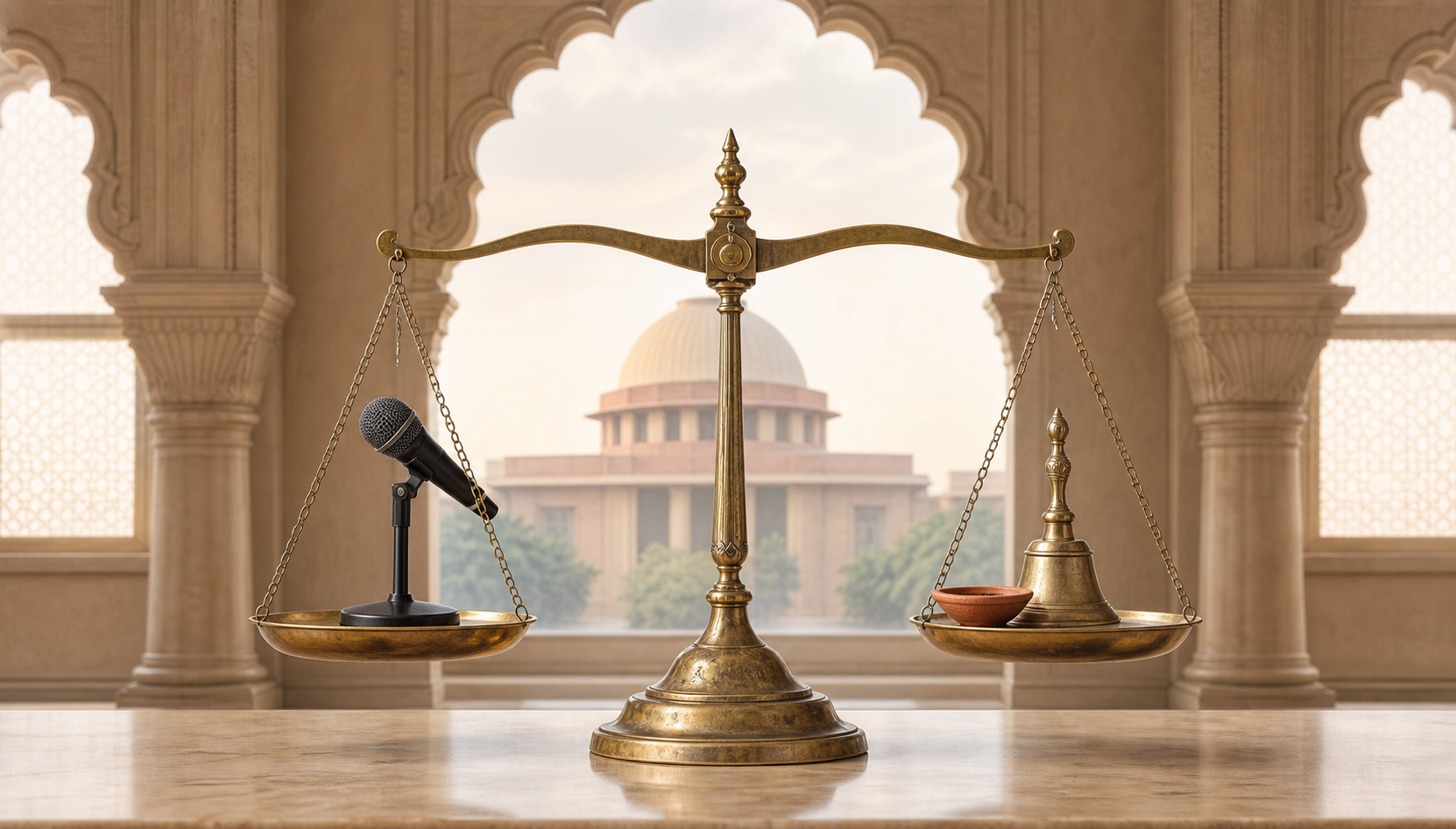
Three reported controversies place Hindu rights and religious sensitivity in very different legal settings: allegedly inflammatory remarks at a public gathering in Chhattisgarh, a disputed sacred analogy in a Nashik bail order, and conflicts over Hindu observance, communal classification and public safety surveyed by HinduPost. Read together, they show why neither offence nor invocations of free speech can settle such disputes by themselves.
The more useful question is how institutions should separate protected criticism, actionable hostility, religious hurt, humanitarian judicial reasoning and political characterisation. That requires attention to the speaker, forum, evidence, procedural stage and remedy in each case.
Key takeaways
- A decision allowing a prosecution to continue is not a finding of guilt, just as granting bail is not an acquittal.
- Criticism of religion, deliberate religious insult and speech alleged to threaten communal harmony raise different questions; context and legally required intent matter.
- Judges can consider pregnancy and other humanitarian circumstances without using religious imagery that may imply conclusions about the accused or police.
- Hindu-rights advocacy is most persuasive when it demands equal rules while distinguishing verified evidence from allegations, labels and disputed interpretations.
The legal question changes with the speaker and forum
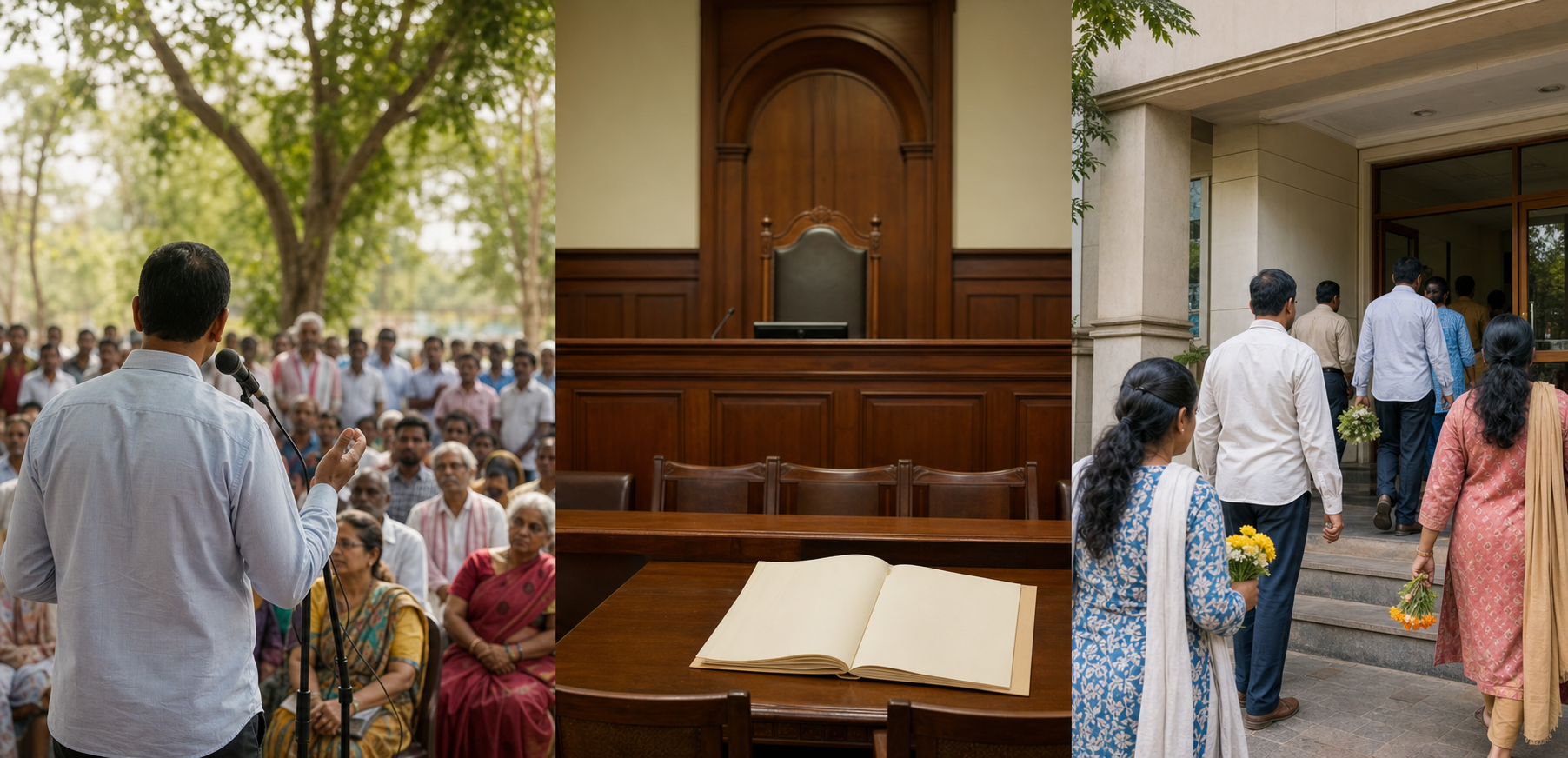
The Chhattisgarh dispute concerns words allegedly spoken by activists to a large public audience. Hindu Existence reported that eleven petitioners were accused of making inflammatory remarks at a meeting held on 27 February 2024 at Saliyatoli Mini Stadium in Kunkuri. The allegations included the statement that "Hindu is not a religion but an abuse" and derogatory meanings attributed to the word Hindu. The petitioners disputed the legal sufficiency of the case and described the meeting as part of social, political and religious discussion.
According to that report, the Chhattisgarh High Court refused on 17 June 2026 to terminate the prosecution at the threshold. The court reportedly found enough material for a prima facie case requiring trial, including the complaint, attendee statements, event pamphlets and purported video evidence cited by the State. That procedural outcome does not establish that every petitioner spoke the alleged words, shared a criminal intention or committed any charged offence. Authenticity, admissibility, attribution, context and intent remain matters for adjudication.
The Nashik controversy reverses the institutional roles: the disputed language was reportedly used by a court rather than by an activist addressing a rally. Hindu Janajagruti Samiti objected to an alleged analogy between the pregnancy of accused Nida Khan and the circumstances of Bhagwan Shri Krishna’s birth. HJS interpreted the comparison as implicitly placing the police in the position of Kansa. Yet the available account did not reproduce the complete order, identify the precise court or case number, or supply the full reasoning and bail conditions. The objection can therefore be assessed as a reported concern about judicial expression, but not as a complete account of what legally determined bail.
HinduPost’s review adds a third setting: conflict over religious practice in a public heritage space. It reported objections to MP Medha Kulkarni’s participation in Vat Purnima observances near Mahatma Phule Wada in Pune, alongside her response that she had been invited and that permission had been obtained. Here, the immediate issue was neither criminal speech nor judicial rhetoric. It was whether criticism of a ritual’s symbolism should become an effective restriction on an otherwise lawful observance. The applicable inquiry consequently turns toward neutral access, preservation, safety and public-order rules.
Offence, hurt and public order cannot be treated as synonyms

The Chhattisgarh petitioners reportedly relied on freedom of speech under Article 19(1)(a), the constitutional duty to cultivate scientific temper and reform, and the absence of a demonstrated intention to promote hostility. The State answered that the alleged language could not be separated from the audience, tone, religious and political setting, and possible effect on communal harmony. The High Court’s refusal to quash, as reported, left that contest for trial rather than declaring either that criticism of Hindu identity is always criminal or that speech framed as reform is automatically protected.
The Nashik objection begins with religious hurt but points toward a different legal problem. Sacred narratives carry theological and moral meanings that can make a judicial metaphor appear to assign heroic or tyrannical roles before guilt has been determined. That makes restraint in judicial writing institutionally valuable. It does not follow, however, that an objection to a metaphor by itself invalidates bail. The HJS account distinguishes a possible request to clarify or remove unnecessary remarks from a challenge to the operative decision, which would require examination of the actual bail reasoning, medical circumstances, prosecution objections, risks and safeguards.
HinduPost’s discussion of violence during Kara Hunnime in Haveri illustrates why public-order terminology also demands precision. The review reported that eight people were injured after a disagreement over firecrackers near a mosque escalated, but it noted conflicting accounts of whether the incident was an anti-Hindu attack, violence between two groups or an event to which police had not initially assigned a communal motive. A Hindu festival participant’s right to safety remains important under every version. The classification of the violence, however, depends on evidence of motive rather than the religious identities of those involved alone.
The same distinction governs the term hate crime. HinduPost argued that targeted desecration, forced conversion or explicit anti-Hindu threats may provide evidence of identity-based hostility, whereas an offence involving people of different religions does not automatically prove such a motive. This evidentiary discipline does not minimise harm. It identifies what investigators and advocates must establish if a case is to support a specifically anti-Hindu classification.
Religious neutrality requires discipline in both directions
A neutral framework must preserve room for critical inquiry into religious beliefs and social customs. It must also protect Hindus from targeted hostility and allow Hindu practices to occur under the same lawful conditions applied to other communities. The Vat Purnima dispute makes the symmetry especially clear: critics may contest a ritual’s historical or social meaning, but criticism should not operate as a religious veto unless a consistently applied rule concerning the site justifies a restriction.
The same even-handedness should govern institutional language. A court may respond humanely to pregnancy without placing a contested case inside a sacred story whose moral roles could be read as predetermined. Conversely, public criticism of that language should not erase the accused person’s presumption of innocence or the relevance of health and dignity in custodial decisions. Respect for Shri Krishna’s sacred significance and fair consideration of a pregnant accused are not mutually exclusive objectives.
Political labels can disrupt this balance. The Nashik account cautioned that "Corporate Jihad" was a charged characterisation rather than a defined offence. HinduPost similarly warned against inferring an ideological or anti-Hindu motive merely from the religious identity of a suspect in another reported case. Such expressions may communicate an organisation’s interpretation, but responsible legal analysis must return to statutory allegations, individual conduct and admissible evidence. The same standard should apply when allegedly anti-Hindu speech is defended as reform: the label selected by either side cannot replace examination of the words, intent and context.
From public grievance to a legally durable rights claim

The first requirement is an exact record. In a speech prosecution, that means identifying which person allegedly said what, preserving the complete recording rather than an isolated extract, establishing its provenance and examining the surrounding address. In a dispute over judicial language, it means obtaining the full order and separating the operative reasons from an incidental observation. In a festival clash, it means comparing police records, medical evidence, witness accounts and available video before assigning a communal motive.
The second requirement is procedural clarity. Charge framing asks whether a case should proceed; it does not determine guilt. Bail concerns custody while proceedings continue; it does not decide criminal responsibility. A complaint about a judge’s wording may call for clarification or removal of a remark, while reversal or cancellation of bail raises distinct legal issues. Advocacy loses precision when these different decisions are presented as interchangeable verdicts.
The third requirement is a remedy matched to the demonstrated harm. Alleged criminal incitement belongs in an evidence-tested prosecution subject to constitutional safeguards. Unnecessary judicial rhetoric may warrant review focused on the language. Unequal restrictions on worship call for a neutral-access analysis. Festival security requires predictable, proportionate rules enforced without religious preference. Keeping these remedies distinct prevents a valid Hindu-rights concern from being weakened by a demand the record cannot support.
Future controversies will test whether authorities protect religious communities without criminalising mere disagreement and preserve liberty without becoming indifferent to targeted degradation. Consistent documentation, restrained institutional language and equal application of public-order rules offer the soundest basis for meeting that test.
References
- Hindu Existence – Inside Chhattisgarh HC’s Crucial Order: 11 Activists Face Trial Over ‘Hindu’ Remarks
- Hindu Janajagruti Samiti – HJS Objects to Controversial Shri Krishna Analogy in Nashik Bail Order
- HinduPost – Hinduphobia Watch: Eight Urgent Cases Shaping Hindu Rights, 5-11 July 2026