
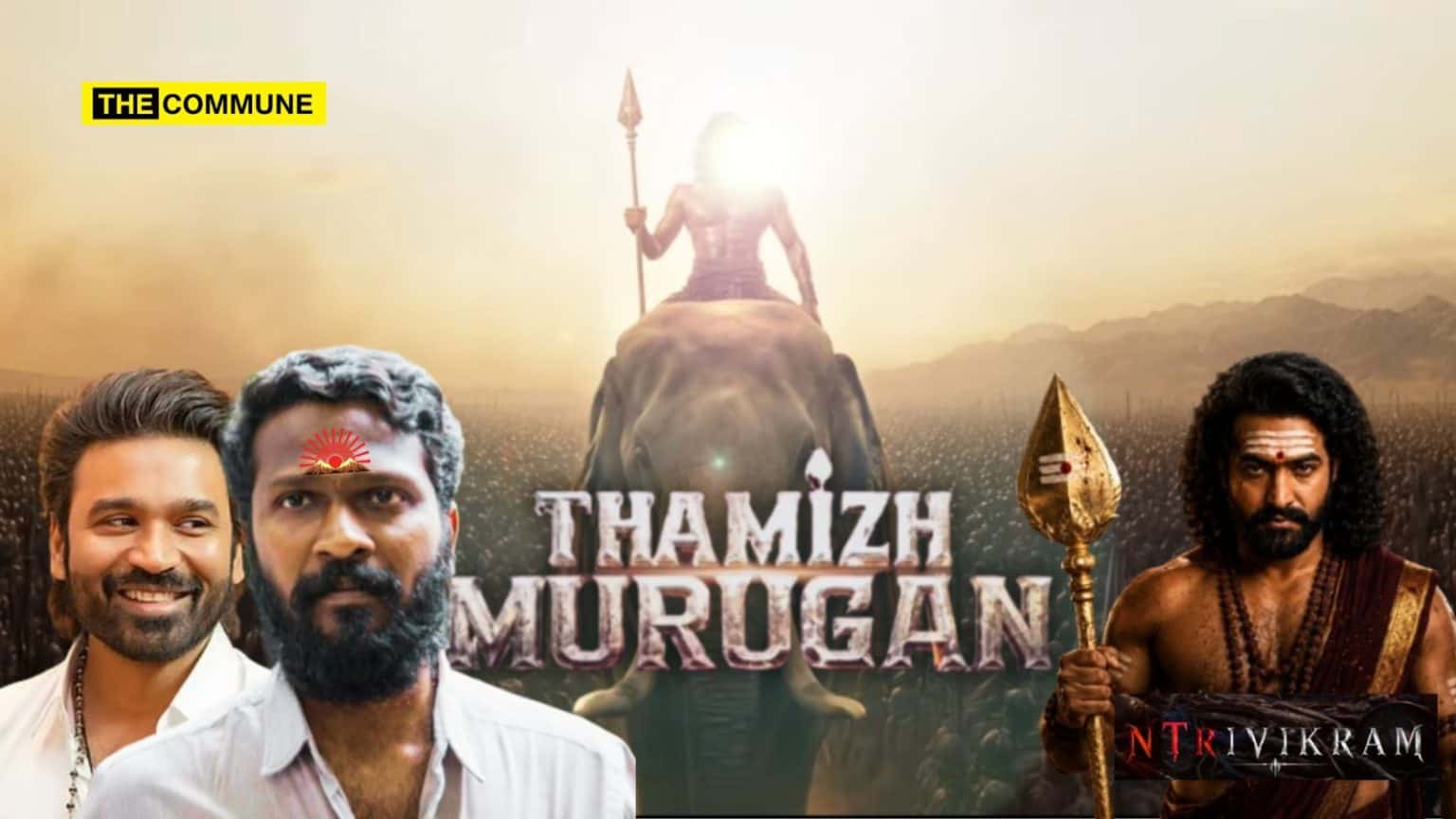
A reported film project titled Tamizh Murugan has placed a familiar question before Dharmic audiences: when cinema draws upon a revered deity, does it illuminate a living tradition or reshape it to serve a narrower political narrative?
The available source material is brief and openly polemical. A responsible reading therefore requires separating what Hindu Post reports from the larger cultural questions that viewers can assess for themselves.
What the limited report actually says
Hindu Post relays a July 11, 2026 article credited to The Commune. It reports that actor Dhanush and filmmaker Vetri Maaran are associated with Tamizh Murugan. The source contrasts this project with a Telugu film involving Jr NTR that it describes as a grand treatment of Murugan as the divine commander of celestial forces.
The source alleges that Tamizh Murugan will advance a secular Dravidian interpretation that diminishes or denies the deity’s divinity. However, the supplied material contains no plot summary, dialogue, production statement, or completed-film evidence with which readers could test that characterization. Its prediction about the film’s reception is likewise opinion, not an established outcome. Those limits matter because the headline also uses strongly adversarial labels that should not be repeated as verified descriptions.
Murugan’s many names reveal a shared sacred geography
The most substantial point in the source concerns Murugan’s reach beyond any single linguistic identity. It notes that devotees know the deity as Kartikeya in North India, Subrahmanya in Karnataka, Kumara Swamy in Andhra Pradesh, Skanda in Sanskrit literature, and Murugan in Tamil Nadu. It also describes a devotional geography extending from the Himalayan region to Tiruchendur in the south.
These names are not competing ownership claims. They demonstrate how Sanatana Dharma permits regional language, temple custom, poetry, and sectarian emphasis to give distinctive expression to a connected sacred inheritance. Tamil devotion enriches Murugan’s identity without confining him to Tamil Nadu; Sanskrit, Kannada, Telugu, and northern traditions likewise broaden rather than erase that inheritance.
The same principle offers a wider Dharmic lesson. Hindu, Buddhist, Jain, and Sikh traditions retain real theological differences, yet each has been sustained through ethical discipline, sacred memory, teacher lineages, community institutions, and the civilisational landscape of Bharat. Unity does not require sameness. It requires resisting attempts to turn language, region, or sampradaya into a reason for cultural estrangement.
The real test is how cinema frames the sacred
A film may reinterpret mythology without automatically disrespecting it. Indian storytelling has always allowed multiple retellings, visual styles, and devotional moods. The more useful question is whether an adaptation engages honestly with the tradition’s own understanding of its deity or merely borrows familiar imagery while emptying it of sacred meaning.
Audiences can examine whether Murugan is treated as a living object of worship, a dramatic character, a cultural emblem, or only a vehicle for contemporary ideology. They can also ask whether regional pride is presented as part of a larger Dharmic civilisation or constructed through opposition to it. This approach is more rigorous than declaring either success or failure before sufficient material is available.
Key takeaways
- Hindu Post reports that Dhanush and Vetri Maaran are associated with a project titled Tamizh Murugan.
- The source contrasts it with a Murugan-centered Telugu production involving Jr NTR.
- Claims about the new project’s ideological treatment remain the source’s interpretation because the supplied material offers no detailed plot evidence.
- Murugan’s regional names express a connected Hindu sacred tradition rather than mutually exclusive identities.
What audiences should look for next
Trailers, official statements, and eventually the film itself would provide a fairer basis for judging Tamizh Murugan. Until then, criticism is strongest when it defends sacred continuity without treating speculation as fact.
Whatever cinematic form emerges, Murugan’s enduring presence across languages and regions cannot be reduced to one production or political frame. Dharmic audiences can meet future adaptations with discernment, confidence, and a commitment to the civilisational bonds that regional creativity is capable of strengthening.
Inspired by this post on Hindu Post.
