
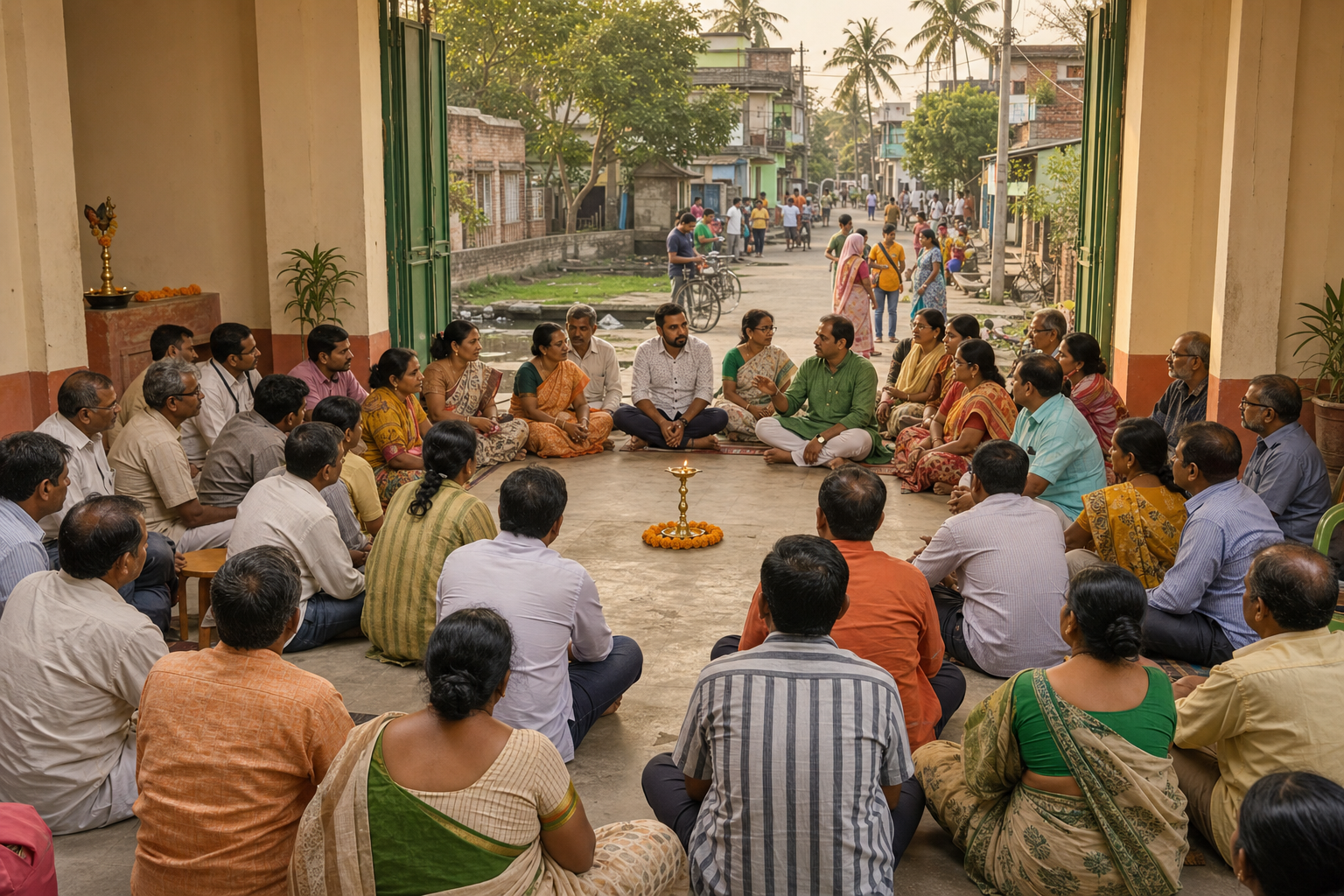
A Hindu Rashtra-Jagruti meeting in North 24 Parganas offers a useful case study in the difference between assembling around a civilizational idea and building a durable civic program. The supplied article reports that the Hindu Rashtra Samanvay Samiti convened the gathering to clarify its objectives and discuss a path forward for Hindu Rashtra.
The larger question is what should follow such a meeting. A credible answer requires clear definitions, lawful methods, locally relevant work and public accountability. It also requires care with the evidence: the source packet contains one identifiable article rather than several independent accounts, so the reported event details cannot be treated as independently corroborated.
What the report establishes, and what remains unknown
The factual core is narrow. According to the supplied DharmaRenaissance Blog article, a Hindu Rashtra-Jagruti meeting took place in North 24 Parganas under the auspices of the Hindu Rashtra Samanvay Samiti. Its stated focus was the committee’s objectives and the future direction of work toward Hindu Rashtra.
The article does not provide the date, exact venue, attendance, names of speakers, adopted resolutions or an implementation schedule. Those omissions matter. Without them, the meeting’s size, representativeness and formal decisions cannot responsibly be inferred. The event can be analyzed as an expression of organized intent, but not yet as evidence of a district-wide mandate or a completed program.
The article also refers to Hindu Janajagruti Samiti’s coverage of the 2024 Vaishvik Hindu Rashtra Mahotsav. In that earlier account, participating organizations reportedly intended to coordinate throughout the year through the Hindu Rashtra Samanvay Samiti and develop a connected Hindu organizational ecosystem. Because that earlier report was not supplied separately, it provides second-hand context for the committee’s emphasis on coordination rather than independent confirmation of what the North 24 Parganas meeting decided.
Key takeaways
- The confirmed event record is limited to its location, organizer and broad purpose; its scale and resolutions remain undocumented in the supplied material.
- Hindu Rashtra must be defined in institutional and ethical terms if it is to guide civic action rather than remain an open-ended slogan.
- Coordination becomes meaningful when it produces cultural education, legal literacy, public service, responsible leadership and measurable follow-through.
- Work in North 24 Parganas would need local adaptation, peaceful methods and safeguards for dignity, conscience and diversity.
The transition from an assembly to civic infrastructure

A public meeting can generate attention and shared purpose, but civic mobilization depends on repeatable institutions. The supplied article proposes several connected fields of work: cultural literacy, coordination among Hindu institutions, civic and legal education, seva, cooperation among Dharmic traditions and leadership development. These are analytical recommendations in the article, not reported resolutions of the meeting.
Together, however, they describe a coherent sequence. Cultural literacy gives participants a basis for distinguishing scripture, history, collective memory and political interpretation. Legal literacy helps channel concerns through documentation, representations, administrative procedures and judicial remedies. Coordination connects temples, service groups, educational bodies, cultural organizations and neighborhood networks without requiring them to surrender their autonomy.
Seva supplies the public-interest test. Tutoring, heritage conservation, assistance during emergencies, environmental work and support for people in distress are among the forms of service suggested by the article. Their civic credibility would depend on competence and equal human concern, not on making assistance conditional upon religious or political agreement.
Leadership development links these activities over time. A movement dependent on a few prominent individuals remains fragile. Documented responsibilities, mentoring, succession planning and substantive participation by women, younger adults, scholars, religious figures, professionals, artisans and local volunteers can turn episodic enthusiasm into distributed capacity. These practices also make it easier to determine who is responsible for decisions and outcomes.
Hindu Rashtra requires a rights-bearing definition
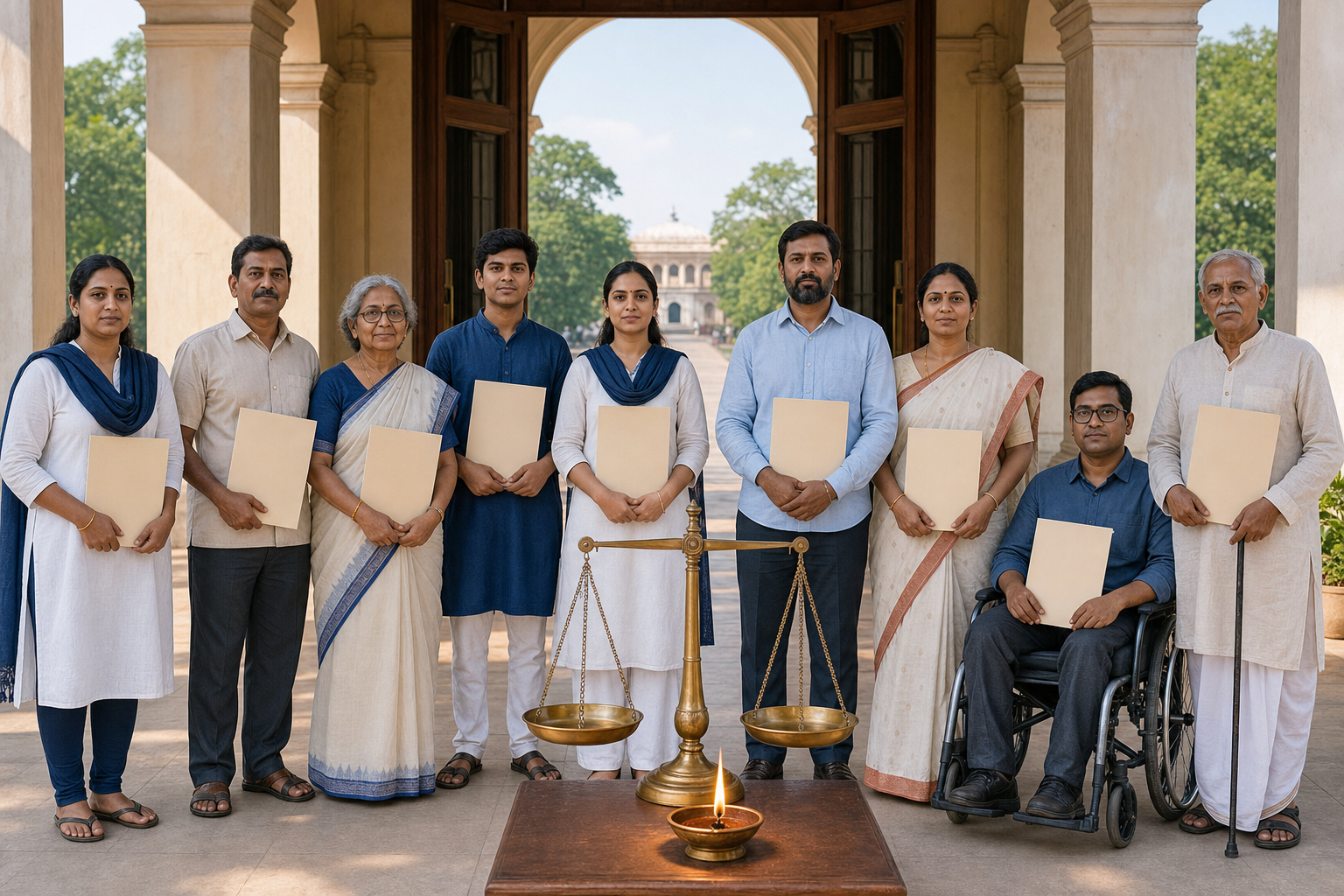
The term Hindu Rashtra does not carry one universally agreed institutional meaning. As the source article observes, it may be used for civilizational identity, public recognition of Hindu heritage, governance influenced by Dharma, institutional reform, constitutional change or an explicitly religious conception of the state. Those possibilities are not interchangeable.
A cultural initiative celebrating Hindu inheritance raises different questions from a proposal to alter state institutions. Civic mobilization therefore needs to state what it affirmatively seeks: which institutions would change, which would remain, what rights every citizen would possess, how power would be limited and how freedom of conscience and internal diversity would be protected. Without such precision, supporters and critics can attach incompatible meanings to the same phrase.
The article offers an ethical interpretation grounded in truth, service, self-discipline, justice, accountable authority, cultural stewardship and care for vulnerable people. This formulation is best understood as a proposed standard for Dharmic public conduct, not as proof of consensus about a political model. Its practical value lies in making conduct testable: agitation that abandons truthfulness, legal restraint or human dignity would contradict the ethical principles invoked to justify it.
Unity also cannot simply mean uniformity. Hindu traditions encompass different philosophical schools, sampradayas, rituals, languages and regional practices. The article further advocates cooperation with Buddhist, Jain and Sikh communities while preserving their distinct voices and institutional identities. Shared heritage work or ethical initiatives may create common ground, but partnership remains credible only when it does not erase meaningful differences.
A locally adapted and publicly accountable Bengal model
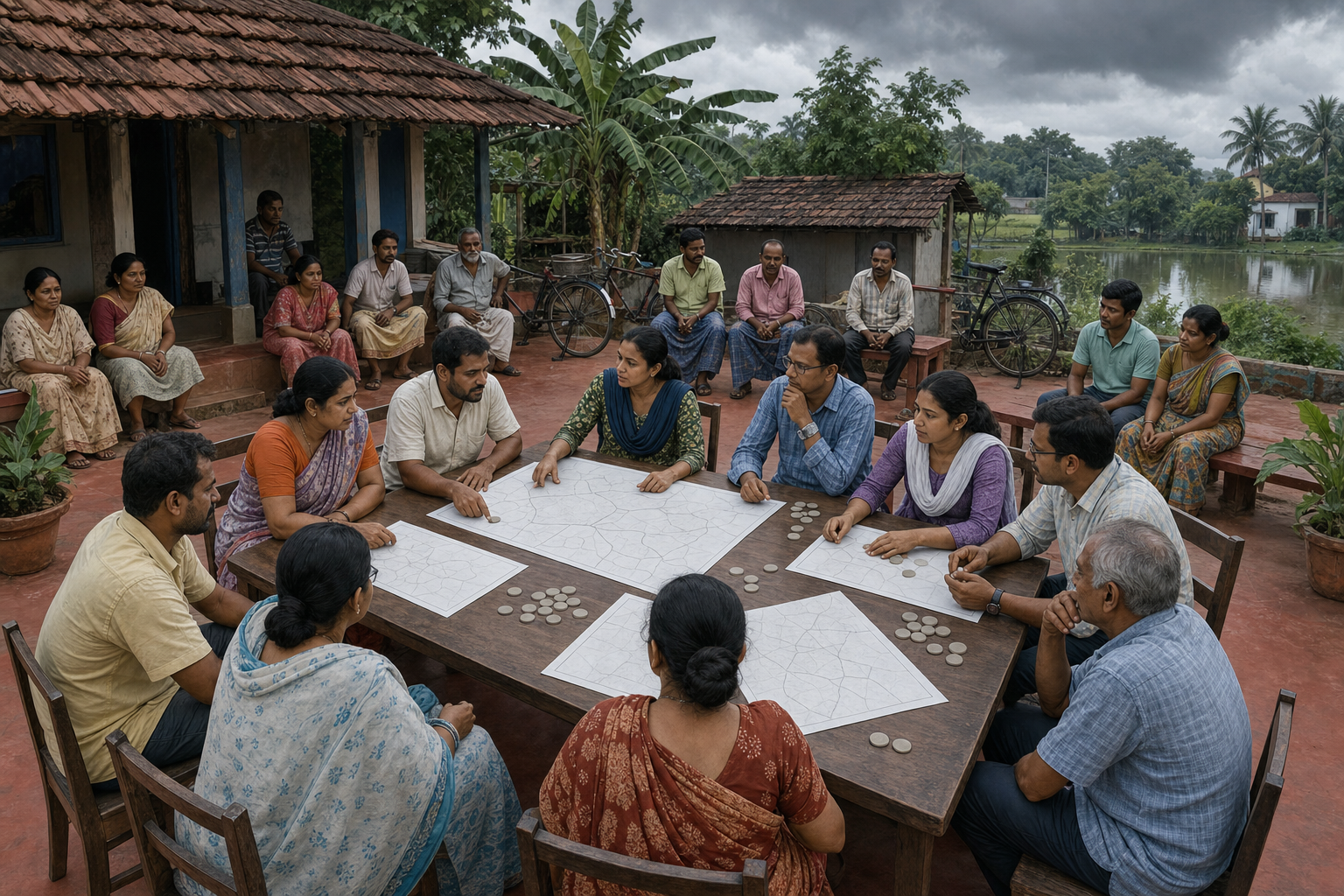
The source article, drawing on official district descriptions, portrays North 24 Parganas as a varied district of five subdivisions containing urban and industrial areas, agricultural plains and riverine zones. It also notes the district’s proximity to Kolkata and its international boundary with Bangladesh. These geographical facts support a practical conclusion: one standardized mobilization format is unlikely to fit every locality. The border setting is relevant context, but it is not, by itself, evidence of a security threat or social grievance.
Locally adapted work could use Bengali-language educational material, address different schedules and livelihoods, and cooperate with institutions already trusted in particular communities. A densely populated urban area, an agricultural locality and a riverine settlement may require different meeting formats, service priorities and communication channels even when the broad civilizational objective is shared.
Future mobilization can be assessed through a straightforward accountability test. Its definition of Hindu Rashtra should be publicly intelligible. Its methods should be peaceful and legally informed. Claims should be supported by records rather than rumor. Responsibilities and decision-making procedures should be visible. Service should create recognizable public benefit, and cooperation should respect both internal Hindu plurality and the dignity of people outside the movement.
Progress would become easier to evaluate if subsequent gatherings published their charters, resolutions, responsible committees and review schedules. Until such documentation is available, the North 24 Parganas meeting is best regarded as a reported starting point. Its lasting significance will depend on whether its stated direction develops into disciplined, transparent and constitutionally responsible civic practice.