
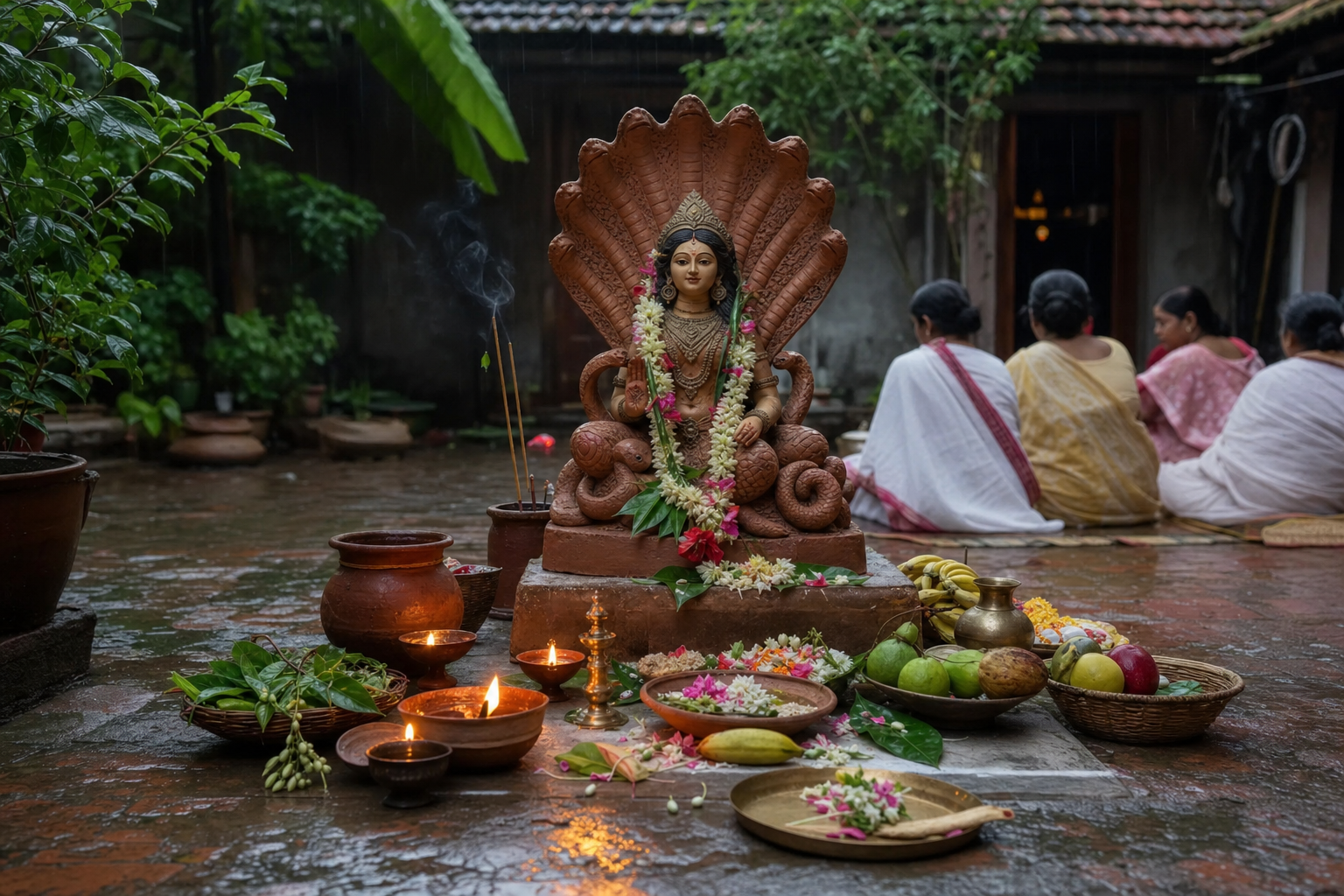
Manasa Devi Puja in 2026 is best understood as a monsoon worship cycle shaped by lunar tithis, Bengali solar months and inherited family customs. The supplied DharmaRenaissance Blog article identifies 17 August as the clearest common date, while also documenting observances from July through the Bhadro closing rites in September.
This guide brings the calendar, regional variations, sacred narratives and practical considerations together so that devotees can distinguish a principal festival date from the wider seasonal tradition.
Key takeaways
- The source identifies Monday, 17 August 2026, associated with Nag Panchami, Manosha Puja and Ashtanag Puja, as the most dependable shared reference point.
- Wednesday, 16 September 2026, is presented as a principal Bhadro closing observance in traditions connected with Bhadra Sankranti, Ranna Puja or Arandhan.
- Additional dates in July, August and September represent stages in a seasonal cycle or particular household customs, not competing versions of one standardized festival.
- Because lunar tithis, Bengali solar dates and regional conventions do not always align, a location-specific panjika and the family’s own tradition should determine the final schedule.
The 2026 calendar is a sequence, not a single day
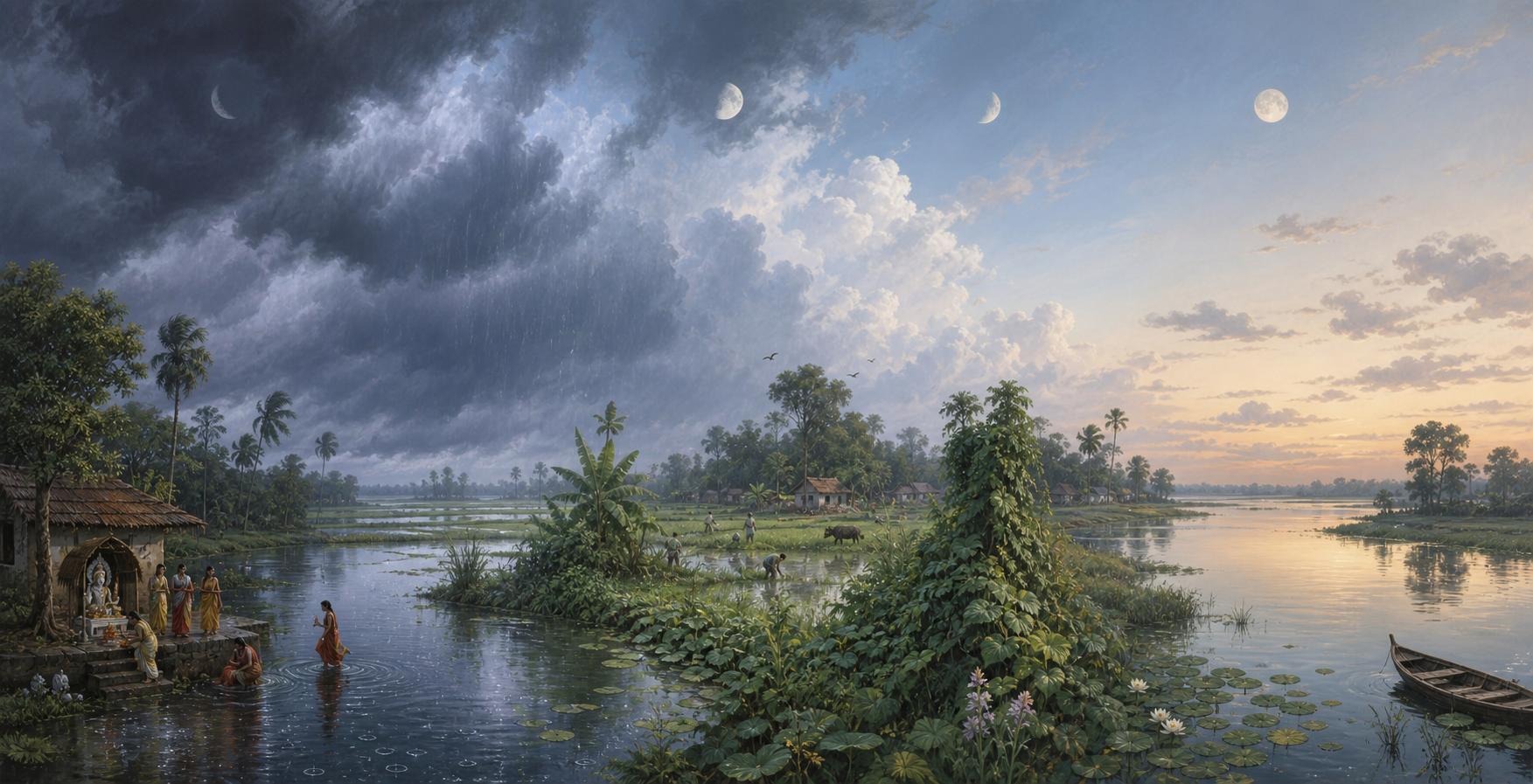
The source article reports several dates for Manasa worship in 2026. Read together, they describe a progression across Srabon and Bhadro rather than five interchangeable choices for the same ceremony.
| Reported date | Calendar or ritual association | How to interpret it |
|---|---|---|
| 17 July 2026 | Listed separately by the Government of India’s Positional Astronomy Centre as the beginning of Manasa Puja in Bengal, according to the source article | Possible formal commencement of the worship season |
| 18 July 2026 | Manosha Puja; identified in the source schedule as 1 Srabon 1433 | First-Srabon household or regional observance |
| 3 August 2026 | Manosha Puja; 17 Srabon 1433 | Intermediate Shraban observance maintained in some traditions |
| 17 August 2026 | Nag Panchami, Manosha Puja and Ashtanag Puja; 31 Srabon 1433 | Clearest principal reference date in the supplied account |
| 2 September 2026 | Manosha Puja; 16 Bhadro 1433 | Continuation of the worship cycle into Bhadro |
| 16 September 2026 | Bhadro closing observance associated in some traditions with Bhadra Sankranti customs | Seasonal conclusion rather than another Nag Panchami date |
For Kolkata, the article cites a commonly used drik calculation placing Shukla Panchami from approximately 4:52 p.m. on 16 August until 5:00 p.m. on 17 August. It cautions that exact timings can shift with location and calculation method.
The article also flags an internal inconsistency concerning 11 September. Its detailed source list labels that date for Monosha Puja and Ashtanag Puja, while its summary gives 16 September for the Bhadro conclusion. The article reports that independent panchang calculations place Amavasya at sunrise in Kolkata on 11 September and therefore treats the 11 September entry as a likely editorial problem. Devotees should not adopt that date without confirmation from a trusted local panjika, temple or family purohit.
Why location and family custom can change the date
A tithi does not follow the midnight-to-midnight boundaries of a civil date. As the source explains, it is based on each 12-degree increase in the angular separation of the Moon and Sun. It may begin or end at any hour, cross midnight, or prevail at sunrise on one date while occupying the preferred worship period on another.
Different observances can also rely on different calendrical rules. Srabon and Bhadro are Bengali solar months, whereas Nag Panchami is fixed by a lunar Panchami tithi. A household practice attached to 1 Srabon, 17 Srabon, Panchami or Bhadra Sankranti is therefore not necessarily calculating the same event in a different way; it may be preserving a distinct point within the larger Manasa season.
Regional panjikas can further differ in astronomical parameters, sunrise rules and ritual conventions. A Kolkata calculation should not automatically be transferred to another Indian city or to a diaspora community. Families outside India must also decide whether their tradition follows the tithi at their present location or retains the customary date used by their community of origin. That decision belongs to the relevant household, temple or sampradaya rather than to a universal online timetable.
The goddess and the narrative world of Manasa Puja
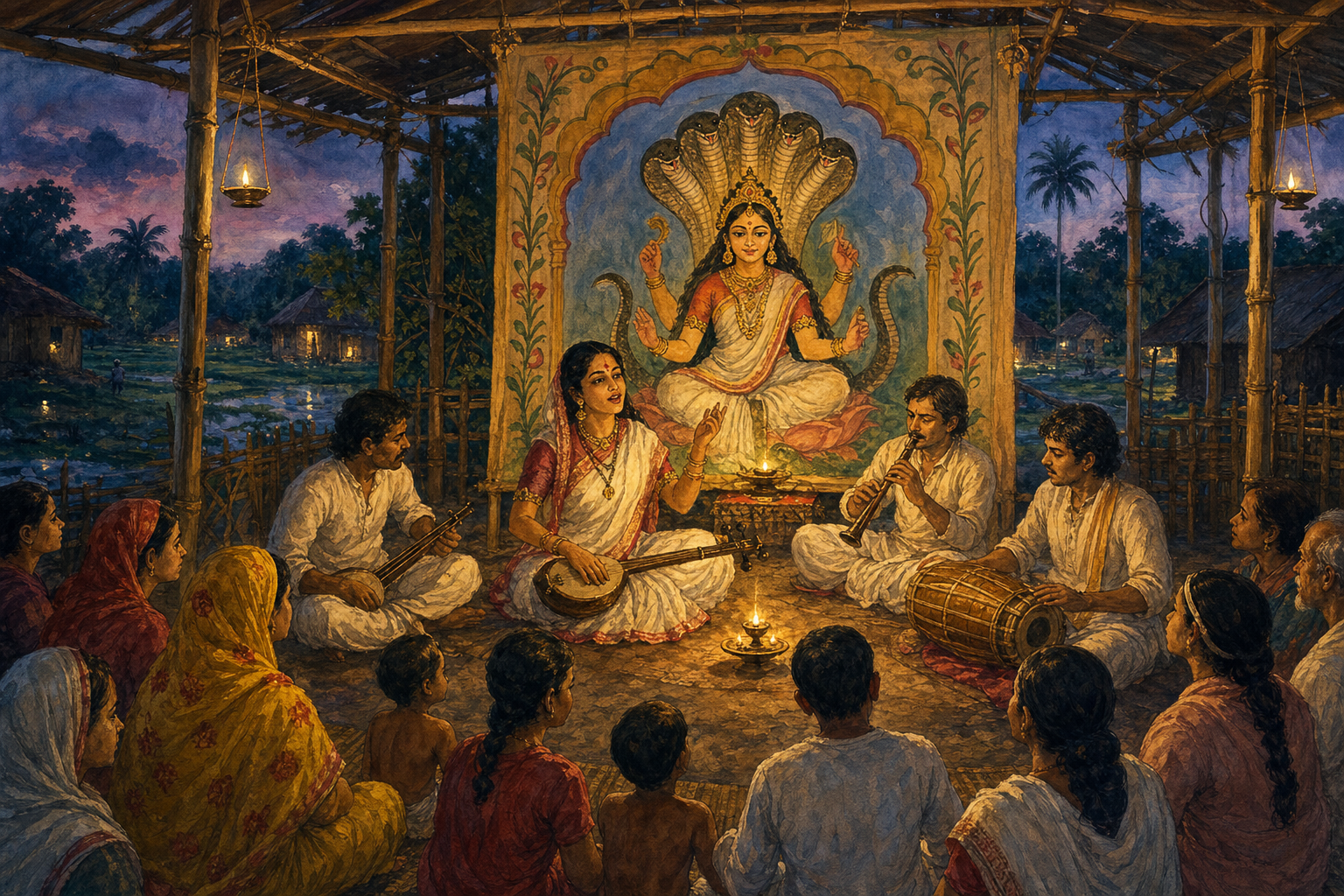
Known as Manasa, Manasha, Manosha or Monosha, and in some settings as Bishahari or Padmavati, the goddess is especially revered in Bengal and Assam, with related traditions reported in Jharkhand, Bihar and Odisha. The source describes her devotional roles as sovereign over serpent powers and poison, protector of children and families, and giver of fertility, prosperity and agricultural well-being.
Her sacred identity cannot be reduced to one uniform genealogy. Later Sanskritic accounts associate Manasa with Jaratkaru, describing her as the sister of Vasuki, wife of the sage Jaratkaru and mother of Astika, who ends King Janamejaya’s serpent sacrifice. Bengali Manasamangal traditions often place her within a different narrative framework connected with Shiva. The source presents these as parallel layers in the development of the tradition rather than details that must be forced into a single biography.
The Manasamangal literature gives the worship much of its enduring emotional vocabulary. In its best-known narrative pattern, the merchant Chand Sadagar refuses to recognize Manasa, and his resistance brings devastating losses. His youngest son, Lakhindar, dies from a snakebite on his wedding night despite attempts to secure the bridal chamber.
Behula, Lakhindar’s bride, will not accept despair as the final answer. She travels with his body, withstands trials and appeals to the divine assembly. Her perseverance leads to the restoration of Lakhindar and Chand’s other sons. Chand eventually worships Manasa, although many versions preserve his reluctance by having him make the offering with his left hand.
These stories circulated through recitation, song, dramatic performance and painted scrolls as well as written texts. Manasa Puja consequently joins theology to vernacular literature and family memory: the goddess’s recognition, Chand’s resistance and Behula’s fidelity become ways of thinking about vulnerability, endurance and accommodation with powers beyond human control.
Observing the festival without flattening its traditions
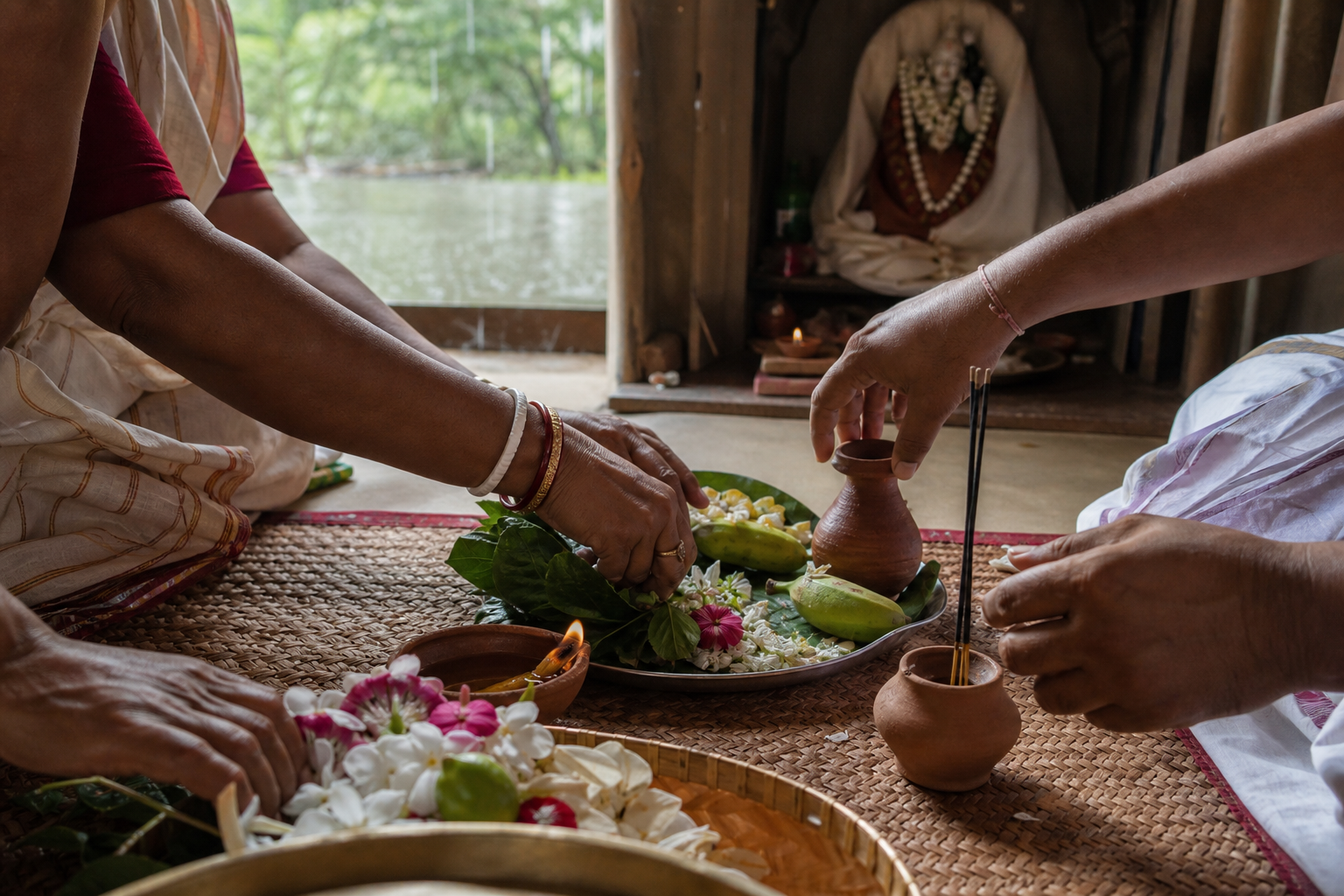
A responsible plan begins by identifying what the household is actually observing: Nag Panchami, a fixed Srabon date, a recurring family vrata or the Bhadro conclusion. The relevant date and worship period can then be checked against a location-specific panjika and confirmed through the family’s established religious authority.
The source associates the wider season with vrata, sacred storytelling, song and shared food. It also notes that traditions surrounding Bhadra Sankranti, Ranna Puja or Arandhan may arrange cooking, fasting, worship and concluding rites differently. This variation makes a supposedly universal ritual recipe less useful than careful continuity with the practice of one’s household or regional community.
The monsoon setting is central to the observance’s meaning. In landscapes marked by rain, swollen waterways, cultivated fields and greater encounters with snakes, worship turns environmental danger into disciplined reverence. Its protection theology, agricultural associations and family-centered rituals all arise within that seasonal setting.
As the 2026 monsoon approaches, households can prepare most faithfully by settling their calendrical convention early and allowing inherited practice, local conditions and trusted guidance to shape the observance.