
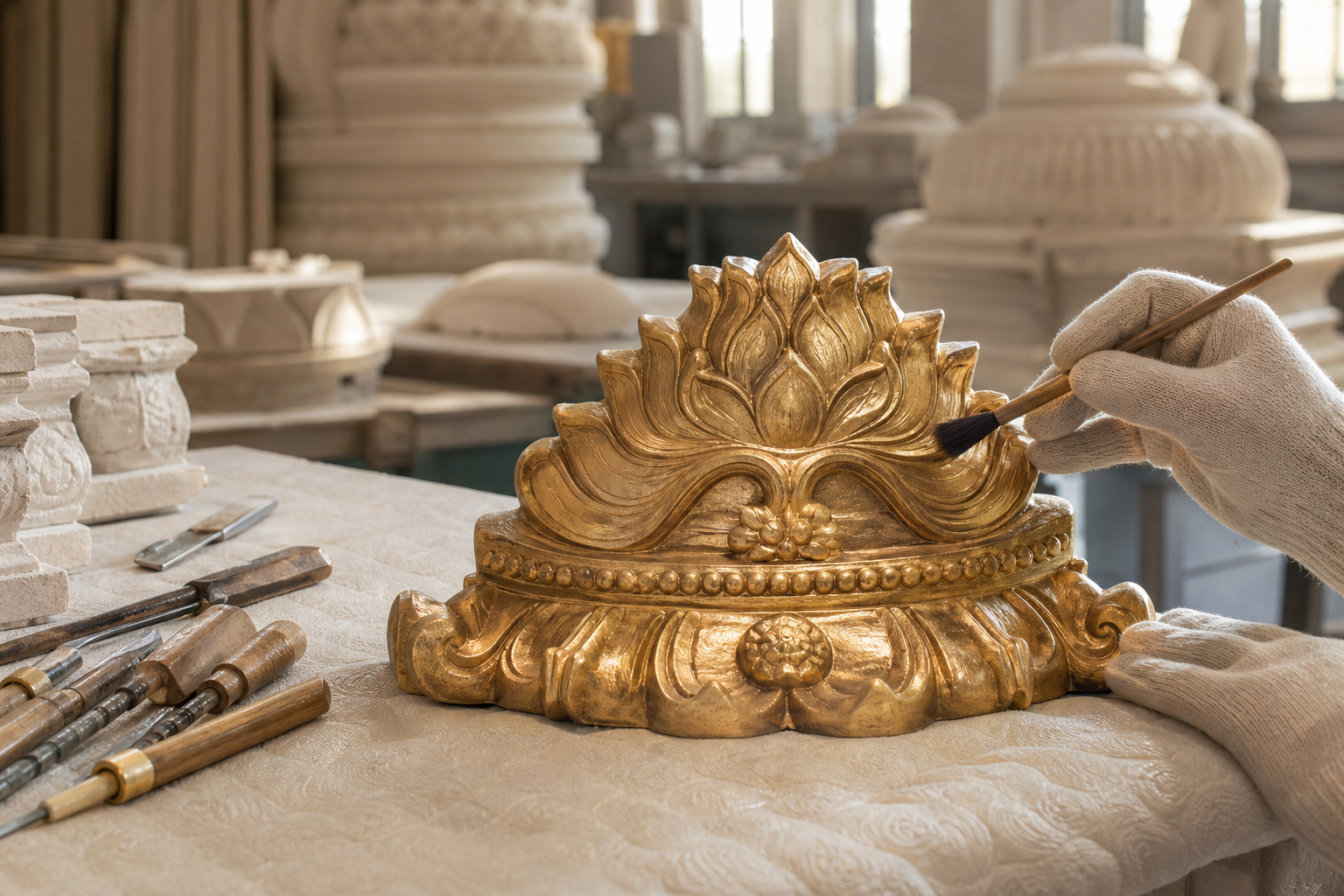
The gold-covered ornaments emerging from TOVP’s Gauranga Factory offer a close-range view of how sacred architecture is made. Their significance lies not only in the precious finish, but in the sequence of preparation, judgment and handwork required before a decorative element can become part of a monumental temple.
The supplied report documents only a limited portion of that process. Read carefully, however, it helps distinguish what has been confirmed at the workshop from the broader technical questions that will determine how the craftsmanship looks, performs and can eventually be conserved.
From the monumental temple to the workshop bench
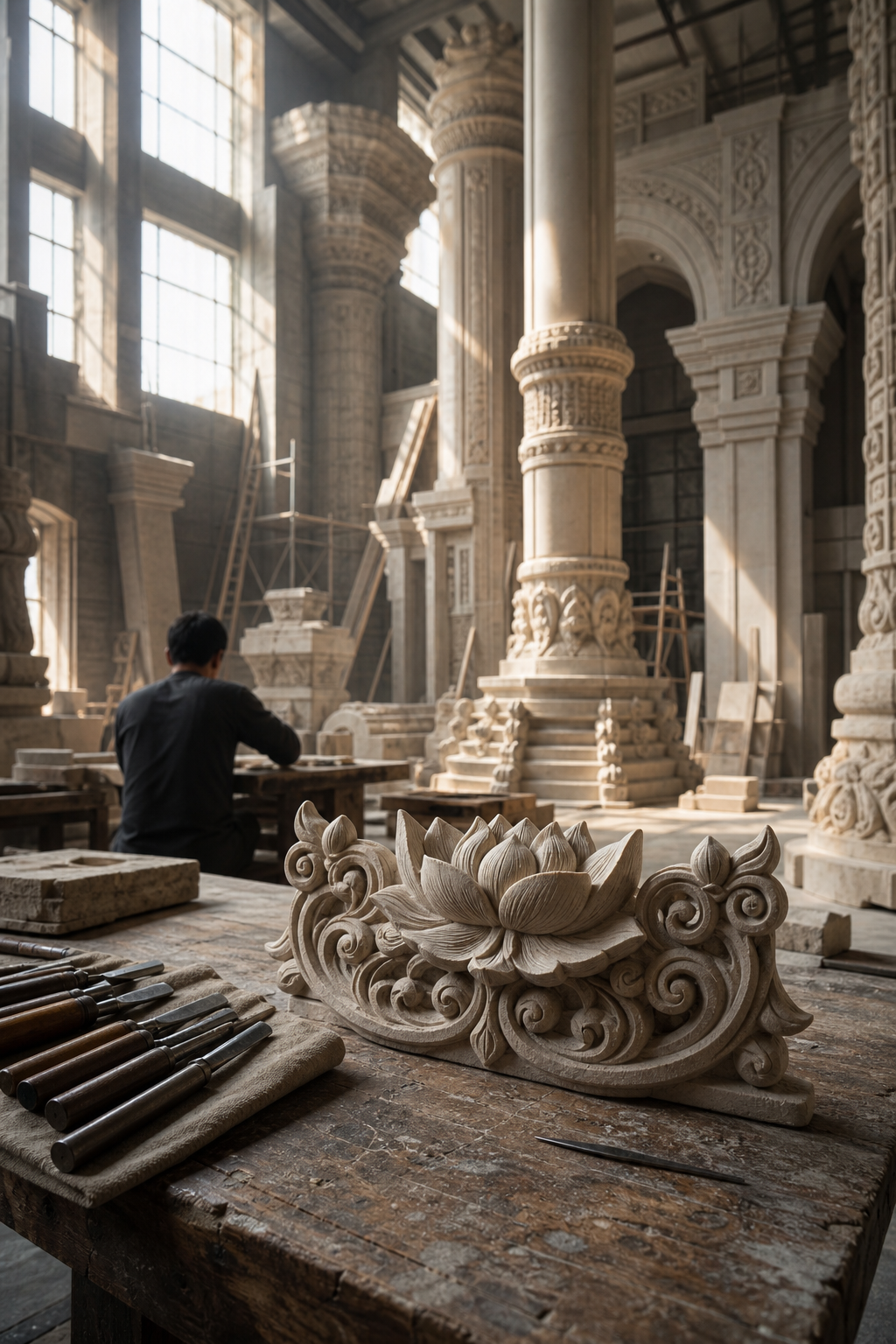
According to the DharmaRenaissance Blog report, a July 13, 2026 TOVP construction update showed artisans applying intricate gold leaf by hand to ornaments and decorative elements at the Gauranga Factory. The report presents this work as both technically exacting and connected to the devotional purpose of building a sacred space.
This workshop perspective changes how the Temple of the Vedic Planetarium can be understood. The project in Sri Mayapur, West Bengal, is described by the source as an ISKCON temple, educational complex and planetarium whose larger program brings worship together with presentations of Vedic philosophy, cosmology, history and culture. Its visual character therefore depends on more than the scale of its domes and interiors. It also depends on the quality of individual surfaces that visitors may encounter through changing light, ritual use and close observation.
The source confirms that gilding work is under way, but it does not identify the gold’s karat or alloy, the underlying materials, the adhesive system, the quantity being produced or the ornaments’ eventual installation sites. It also supplies no overall completion percentage for the temple. Those boundaries are important: the update establishes the presence of specialized craftsmanship, not a complete technical specification or a comprehensive measure of construction progress.
The quality of gold begins beneath the gold
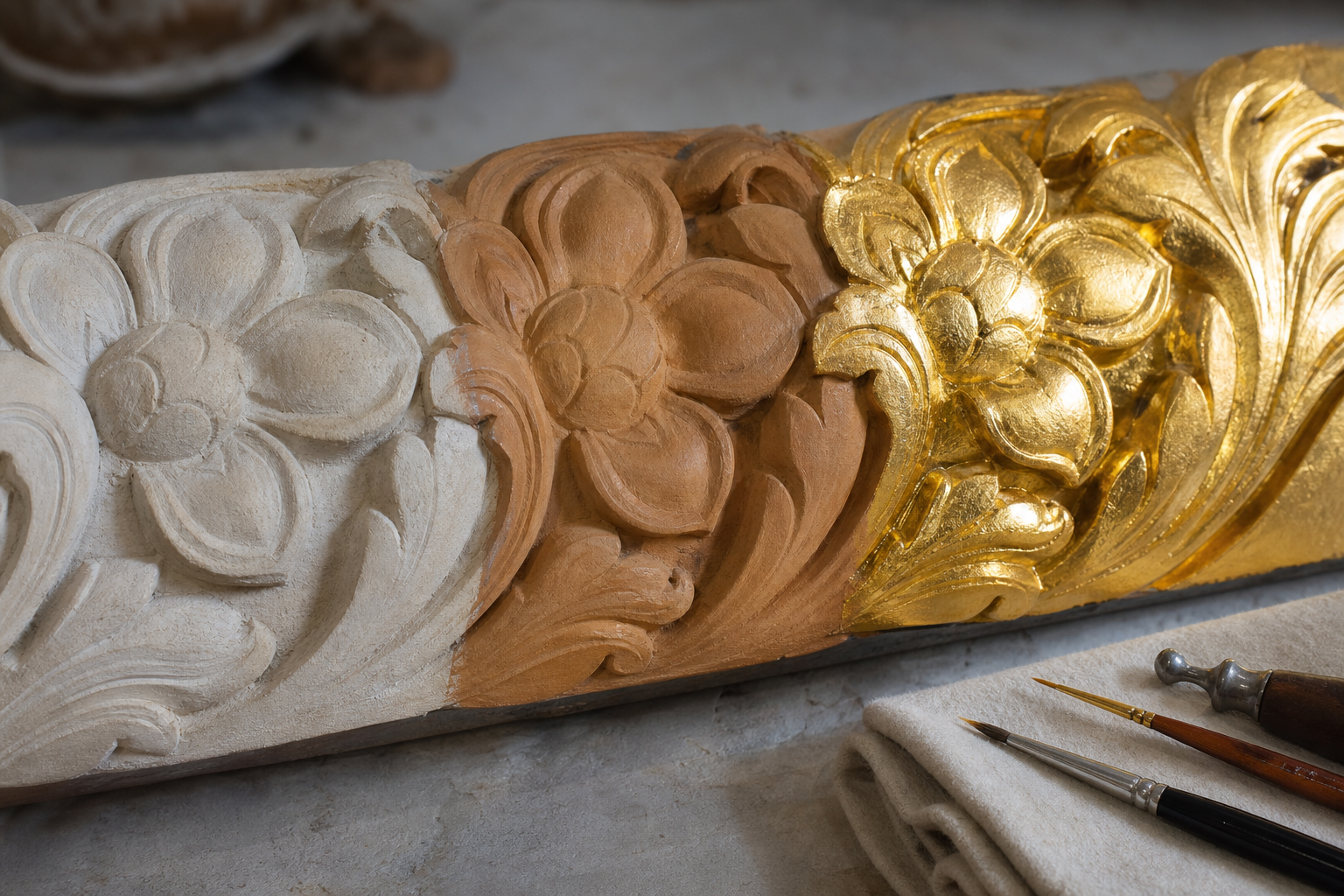
In general craft terminology, gilding places extremely thin metal leaf over a prepared support. It is distinct from making an object out of solid gold, coating it with metallic paint or depositing metal through a plating process. Because leaf follows the contours beneath it, it can reproduce fine ornamentation with great clarity. The same property also means that it may reveal scratches, pores, seams, dust and uneven tooling rather than conceal them.
Surface preparation is consequently part of the visible artistry. A sound gilding system ordinarily requires the substrate to be stable, sufficiently cured and free of oils, loose material and contamination. Defects may need to be filled and leveled before compatible sealers, primers or grounds are introduced. Fine sanding and cleaning can determine whether the completed surface reads as coherent gold or as a collection of small imperfections.
The correct preparation varies with the object. Wood moves as moisture conditions change; metal can corrode beneath an apparently intact finish; porous mineral materials can carry moisture or salts; and composite ornaments may join materials that expand at different rates. These are established considerations in architectural finishing, not confirmed descriptions of the unidentified substrates shown in the Gauranga Factory update.
The layer immediately below the leaf can also influence its appearance. A warm-toned ground, for example, may affect the perceived depth of the finished gold and make microscopic joints less visually disruptive. That optical role does not replace complete coverage or sound adhesion. It demonstrates instead that the finished color is the result of a system, not the leaf alone.
Artisanship resides in timing, touch and reflected light

The hand application reported at the factory requires control over materials that are easily displaced or damaged. The work area must limit dust and uncontrolled air movement, while tools and hands must be managed so that the leaf is neither torn nor contaminated. Curves, recesses and raised details add another challenge because coverage must remain continuous across surfaces that cannot be approached from a single angle.
Adhesive timing is equally consequential. In oil-size and other adhesive gilding systems, leaf is laid when the prepared surface has reached a suitable degree of tack. Application that is too early can produce a dull, irregular or flooded appearance; application that is too late can leave weakly attached areas or gaps. Traditional water gilding follows a different material logic and can permit highly reflective burnishing on suitable grounds. The source does not disclose which method the TOVP artisans are using, so the distinction explains the possible craft choices without assigning one to the project.
Inspection completes the act of application. An ornament can appear adequately covered from one viewpoint while exposing seams, holidays or changes of sheen when light moves across it. Consistent sacred ornament therefore depends on shared standards: how overlaps are handled, which marks require repair, what level of tonal variation is acceptable and how completed pieces are protected before installation. Repetition across many elements makes disciplined quality control as important as the virtuosity of any single artisan.
Key takeaways
- What is documented: The supplied report says artisans at the Gauranga Factory are hand-applying gold leaf to TOVP ornaments and decorative elements.
- What remains unspecified: The report does not publish the leaf composition, substrate, adhesive, coating system, production quantity or final placement.
- Why preparation matters: Thin leaf reproduces the condition of the surface below it, making filling, sealing, priming and cleaning integral to the final appearance.
- Why hand skill matters: Tack, air movement, tool pressure, coverage around complex forms and inspection under varied light can all affect the result.
- Why records matter: Material and process documentation would help future custodians diagnose changes and make compatible repairs.
Sacred intent extends into stewardship
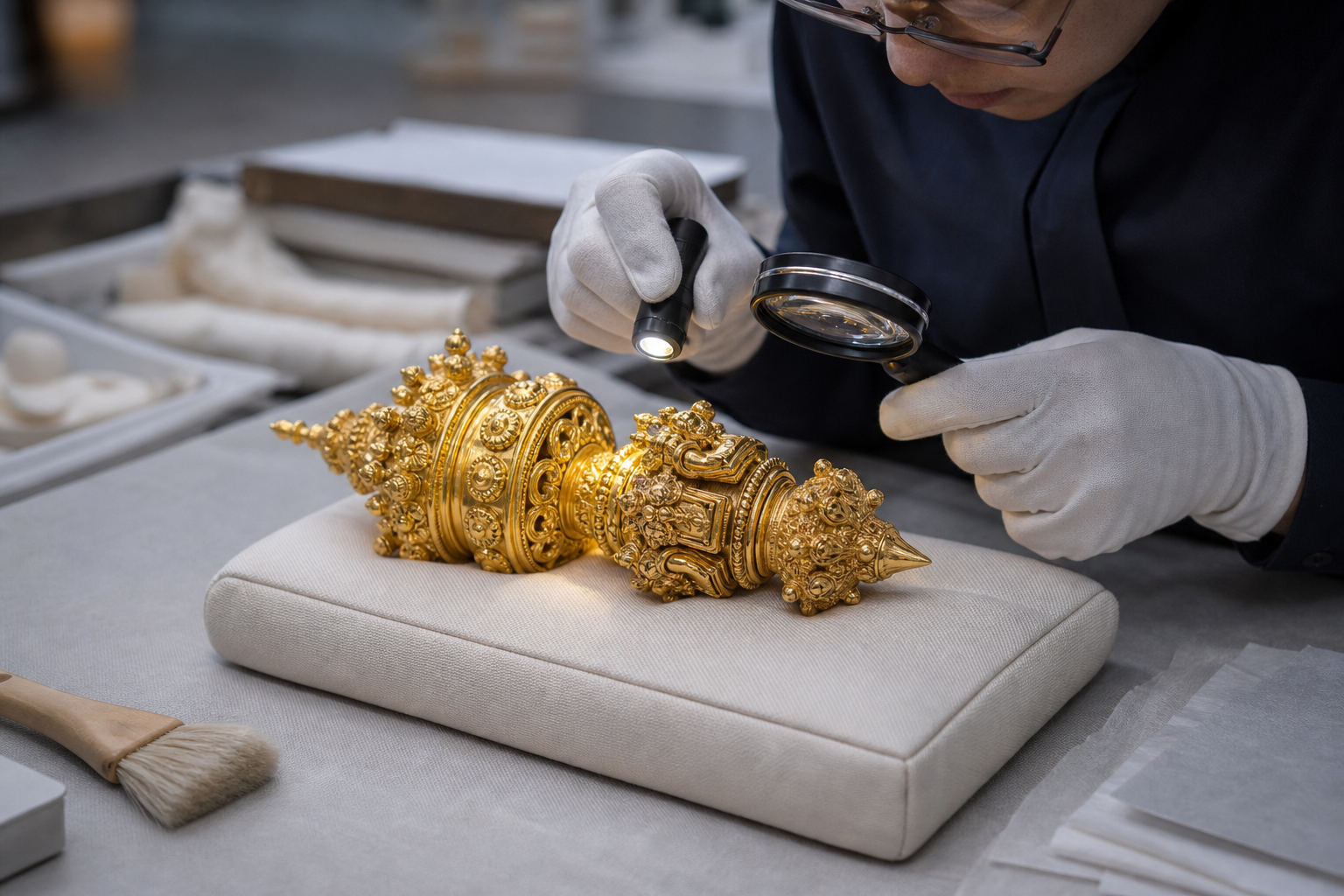
Devotional purpose and technical accountability are not competing interpretations of this work. In a sacred building, careful fabrication can itself express respect for the place being created. At the same time, the durability of that expression depends on decisions about exposure, handling, cleaning and eventual maintenance. An ornament installed indoors will face different conditions from one exposed to weather, and the source does not identify which environment awaits the pieces shown.
A useful project record would connect each ornament to its substrate, preparation layers, leaf batch, adhesive or size, test panels, application conditions, installers and repair history. Photographs taken before, during and after gilding could preserve information that becomes invisible once the gold is complete. Such records would turn workshop knowledge into an institutional resource rather than leaving future conservators to reconstruct the system from appearance alone.
Future TOVP updates could make the craftsmanship more legible by following selected elements from preparation through gilding, transport and installation. Connecting the artisans’ bench-scale decisions to the ornaments’ final architectural setting would show how devotional labor, material knowledge and long-term stewardship converge in the completed temple.