
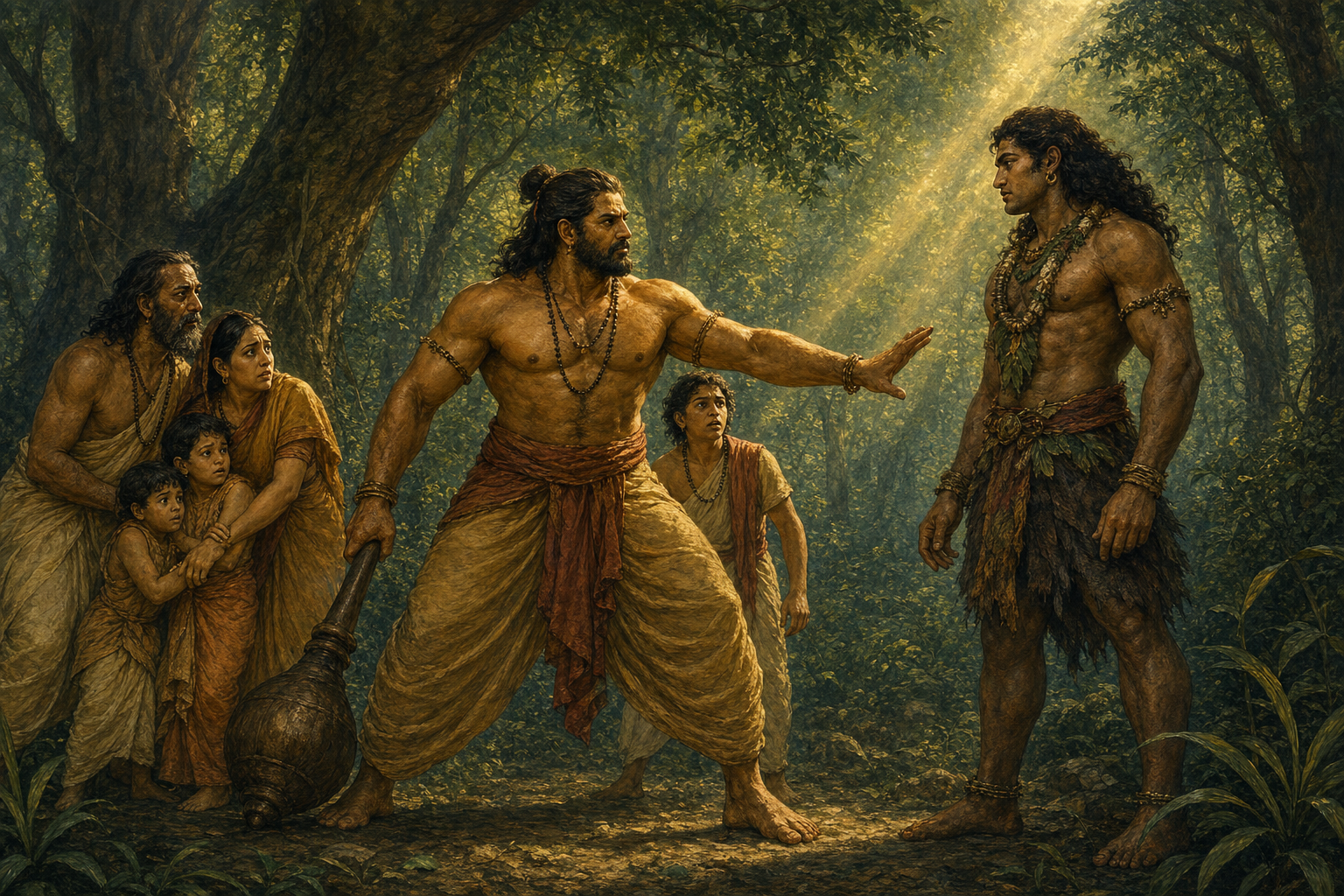
The confrontation between Bhima and Ghatotkacha is most illuminating when read as a carefully designed dramatic test, not as an overlooked episode of the Sanskrit Mahabharata. Madhyama-vyayoga takes relationships established by the epic and places them inside a new crisis involving coercion, sacrifice, parental authority, and recognition.
This distinction clarifies the play’s achievement. The epic supplies the bond between father and son; the drama asks what happens when filial loyalty is detached from moral judgment and paternal responsibility must extend beyond one’s biological family.
The first distinction: epic relationship, dramatic encounter
The supplied DharmaRenaissance account emphasizes that Bhima’s confrontation with Ghatotkacha belongs to Madhyama-vyayoga, a one-act Sanskrit heroic drama traditionally attributed to Bhāsa. It is not narrated as such in the Mahabharata. Preserving that boundary does not make the play less authoritative as literature; it shows how epic characters could acquire new ethical and emotional possibilities through performance.
According to the article, the relationship behind the drama begins in the Adi Parva. After the Pandavas escape from the house of lac, Bhima protects his sleeping relatives in the forest. Hidimba, the sister of a hostile rakshasa, rejects her brother’s violent purpose, warns the travelers, and seeks to marry Bhima. The union proceeds with the permission of Kunti and Yudhishtira under conditions that allow Bhima to continue meeting his obligations to the Pandavas.
Ghatotkacha, born from that union, matures with extraordinary speed and is presented in the epic account as powerful, devoted, and ready to help his paternal family when called. The same source notes that the Vana Parva later depicts him responding immediately when Bhima needs assistance during the Pandavas’ exile. He salutes the group, is embraced by Bhima, and helps transport the exhausted Draupadi while other rakshasas assist the remaining travelers.
The two portrayals are complementary rather than interchangeable. The epic episode establishes Ghatotkacha as a reliable son whose power relieves suffering. The play invents circumstances in which his readiness to serve a parent becomes morally hazardous. Devotion remains the common trait, but its direction and consequences change.
The source also reports that the play was first published in 1912 by T. Ganapati Sastri from manuscript material containing thirteen works attributed to Bhāsa, with a revised edition following in 1917. Because both authorship and dating have remained debated, describing Madhyama-vyayoga as traditionally attributed to Bhāsa is more precise than treating the attribution as settled.
A heroic form built around an ethical trap
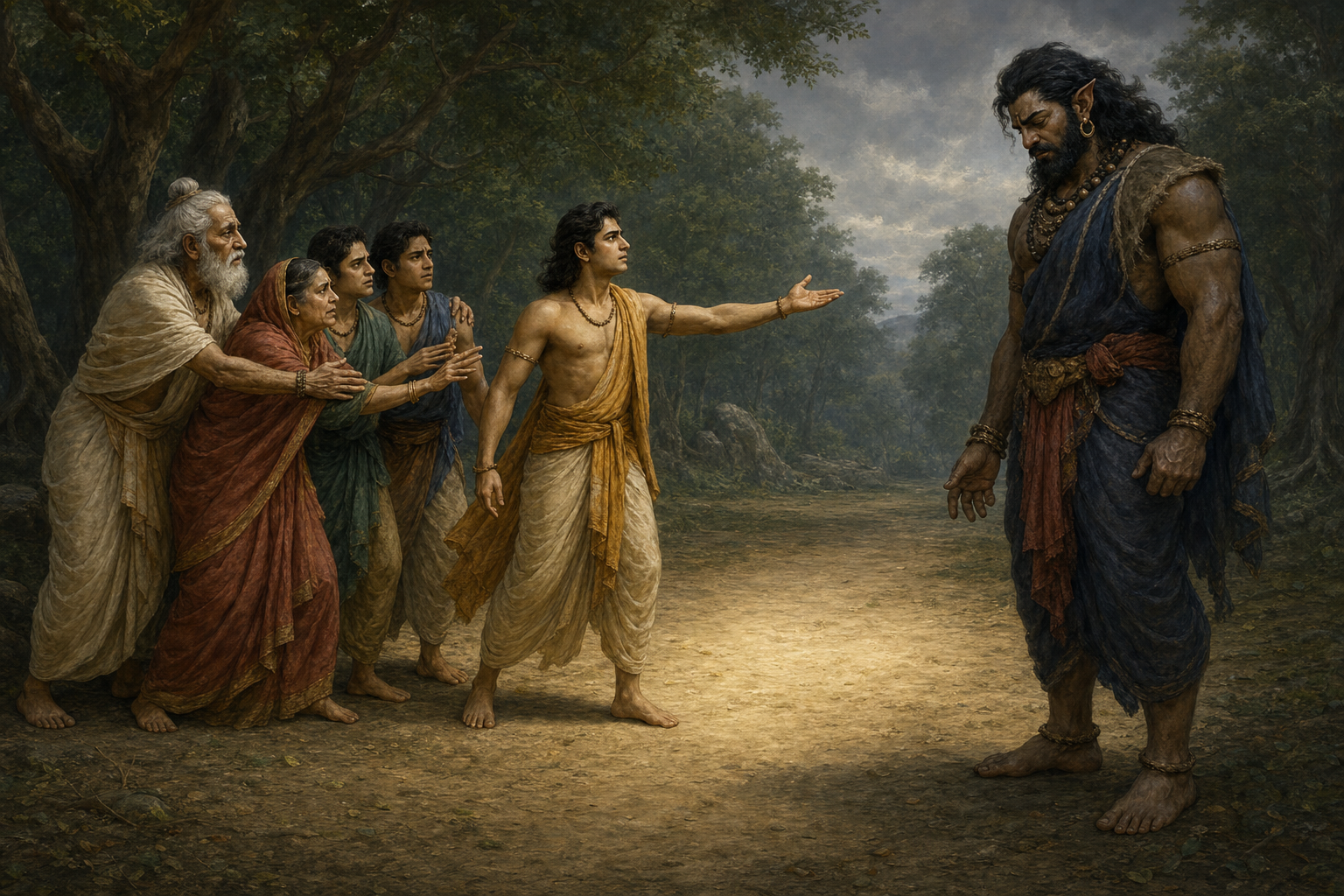
The designation vyayoga, as explained in the source, refers to a compact heroic drama centered on renowned male figures, forceful conflict, and elevated or martial feeling rather than a romantic contest. Madhyama-vyayoga uses those conventions, but its deepest conflict begins before the contest between powerful warriors. It begins with an ordinary household placed under an extraordinary threat.
The DharmaRenaissance article places the action during the Pandavas’ forest exile. While most of the brothers are away for a rite connected with their priest Dhaumya, Bhima remains near the hermitage as its protector. Kesavadasa, an elderly Brahmin, is traveling with his wife and three sons to a relative’s initiation ceremony when Ghatotkacha intercepts them.
Ghatotkacha announces that his mother has ordered him to bring her a man with whom she can end a fast. His condition is severe: one son must be surrendered so that the others may depart, or the entire family will be destroyed. Physical strength is thereby converted into coercive authority, forcing the household to distribute a cost it never chose.
The parents first attempt to absorb that cost themselves. Kesavadasa offers his aging body, and his wife then proposes her own life. Ghatotkacha rejects both offers because neither an old man nor a woman satisfies the command as he understands it. Each son subsequently volunteers, turning the scene into a display of mutual devotion under duress.
That duress is essential to interpreting the family’s conduct. Their offers reveal courage, but they cannot be treated as ordinary acts of free consent. Every decision is made beneath the threat of collective death. The father’s attachment to the eldest and the mother’s protection of the youngest leave the middle son confronting the possibility that he is the person most easily surrendered. His acceptance of the role is therefore both sacrificial and painfully shaped by unequal expressions of parental attachment.
Before leaving, the middle son asks to visit a lotus pond. The source, drawing on Richard Salomon’s textual analysis, explains that the young man makes a water offering for himself because he expects to die without descendants. The episode enlarges the threatened loss beyond physical death: the intended victim anticipates the absence of anyone who could later perform the rite for him.
Ghatotkacha’s failure is obedience without judgment
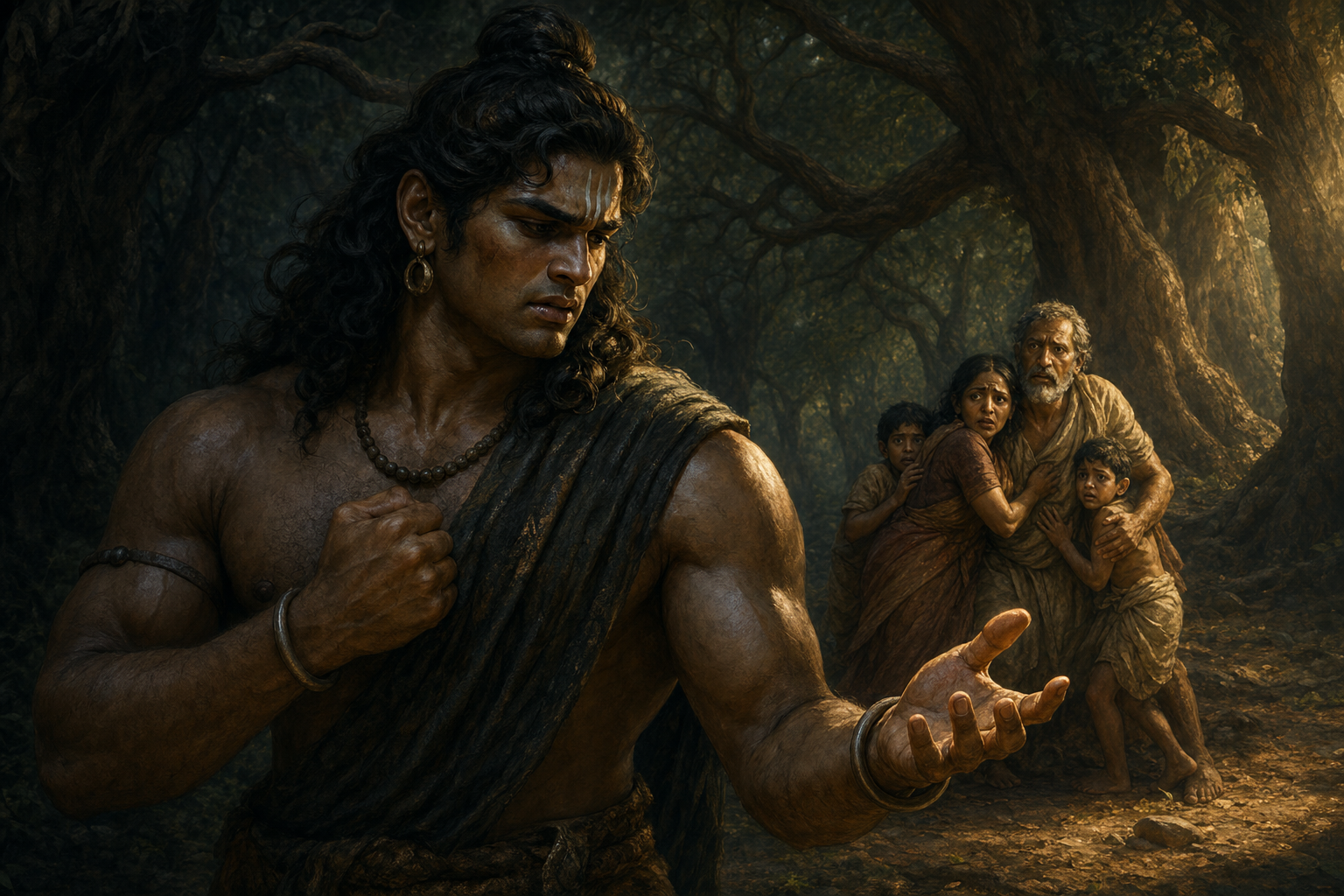
The play’s Ghatotkacha is ethically more complicated than a conventional monster. According to the source account, he recognizes that the contemplated act is forbidden and that the family deserves respect. His hesitation indicates conscience, intelligence, and an ability to perceive virtue. Yet he proceeds because he treats obedience to his mother as decisive.
This combination makes his error more revealing than simple cruelty. He does not lack moral awareness; he subordinates it. The drama thus distinguishes filial devotion from a mature understanding of duty. A parental command may explain an action, but it does not automatically make that action right, especially when compliance transfers grave harm to innocent people.
Ghatotkacha also narrows the problem by concentrating on whether the selected victim matches the terms of his assignment. That procedural focus displaces the more fundamental question of whether anyone may be seized at all. The family’s virtue affects him emotionally, but not yet enough to make him reconsider the legitimacy of the demand.
Read beside the epic background reported by the article, the dramatic characterization becomes sharper. The capacity to answer a parent’s call is admirable when it brings relief to Draupadi and the traveling party. The same readiness becomes dangerous when it is used to compel a vulnerable family. Loyalty acquires ethical value from the purpose it serves, not merely from the intensity with which it is expressed.
Bhima changes the meaning of strength and fatherhood
Bhima enters the dramatic problem as more than Ghatotkacha’s physical equal. He is responsible for protecting the hermitage and must therefore respond to the danger facing strangers. The confrontation places his public duty and paternal bond in apparent opposition: stopping the aggressor means opposing his own son, even before their relationship is fully recognized.
This reversal gives the play its distinctive moral force. Ghatotkacha believes that duty means carrying out his mother’s order. Bhima demonstrates a broader responsibility grounded in protection of those exposed to unjust force. Fatherhood is consequently expressed not through indulgence but through correction, restraint, and the refusal to let kinship excuse wrongdoing.
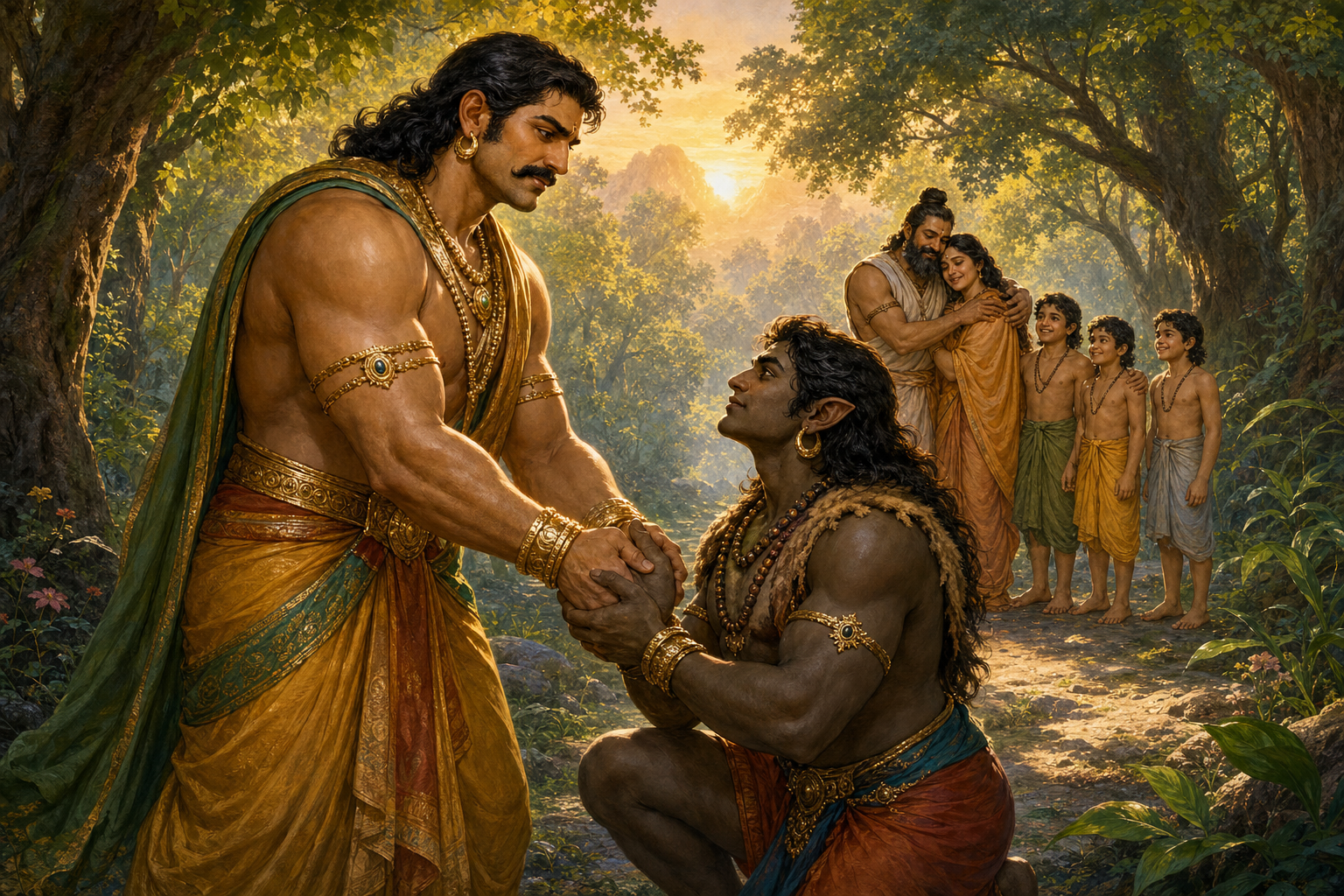
The source describes the drama as moving through mistaken identity toward recognition and reconciliation rather than catastrophe. Recognition does not erase the preceding danger. Instead, it reorganizes the audience’s understanding of the struggle: the threatening warrior is also a devoted son, while the intervening champion is also the father whose example can redirect that devotion.
Strength likewise receives two different dramatic meanings. Ghatotkacha initially uses superior power to restrict another family’s choices. Bhima’s intervention aligns power with guardianship. The contrast suggests that heroic force is not self-validating; its moral character depends on whether it coerces the vulnerable or creates room for them to live.
The recognition scene also prevents the conflict from collapsing into a simple opposition between good father and evil son. The play retains Ghatotkacha’s filial sincerity while exposing its insufficiency, and it allows Bhima to oppose the deed without ceasing to care for the person committing it. Reconciliation is therefore not a retreat from judgment but the result of judgment joined to relationship.
Key takeaways
- The Bhima-Ghatotkacha confrontation is a dramatic invention of Madhyama-vyayoga, not an episode narrated in that form by the Sanskrit Mahabharata.
- The epic background establishes Ghatotkacha’s devotion, while the play tests whether devotion remains virtuous when a parental order conflicts with the protection owed to innocent people.
- The Brahmin family’s self-sacrifice occurs under coercion; its members’ courage should not obscure the injustice of the choice imposed on them.
- The middle son’s predicament reveals the emotional harm produced when unequal parental attachments become visible during a crisis.
- Bhima embodies a form of fatherhood that combines care with correction and a form of heroism that uses strength to protect rather than compel.
- Recognition resolves mistaken identity, but the drama’s ethical achievement lies in redirecting loyalty instead of treating kinship as an excuse.
Future readings of Madhyama-vyayoga can preserve both its epic inheritance and its independence as drama. Keeping those layers distinct makes its central question more urgent: not whether loyalty matters, but how loyalty must be judged when love, authority, and responsibility pull in different directions.