
The Indo-Pacific is often presented as a strategic map of oceans, states and competing interests. The excerpt published by Hindu Post advances a different thesis: Bharat’s relationship with this region also belongs to a much older civilisational story shaped by maritime contact, commerce, culture and philosophy.
That perspective does not replace modern diplomacy or security analysis. It broadens the frame, helping readers see why cultural memory, intellectual exchange and Dharmic connections can still influence how Bharat understands its eastern neighbourhood.
Beyond a modern strategic label
A conventional geopolitical reading asks which states possess economic, military or diplomatic influence across the Indian and Pacific Oceans. A civilisational reading asks an additional question: what relationships existed before today’s political terminology and borders?
According to the passage carried by Hindu Post, civilisational India cultivated connections with Pacific peoples and settlements through more than a millennium of maritime, commercial, cultural and philosophical exchange. This is an interpretive claim rather than a complete history of every contact. Its value lies in restoring historical depth to a region frequently described only through present-day rivalry.
Maritime exchange as civilisational infrastructure
Sea routes can carry more than goods. Repeated movement also creates opportunities for stories, artistic forms, religious ideas and philosophical questions to travel, be translated and take local forms. Civilisations therefore meet through adaptation rather than the mechanical export of a finished cultural package.
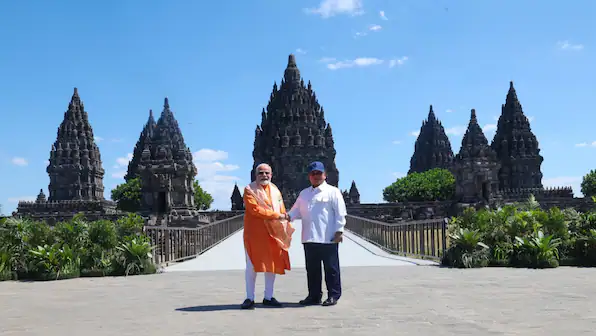
The supplied excerpt does not identify particular ports, commodities or institutions, so those details should not be inferred from it. It instead offers a broad framework in which maritime commerce and cultural exchange reinforce one another. The passage uses Prime Minister Narendra Modi’s tour of the Pacific space as a contemporary occasion for revisiting that framework, although it provides no itinerary or policy outcomes.
Kalidas Nag and Tagore recovered an eastern horizon
Hindu Post’s excerpt credits historian and cultural philosopher Kalidas Nag as perhaps the first Indian to use the term Indo-Pacific Domain in a modern context. It reports that Nag had studied India’s civilisational presence in Southeast Asia and the Pacific since the 1920s and accompanied Rabindranath Tagore to the Far East in 1924.
Tagore’s own 1927 journey through Java, Sumatra and Bali is presented as an important renewal of contact with civilisational partners. His banyan-tree metaphor pictured Indian civilisation as extending its shade beyond its birthplace. The image suggests influence through growth, relationship and intellectual hospitality rather than through a narrowly territorial idea of power.
The excerpt also invokes the Bengali Buddhist teacher Atisa Dipankara, whom it says was traditionally believed to have visited Sumatra in the 10th century and remained there for a decade. Because the source itself hedges this account, it should be treated as a reported tradition, not as independently established chronology. Even so, its inclusion makes the Buddhist strand of Bharat’s eastern memory central rather than incidental.
Key takeaways
- The civilisational argument adds historical memory to modern Indo-Pacific strategy.
- The source places maritime, commercial, cultural and philosophical exchange within one connected process.
- Kalidas Nag and Rabindranath Tagore helped modern Bharat look eastward through a civilisational lens.
- Atisa Dipankara represents the Buddhist dimension of those remembered connections.
Dharmic unity without erasing difference
A pro-dharma reading of the Indo-Pacific should neither turn cultural memory into an ownership claim nor collapse distinct traditions into one. Hindu, Buddhist, Jain and Sikh paths have their own teachings, institutions and histories. Yet they also participate in an overlapping civilisational vocabulary of dharma, disciplined self-cultivation, compassion, service, ethical responsibility and spiritual freedom.
Atisa supplies an explicit Buddhist bridge in the source. More broadly, Jainism’s emphasis on ahimsa and Sikhism’s emphasis on seva deepen a shared ethic while retaining their distinctive voices. Hinduism’s many sampradayas similarly demonstrate that unity need not require uniformity. A constructive cultural Hindutva can therefore express confidence in Bharat’s civilisational memory while respecting the integrity of every Dharmic path.
From inherited memory to responsible diplomacy
The civilisational lens is most useful when it complements evidence-based statecraft. It can encourage cultural dialogue, scholarly cooperation and respectful engagement with societies whose histories intersect with Bharat’s, but it cannot substitute for careful research or contemporary policy analysis.
Its strongest contribution is a change of posture. The Indo-Pacific need not be imagined only as an arena where powers compete. It can also be approached as a space where old relationships are studied honestly and renewed without demanding cultural sameness. That combination of confidence, plurality and responsibility offers Bharat a distinctly Dharmic basis for future engagement.
Inspired by this post on Hindu Post.
