
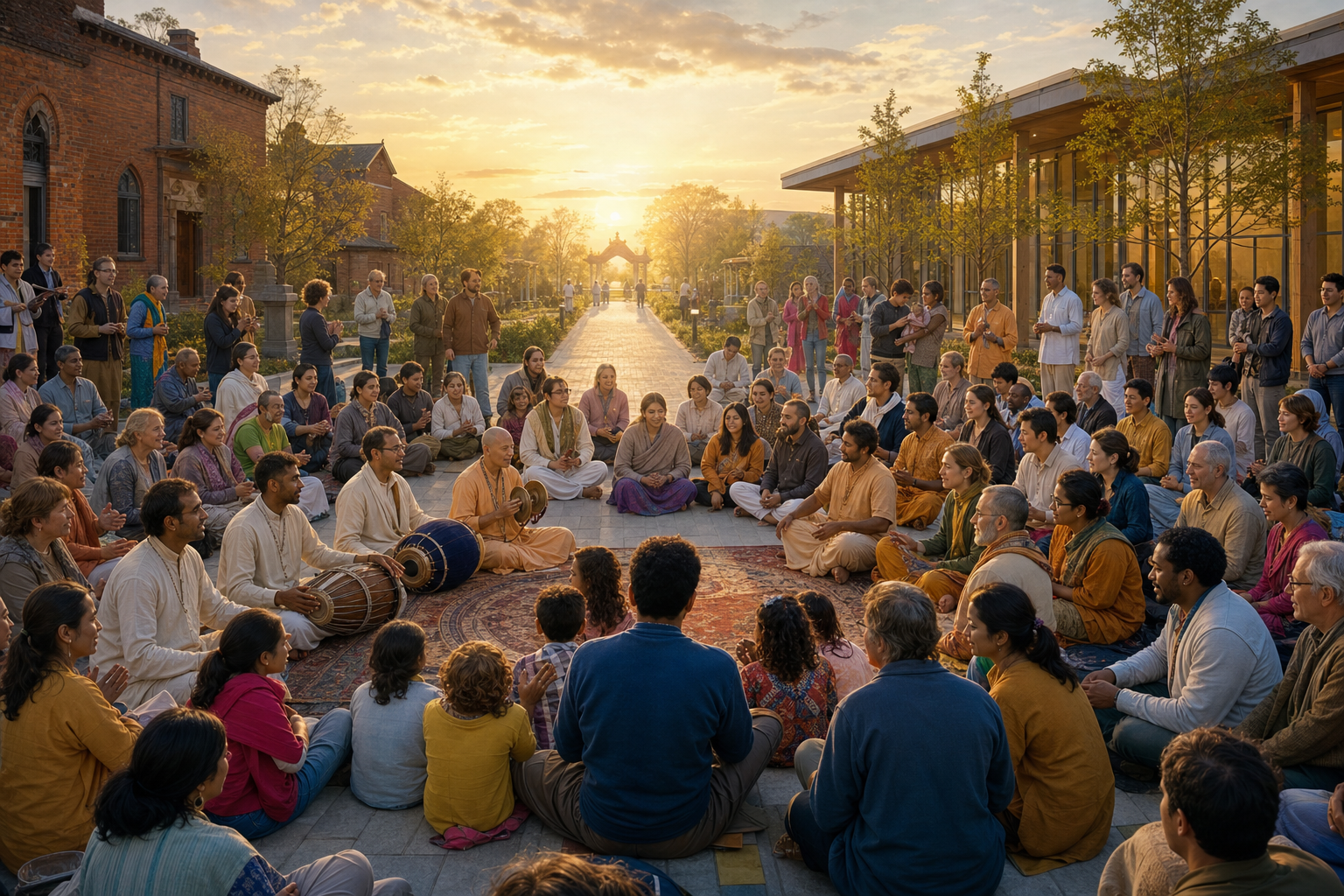
ISKCON’s sixtieth anniversary brings two questions into the same frame: what exactly has endured since the society’s incorporation, and what must mature if that inheritance is to remain meaningful? Two anniversary reports approach those questions from complementary directions, pairing institutional remembrance at Bhaktivedanta Manor with a London programme explicitly oriented toward the next sixty years.
Read together, the reports suggest that the anniversary’s real value lies neither in nostalgia nor in predictions. It lies in using ISKCON’s founding purposes to examine the relationship between spiritual teaching, communal practice, institutional conduct, ecological responsibility and changing forms of communication.
What the sixtieth anniversary actually marks
Both source articles report that ISKCON was formally incorporated in New York on 13 July 1966. They also make an essential distinction: this date marks the legal beginning of a particular organization, not the beginning of devotion to Krishna or of the Gaudiya Vaishnava tradition. ISKCON understands itself as transmitting a much older lineage associated with Sri Chaitanya Mahaprabhu and grounded especially in the Bhagavad-gita and Srimad-Bhagavatam.
According to the reports’ summaries of ISKCON’s history, A. C. Bhaktivedanta Swami Prabhupada travelled to the United States in 1965 and developed a small community through teaching, translation and kirtan in New York. Incorporation then provided a public structure through which worship, education, publishing and community formation could be coordinated. The movement subsequently developed temples, festivals, rural communities, educational programmes and publishing activity in numerous countries.
The two announced British observances give this institutional history different emphases. The Bhaktivedanta Manor-focused report describes a programme scheduled for Monday, 13 July 2026, at Sri Krishna Haveli on the Manor estate near Watford, from 4:45 p.m. to 9:00 p.m. local time, accompanied by a broadcast. Its programme returns to ISKCON’s seven founding purposes. The London-focused report describes a special evening class, titled “The Next 60 Years,” presented by Devamrita Swami through the ISKCON London Radha-Krishna Temple channel.
This juxtaposition supplies the anniversary with a useful tension. The Manor programme asks the movement to remember the commitments for which it was organized; the London programme asks what those commitments require under new conditions. The second source contains programme information rather than a transcript, however, so no particular proposal in this synthesis should be attributed to Devamrita Swami. The class title establishes the question, not a verified record of his answer.
The founding purposes can serve as a decision framework

Both reports return to the seven purposes recorded at ISKCON’s incorporation. As summarized by the sources, they concern systematic spiritual education; the presentation of Krishna consciousness through Bhagavad-gita and Srimad-Bhagavatam; stronger relationships among members and with Krishna; congregational chanting; the creation of sacred places; a simpler and more natural way of life; and the publication and distribution of literature.
Their continuing importance is structural. The purposes connect activities that can otherwise drift apart. Education gives conceptual depth to worship. Community gives daily social form to theological convictions. Chanting makes devotion participatory rather than merely observational. Sacred places sustain continuity, hospitality and collective memory. Simpler living tests whether religious values affect food, consumption, land and relationships with animals. Publishing carries all these commitments beyond a local congregation.
This also means that the seven purposes should not be treated as seven independent departments. A publishing operation that maximizes circulation without cultivating comprehension would satisfy only part of its mission. A well-attended festival without pathways into study, practice and service could create visibility without formation. Conversely, rigorous textual education that neglects belonging and care could preserve ideas while failing to build a durable community.
The sources therefore support a future strategy based on translation rather than reinvention. Here, translation means finding methods appropriate to a different audience or medium while keeping the governing spiritual purpose visible. Printed books can be joined by recordings, websites, social media and livestreams; teaching can take place in a temple, classroom or digital setting. Yet a change of medium does not remove the need for accurate explanation, disciplined practice and ethical responsibility.
Transmission requires more than preserving an archive

The London-focused report draws attention to the different ways institutional time is experienced. People connected to the founding era may remember uncertainty, sacrifice and direct relationships with early leaders. Later generations may receive ISKCON as an established religious home, including both its inherited strengths and questions requiring attention. Newcomers may first encounter it through a festival, meal, book, university activity or digital video. A viable future must allow these perspectives to inform one another rather than compete for ownership of the tradition.
That challenge makes formation more important than exposure. The same report emphasizes that bhakti includes hearing, chanting, remembrance, worship, prayer, service and self-offering. It also distinguishes personal japa from congregational sankirtana: one develops regular individual attention, while the other gives remembrance a shared and public form. Merely hearing the Hare Krishna maha-mantra or possessing a scriptural text is not the same as understanding how either practice belongs within a disciplined devotional life.
The Bhaktivedanta Manor report adds the importance of place. It presents the Manor’s worship areas, gardens, farm, educational facilities and gathering spaces as parts of a sacred landscape rather than as unrelated amenities. Such places transmit tradition through repeated practice: people study, serve, sing, share food and remember together. Digital access can preserve and widen contact with those activities, but it cannot by itself supply every dimension of mentorship, accountability or communal participation.
The central educational task is consequently twofold. ISKCON must keep its theology intelligible without reducing it to slogans, and it must connect theological understanding with conduct. The London report describes bhakti as an integrated path rather than a cultural label or isolated emotion. That framing offers a demanding standard for the next generation: success is not simply recognition of ISKCON’s vocabulary, but the development of informed, sustained and ethically consequential practice.
Future credibility depends on institutional coherence

The anniversary reports acknowledge the historical significance of ISKCON’s growth, but the London-focused account argues that scale cannot be the only measure. It points instead toward spiritual depth, ethical maturity, knowledge, community care and service. This shifts the future question from how large the movement can become to whether its institutions help people embody the purposes they publicly affirm.
Community is one test. The third founding purpose, as explained in the reports, joins closeness among members with nearness to Krishna. Social belonging is therefore not an optional convenience, but neither is it an end in itself. Its religious value depends on whether community encourages service, learning, responsibility and mutual care. Accountability belongs inside this vision because institutions teach not only through formal classes but also through how authority, relationships and shared resources are handled.
Ecological practice is another test. The Manor-focused article connects the purpose of simpler and more natural living with agriculture, cow care, vegetarian food and reduced dependence on highly consumptive habits. It also cautions against romanticizing these commitments: farms and communities require land, expertise, labour, finance and responsible governance. The future contribution of this purpose will therefore depend on credible practice rather than pastoral imagery alone.
Communication presents a related challenge. The Manor broadcast and London video channel demonstrate how the founding commitment to publication can extend into contemporary media. Digital distribution can make an anniversary, class or kirtan available beyond a physical venue and can preserve a public record. Its deeper value, however, depends on what follows initial attention: reliable teaching, opportunities for questions, pathways into practice and relationships capable of supporting long-term growth.
These areas are mutually dependent. Ecological claims need competent governance; governance needs spiritually and ethically educated participants; education needs communities in which knowledge can be practised; and outreach needs places, teachers and relationships able to receive those it reaches. Institutional coherence is achieved when the seven purposes reinforce one another rather than competing for prestige or resources.
Key takeaways
- The anniversary commemorates ISKCON’s incorporation in 1966, while the Gaudiya Vaishnava tradition it represents is substantially older.
- The Bhaktivedanta Manor and London reports frame the milestone through complementary questions of institutional memory and future responsibility.
- ISKCON’s seven purposes connect education, scripture, community, chanting, sacred space, simpler living and communication; weakening one can diminish the others.
- The next phase is best evaluated through depth of formation, community care, accountability, ecological realism and the responsible use of digital media, not visibility alone.
Viewed together, the two anniversary reports make the founding charter less a historical exhibit than a continuing standard. ISKCON’s next sixty years will depend on whether its communities can preserve a clear theological centre while allowing methods, media and institutions to mature. If the seven purposes remain connected in practice, remembrance of 1966 can become a disciplined basis for choices still ahead.
References
- DharmaRenaissance Blog — ISKCON at 60: Essential Guide to Bhaktivedanta Manor’s Landmark 2026 Celebration
- DharmaRenaissance Blog — ISKCON at 60: A Powerful Framework for the Next Six Decades with Devamrita Swami