
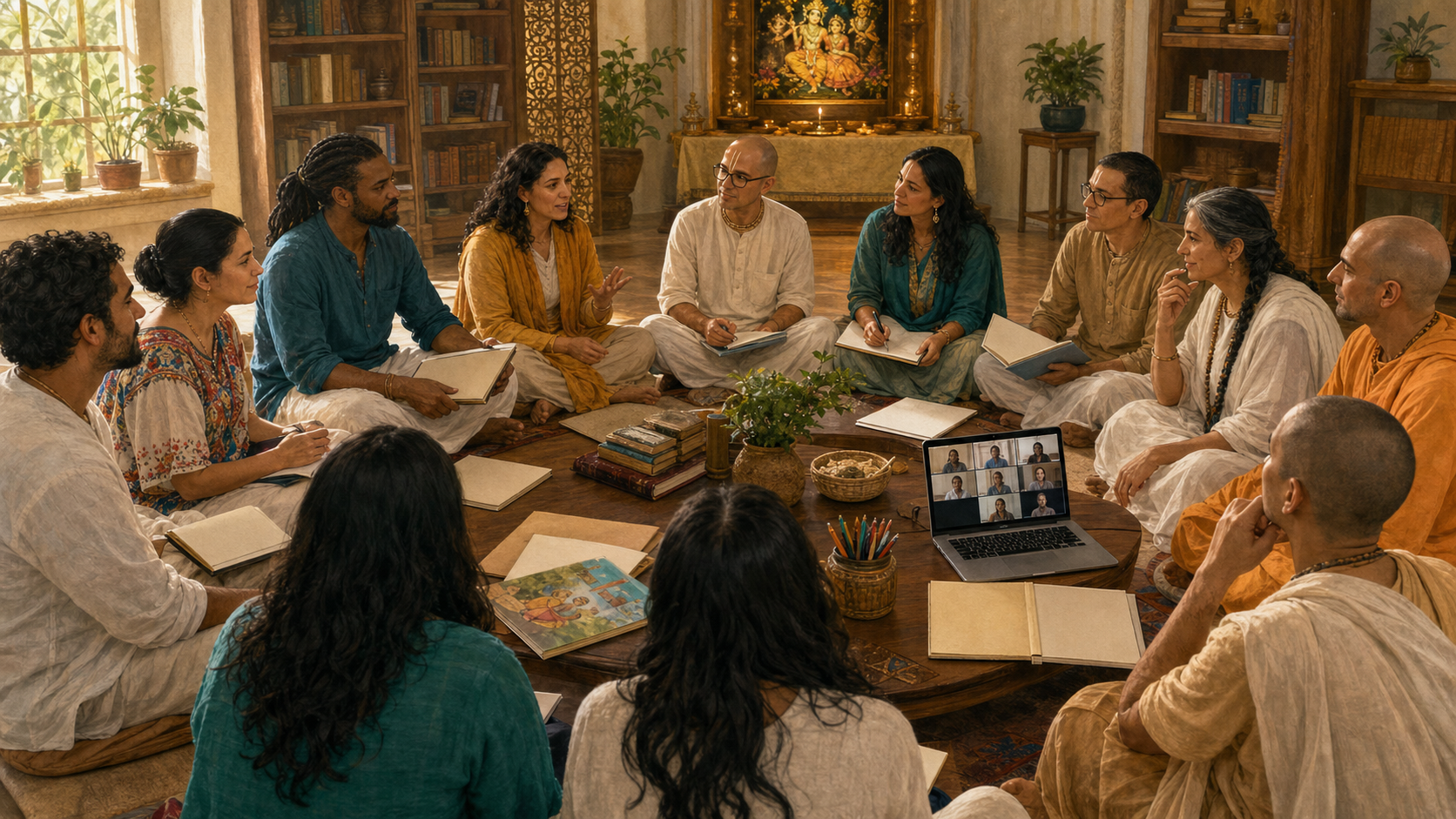
ISKCON education across the Americas faces a practical question: how can a shared devotional purpose become coherent educational practice without erasing differences among temples, schools, study groups, languages, and learners? The published account of Viplavah 2026 offers one case through which to examine that question.
The event record connects curriculum development, teacher formation, educational leadership, digital access, and institutional cooperation. Its larger value, however, lies in showing what a symposium can contribute to an educational system, what must still happen locally, and what evidence is needed before participation can be equated with lasting impact.
Key takeaways
- Viplavah 2026 is best understood as a coordination and knowledge-sharing forum, not as proof that learning outcomes improved.
- Its Pan-American mandate and its wider online reach were complementary but distinct: regional priorities shaped the gathering even though participants elsewhere could connect.
- Curriculum, teacher development, leadership, assessment, and reliable operations function as parts of one educational system rather than separate projects.
- Live participation and recordings serve different learning needs, while internet access, language support, captioning, and presentation design still influence inclusion.
- The symposium’s durable value will depend on whether shared ideas are documented, adapted responsibly, implemented locally, and evaluated over time.
A regional forum with wider digital reach
According to the source article, the official announcement identified Viplavah 2026 as the PAN America Mini-Symposium 2026. It was held online on Friday, July 10, 2026, as a two-hour program organized principally for North, Central, and South America. The post-event account also acknowledged participation from other parts of the world.
That distinction matters. A gathering can be internationally accessible without losing its regional purpose. In this case, the Pan-American frame created space for concerns arising across a large and varied geography, while digital distribution enabled people beyond that organizational area to listen or participate. Wider access should therefore not be mistaken for evidence that every locality has the same educational circumstances.
The article places the event within a longer institutional effort. It reports that the ISKCON Ministry of Education established Viplavah as an annual international education symposium in 2019 so that educators could exchange insights gained through practice. It also describes the Ministry, based on the Governing Body Commission’s ministries directory, as facilitating and developing ISKCON’s educational system through principles, guidelines, values, assessment, and accreditation questions, while leaving implementation to local initiatives.
This division of responsibility provides a useful model for a dispersed religious community. A regional or international body can create common language, circulate resources, and encourage standards. Local educators still have to decide how pacing, examples, learner support, and assessment should work in a particular setting. Cooperation is therefore neither complete uniformity nor isolated experimentation; it is disciplined adaptation within a shared educational purpose.
From symposium exchange to an educational system

Institutional coordination without centralized delivery
A symposium can connect people who otherwise work in separate institutional or geographic settings. The Viplavah account presents this connection as part of the Ministry’s facilitative role: educators and leaders can compare experience, discuss resources, and learn about developments elsewhere without transferring all responsibility away from local communities.
The educational benefit comes from making relationships visible. Curriculum decisions affect teacher preparation; assessment reveals whether objectives are clear; leadership determines whether teachers receive support; and administration determines whether classes, materials, and follow-up actually appear. Treating these as an interconnected system makes it easier to identify why a promising course may succeed in one setting yet struggle in another.
Teachers as carriers of practical knowledge
The source interprets Viplavah as a community-of-practice mechanism. Educators accumulate knowledge that may never appear in a formal manual: where learners become confused, how a difficult passage can be introduced, which sequence supports understanding, and how local culture affects participation. Presentations and discussion can turn some of that experience into shared institutional memory.
Experience becomes more useful when its evidentiary levels remain distinct. An educator may report an observation, offer an interpretation, and recommend an action. Those are related but not identical claims. Keeping them separate allows peers to learn from a local success without assuming that its method will transfer unchanged to children, adults, newcomers, experienced practitioners, or students learning in another language.
Curriculum, assessment, and operations
The article’s framework associates educational renewal with attention to foundational texts, capable teaching, coherent objectives, appropriate assessment, ethical leadership, and contextual application. This is more substantial than treating renewal as the adoption of a new platform or vocabulary. Technology can distribute instruction, but it cannot by itself determine what should be learned, how understanding should be demonstrated, or how teachers should respond when learners need additional support.
Operational service belongs inside this educational picture. The account notes the work involved in scheduling across regions, coordinating speakers, managing platforms, preparing materials, moderating discussion, recording sessions, and arranging follow-up resources. Such tasks may be less visible than a presentation, yet their quality affects whether participants can concentrate, contribute, and retrieve material afterward.
Digital participation broadens access unevenly

Viplavah 2026 reportedly combined live online participation with recordings and shared resources. These formats support different forms of learning. A live session allows immediate questions, clarification, and a sense of collective presence. A recording allows viewers to pause, review terminology, take notes, and return to complex material around service, work, family, or time-zone constraints.
The two modes should be evaluated separately rather than placed in a simple hierarchy. Live attendance does not guarantee close engagement, while asynchronous viewing need not be passive. Conversely, making a recording available does not establish that it was found, watched, understood, or applied. A well-designed educational network needs ways for later viewers to locate relevant material and connect it to discussion, mentoring, or local practice.
The source also cautions that online delivery does not remove every barrier. Stable internet service, suitable devices, familiarity with platforms, captioning, language support, and accessible presentation design affect who can participate fully. Multi-platform distribution can create more entry points, but inclusion should ultimately be judged by actual access and engagement rather than the number of channels carrying a broadcast.
For education across the Americas, this suggests a dual responsibility. Regional organizers can improve the accessibility and retrievability of shared resources, while local communities can help learners interpret and use them. Digital reach becomes educational reach only when content is connected to people, context, and sustained support.
Evidence standards and the next test

The available account establishes that the gathering occurred, named presenters served, participants engaged through online channels, resources were shared, and recordings were made available. It does not provide attendance statistics, presentation abstracts, test results, or a formal impact evaluation. Because the supplied material contains one published account, these event details are reported claims rather than independently corroborated findings.
The article recognizes Hanumatpreshak Maharaj, Tapan Mishra Prabhu, Suniti Devi Dasi, Karunanidhi Das, and Parampadam Das as presenters. It identifies Balimardana Das as the host and, in the closing statement, as Co-Minister of ISKCON MOE NA. However, the available recap does not attach a verified presentation title, thesis, or recommendation to any individual. Specific ideas should therefore be attributed to a speaker only after consulting the corresponding recording or presentation material.
A responsible evaluation can proceed through several levels. Organizers can first document who was able to participate and by which mode; then examine whether participants engaged with the material; then ask whether educators adapted or implemented anything locally; and finally look for evidence that those changes improved teaching, learner support, or institutional cooperation. This sequence prevents platform activity from being treated as an educational outcome.
The next phase for Pan-American cooperation is therefore not simply another event. It is the creation of a dependable cycle in which practitioner knowledge is captured, claims remain traceable, resources are accessible, local adaptations are documented, and results return to the wider community for examination. If that cycle develops, Viplavah can serve not only as a gathering but as infrastructure for sustained educational learning across ISKCON in the Americas.