

India-Indonesia relations are often narrated backwards: ancient affinity first, modern strategy second. The supplied DharmaRenaissance Blog account of Prime Minister Narendra Modi’s state visit from 6 to 8 July 2026 points to a more demanding interpretation. Civilisational familiarity can lower political friction, but its strategic value appears only when it is translated into institutions, interoperable systems and durable economic ties.
The visit can therefore be read as a test of conversion: can inherited goodwill become practical cooperation without being reduced either to ceremony or to a narrow security transaction? The source reports fourteen cooperative instruments and six major announcements, spanning far more than defence. Their importance will depend on whether they generate recurring coordination and operational capacity.
The relationship’s weight comes from scale and geography
The source describes Indonesia as the world’s fourth most populous country, the largest Muslim-majority society and ASEAN’s largest economy, with a population exceeding 288 million. It also cites official Indian data placing bilateral merchandise trade at approximately US$24.78 billion in financial year 2025-26. These reported figures frame the relationship as an engagement between two large developing economies rather than a peripheral diplomatic partnership.
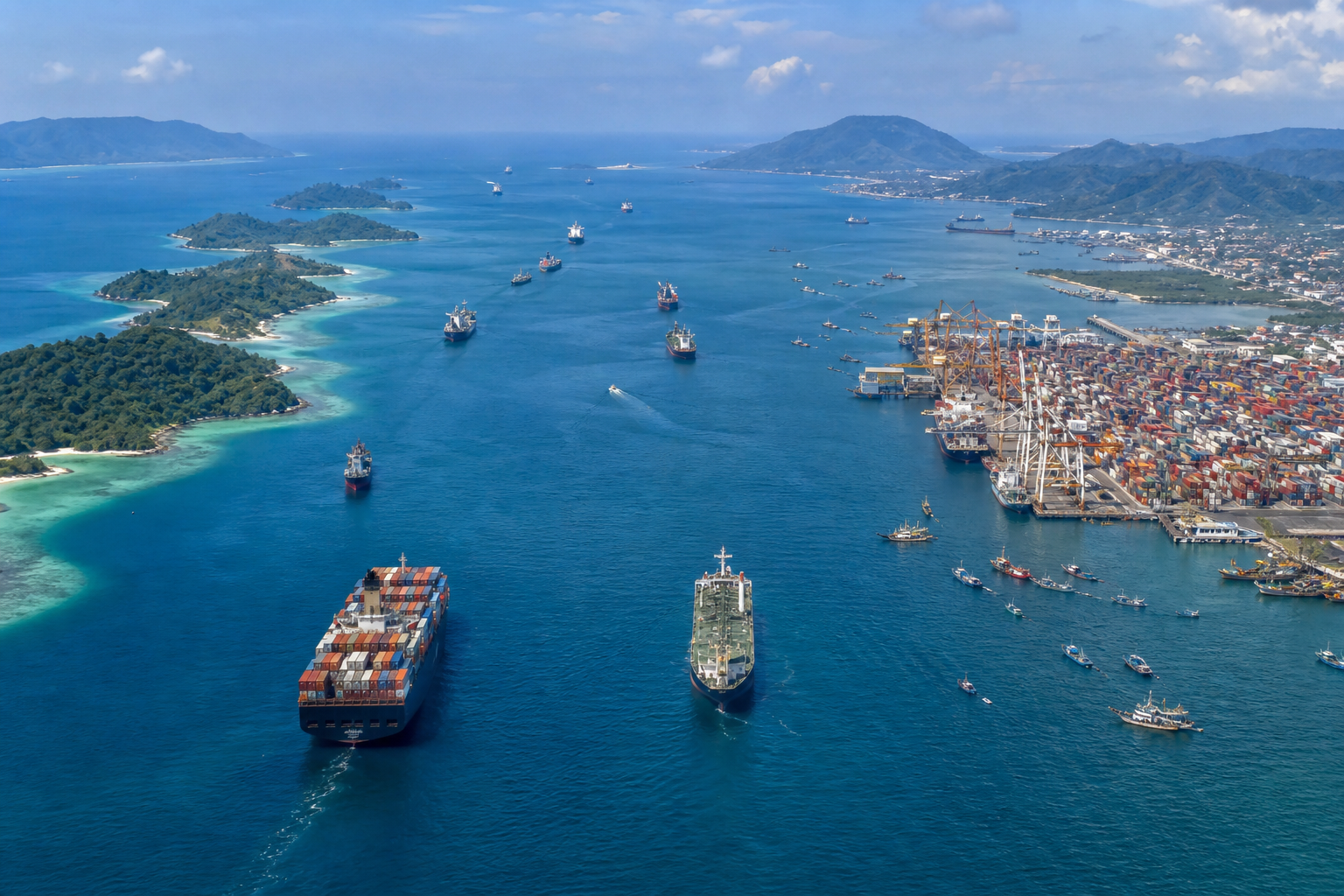
Geography adds a second layer. Indonesia’s archipelago sits across the maritime system connecting the Indian and Pacific Oceans. The article cites a United States Energy Information Administration estimate that approximately 23.2 million barrels per day of petroleum and other liquids passed through the Strait of Malacca during the first half of 2025. That volume illustrates why disruption around Indonesia would affect energy costs, freight, insurance and manufacturing well beyond the two countries.
The strategic map is broader than a single chokepoint. The source also identifies the Sunda and Lombok routes, the approaches to the Andaman Sea and the waters around Sumatra as parts of the same maritime system. India’s Andaman and Nicobar Islands face Indonesia’s Aceh province across a comparatively narrow stretch of sea. This proximity creates overlapping interests in shipping safety, fisheries, search and rescue, environmental protection, disaster response and awareness of activity at sea.
The political foundation predates the 2026 visit. According to the article, the relationship was elevated to a Comprehensive Strategic Partnership in 2018 alongside a shared vision for Indo-Pacific maritime cooperation. President Prabowo Subianto’s participation as chief guest at India’s Republic Day celebrations in January 2025 then supplied additional political momentum. The emerging logic is cumulative: summit diplomacy sets direction, while parliamentary exchanges, working groups and sectoral arrangements are intended to keep cooperation moving between high-level visits.
Civilisational trust is diplomatic infrastructure, not an outcome

The account provides less of an inventory of ancient history than an argument about the contemporary use of civilisational trust. Shared language around pluralism, democracy and unity amid diversity can make cooperation politically intelligible to both societies. Yet cultural affinity does not itself produce maritime data exchange, defence maintenance or commercial investment. It functions more like diplomatic infrastructure: valuable because it can support difficult commitments over time.
The visit’s two most visible symbols reinforced that public dimension. The source reports that President Prabowo conferred the Bintang Republik Indonesia Adipurna, described by Indonesia as its highest state decoration, on Modi. It also reports that Modi became the first Indian prime minister to address Indonesia’s Parliament. The award personalised recognition, while the parliamentary setting widened the audience beyond the two executives to include legislators, parties and the wider public.
That distinction matters because durable bilateral policy must survive elections and changes of leadership. A parliamentary address can help locate the relationship within a national political conversation, but only implementation will show whether the symbolism built lasting support. The article appropriately distinguishes an award from an agreement, an agreement from a funded project and a project announcement from functioning capacity.
The same caution applies to the fourteen reported instruments and six announcements. They do not necessarily share a legal status, budget, timetable or enforcement mechanism. Their collective significance lies in the density and direction of the agenda, not in treating every memorandum as a completed achievement.
Maritime and defence cooperation will test strategic maturity
Defence attracted particular attention because the reported outcomes included cooperation concerning the BrahMos missile system and an Air-to-Air Missile Cooperation Agreement. The source is careful about what these formulations do and do not establish. It notes that the official list did not name the air-to-air system, even though public commentary connected it to India’s Astra family. It likewise reports confirmed BrahMos cooperation without asserting a settled configuration, contract value, delivery schedule or basing plan.
This restraint is important. A framework for cooperation may open the way to procurement, co-production, research or training, but it is not interchangeable with a signed acquisition contract. The more consequential possibility is a long-term network of maintenance, testing, software support, secure communications, spares and upgrades. Such relationships can produce operational familiarity and continuing institutional contact well after an initial agreement.
The source places these openings within a wider programme encompassing exercises, staff talks, military training, hydrography, information sharing, shipbuilding, repair, co-production, technology transfer and defence supply chains. It also cites India’s Ministry of Defence as reporting record defence exports of ₹38,424 crore in financial year 2025-26, reaching more than eighty countries. In that context, cooperation with Indonesia is presented as part of India’s attempt to connect domestic production and research with credible export partnerships.
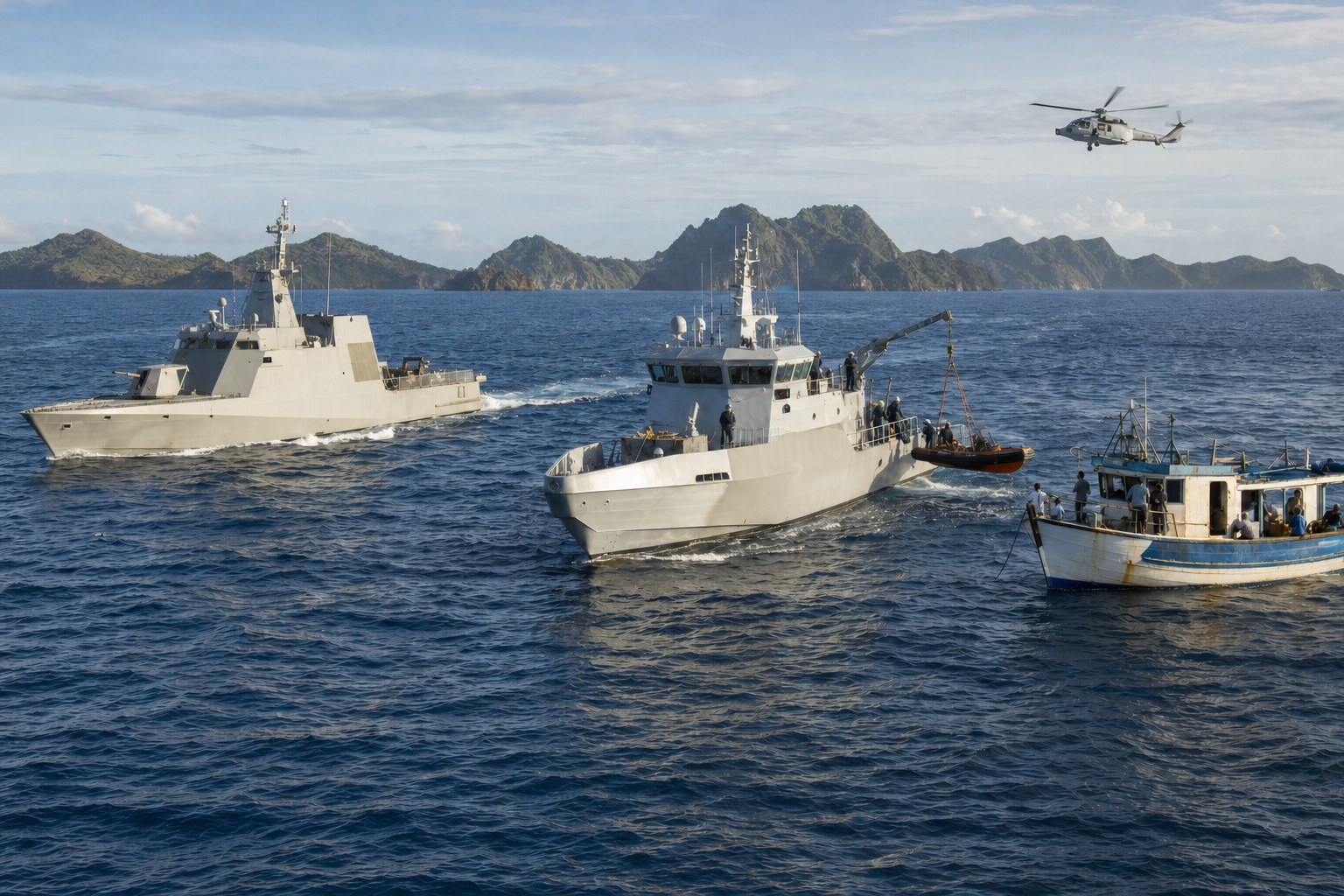
Some of the most practical security measures concern situational awareness rather than weaponry. The article reports the renewal of a maritime safety and security memorandum, an implementing arrangement between Indonesia’s BAKAMLA and the Indian Coast Guard, and a planned Indonesian liaison officer at the Information Fusion Centre-Indian Ocean Region in Gurugram. These mechanisms could shorten the time required to compare shipping information, classify suspicious activity and coordinate responses.
Maritime domain awareness generally depends on combining imperfect sources such as coastal radar, vessel identification signals, satellite imagery, registries, patrol reports and commercial data. Liaison personnel are useful because sensors alone cannot resolve every anomaly, particularly when vessels disable or manipulate identifiers. The effectiveness of the reported arrangement will therefore depend on the regularity, quality and permitted uses of the information exchanged.
The humanitarian dimension may prove equally valuable. The source notes that both countries face earthquakes, tsunamis, volcanic hazards, cyclones and maritime accidents, and reports a separate disaster-management memorandum covering preparedness, resilient infrastructure, data applications and recovery. Search-and-rescue and disaster-relief cooperation can deliver direct public benefit while building habits of coordination among navies, coast guards, civil agencies and local authorities.
Key takeaways
- Civilisational affinity is best understood as a reserve of political trust, not a substitute for contracts, budgets and operational arrangements.
- Indonesia matters to India because economic scale and maritime geography reinforce one another across the Indo-Pacific.
- Maritime information sharing, search and rescue, and disaster response offer immediate tests of whether institutional cooperation works.
- Missile-related agreements are strategically significant, but the supplied source does not establish every system, configuration or delivery detail discussed publicly.
- The agenda’s breadth could create strategic interdependence only if separate sectoral initiatives progress beyond memoranda and ceremonial announcements.
From a broad agenda to measurable interdependence

The reported programme reaches across critical minerals, steel, digital networks, telecommunications, health, agriculture, education, space, cultural conservation and disaster management. This breadth is not incidental. Defence cooperation is more durable when supported by industrial capacity; digital connectivity matters more when paired with secure institutions; and maritime resilience depends partly on infrastructure, communications and emergency planning.
Breadth also creates an implementation risk. Numerous instruments can disperse responsibility unless they are attached to lead agencies, timelines, financing and review mechanisms. The next meaningful evidence will be found in identifiable contracts, technical working arrangements, recurring exercises and training, functioning liaison channels, disclosed production or maintenance plans, and commercial projects that progress from announcement to operation.
The source characterises the emerging partnership as something other than a treaty alliance, consistent with both countries’ emphasis on strategic autonomy, ASEAN centrality and inclusive regional arrangements. That can be a strength if cooperation remains practical: neither side must adopt the other’s entire strategic outlook in order to protect shipping, strengthen disaster readiness, diversify supply chains or build compatible capabilities.
The durable measure of the 2026 visit will therefore be institutional memory. If agencies continue meeting, exchanging information and completing projects after the ceremonies have faded, civilisational trust will have become a working strategic asset. If implementation stalls, even an unusually wide agenda will remain primarily declaratory.