
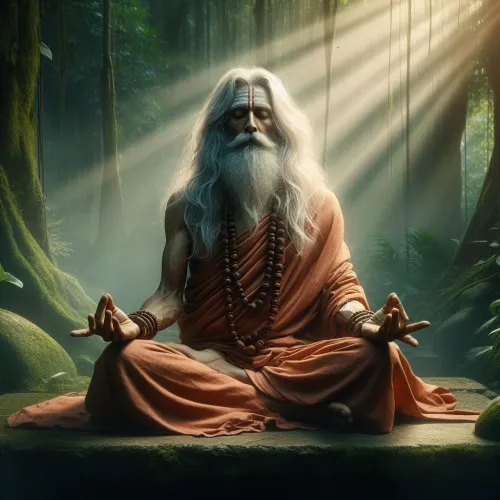
Bhrigu Maharshi occupies a revered place in Hindu sacred memory as a sage connected with Brahma and the text known as the Bhrigu Samhita. The surviving source excerpt, however, is a compact devotional profile rather than a detailed biography.
This guide separates the traditions reported by Hindu Pad from broader interpretive context. That distinction helps readers appreciate Bhrigu’s significance without adding dates, episodes, or textual claims that the supplied account does not establish.
What the available account says about Bhrigu
According to Hindu Pad, Maharishi Bhrigu was one of the Prajapatis created by Lord Brahma. The source also presents him as a mind-born son of Brahma and describes him, in devotional terms, as Brahma’s foremost son.
The same account associates Bhrigu’s birth with the region now known as Uttar Pradesh, while explicitly framing that association as a belief. It also identifies him as the author of the Bhrigu Samhita. These are the principal claims that can be drawn from the supplied material; it does not provide a chronology, supporting citations, or a fuller life narrative.
Prajapati and the language of sacred genealogy
In Hindu religious vocabulary, Prajapati is a title associated with creation, generation, and the continuity of life. Placing Bhrigu among the Prajapatis therefore presents him within a sacred account of cosmic order, not merely as an individual teacher located in ordinary history.
The description of Bhrigu as mind-born should likewise be read in the language of sacred genealogy. Such language can express an intimate relationship between a sage, divine intelligence, and the transmission of knowledge. This is interpretive context rather than an additional biographical fact, and it should not be converted into a modern historical or biological claim.
What can be said about the Bhrigu Samhita
The source credits Bhrigu with authorship of the Bhrigu Samhita, making the text central to his remembered identity. It supplies no further information about the work’s contents, date, manuscript history, or transmission, so none of those details can responsibly be inferred from this excerpt alone.
Traditional authorship can communicate composition, inspiration, authority, or affiliation with a teaching lineage. Because the brief account does not explain which sense it intends, the careful formulation is that Hindu tradition, as reported by Hindu Pad, attributes the Bhrigu Samhita to Maharishi Bhrigu.
Key takeaways
- Hindu Pad identifies Bhrigu as a Prajapati created by Lord Brahma.
- The source presents him as a mind-born and especially honored son of Brahma.
- It reports a traditional association between his birth and present-day Uttar Pradesh.
- It attributes the Bhrigu Samhita to him but offers no further textual or historical details.
Bhrigu’s place in a wider Dharmic inheritance
Bhrigu’s sacred genealogy belongs specifically to Hindu tradition and should be understood on its own terms. Buddhism, Jainism, and Sikhism do not share that genealogy, and genuine Dharmic unity does not require their teachings to be treated as interchangeable.
A meaningful common thread lies instead in the esteem that Dharmic traditions give to teachers, disciplined inquiry, ethical cultivation, and the responsible transmission of wisdom. A confident Hindu civilizational outlook can preserve Bhrigu’s distinctive place in Sanatana memory while respecting the independent lineages through which other Dharmic communities pursue truth and liberation. This is unity without erasure: solidarity grounded in mutual reverence rather than forced sameness.
Reading a brief traditional profile responsibly
The source provides a foundation for understanding how Bhrigu is remembered, but not enough material for a comprehensive historical portrait. Readers should therefore distinguish devotional tradition, symbolic interpretation, and independently documented history instead of allowing one category to impersonate another.
Approached with both reverence and intellectual care, Bhrigu’s profile becomes an invitation to preserve sacred memory while continuing the patient study of India’s textual inheritance.
Inspired by this post on Hindu Pad.
