
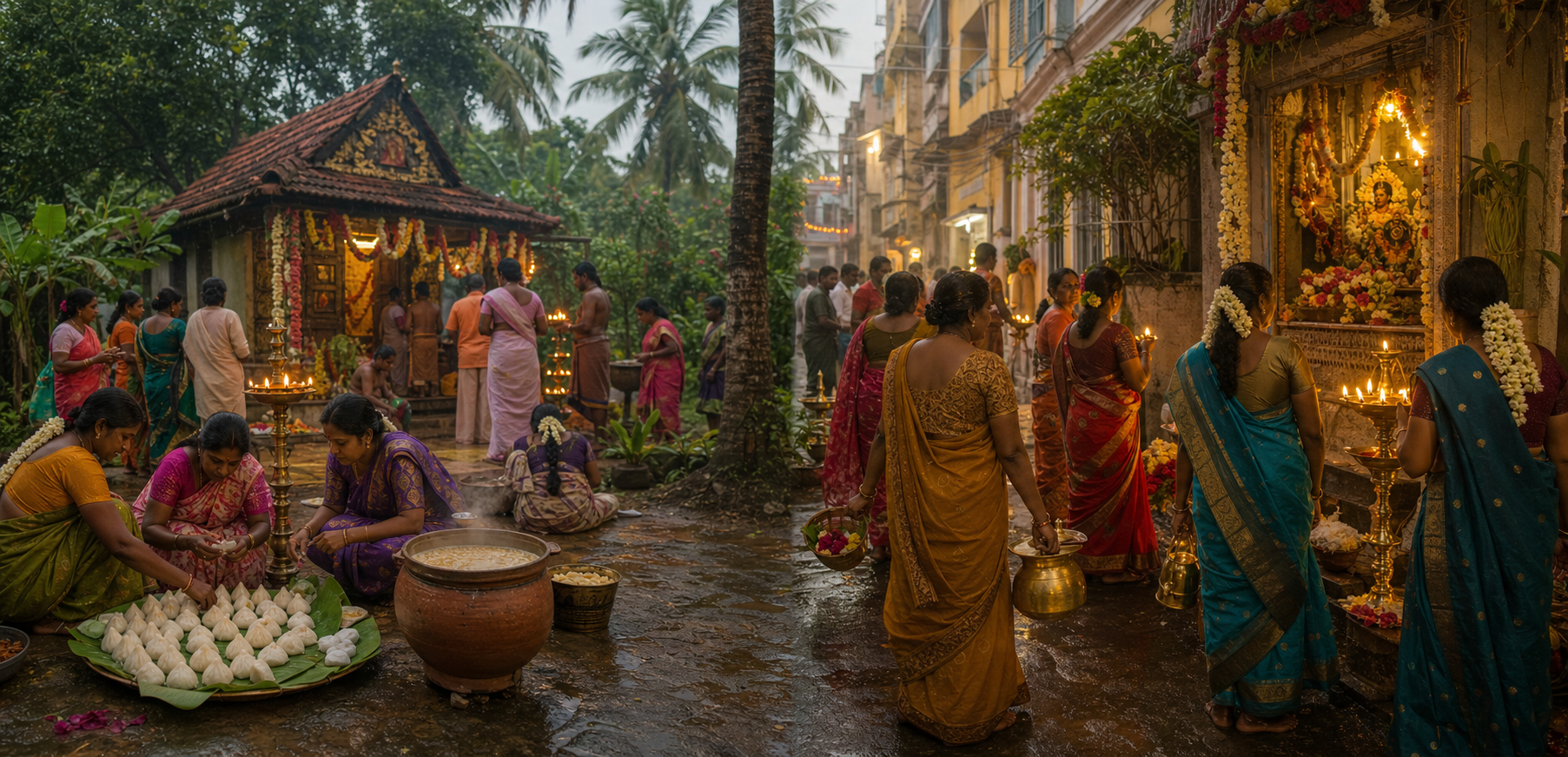
Aadi temple festivals are best understood not as one statewide programme but as a sacred season given local form. A comparison of Avvaiyar Amman Temple at Thazhakudy near Nagercoil and Mundaka Kanni Amman Temple in Chennai shows how the same Tamil month can revolve around different weekdays, offerings, sacred narratives and community settings.
The two source accounts offer a practical way to distinguish what is shared across Aadi worship from what belongs to a particular shrine. That distinction matters for devotees planning a 2026 visit and for readers seeking to understand the diversity within Tamil Amman traditions.
One sacred month, two weekly festival rhythms
Both source articles describe Aadi as a Tamil solar month extending broadly from mid-July to mid-August. Under their shared 2026 calendar framework, Aadi begins on Friday, July 17. The Thazhakudy festival guide explains that solar-month boundaries can vary between almanacs because of computational and calendrical conventions, so a local temple announcement or accepted Tamil panchangam should take precedence when precise timing matters.
| Festival focus | 2026 dates reported by the sources | Local significance |
|---|---|---|
| Aadi Pirappu | Friday, July 17 | Beginning of Aadi under the calendar framework used by both guides |
| Aadi Chevvai at Thazhakudy | July 21, July 28, August 4 and August 11 | Four Tuesdays forming the principal Avvaiyar Amman Temple festival cycle |
| Aadi Velli in Mylapore | July 17, July 24, July 31, August 7 and August 14 | Five Fridays of intensified Goddess worship at Mundaka Kanni Amman Temple |
The difference is not a dispute about Aadi but an example of ritual localisation. At Thazhakudy, the month-long sacred season is organised most distinctively around Aadi Chevvai, or Tuesdays. At Mylapore, Aadi Velli, or Fridays, provides the recurring festival rhythm. The Thazhakudy source presents Tuesday through devotional ideas of disciplined energy, protection and overcoming obstacles, while the Mylapore account associates Friday with the Goddess, auspiciousness and household well-being. These are religious interpretations within living traditions, not universal causal claims.
A shared devotional grammar expressed through local offerings
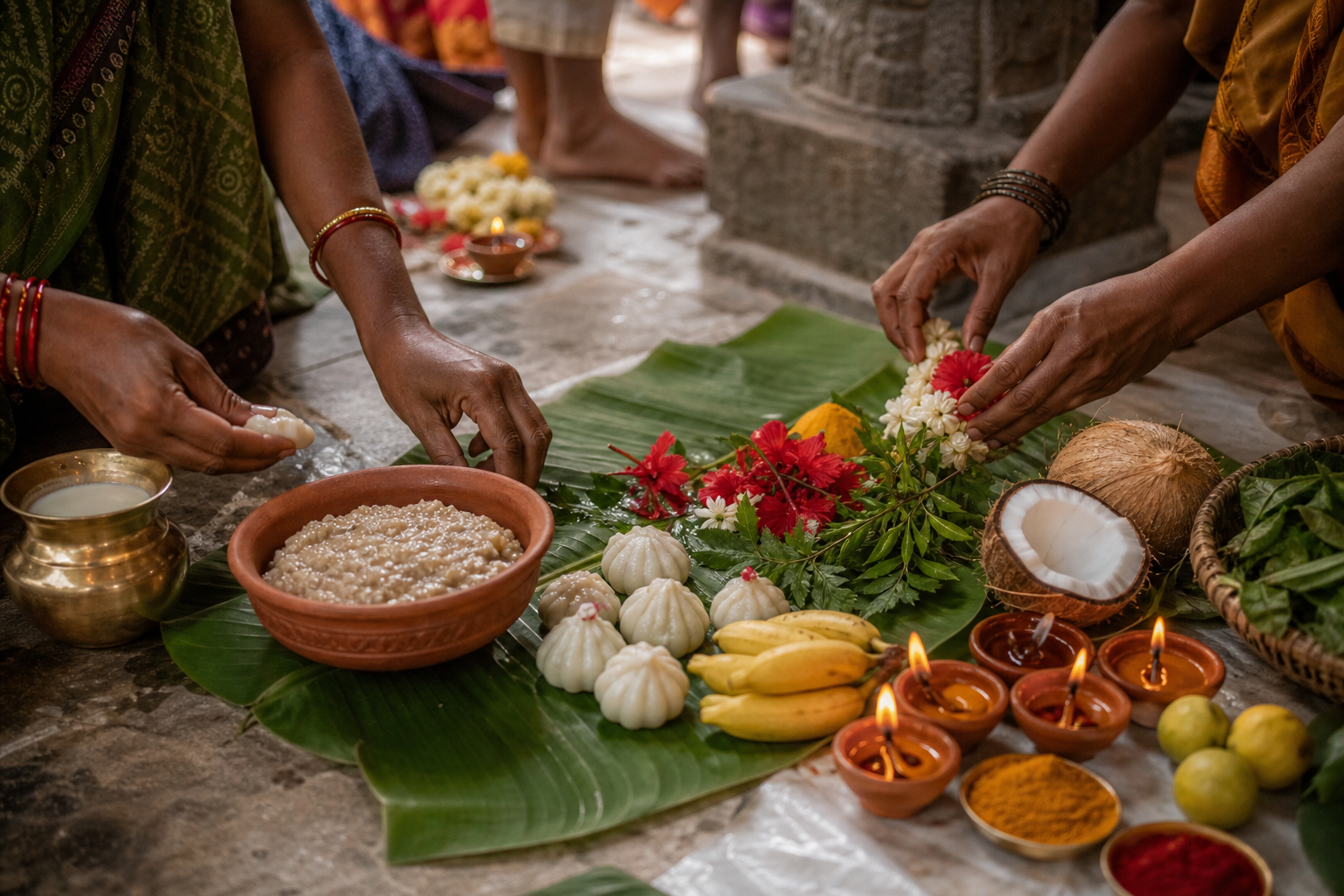
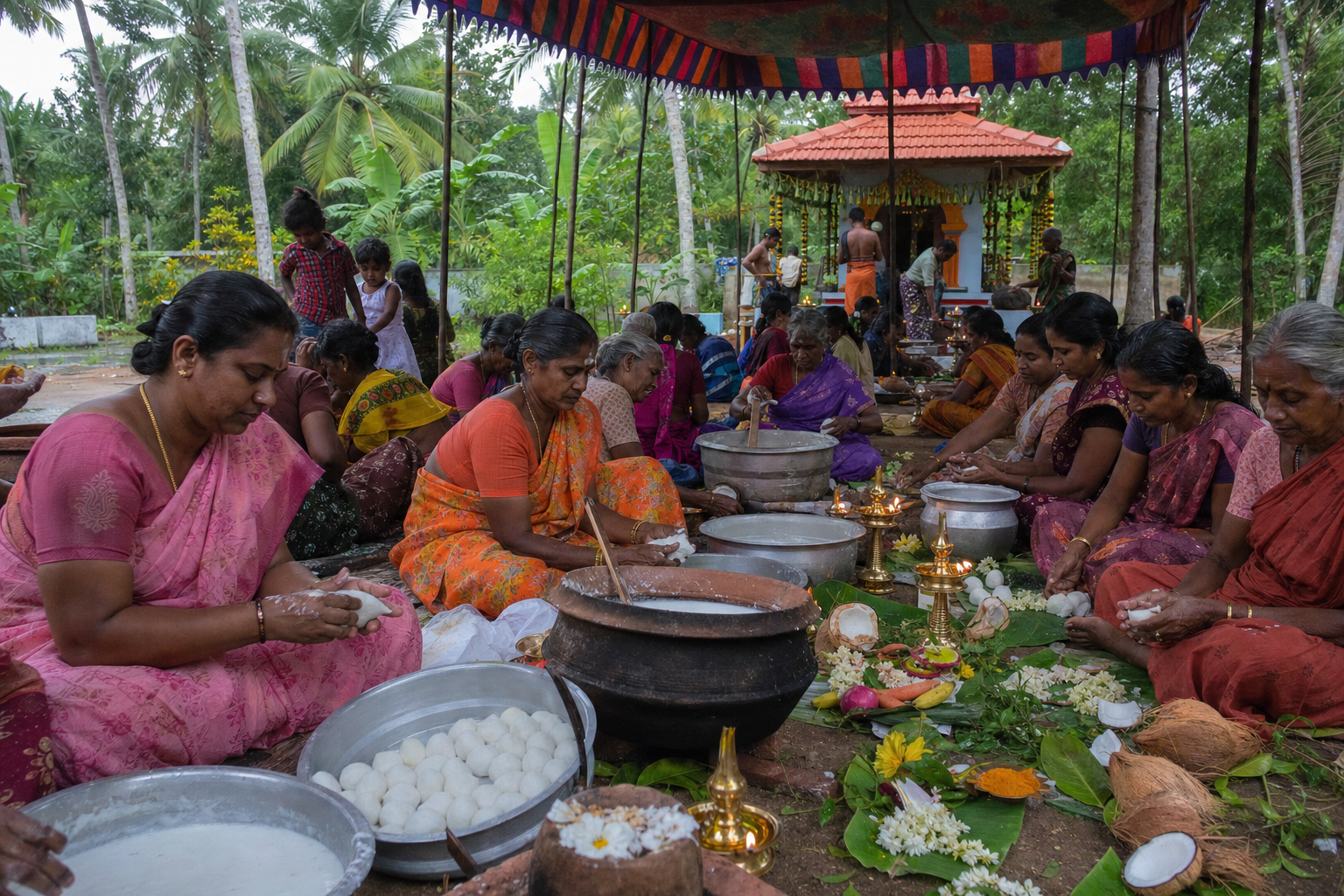
Despite their different weekly centres, both festivals connect Shakti worship with family concerns, disciplined vows, food and collective participation. The Thazhakudy guide reports special pujas, women-centred vows and food offerings, including the kozhukattai closely associated with large Tuesday gatherings. It also describes devotees arriving from elsewhere in Tamil Nadu and from neighbouring Kerala.
The Mylapore source depicts a more visibly urban and neighbourhood-based setting. During Aadi Velli, the streets around the temple become part of the devotional environment through flowers, turmeric, kumkum, lamps and milk offerings. Pongal and koozh connect worship inside the shrine with preparation, distribution and service outside it. The account consequently presents the festival as a meeting point between household practice and temple ritual rather than as a spectacle confined to the sanctum.
The Mylapore article also reports a five-Goddess thematic sequence for 2026: Swarnambika on July 17, Angala Amman on July 24, Kalikambal on July 31, Kamakshi Amman on August 7 and Lakshmi on August 14. The source explicitly treats this as a local devotional framework rather than a standard sequence for every Amman temple. Its themes range from prosperity and protection to courage, health, harmonious relationships and peace of mind.
Taken together, the reports show that Aadi has unity without ritual uniformity. Food may function as an offering, fulfilment of a vow or shared sustenance; colour and fragrance may mark both private devotion and public space; and prayers for protection or prosperity may be directed through different local forms of the Divine Mother. The common structure is reverence for Shakti, while each temple determines the idiom through which that reverence is expressed.
Sacred geography shapes the meaning of each celebration
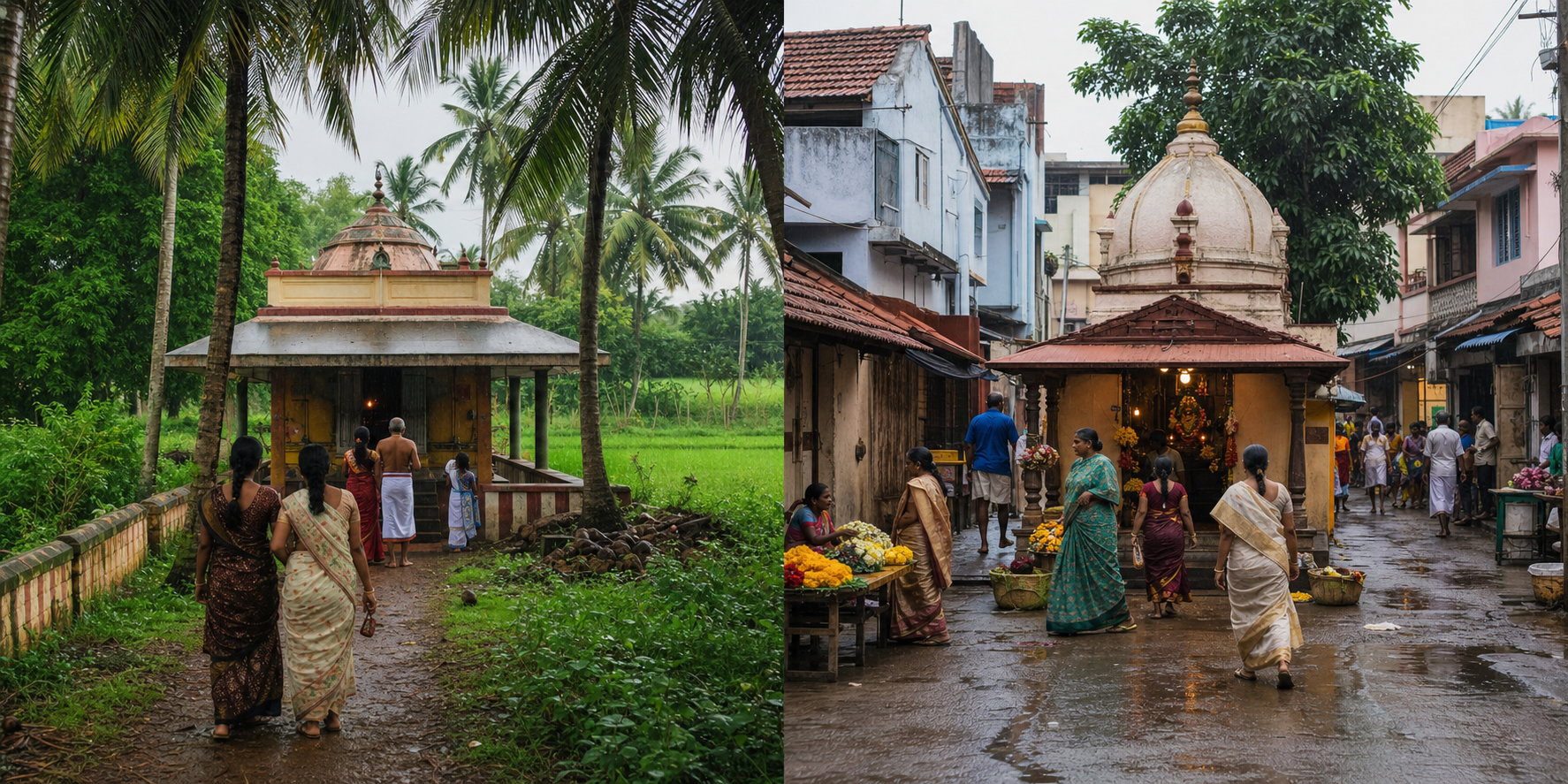
At Thazhakudy, Avvaiyar is venerated not merely as a literary personality but as Amman. The source cautions that the name Avvaiyar is associated with more than one woman poet from different historical periods; temple tradition, however, gathers those layered memories into a revered maternal figure. Wisdom, ethical instruction, elderhood and feminine authority thereby become part of the shrine’s sacred identity. Local narratives also connect the place with Avvaiyar’s encounters with Murugan, although the article presents these as temple traditions rather than historically verified events.
The Thazhakudy building history remains provisional in the supplied account. One guide cited by the article calls the temple approximately 300 years old, while a reported 2025 heritage walk tentatively relates its fabric to the sixteenth- or seventeenth-century Vijayanagara-Nayaka period. The article describes a south-facing temple with a sanctum, ardha mandapam, mukha mandapam and small vimana, along with Dwarapalakis, Naga images, Vinayagar and a Murugan shrine. It also notes that renovation was visible during the 2025 visit, making current temple guidance more reliable than older photographs for understanding present conditions.
Mundaka Kanni Amman Temple occupies a different kind of sacred landscape. The Mylapore article places it north of Kapaleeswarar Temple and west of Madhava Perumal Temple, within an urban area where Shaiva, Vaishnava and Amman institutions retain distinct identities while sharing civic space. Citing the Tamil Nadu Hindu Religious and Charitable Endowments Department’s received history, the article reports a traditional age of approximately 1,300 years and describes the presiding Goddess as a swayambhu. It also cautions that the accompanying official account does not supply an inscriptional or archaeological sequence establishing that chronology.
The Mylapore shrine’s retained thatched covering, minimally anthropomorphic sacred form, anthill, tree and naga images make material continuity central to its identity. Oral explanations cited by the source connect the thatch with naga worship or with the Mother’s willingness to bear heat while granting relief to devotees. These explanations belong to devotional tradition, but the preserved roof also demonstrates how communities can renovate a temple while protecting a feature understood as inseparable from the deity’s presence.
Planning a 2026 visit without flattening local practice
The calendar is the starting point, not the whole programme. The reported dates identify the relevant Tuesdays and Fridays, but special pujas, alankarams, offering arrangements and crowd procedures may be set locally. Visitors should confirm the temple’s current notice before organising a vow, group journey or time-sensitive ritual.
Names and spellings require similar care. The southern shrine is variously described as Avvaiyar or Avvayar Amman Temple, and its village name appears as Thazhakudy or Thalakudy. The source specifically distinguishes it from other Avvaiyar-associated sites in Kanniyakumari district. In Chennai, Mundaka Kanni, Mundakakanni, Mundagakanni and Mundgakanni refer to the same Mylapore temple; the source gives the official address as 42, Mundakakanni Amman Koil Street, Mylapore, Chennai 600004.
Crowd patterns also differ. Every reported Thazhakudy Tuesday belongs to the temple’s main Aadi cycle. At Mylapore, the source says all five Fridays are significant while identifying the first and third Fridays as occasions of particular attention; it notes that devotees often arrive early for milk offerings and darshan. No visitor should assume that an offering accepted at one shrine will be performed in the same way at another. This is especially important around the anthill and naga images in Mylapore, where the source directs devotees to follow temple personnel and avoid disturbing the sacred setting.
Key takeaways for understanding Aadi festivals
- Aadi is a sacred Tamil month containing several observances, not a single festival with one statewide programme.
- Thazhakudy’s Avvaiyar Amman tradition is centred on four Aadi Tuesdays in 2026, while Mylapore’s Mundaka Kanni Amman observance is organised around five Aadi Fridays.
- Both temples connect Goddess worship with vows, offerings, food and community participation, but their sacred narratives and ritual emphases remain local.
- Published dates provide a planning framework; temple notices should govern actual timings, permitted offerings and on-site arrangements.
As the 2026 season approaches, attention to temple announcements will allow visitors to honour both the shared significance of Aadi and the local traditions that give each celebration its character.
References
- DharmaRenaissance Blog — Essential Guide to Aadi Festival 2026 at Nagercoil’s Avvaiyar Amman Temple
- DharmaRenaissance Blog — Sacred Aadi Velli at Mylapore’s Mundaka Kanni Amman Temple: Complete 2026 Guide