

Bhima’s encounters with Hidimba, Baka and Kirmira are not merely three demonstrations of physical strength. Read as a connected sequence, they show how the Mahabharata distinguishes protective force from predation while testing whether violence can remain answerable to dharma.
The supplied DharmaRenaissance account presents each adversary as a different kind of danger: Hidimba threatens a vulnerable family, Baka turns human consumption into a system imposed on a community, and Kirmira seeks revenge for earlier deaths. Their connection reveals both the necessity of Bhima’s strength and the moral limits placed upon it.
Three conflicts, three forms of predatory power
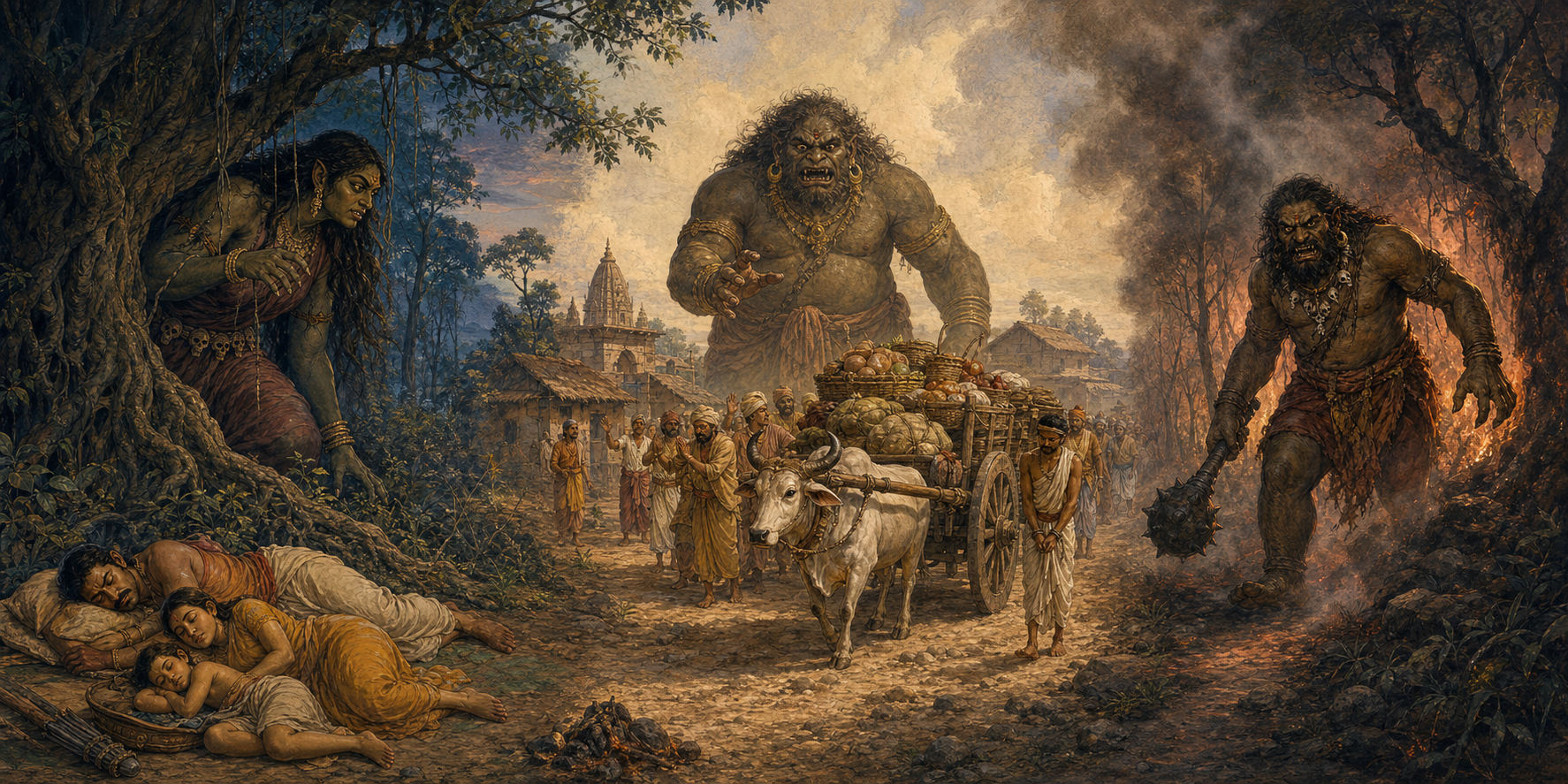
The three episodes belong to different stages of the Pandavas’ displacement. According to the source, the encounter with Hidimba follows their escape from the house of lac; the struggle with Baka occurs while they are living anonymously at Ekachakra; and Kirmira confronts them near the beginning of their forest exile. Their narrative settings change, but Bhima repeatedly stands between dependants and a power that treats human beings as prey.
| Encounter | Form of danger | Bhima’s protective role | Wider consequence |
|---|---|---|---|
| Hidimba | An immediate attempt to seize the sleeping travellers as food | Bhima guards Kunti, his brothers and Hidimbi when her brother threatens her | Restraint after the battle permits a new alliance through Hidimbi and Ghatotkacha |
| Baka | A compulsory tribute imposed on Ekachakra that includes a human victim | Bhima’s strength is directed against an established system of communal terror | Baka’s death later becomes one of Kirmira’s motives for revenge |
| Kirmira | Retaliation grounded in kinship and friendship | Bhima again confronts danger during the Pandavas’ exile | The episode links the earlier conflicts into a continuing vengeance chain |
The source cautions against treating the three adversaries as a single biological clan. It identifies Kirmira as Baka’s brother and Hidimba’s friend, creating a network of blood relationship, personal loyalty and shared predatory conduct rather than one documented lineage. This precision matters because Kirmira’s grievance gathers two separate deaths into one demand for retribution.
Names and textual locations can also vary by edition. The account notes Hidimva as a form of Hidimba, Vaka or Bakasura for Baka, and Kirmeera for Kirmira. It places the Hidimba and Baka narratives in the Adi Parva and Kirmira’s confrontation in the Vana Parva, while warning that section numbering differs among recensions and translations.
Bhima’s strength is framed as guardianship

The Hidimba episode establishes the pattern under conditions of extreme vulnerability. The source reports that the Pandavas and Kunti fall asleep in the wilderness after escaping the plot at Varanavata, while Bhima remains awake. Hidimba detects the travellers and sends his sister Hidimbi to bring them as food. She instead assumes a human appearance, warns Bhima and offers to carry the family away.
Bhima refuses to desert or needlessly disturb those in his care. When Hidimba arrives and threatens both the travellers and his disobedient sister, Bhima draws him away from the sleepers before wrestling with him. Arjuna offers assistance after the others awaken, but Bhima completes the fight and kills the attacker. The sequence makes his physical confidence serve a clear responsibility: danger is drawn toward the guardian and away from the guarded.
The boundary after victory is equally important. The source reports that Bhima remains suspicious of Hidimbi, but Yudhishthira prevents anger and fear from becoming violence against her. Kunti hears Hidimbi’s case, and the family recognizes that her conduct differs from her brother’s. Force is therefore directed at an aggressor rather than extended indiscriminately to everyone associated with him.
Baka’s domination of Ekachakra changes the scale of the problem. The source describes a compulsory arrangement under which the community must provide tribute that includes a human victim. This is not a sudden attack on one travelling family but predation made regular and socially binding. Bhima’s killing of Baka consequently represents protection from an entrenched regime of fear, even though the Pandavas themselves are living in concealment and cannot safely claim public authority.
Kirmira turns protection into a cycle of revenge

Kirmira’s motive gives the sequence its cumulative shape. As reported by the source, he confronts the exiled Pandavas because Bhima killed Baka, his brother, and Hidimba, his friend. From Kirmira’s perspective, the earlier acts have created obligations of loyalty and vengeance. From the Pandavas’ perspective, those acts answered threats against a family and a terrorized community.
The moral tension does not depend on denying Kirmira’s relationships. His anger demonstrates that even justified protection can have consequences within the aggressors’ social world. Yet kinship and friendship do not retrospectively erase Baka’s imposed human tribute or Hidimba’s attempt to consume the travellers. The episode instead separates an understandable motive for grief from a justified claim to continue the violence.
This distinction makes the vengeance chain more than a sequence of increasingly powerful opponents. Bhima’s victories do not automatically restore peace because coercive networks preserve memory, allegiance and retaliation. The Mahabharata’s forest world thus presents a difficult feature of justice: stopping immediate harm may be necessary, but the act can still generate a later adversary.
Rakshasa identity does not determine moral conduct

The source emphasizes that Rakshasa is a complex epic category associated with capacities such as exceptional strength, altered form and night fighting. It should not be treated as a simple moral synonym for a consumer of human flesh. Hidimba, Baka and Kirmira are portrayed as human predators, but Hidimbi rejects the conduct demanded by her brother.
That refusal changes the direction of the narrative. The source reports that Yudhishthira permits a regulated union between Bhima and Hidimbi: Bhima may spend the day with her but returns to his family at night, and he remains until the birth of their son. Ghatotkacha matures with supernatural speed, honours both parents and promises to aid the Pandavas when called.
The later consequences make Hidimbi’s moral agency central rather than incidental. According to the account, Ghatotkacha helps the Pandavas during exile, including by carrying an exhausted Draupadi through difficult terrain. In the Kurukshetra war, his nocturnal power pressures the Kaurava forces until Karna uses against him the single-use divine missile he had preserved for Arjuna. The source further reports Krishna’s interpretation that expending the weapon on Ghatotkacha was decisive for Arjuna’s survival.
The contrast is deliberate: Hidimbi shares her brother’s broad identity but refuses his command, protects his intended victims and forms a bond whose consequences reach the great war. The episodes therefore judge characters by decisions and allegiances, not by category alone. Bhima’s force and Yudhishthira’s restraint work together; one stops the immediate attacker, while the other leaves room to recognize a potential ally.
Key takeaways
- Hidimba, Baka and Kirmira are connected through conflict, kinship and friendship, but the supplied source does not identify them as one bloodline.
- Each encounter presents a different problem: direct attack, institutionalized tribute and retaliatory vengeance.
- Bhima’s violence is repeatedly framed as protective because it answers threats to dependants or a vulnerable community.
- Yudhishthira’s treatment of Hidimbi prevents legitimate defence from becoming collective punishment.
- Hidimbi and Ghatotkacha show that Rakshasa identity does not predetermine conduct or allegiance.
Further study of Bhima’s forest battles can therefore move beyond cataloguing defeated adversaries and examine how the epic pairs strength with discrimination. The enduring question is not simply whether force wins, but whether it protects without erasing moral choice.