
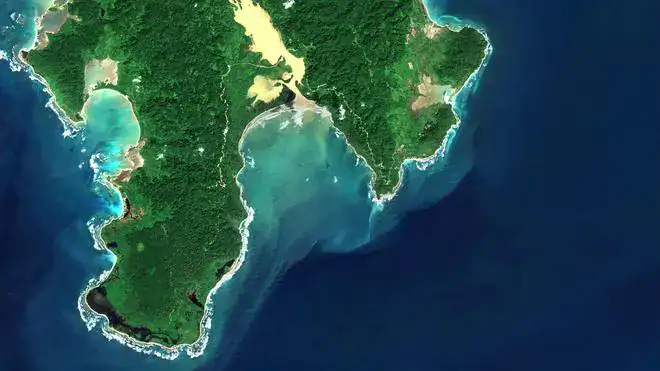
Great Nicobar is a rare test of whether Bharat can turn favorable geography into durable national capability without degrading the island that makes that capability possible. The proposed port, airport, power system and township promise maritime reach, but they also concentrate economic, ecological, tribal and disaster risks in one place.
The sound measure of success is therefore not construction alone. It is whether each phase delivers verified public value while respecting enforceable limits.
One project, four dependent systems
The supplied analysis reports that the Holistic Development of Great Nicobar Island combines an international container transshipment terminal at Galathea Bay, a greenfield international airport, a 450 MVA gas-and-solar power system and a township with supporting utilities. It cites a March 2025 Lok Sabha reply that recorded a tentative cost of approximately Rs 81,000 crore over 30 years.
These components form a single operating system: the port needs power, water, communications, workers and emergency access, while the airport and township depend on real logistical demand. That interdependence makes phasing essential. Port expansion should follow demonstrated cargo, and urban growth should follow verified employment and population needs rather than speculative projections.
Location creates leverage, not guaranteed success
The account places the proposed port about 40 nautical miles from a major international shipping route and reports natural water depth exceeding 20 metres at Galathea Bay. This position near the western approaches to the Strait of Malacca could strengthen maritime awareness, logistics, search-and-rescue operations and Bharat’s presence along the sea lanes connecting the Indian and Pacific Oceans.
Geography, however, does not confer control over the strait or guarantee customers. The reported 14.2-million-TEU design figure describes potential capacity, not actual traffic. A transshipment hub succeeds only when shipping lines find its prices, turnaround times, reliability and feeder connections competitive. Strategic value can support investment, but it cannot substitute for transparent commercial testing.
Stewardship is part of national strength
The source notes that UNESCO added the Great Nicobar Biosphere Reserve to its global network in 2013. It also describes mature rainforest, leatherback turtle nesting habitat and lands used by the Shompen and Nicobarese communities. Citing government project material, it reports that 84.10 square kilometres of the development area overlaps notified tribal reserve land. Replacing reserve acreage elsewhere cannot by itself preserve access, food resources, movement routes or cultural meaning.

Dharmic traditions offer a useful ethical vocabulary for this challenge without replacing law or science. Hindu dharma connects authority with duty; Jain and Buddhist teachings on ahimsa sharpen the obligation to minimize avoidable harm; Sikh seva directs public strength toward protection and relief. These traditions are distinct, yet they converge on a vital principle: power is legitimate when exercised with restraint, responsibility and regard for life.
That principle also protects national interests. The island lies in India’s highest seismic-risk classification, and the analysis recalls the severe effects of the 2004 earthquake and tsunami. Redundant power, communications, water and evacuation systems are not optional additions. Infrastructure that fails during a disaster cannot fulfil its strategic purpose.
Safeguards must operate as decision gates
The source reports that environmental clearances were granted in November 2022 with 42 project-specific conditions. It further states that, on February 16, 2026, the National Green Tribunal declined to interfere with the clearance while requiring full and strict compliance. Approval therefore permits work subject to obligations; it does not certify that future impacts are harmless.
Effective oversight would connect published measurements to predetermined responses. Excess turbidity, shoreline damage, freshwater stress, habitat interruption or a breach of tribal protections should trigger investigation, redesign or a work stoppage. Independent monitoring should cover ecological indicators, disaster readiness, public expenditure and commercial milestones. Security-sensitive information can remain protected without treating ordinary environmental compliance as secret.
Key takeaways
- Great Nicobar can expand Bharat’s maritime reach and disaster-response capacity.
- Planned port capacity is not evidence of future cargo demand.
- Rainforest and tribal lands cannot be replaced through area accounting alone.
- Seismic, tsunami and freshwater constraints must shape the engineering design.
- Every expansion phase should depend on independently verified performance.
A strategic asset must remain a living island
Bharat need not choose between maritime capability and responsible stewardship. The harder and more dharmic task is to build only what evidence justifies, preserve what cannot be recreated and correct failures before they become irreversible. If Great Nicobar is governed by that discipline, it can demonstrate a form of statecraft in which national confidence, indigenous dignity and care for nature reinforce one another.
