
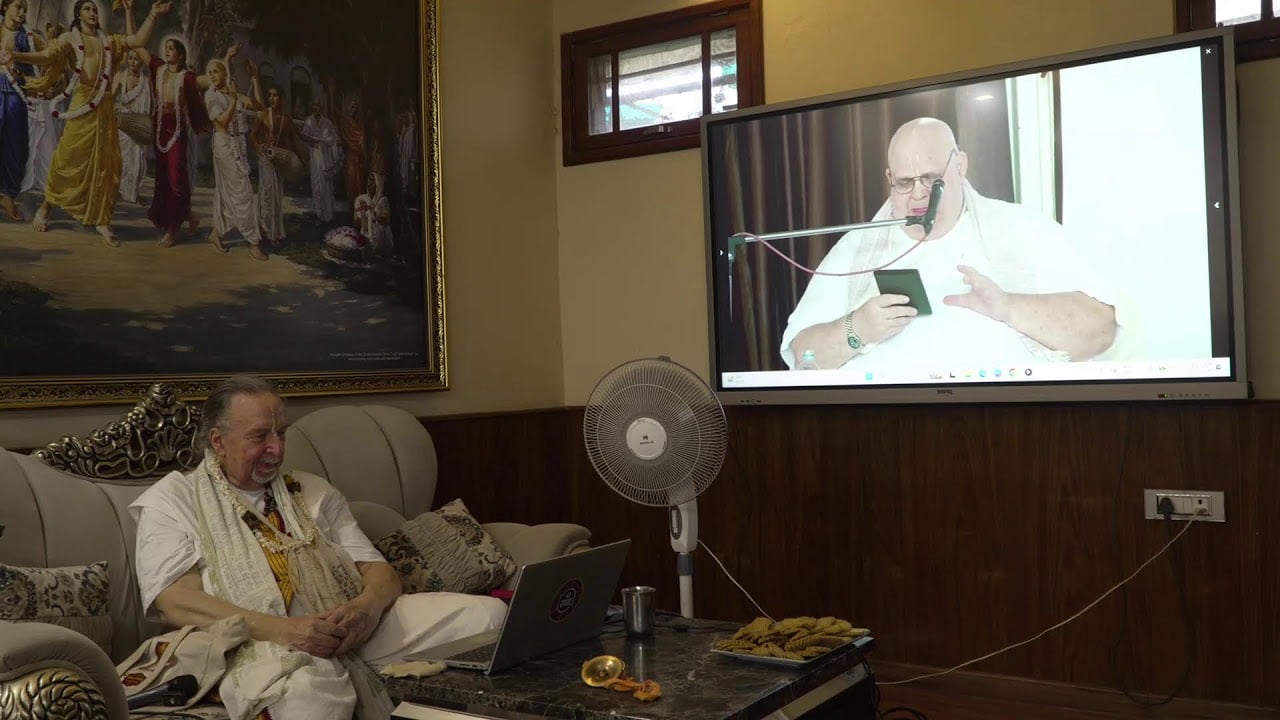
The disappearance day glorification of HG Brahmananda Prabhu at ISKCON Vrindavan is more than a memorial event. In the Gaudiya Vaishnava tradition, such an observance becomes a disciplined act of remembrance, gratitude, and theological reflection. The life of a senior devotee is not studied merely as biography, but as a living case study in guru-seva, devotional institution-building, and the transmission of Krishna consciousness across cultures.
Brahmananda Prabhu is remembered within ISKCON as one of Srila Prabhupada’s early Western disciples, a devotee who stood near the beginning of a movement that began in modest circumstances and later became a global religious community. His life belongs to the earliest phase of the Hare Krishna movement, when the preaching of A. C. Bhaktivedanta Swami Prabhupada moved from a small storefront in New York to temples, publications, public kirtans, and missionary work across continents.
To understand the emotional weight of a disappearance day, one must first understand the Gaudiya Vaishnava meaning of departure. The passing of a Vaishnava is not treated only as a moment of loss. It is also approached as a sacred opportunity to examine what kind of service was offered, what qualities were embodied, and what responsibilities remain for those who inherit a spiritual tradition. In that sense, Brahmananda Prabhu’s remembrance naturally turns the mind toward fidelity, sacrifice, humility, and the enduring role of discipleship.
ISKCON’s early history is remarkable because it joined intense theological conviction with practical organization. Srila Prabhupada arrived in the United States in 1965 and established the International Society for Krishna Consciousness in 1966. The first generation of disciples had to learn Sanskritic theology, temple worship, kirtan, prasadam distribution, book production, public speaking, and community administration at the same time. Brahmananda Prabhu’s service should be read within that demanding environment, where devotion was measured not only by emotion but also by reliability.
Historical accounts of the period show that the early devotees were not inheriting a ready-made institution in the West. They were helping build one. The name Brahmananda appears in connection with that formative circle of disciples who accepted Srila Prabhupada’s discipline and helped carry forward his mission. In a 1967 letter, Srila Prabhupada referred appreciatively to the sincerity of disciples such as Brahmananda, emphasizing that genuine preaching depends not on academic status or wealth but on empowerment, steadiness, and purity of purpose.
This point is central to any serious glorification. Brahmananda Prabhu’s significance does not rest merely on being early. Chronology alone does not create spiritual stature. What gives meaning to his remembrance is the quality of service associated with those early years: accepting responsibility when there were few resources, remaining close to the founder-acharya’s instructions, and helping transform private conviction into public religious culture.
The disappearance day observed at ISKCON Vrindavan is especially meaningful because Vrindavan is not simply a geographic setting in Krishna consciousness. It is the sacred landscape of remembrance, the theological center of Krishna-bhakti, and the place where Srila Prabhupada spent significant periods in translation, worship, and final pastimes. To remember Brahmananda Prabhu in Vrindavan is therefore to situate his life within the heartland of the tradition he served.
For devotees, the word seva is not a vague ideal. It includes concrete acts: managing a temple, supporting publication, arranging programs, receiving guests, protecting standards, serving other Vaishnavas, and continuing even when external recognition is limited. The early ISKCON generation had to translate devotion into daily systems. Brahmananda Prabhu’s legacy is best appreciated through this disciplined lens, because spiritual movements endure only when inspiration becomes organized service.
The mood of glorification also requires careful balance. Academic honesty does not reduce devotion; it strengthens it. A mature tribute avoids exaggeration, personality worship, and sentimental simplification. It recognizes that the life of a devotee can be honored most authentically by studying the principles that animated that life. In Brahmananda Prabhu’s case, those principles include loyalty to guru, courage in outreach, institutional responsibility, and service to the spread of bhakti beyond cultural boundaries.
That cross-cultural dimension is essential. The Hare Krishna movement introduced many Western seekers to Bhagavad Gita, Srimad Bhagavatam, kirtan, deity worship, vegetarian prasadam, japa meditation, and the broader devotional framework of Sanatana Dharma. Brahmananda Prabhu’s generation helped show that Krishna consciousness could be practiced outside India without being detached from its scriptural roots. This was not a dilution of Hindu spirituality, but an attempt to make its discipline intelligible and livable in new settings.
Disappearance day remembrance therefore becomes a mirror for contemporary spiritual life. Modern seekers often inherit religious content through videos, lectures, festivals, and social media, but the first generation of ISKCON devotees often had to build the channels through which that content would later travel. Their example asks a difficult question: is devotion being consumed as inspiration, or practiced as responsibility?
Brahmananda Prabhu’s life also invites reflection on the guru-shishya relationship. In dharmic traditions, the disciple is not merely a listener. The disciple receives instruction, tests it through practice, and becomes accountable to a lineage. In Gaudiya Vaishnavism, this accountability is expressed through hearing, chanting, service, humility, and fidelity to parampara. Such a framework gives devotional life its structure and protects it from becoming only private emotion.
The emotional dimension of this remembrance should not be understated. Communities preserve themselves through memory. When devotees gather to hear about a departed Vaishnava, the atmosphere often carries gratitude, longing, and renewed seriousness. The stories of earlier servants become a form of moral instruction. They remind younger generations that temples, publications, festivals, and spiritual communities were built through sacrifice, not convenience.
In a wider dharmic context, such remembrance supports unity rather than sectarian division. Hindu, Buddhist, Jain, and Sikh traditions all preserve forms of reverence for teachers, elders, renunciants, saints, and exemplars of disciplined life. The language and theology differ, yet the shared civilizational instinct is clear: a community remains healthy when it remembers those who embodied discipline, compassion, self-restraint, and service.
For this reason, Brahmananda Prabhu’s glorification should be understood not as a narrow institutional ritual but as part of a larger culture of gratitude. Remembering a Vaishnava properly means becoming more serious about one’s own conduct. It means asking whether speech is becoming kinder, whether practice is becoming steadier, whether service is becoming less self-centered, and whether the inherited tradition is being strengthened for future generations.
The technical foundation of Krishna consciousness is also relevant here. Bhakti is not presented in Gaudiya Vaishnava theology as mere sentiment. It is a disciplined path involving sadhana, nama-japa, sadhu-sanga, scriptural study, deity worship, prasadam, and practical service. A devotee’s life is therefore evaluated not by public image alone, but by participation in these interlocking practices. Brahmananda Prabhu’s remembrance naturally returns attention to this integrated devotional system.
Srila Prabhupada’s mission depended on books, kirtan, prasadam, and communities that could carry theology into daily life. Early disciples such as Brahmananda Prabhu helped demonstrate that the movement required both contemplative faith and operational competence. A temple needed accounts, schedules, cleanliness, cooking, teaching, correspondence, outreach, and personal discipline. This practical dimension is often overlooked, but it is central to the history of ISKCON.
The remembrance also points toward Vrindavan’s deeper lesson: devotion becomes most powerful when it softens the heart while sharpening responsibility. Sentiment without discipline becomes unstable. Discipline without affection becomes dry. The Vaishnava ideal joins both. A disappearance day, when observed thoughtfully, allows a community to grieve, honor, study, and recommit.
In that spirit, the glorification of HG Brahmananda Prabhu becomes a call to preserve the best of the early ISKCON mood: sincerity over display, service over status, remembrance over forgetfulness, and unity over rivalry. His life is not only a chapter in the Hare Krishna movement’s past. It remains a prompt for present-day practitioners to ask how inherited blessings can be converted into living service.
Sources consulted for historical orientation include the ISKCON Vrindavan video presentation at YouTube, publicly available biographical material on A. C. Bhaktivedanta Swami Prabhupada, background on Back to Godhead, and related early-ISKCON references concerning Satsvarupa dasa Goswami and Bhakti Tirtha Swami. These references help situate Brahmananda Prabhu’s remembrance within the broader history of Srila Prabhupada’s mission, Gaudiya Vaishnavism, and the global development of Krishna consciousness.
Inspired by this post on Dandavats.
