
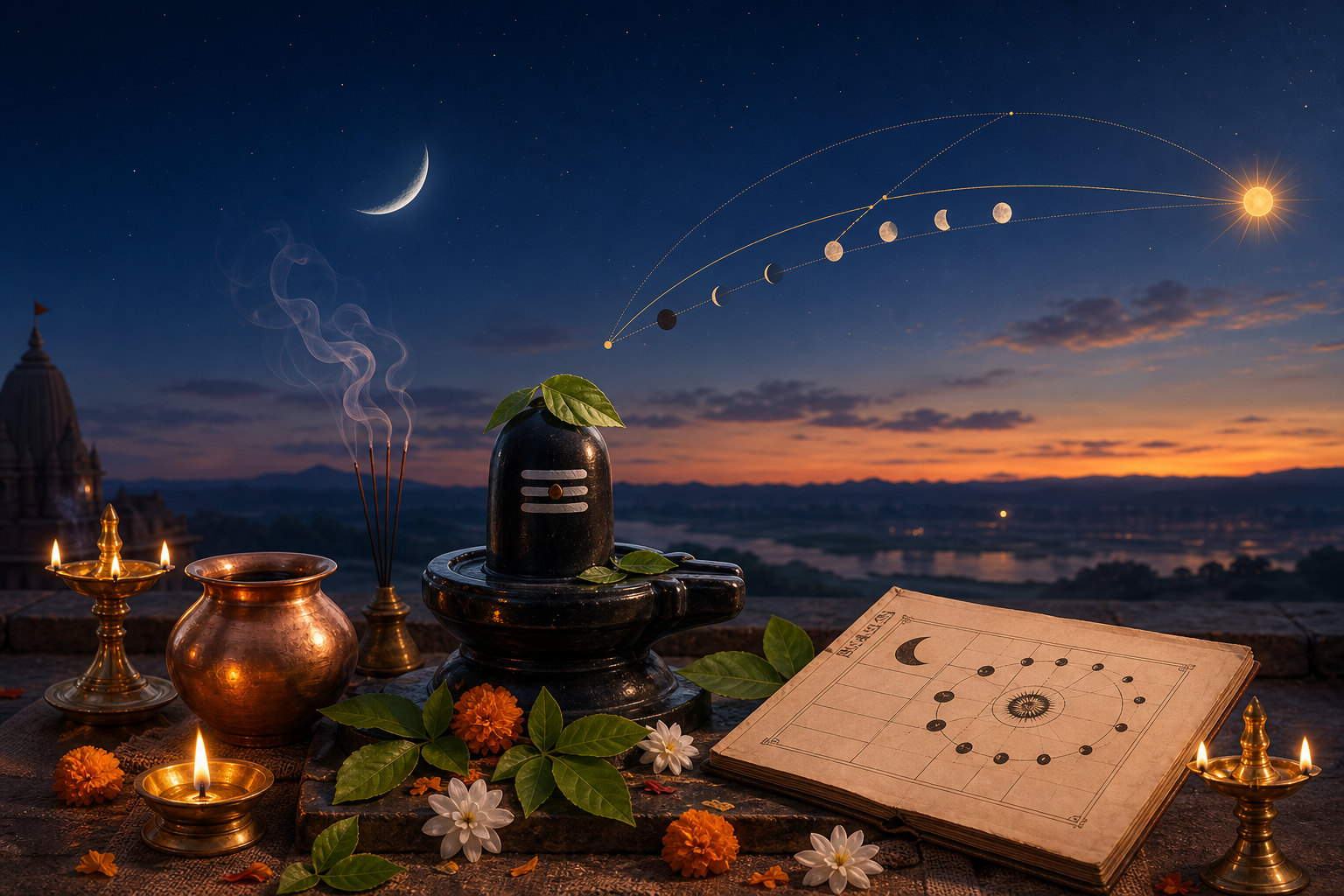
The Hindu calendar for Sunday, July 12, 2026, is marked primarily by Krishna Paksha Trayodashi tithi, the thirteenth lunar day in the waning or dark phase of the moon. According to the given panchang reference for most regions, Krishna Paksha Trayodashi continues until 8:30 PM on July 12. After that time, Krishna Paksha Chaturdashi begins, carrying the lunar cycle into the fourteenth tithi before Amavasya.
This transition from Trayodashi to Chaturdashi is important because a Hindu panchang does not measure the day only by the civil calendar date. It follows the angular relationship between the sun and the moon, and that relationship changes continuously. For this reason, a tithi may begin or end at any hour of the day, and July 12, 2026, should be read as a lunar day whose spiritual rhythm shifts in the evening.
Krishna Paksha refers to the waning half of the lunar month, when the visible moon gradually decreases after Purnima and moves toward Amavasya. In Hindu tradition, this period is often associated with introspection, reduction, restraint, ancestral remembrance, and inner discipline. It is not merely a phase of darkness in a negative sense; it is a symbolic period of turning inward, simplifying intention, and preparing the mind for renewal.
Trayodashi, the thirteenth tithi, has a special place in Hindu ritual life because it is closely connected with Pradosh observances when the timing supports them. Pradosh is traditionally associated with worship of Lord Shiva during the twilight period, especially when Trayodashi prevails during the evening. Since the listed Trayodashi remains until 8:30 PM on July 12, the day carries particular relevance for devotees who observe Shiva puja, fasting, japa, meditation, or simple forms of disciplined worship during the evening hours.
From a technical panchang perspective, tithi is one of the five core limbs of the traditional calendar, along with vara, nakshatra, yoga, and karana. A tithi is determined by the difference in celestial longitude between the moon and the sun. Each tithi corresponds to a 12-degree separation, which is why tithi timing does not always align neatly with sunrise-to-sunrise civil days. This is one of the reasons Hindu calendar calculations can vary by place, tradition, and local sunrise.
The phrase “in most regions” is therefore significant. Panchang entries are location-sensitive, and local sunrise, longitude, latitude, and calculation tradition can affect ritual application. A devotee in India, North America, Europe, or Southeast Asia may see slightly different local observance windows even when the broad lunar tithi remains the same. For exact vrata, puja, or temple observance, a regional panchang should always be consulted.
After 8:30 PM, Krishna Paksha Chaturdashi begins. Chaturdashi is the fourteenth tithi and is especially significant in relation to Shiva worship, austerity, and practices that prepare the mind for the silence of Amavasya. In the waning phase, Chaturdashi often carries a more intense contemplative quality, and many spiritual households treat it as a time to reduce distraction, complete pending duties, and focus on prayer or self-discipline.
The practical value of this panchang entry lies in helping households plan religious activities with clarity. For families that maintain daily puja, the Trayodashi period until 8:30 PM provides a meaningful window for worship, charity, mantra recitation, scriptural reading, and remembrance of dharma. For those observing Pradosh-related discipline, the evening timing becomes especially relevant because the devotional focus is traditionally placed around sunset and twilight.
Good time, or shubh muhurat, should be understood carefully in this context. A tithi alone does not determine the full auspiciousness of a moment. Panchang-based decision-making also considers nakshatra, vara, yoga, karana, lagna, Rahu Kaal, Yamaganda, Gulika Kalam, and the nature of the activity being planned. A day may be spiritually powerful for worship and fasting while still requiring separate muhurat analysis for marriage, housewarming, travel, business openings, or major financial commitments.
Nakshatra and rashi also form part of the broader panchang interpretation. Nakshatra refers to the lunar mansion occupied by the moon, while rashi refers to the zodiac sign connected with lunar or planetary placement. These details help astrologers and ritual practitioners refine the quality of time. However, when only the tithi information is available, the safest and most accurate interpretation is to emphasize the confirmed Trayodashi-to-Chaturdashi transition rather than assume unsupported nakshatra or rashi details.
In daily Hindu practice, such calendar details create a bridge between cosmic time and ordinary life. The value of the panchang is not limited to prediction; it provides a disciplined framework for aligning conduct with sacred rhythm. Even a simple awareness that July 12, 2026, is Krishna Paksha Trayodashi until evening can encourage quieter speech, mindful food habits, restraint in unnecessary conflict, and a deeper orientation toward prayer.
The dharmic traditions of Hinduism, Buddhism, Jainism, and Sikhism all preserve, in different ways, the importance of disciplined time, mindful living, and ethical conduct. While their ritual calendars and theological frameworks differ, they share a civilizational respect for self-regulation, compassion, remembrance, and inner refinement. A panchang entry such as this can therefore be read not only as a Hindu calendar note but also as a reminder of the wider dharmic emphasis on living with awareness.
For devotees of Lord Shiva, Krishna Paksha Trayodashi can carry a distinct emotional resonance. The twilight worship associated with Pradosh often feels intimate and reflective, especially for families that light a lamp, offer water or bilva leaves, chant mantras, or sit quietly before the deity. Such practices are modest in outward form, yet they can bring structure, humility, and calm to a busy household.
At an academic level, this also shows how the Hindu calendar integrates astronomy, ritual, and social practice. The tithi is calculated through celestial movement, but its meaning is lived through vrata, puja, family customs, temple observances, and moral reflection. This combination of technical precision and spiritual interpretation is one of the enduring strengths of the panchang tradition.
Therefore, the key panchang note for Sunday, July 12, 2026, is straightforward but meaningful: Krishna Paksha Trayodashi prevails until 8:30 PM, after which Krishna Paksha Chaturdashi begins. The day is especially suitable for inward-looking spiritual practice, Shiva worship, disciplined prayer, and careful attention to the lunar transition. For specific muhurat decisions, the tithi should be read together with a complete local panchang for the relevant place.
Inspired by this post on Hindu Blog.
