
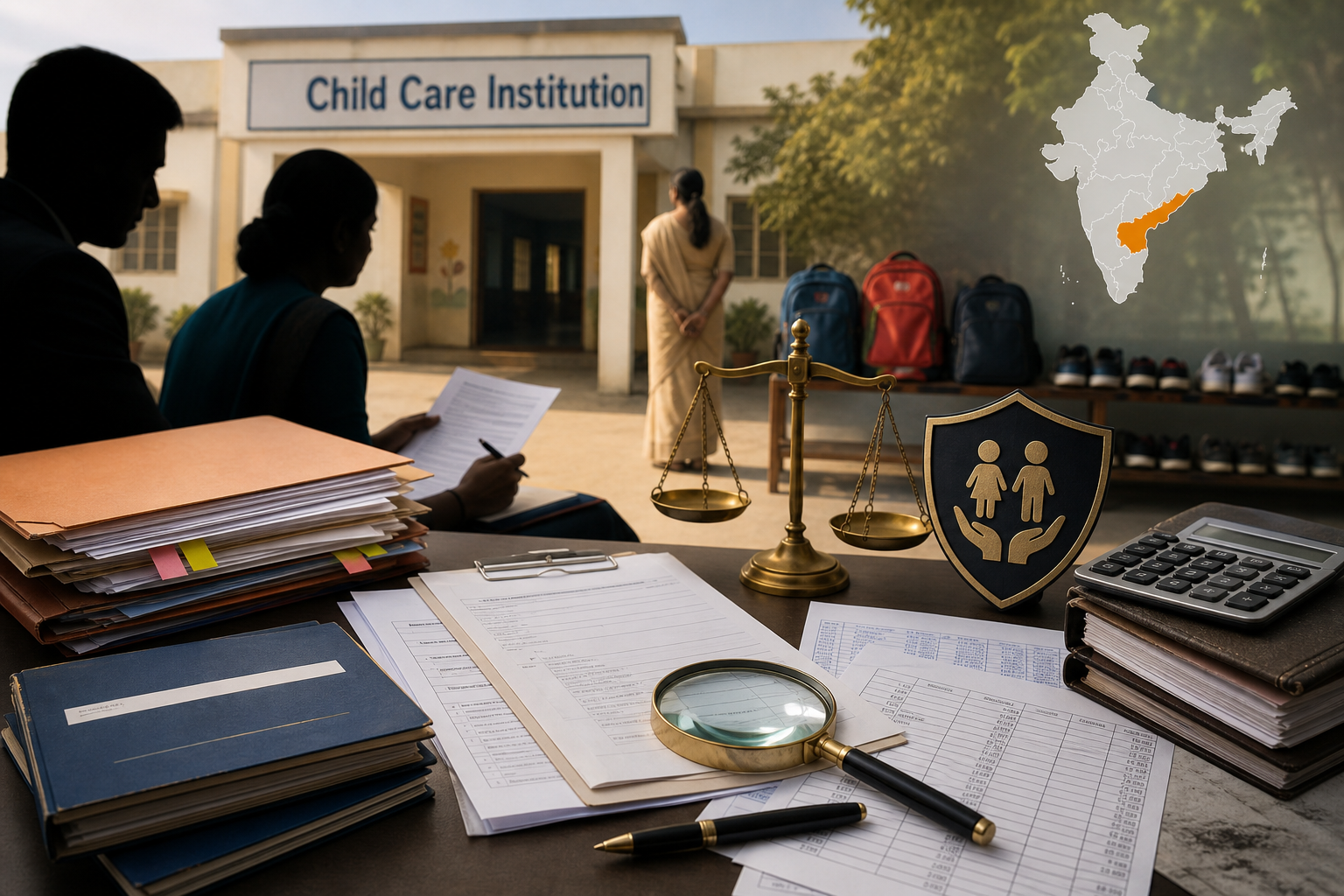
A complaint placed before the National Human Rights Commission has brought St. Anthony’s Orphanage in Adoni, Andhra Pradesh, under sharp public and regulatory scrutiny. The complaint, filed by the Legal Rights Protection Forum, alleges that the institution may have operated child care facilities without the statutory recognition required under the Juvenile Justice (Care and Protection of Children) Act, while also receiving substantial foreign contributions for orphan welfare and related purposes. Since the matter concerns children, institutional accountability, and foreign-funded social service, the allegations require careful examination without presuming guilt before competent authorities complete their inquiry.
The issue is significant because child care institutions in India do not function merely as charitable shelters. Under the Juvenile Justice framework, any institution housing orphaned, abandoned, surrendered, or otherwise vulnerable children is expected to operate within a formal protective structure. That structure is meant to ensure that children are not invisible to the State, that their identities and legal status are documented, that their nutrition, health, education, safety, and rehabilitation are monitored, and that inspections can take place through designated child protection authorities.
The core allegation before the NHRC is that St. Anthony’s Orphanage was not found in the official list of registered child care institutions in Kurnool district, according to information reportedly obtained under the Right to Information Act from the District Women and Child Development Agency. The complaint also claims that telephonic verification with the District Probation Office and the District Child Protection Unit indicated that the institution had not received recognition as a child care institution under the Juvenile Justice Act. If these claims are verified, the legal concern would not be a minor paperwork lapse; it would go to the heart of whether children were housed within the statutory child protection system.
Reports cited in the complaint, including coverage by The Commune, state that the LRPF has asked the NHRC to examine whether the orphanage functioned without mandatory recognition and whether district authorities were aware of the children allegedly housed there. The complaint further seeks verification of institutional records, inspection reports, admissions registers, health records, education details, and the legal status of every child said to be residing in the premises.
The Juvenile Justice Act makes registration central to child protection. The purpose of recognition is not to obstruct charity, but to place vulnerable children under an accountable framework. A registered child care institution is expected to remain answerable to the Child Welfare Committee, District Child Protection Unit, district administration, and other competent authorities. In practical terms, this means that every child should have a traceable record, every placement should have a lawful basis, and every institution should be subject to minimum standards and periodic inspection.
This is why the complaint has wider implications beyond one institution. A society may respect sincere service wherever it is found, whether in Hindu, Buddhist, Jain, Sikh, Christian, Muslim, or secular charitable traditions, but respect for service cannot replace compliance with child protection law. Vulnerable children need compassion, but they also need enforceable safeguards. In this sense, the complaint raises a basic governance question: can any institution caring for children remain outside the statutory framework while continuing to present itself as a child welfare facility?
The foreign funding component adds another layer of scrutiny. The complaint refers to annual FC-4 returns filed before the Ministry of Home Affairs and alleges that St. Anthony’s Orphanage received ₹37,916,457, or about ₹3.79 crore, in foreign contributions between the financial years 2006-07 and 2018-19. According to the complaint, these funds were received for purposes such as construction and management of the orphanage, educational activities, social programmes, and maintenance. The LRPF has urged authorities to examine whether these funds were used strictly for the declared objectives and whether the institution’s operational status matched the purposes for which foreign contributions were received.
Foreign Contribution (Regulation) Act compliance is especially important where overseas donations are linked to child welfare. FCRA registration permits eligible associations to receive foreign contributions, but it also creates obligations concerning declared objectives, designated bank accounts, annual returns, accounting discipline, and lawful utilization. Where an organization receives funds for orphan welfare, regulators may reasonably examine whether the funded activity was carried out through a legally recognized child care institution and whether the financial records correspond to actual, lawful operations on the ground.
The complaint states that the institution’s FCRA registration remains valid until 31 March 2029. On that basis, it seeks a broader inquiry into whether additional foreign contributions were received after 2018-19, whether those funds were reported through the prescribed process, and whether utilization remained aligned with FCRA norms. The question is not merely how much money was received, but whether public-facing charitable claims, legal permissions, accounting records, and child protection compliance all point in the same direction.
The complaint also refers to public material and institutional representation. It alleges that St. Anthony’s Orphanage has presented itself through public-facing channels as operating separate orphanages for boys and girls in Adoni under the administration of the Diocese of Kurnool. It further identifies Fr. P. John David as the institution’s director and refers to diocesan publications and newsletters that reportedly mention the orphanage’s activities. The complainant argues that such material indicates an administrative connection between the orphanage and the diocese, a claim that authorities may need to assess through documents rather than inference alone.
Public representation matters because it can show how an institution described its work to donors, communities, and regulators. If an organization publicly portrayed itself as caring for orphaned children, then the legal inquiry may ask whether those children were formally produced before the Child Welfare Committee, whether their placement was lawful, whether their care plans were documented, and whether the premises were recognized for that purpose. Such verification is essential to protect both children and legitimate institutions from uncertainty.
Another major part of the LRPF complaint concerns alleged overlap in governance. The complaint points to possible common office bearers between St. Anthony’s Orphanage and other FCRA-registered entities linked to the Diocese of Kurnool, including the Diocesan Educational Society, the Kurnool Diocese Social Service Society, and the Diocese of Kurnool Society. According to the complainant, several individuals allegedly held leadership roles across these organizations. The concern raised is whether overlapping governance structures could have enabled coordinated financial operations, conflicts of interest, or movement of funds between related entities in ways that require regulatory examination.
Overlapping office bearers are not automatically unlawful. Many charitable ecosystems have shared personnel, common trustees, and related administrative networks. However, where foreign contributions are involved, regulators generally look for financial clarity, separate accounting, lawful transfers, and adherence to the specific objectives for which each entity received permission. The complaint therefore seeks scrutiny of whether each organization maintained distinct records and whether funds meant for one declared charitable purpose were kept within the boundaries of law.
The most sensitive part of the matter remains the status of the children. The LRPF has urged the NHRC to verify whether the District Child Protection Unit, Child Welfare Committee, and district administration were informed about children housed at the orphanage. It also asks whether the institution maintained proper registers, whether the children received education and healthcare, whether nutrition and safety norms were followed, and whether periodic inspections occurred. These are not abstract administrative points; they determine whether children were protected by law or left dependent on internal institutional discretion.
For families and communities, allegations involving children often create understandable anxiety. At the same time, public discussion must remain disciplined. The NHRC has not announced findings, no official adjudication has established wrongdoing, and St. Anthony’s Orphanage and the Diocese of Kurnool have not publicly responded to the allegations contained in the complaint. A fair process requires that authorities examine documents, inspect premises, hear institutional responses, and distinguish between proven violations, procedural gaps, and unsupported claims.
The requested inspection is broad in scope. The complaint asks the NHRC to direct a detailed inspection of all premises allegedly operated by St. Anthony’s Orphanage, verify the identity and legal status of every child residing there, examine institutional and financial records, and obtain reports from the District Child Protection Unit, the Child Welfare Committee, and the District Collector. It also seeks scrutiny of financial transactions and operational linkages between the orphanage and other diocese-linked organizations receiving foreign contributions.
If violations are established after investigation, the complaint seeks criminal, regulatory, and administrative action against those found responsible. If the allegations are not established, an official inquiry would still serve an important public purpose by clarifying the institution’s legal position and protecting public confidence in child welfare work. In either outcome, the central principle should remain the same: no child should be housed outside the framework designed to protect vulnerable children.
The matter also reflects a broader pattern in Andhra Pradesh, where complaints and representations have periodically raised questions about missionary-run institutions, foreign funding, governance, and statutory compliance. Such scrutiny should not be read as hostility toward any faith community. In a plural society, every religious and charitable institution, including those rooted in Dharmic traditions and those belonging to other faiths, must meet the same standards of transparency when dealing with children, public trust, and foreign contributions.
From a civic perspective, the LRPF’s reliance on RTI responses, regulatory filings, and government records shows how documentary accountability can shape public oversight. The strength of such complaints ultimately depends on whether the documents support the allegations and whether competent authorities verify the facts independently. The role of the NHRC, the Ministry of Home Affairs, and district child protection authorities will therefore be crucial in determining whether the complaint reveals serious violations or whether the institution can demonstrate compliance.
At present, the only settled fact is that a complaint has been submitted and official findings are awaited. The appropriate next step is not public conviction, but institutional verification. The NHRC and other competent authorities must examine the registration status, child care records, FCRA returns, governance links, and actual conditions at the premises. For a society committed to dignity, accountability, and inter-community fairness, child protection cannot depend on trust alone; it must rest on transparent records, lawful recognition, and enforceable oversight.
Inspired by this post on Hindu Post.
