
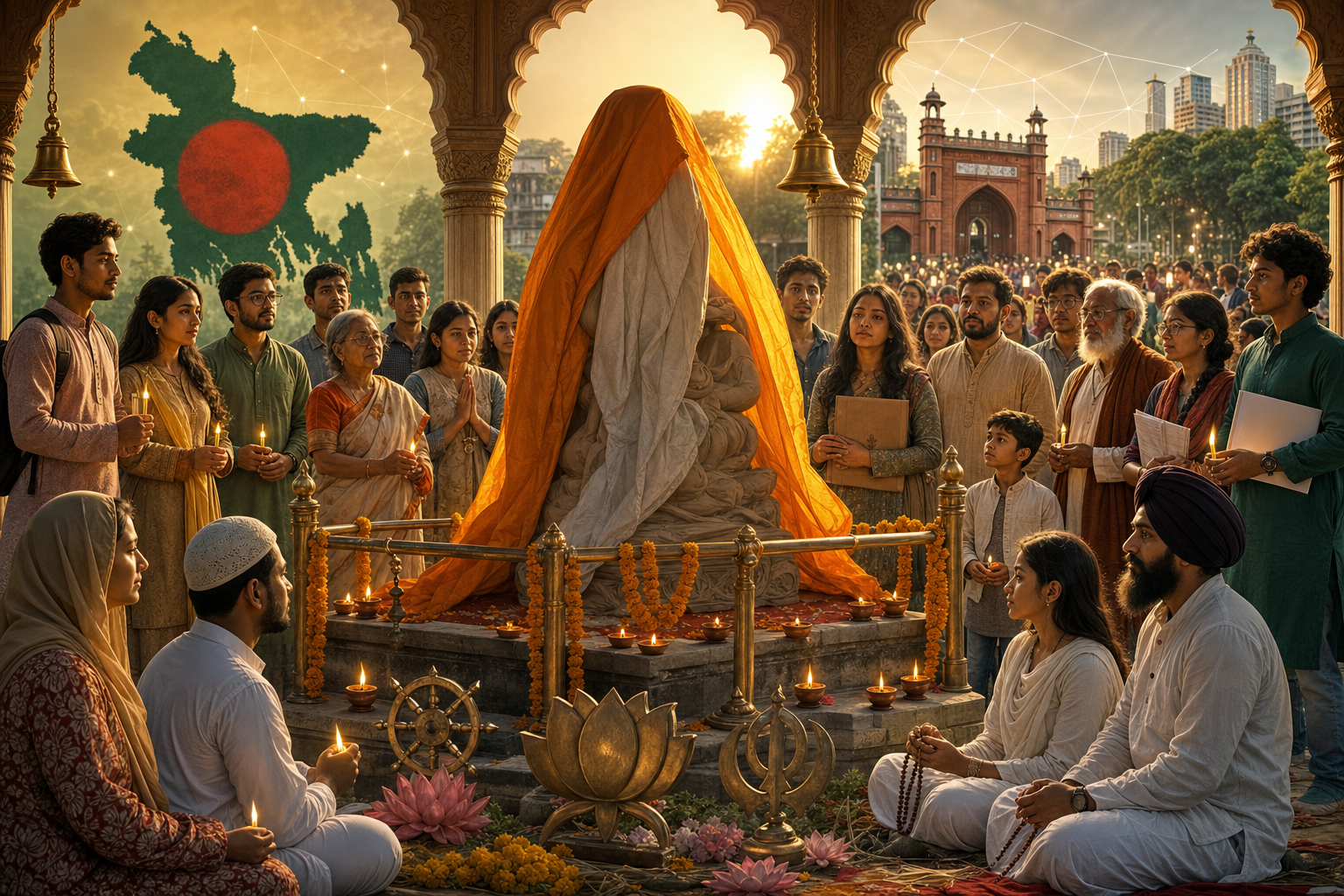
The controversy over the proposed Shri Ram murti at the Sri Sri Radha Govinda and Kali Temple complex in Bangladesh is not merely a dispute about one religious structure. It has become a revealing case study in minority security, religious freedom, public intimidation, and the uneven application of human-rights principles. When a vulnerable community is pressured to suspend a lawful religious project after coordinated online hostility and street mobilisation, the question extends beyond temple construction. It becomes a question of whether Bangladesh’s Hindu minority can express its dharma publicly without fear.
According to reporting by Hindu Voice, the Shri Ram murti project had proceeded for nearly two years as part of the development of the Sri Sri Radha Govinda and Kali Temple complex. The construction reportedly became controversial only in early June 2026, when online agitation began targeting the murti, Prabhu Shri Ram, Hindu religious practice, and Bangladeshi Hindus more broadly. What began on social media soon moved into public mobilisation, transforming a local temple development into a national flashpoint.
The significance of this shift is important. A constitutional society is tested not when a majority religious expression is protected, but when a minority religious expression is unpopular, vulnerable, and easy to intimidate. Bangladesh’s constitutional framework includes commitments to secularism, religious practice, and equal status for Hindu, Buddhist, Christian, and other communities, even as Islam is recognised as the state religion. In practical terms, this means the state has a duty to prevent communal intimidation, not merely to respond after violence has occurred.
The campaign against the murti was reportedly amplified by Islamist hardliners and extremist voices, including figures identified in Bangladeshi media and counter-terrorism discourse as radical preachers. Hindu Voice named Jashimuddin Rahmani, spiritual leader of Ansarullah Bangla Team, and Ataur Rahman Bikrompuri of Azadi Andolon Bangladesh as among those whose interventions helped intensify the controversy. Such details matter because minority insecurity is rarely created by a single speech or slogan. It grows when ideological actors, street organisations, digital networks, and weak state response combine into a pressure system.
Reports cited organisations such as Insaf Kayemkari Chatra Sramik Janata, Imam Ulema Council, Islami Chhatra Shibir, Hefajot-e-Islam, and Touhidi Janata as participants in street mobilisation against the murti. Protest leaders reportedly demanded that the structure be dismantled, while some rhetoric escalated toward threats of extra-judicial demolition. In Gaibandha, demonstrators were reported to have struck an image of Shri Ram with sandals and slippers on 12 June 2026, an act experienced by many Hindus as a deliberate humiliation of a revered figure and a message of communal hostility.
The issue therefore cannot be reduced to hurt sentiment on either side. For Bangladeshi Hindus, the deeper concern is whether public Hindu symbols can be made conditional on the approval of mobilised hardliners. A murti is not simply an object of stone, metal, or fibre. Within Hindu practice, it is connected to darshan, devotion, memory, sacred geography, and community identity. When such a symbol becomes the target of coercive mobilisation, the community naturally reads the threat as being directed not only at the structure but at its right to exist visibly.
The temple committee’s reported decision to suspend construction indefinitely shows how intimidation can succeed even without a formal ban. This is one of the most difficult dimensions of minority rights: the state may not officially prohibit worship, yet a minority community may still feel compelled to retreat when protection appears uncertain. The result is a form of informal censorship created through fear, social pressure, and the expectation that authorities will not intervene decisively enough to protect the vulnerable.
In such cases, the legal question and the social question overlap. Legally, religious communities must be free to establish, maintain, and manage their institutions, subject to law and public order. Socially, they must be able to do so without living under constant threat of mob action. Public order cannot mean rewarding the loudest threat-maker by asking the minority to withdraw. If peace is purchased by restricting the peaceful party rather than restraining the intimidator, then the law becomes an instrument of pressure rather than protection.
The broader background makes the controversy more serious. Hindu Voice cited the Bangladesh Hindu Buddhist Christian Unity Council as documenting 522 incidents of atrocities against religious minorities during 2025. It also cited the Human Rights Congress for Bangladesh Minorities as documenting at least 502 incidents targeting Hindus across 62 districts between January and April 2026, including murders or suspicious deaths, attacks on religious institutions, sexual violence, and attacks on homes, businesses, and property. These figures are allegations and documentation by advocacy groups, but they are significant because they reflect the scale of fear being reported by minority communities.
Bangladesh’s Hindu population is about 7.95 percent of the country according to the 2022 census, making Hindus the second-largest religious community but still a clear minority. Numbers alone do not capture vulnerability. A community can be numerically substantial and still politically insecure if its temples, homes, businesses, students, activists, and religious processions are exposed to targeted intimidation. The emotional reality behind these statistics is lived in small decisions: whether to attend a rally, whether to repair a temple, whether to speak publicly, whether to file a police complaint, and whether one’s name or phone number may be circulated online afterward.
The protests that followed the suspension of the Shri Ram murti project are therefore best understood as a demand for civic equality rather than sectarian privilege. Demonstrations reportedly appeared at university campuses, city centres, Shahbagh in Dhaka, Dhaka University, Jahangirnagar University, Rajshahi University, Barishal University, Chattagram, and other locations. Students, young professionals, social activists, temple representatives, and ordinary citizens participated. Their demands centred on religious freedom, equal security, action against hate campaigns, and conditions under which the murti could be completed without fear of violence.
This youth-led dimension is especially important. Younger Hindus in Bangladesh appear to be drawing a painful conclusion: silence does not necessarily guarantee safety. For many families, the inherited instinct may be to keep one’s head down, avoid confrontation, and hope that danger passes. Yet when temples, religious symbols, and community voices remain vulnerable even after repeated restraint, a new generation may decide that dignity requires public assertion. Such assertion need not be aggressive. It can be disciplined, lawful, and constitutional, but it cannot remain invisible.
The reported targeting of activists and student speakers through online abuse, character attacks, doxxing, and calls for harassment reveals another modern feature of communal pressure. Public intimidation no longer depends only on physical crowds. It can be produced through digital networks that stigmatise individuals, circulate personal information, and make advocacy feel personally dangerous. In this sense, minority rights now require both physical security and digital protection. Police response, platform moderation, evidence preservation, and legal accountability all become part of the same security architecture.
Social worker and human-rights activist Timpaul Paul reportedly filed a police complaint at Palashbari Police Station after the Gaibandha incident involving desecration of Shri Ram’s image. Such acts of documentation are crucial. In minority-rights cases, the first battle is often the battle to make harm visible. Without complaints, records, photographs, witness statements, and credible reporting, intimidation disappears into rumour. With documentation, it becomes possible to evaluate patterns, demand accountability, and prevent the erasure of victims’ experiences.
At the same time, documentation must remain careful and disciplined. Academic and factual analysis should distinguish between ordinary Muslims, political Islamism, extremist mobilisation, and specific organisations or individuals accused of incitement. Bangladesh is home to many citizens who do not support intimidation of minorities. The problem under discussion is not the existence of a Muslim-majority society, but the failure to restrain organised sectarian pressure when it targets a vulnerable religious minority. This distinction is essential for justice, social peace, and Dharmic ethics.
From a Dharmic perspective, the issue also reaches beyond Hindu society alone. The protection of Hindu temples in Bangladesh is connected to the wider security of Buddhist, Jain, Sikh, Christian, indigenous, and other minority communities wherever they face coercion. Dharma, in its civilisational sense, is not a licence for retaliation; it is a framework of order, responsibility, truth, restraint, and protection of the vulnerable. A society that allows one community’s sacred symbols to be humiliated under pressure weakens the moral ground on which all communities stand.
This is why unity among Dharmic traditions matters. Hindus, Buddhists, Jains, and Sikhs have distinct theologies, histories, practices, and institutions, but they share a civilisational memory of plural sacred expression. Temples, vihāras, derasars, gurdwaras, processions, murtis, granths, pilgrimage routes, and festivals are not merely private beliefs. They are public forms of continuity. When one tradition is told that its public expression must shrink under threat, every Dharmic community has reason to recognise the danger.
The silence beyond Bangladesh has become one of the most troubling aspects of this episode. According to Hindu Voice, many international human-rights organisations, media institutions, and advocacy networks that previously commented on Bangladesh’s minority situation have shown limited sustained attention to the Shri Ram murti controversy and the wider Hindu-led mobilisation. If minority rights are defended only when they fit a convenient geopolitical narrative, then the principle becomes selective. The credibility of human-rights advocacy depends on consistency, especially when the victims are politically inconvenient.
A similar concern applies within India and the wider Hindu diaspora. The safety of Bangladeshi Hindus has often appeared in speeches, debates, and political commentary. Yet the reported June 2026 protests, student mobilisation, police complaints, and fear surrounding the temple project did not receive the scale of attention one might expect. This is particularly striking in regions with deep historical, linguistic, and familial ties to Bangladesh, including West Bengal and Tripura. Geography and memory should make the suffering of Bangladeshi Hindus difficult to ignore.
The deeper test is moral consistency. If concern for persecuted Hindus depends on which party is in power, which alliance is convenient, or which media cycle is active, then the cause loses its civilisational force. Protection of Hindu minorities in Bangladesh cannot be reduced to a political instrument. It must be treated as a human-rights issue, a religious-freedom issue, and a South Asian stability issue. The victims’ dignity cannot be made conditional on partisan usefulness.
There is also a technical governance lesson. Preventing communal escalation requires early intervention, not delayed reaction. Authorities must monitor incitement, protect threatened religious sites, provide transparent security assessments, prosecute credible threats, and communicate clearly with vulnerable communities. When officials remain vague or passive, rumours fill the vacuum. Minority communities then begin to assume that they are alone, and extremist actors interpret hesitation as permission.
Effective protection also requires equal enforcement. If an image of a revered figure is publicly desecrated to inflame communal tension, the response should not depend on the religious identity of the target. If threats of demolition are issued, they should be treated as threats to public order. If personal information is circulated to intimidate activists, it should be treated as a serious safety risk. The state’s legitimacy depends on showing that citizenship is stronger than mob pressure.
For civil society, the responsibility is broader than outrage. Documentation networks, legal-aid teams, interfaith delegations, student forums, digital-security assistance, trauma support, and responsible media coverage are all necessary. Anger may draw attention, but institutions protect people. Bangladesh’s Hindus, like all vulnerable communities, need more than sympathy after each incident. They need systems that reduce the cost of speaking, worshipping, organising, and living with dignity.
The emotional power of the Shri Ram murti controversy lies in its simplicity. A community sought to complete a sacred image within a temple complex. It was met, according to reports, with a campaign of hostility strong enough to halt construction. Students and ordinary citizens then took to the streets not to demand dominance, but to demand safety. That sequence should disturb anyone committed to religious freedom, whether Hindu, Buddhist, Jain, Sikh, Muslim, Christian, secular, or otherwise.
The path forward must therefore be principled and restrained. Bangladesh’s Hindu minority deserves equal protection under law. Extremist intimidation must be confronted without demonising an entire religious population. Dharmic communities across borders should respond with unity, documentation, advocacy, and compassion rather than communal hatred. Human-rights bodies should apply the same standards to all victims, including those who do not fit fashionable narratives. Above all, the right to worship openly must not become negotiable under threat.
The battle over the Shri Ram murti is ultimately a battle over civic dignity. If Bangladesh can protect a vulnerable Hindu community’s right to complete and worship at a temple project without fear, it will strengthen the promise of equal citizenship for all minorities. If it cannot, the message will travel far beyond one temple complex. It will tell every vulnerable community that public faith survives only at the pleasure of those willing to intimidate. That is why this moment matters, and why silence is not neutrality.
Inspired by this post on Hindu Post.
