
The phrase “You are my Heroes” carries a devotional weight that is larger than ordinary praise. In the setting associated with Radharaman Prabhu, it becomes a meditation on what heroism means within Sanatana Dharma, especially in the Vaishnava bhakti tradition. A hero is not merely one who wins public admiration, commands attention, or displays physical strength. A true hero is one who continues to serve, remember, forgive, protect, and uplift even when the outer world offers little recognition.
In dharmic thought, heroism is inseparable from responsibility. The Bhagavad Gita does not present courage as aggression or domination; it presents courage as steadiness in the performance of dharma. This is why the language of devotion can transform an ordinary community into a field of sacred action. When sincere devotees are called heroes, the word points toward their discipline, humility, sacrifice, and perseverance in spiritual practice.
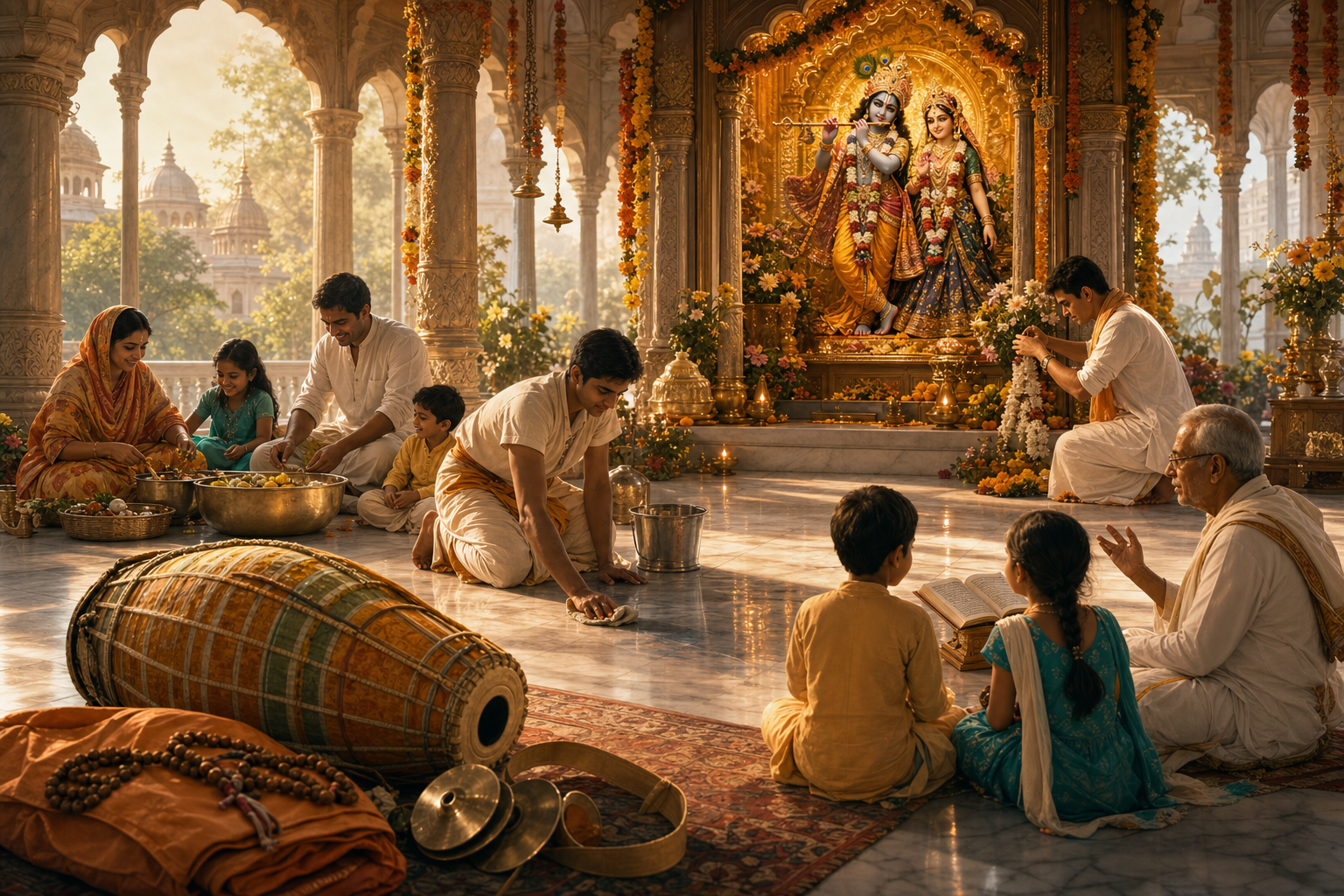
Radharaman Prabhu’s message may be understood through this broader devotional lens. The emotional force of such a statement lies in its recognition of people who quietly carry the burdens of seva. They may not appear in public history, but they keep temples functioning, preserve kirtan traditions, teach children, cook prasadam, clean sacred spaces, support festivals, and hold communities together during moments of fatigue or uncertainty. Their service forms the living infrastructure of Hindu spirituality.
Bhakti has always honored this hidden form of greatness. The tradition remembers saints, acharyas, and spiritual teachers, but it also reveres the unnamed devotee whose life is shaped by remembrance of Krishna, Rama, Shiva, Devi, Vishnu, or the chosen Ishta. This inclusiveness is essential to the unity of dharmic traditions. Hinduism, Buddhism, Jainism, and Sikhism all recognize that inner transformation is made visible through conduct, discipline, compassion, and service.
In the Vaishnava understanding, devotion is not sentiment alone. It is a structured spiritual discipline involving shravana, kirtana, smarana, archana, vandana, dasya, sakhya, and atma-nivedana. These practices refine the mind, redirect desire, and create a life centered on divine remembrance. A devotee who persists in these practices amid modern distractions demonstrates a form of heroism that is quiet but profound.
The modern world often measures success through visibility, consumption, and personal branding. Bhakti reverses that scale. It teaches that the most meaningful life may be one lived in surrender, restraint, and loving service. This is not passivity. It requires vigilance over the senses, steadiness in relationships, ethical discipline, and the courage to live by spiritual values when those values are misunderstood or dismissed.
Calling devotees heroes also corrects a common misunderstanding about spirituality. Spiritual life is sometimes imagined as withdrawal from human difficulty, but dharmic traditions describe it as a disciplined engagement with reality. The devotee still encounters grief, financial pressure, family tension, illness, doubt, and social conflict. What changes is the framework of response. The struggle becomes an opportunity for patience, humility, prayer, and self-correction.
This is why the language of heroism is appropriate. The heroic devotee does not claim perfection. Rather, the heroic devotee rises again after failure, returns to japa after distraction, resumes seva after exhaustion, and seeks forgiveness after error. Such a life is not theatrical, but it is morally demanding. It brings the teachings of the Bhagavad Gita from the page into daily conduct.
Within the Hare Krishna and ISKCON tradition, this understanding has a distinct theological foundation. Srila Prabhupada emphasized that devotion to Krishna must become practical, disciplined, and compassionate. Kirtan, prasadam distribution, scripture study, deity worship, and community service are not ornamental activities. They are instruments of spiritual education and social healing. In that sense, the devotee becomes a bearer of cultural memory and spiritual responsibility.
The title also invites reflection on the relationship between guru, shishya, and community. In many traditions, the teacher is seen as the hero because the teacher guides the disciple toward truth. Yet mature spiritual leadership also recognizes the courage of the disciple. A community does not flourish through instruction alone; it flourishes when individuals accept discipline, serve each other, and embody the teachings in ordinary circumstances.
This mutual recognition protects spiritual life from becoming hierarchical in a narrow sense. Reverence for the guru remains central, but the dignity of the devotee is also affirmed. The teacher honors the effort of the community, and the community honors the wisdom of the teacher. This relationship creates a culture of gratitude rather than mere authority.
There is also a wider civilizational significance. Hindu culture has survived not only because of kings, scholars, philosophers, and saints, but because households preserved rituals, mothers taught children prayers, elders narrated the Ramayana and Mahabharata, artisans built temples, singers carried bhajans, and communities celebrated festivals across generations. These people were cultural heroes because they transmitted dharma through lived practice.
Such recognition matters especially in a time when inherited traditions are often reduced to identity markers or political slogans. Dharma is deeper than social labeling. It is a way of aligning thought, speech, and action with truth, compassion, duty, and self-mastery. The heroic dimension appears when individuals refuse to let spiritual life become shallow, performative, or divisive.
The dharmic ideal of unity does not require uniformity. Hinduism contains Shaiva, Vaishnava, Shakta, Smarta, and many other streams. Buddhism, Jainism, and Sikhism possess their own distinct philosophical and spiritual disciplines. Yet all these traditions honor ethical self-cultivation, reverence for wisdom, restraint from harmful conduct, and the possibility of liberation from ignorance. A mature devotional message strengthens this shared civilizational ground.
Heroism, therefore, should not be confused with sectarian triumphalism. The highest form of dharmic courage is not hostility toward another path, but fidelity to truth without hatred. A devotee becomes heroic by deepening devotion while honoring sincere seekers across traditions. This balance is essential for contemporary Hindu spirituality and for the broader harmony of dharmic communities.
The emotional appeal of “You are my Heroes” also rests in its tenderness. Many people who serve religious communities do so while carrying unseen burdens. A word of gratitude can restore strength. Recognition can remind them that their labor is not invisible. In a devotional context, appreciation is not flattery; it is a form of seva because it nourishes the heart of the servant.
This insight is especially relevant for younger generations. Many young Hindus, Sikhs, Jains, and Buddhists are searching for models of spiritual strength that feel authentic rather than merely inherited. They need examples of people who combine faith with intelligence, devotion with humility, and cultural pride with ethical conduct. The heroic devotee offers such a model.
In practical terms, this message encourages a reconsideration of everyday spiritual life. A person who chants sincerely, studies scripture, serves elders, protects family harmony, respects other paths, speaks truthfully, and works for community welfare is participating in dharma. These actions may appear small, but they shape character. Character, in dharmic philosophy, is not secondary to spirituality; it is one of its clearest expressions.
The deeper lesson is that sacred communities are built through gratitude. When leaders honor devotees, when devotees honor teachers, when families honor elders, and when traditions honor one another, spiritual culture becomes resilient. It can withstand criticism, modernization, migration, and internal difficulty because it is rooted in mutual respect rather than mere sentiment.
Radharaman Prabhu’s phrase thus becomes more than a title. It becomes an invitation to see spiritual greatness where it often remains hidden: in the kitchen, in the temple hall, in the classroom, in the home shrine, in the quiet repetition of the holy name, and in the patient effort to live with integrity. Such heroism does not demand applause, but it deserves remembrance.
The enduring value of this message lies in its ability to unite devotion, humility, and courage. It reminds the dharmic world that the future of Sanatana Dharma depends not only on public voices but also on disciplined hearts. The real heroes are those who keep serving, keep learning, keep forgiving, and keep turning toward the Divine with sincerity.
Inspired by this post on Dandavats.
