
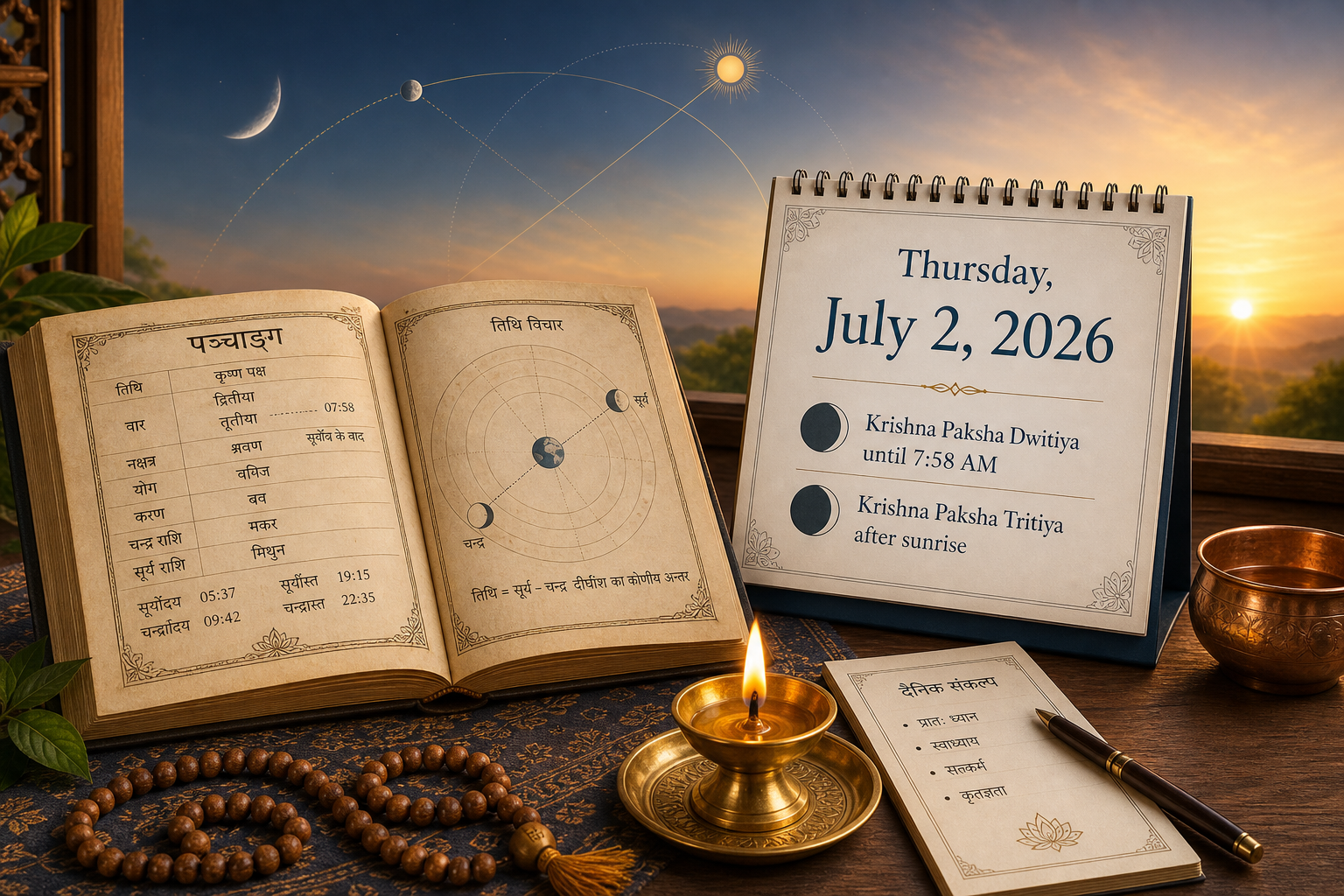
July 2, 2026 Panchang note: July 2, 2026 falls on a Thursday in the civil calendar. The supplied Panchang entry identifies the lunar day as Krishna Paksha Dwitiya until 7:58 AM, after which Krishna Paksha Tritiya begins. This distinction matters because a Hindu calendar date is not defined only by the midnight-to-midnight civil day, but by the movement of the Moon in relation to the Sun and by the local sunrise tradition followed in a region.
In the Hindu calendar, the word Tithi refers to a lunar day. It is calculated from the angular distance between the Sun and the Moon, and each tithi represents a 12-degree separation in that relationship. This is why a tithi may begin or end at any time during a civil day, including early morning, afternoon, evening, or night.
For Thursday, July 2, 2026, the important tithi detail is clear: Krishna Paksha Dwitiya, the second day of the waning or dark phase of the Moon, continues until 7:58 AM. After that time, Krishna Paksha Tritiya, the third day of the waning lunar fortnight, begins. This is the central Panchang marker for the day.
Krishna Paksha is the half of the lunar month that follows Purnima, the full moon. During this period, the visible Moon gradually decreases in brightness until Amavasya. In traditional Hindu timekeeping, this waning phase is often associated with inward movement, reflection, simplification, ancestral remembrance, disciplined worship, and the quiet completion of pending duties.
Dwitiya tithi is the second lunar day and is generally understood through the symbolism of continuation after transition. Since it follows Pratipada, it carries a sense of stabilization. For everyday religious life, this can be a useful reminder that not every spiritually meaningful day must be dramatic; some days are meant for steady routine, modest discipline, and orderly attention to family, study, work, and worship.
Tritiya tithi begins after 7:58 AM on this date. Tritiya, as the third lunar day, is often read as a movement from initial stabilization into active refinement. In practical terms, the day shifts from the Dwitiya quality of continuity into a Tritiya rhythm that can support thoughtful planning, learning, household organization, devotional activity, and careful execution of ordinary responsibilities.
The Panchang is valuable because it trains attention toward time as a sacred and structured field. Rather than treating all hours as identical, Hindu tradition studies the relationship between tithi, nakshatra, yoga, karana, weekday, sunrise, and planetary periods. This integrated approach helps families, priests, students of Jyotisha, and devotees understand how ritual timing and daily conduct are traditionally aligned.
A technical reading of this July 2, 2026 Panchang entry should begin with caution. The supplied source confirms the tithi transition, but it does not provide a full verified listing for nakshatra, rashi, yoga, karana, Rahu Kaal, Gulika Kalam, Yamaganda, Abhijit Muhurat, sunrise, sunset, or regional festival observances. These details are location-sensitive and should be checked against a local Panchang before making ritual or muhurat decisions.
This location sensitivity is not a weakness of the Hindu calendar; it is one of its strengths. A Panchang is rooted in observed celestial relationships and local sunrise reckoning. The same civil date may therefore carry slightly different practical timings in different places. A family in Delhi, Chennai, Mumbai, Toronto, New York, or London may need to check the Panchang according to its own location before finalizing a puja, vrata, journey, or ceremony.
The phrase good time in Panchang usage should be understood carefully. A good time is not determined by tithi alone. Traditional muhurat selection considers the purpose of the activity, the lunar day, weekday, nakshatra, lagna, tarabalam, chandrabalam, avoidance periods, and family custom. For ordinary daily worship, however, the available tithi information is still useful because it gives the day its basic lunar context.
For devotional practice on July 2, 2026, the transition from Krishna Paksha Dwitiya to Krishna Paksha Tritiya may be approached with simplicity. Morning worship before 7:58 AM falls under Dwitiya, while worship after that time falls under Tritiya. Those observing a specific vrata, temple rule, or family ritual should follow the guidance of the relevant sampradaya, priest, regional almanac, or inherited household tradition.
In many Hindu households, the Panchang is not merely a calendar but a quiet daily discipline. It is consulted before beginning a vrata, planning a journey, fixing a ceremony, or understanding the spiritual mood of the day. Even when no major festival is listed, the act of checking the tithi keeps the mind connected to cosmic rhythm, dharma, and the continuity of ancestral practice.
The emotional value of such a calendar lies in its ability to make ordinary time feel meaningful. A simple note such as Krishna Paksha Dwitiya till 7:58 AM, then Krishna Paksha Tritiya, may appear brief, but it reflects a vast civilizational habit of observing the heavens, organizing ritual life, and bringing mindfulness into daily action.
This approach also supports unity among Dharmic traditions. Hinduism, Buddhism, Jainism, and Sikhism have developed distinct calendars, observances, and historical rhythms, yet all preserve a deep respect for disciplined time, ethical living, remembrance, and spiritual practice. A Panchang entry can therefore be read not as sectarian isolation, but as one expression of a broader Dharmic sensitivity to time, order, and inner refinement.
From an academic perspective, Panchang study belongs at the intersection of astronomy, ritual studies, cultural history, Sanskrit terminology, and lived religion. Terms such as tithi, nakshatra, rashi, paksha, yoga, and karana are not decorative labels. They are technical categories within a traditional system of time reckoning that shaped temple festivals, domestic rites, agricultural rhythms, pilgrimage decisions, and community observances across generations.
For readers searching specifically for the July 2, 2026 tithi, the essential answer is concise: it is Krishna Paksha Dwitiya until 7:58 AM, followed by Krishna Paksha Tritiya. For readers searching for the complete July 2, 2026 Panchang with nakshatra and rashi, the responsible answer is that the provided source does not include those verified details, and they should be confirmed through a location-based Panchang.
Such caution is especially important because Panchang calculations are often used for meaningful decisions. Marriage ceremonies, griha pravesh, vrata observances, temple pujas, samskaras, and major journeys should not be fixed only from a partial note. A complete Panchang reading requires the full set of daily elements and, in many cases, guidance from someone trained in the relevant ritual tradition.
At the same time, the available tithi information remains useful for everyday spiritual orientation. Krishna Paksha invites a quieter rhythm, and the movement from Dwitiya to Tritiya suggests a day suited to reflection, careful work, modest devotional practice, and steady attention. It is a day better understood through discipline and clarity than through haste or excess.
Therefore, the July 2, 2026 Hindu calendar entry should be read as a focused tithi record rather than a complete muhurat guide. Its most reliable teaching is the lunar transition itself: Krishna Paksha Dwitiya ends at 7:58 AM, and Krishna Paksha Tritiya continues thereafter. That single detail is enough to anchor the day within the sacred lunar cycle, while still leaving room for local verification of nakshatra, rashi, and auspicious timings.
In practical terms, this Panchang entry encourages a balanced response. It respects the precision of traditional Hindu calendar calculation, avoids unsupported claims, and keeps the focus on meaningful daily practice. For those who follow the Panchang regularly, July 2, 2026 becomes another reminder that sacred time is not distant from ordinary life; it is woven into the morning, the household, the prayer space, and the disciplined choices of the day.
Inspired by this post on Hindu Blog.
