
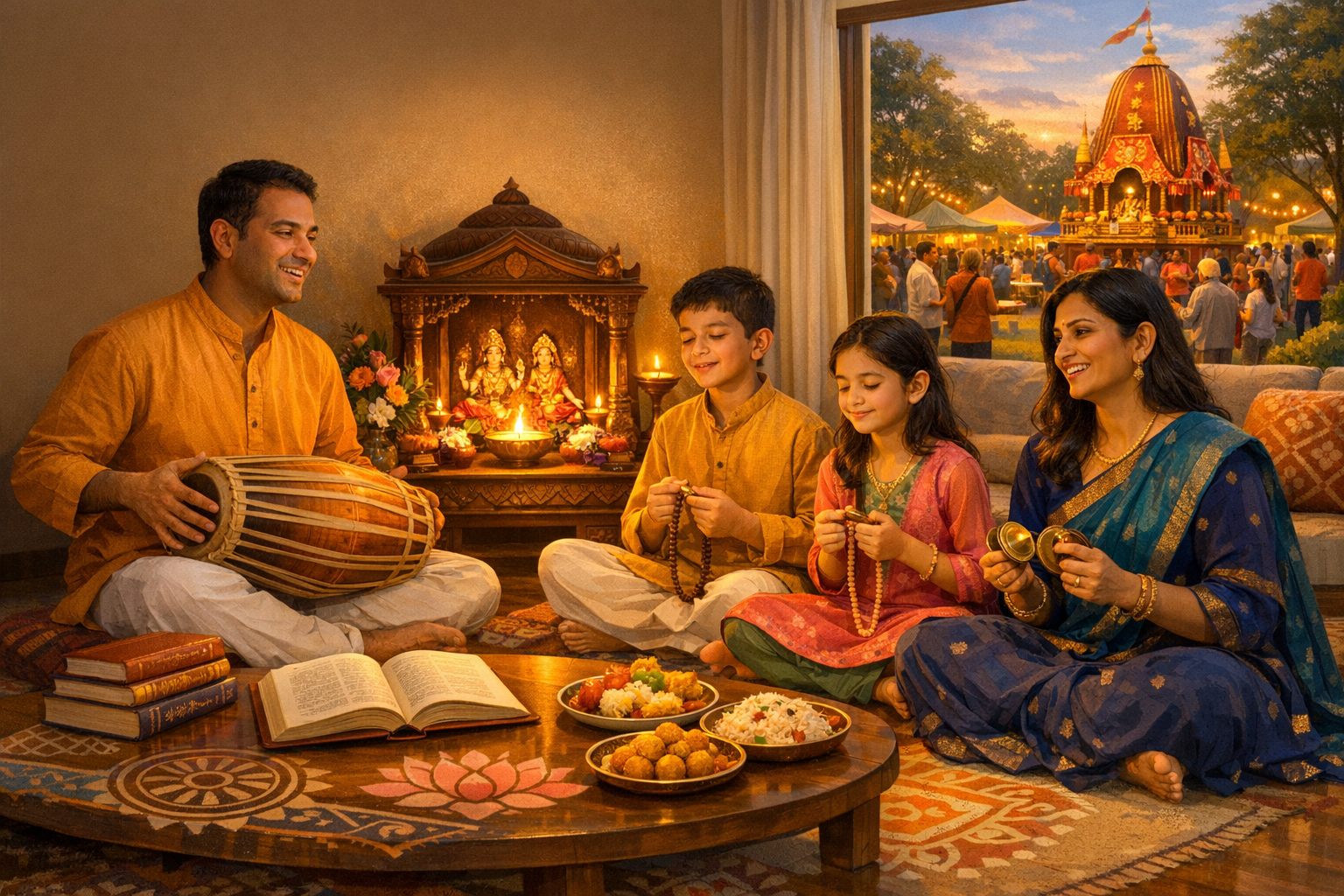
Across North America and other global hubs, Indian-origin families who migrated for higher education and professional opportunity often discover that material stabilitycareers, households, and mortgagesarrives hand in hand with profound cultural questions. How can one relate to a largely materialist milieu without losing Indian values? How can children be reared with confidence and kindness while remaining protected from avoidable excesses? How can a living connection to cultural memory be sustained? And which goals, finally, should be pursued and transmitted? These concerns have animated Hindu, Buddhist, Jain, and Sikh households alike, and they frame an inquiry into the distinctive genius of A. C. Bhaktivedanta Swami Prabhupada (Srila Prabhupada), whose synthesis of theology, pedagogy, and institution-building offers a durable response.
Srila Prabhupada’s enduring contribution lies in a portable, family-centered design for spiritual lifeBhakti-yoga articulated in clear language, embodied in daily habits, expressed as joyous public culture, and secured through resilient institutions. This design did not merely transplant Gaudiya Vaishnava traditions into Western cities; it operationalized dharmic principles that any conscientious household could adapt without sectarian friction. In this light, his work functions as a civilizational blueprint for the Hindu diaspora and, by extension, for dharmic communities committed to unity in religious diversity.
At the level of scholarship, Srila Prabhupada translated and commented on canonical worksBhagavad-Gita As It Is, multi-volume Srimad-Bhagavatam, and Sri Caitanya-caritamritabridging classical Sanskrit thought with contemporary idiom. The method is notable for its fidelity to parampara (disciplic succession) while providing accessible exposition for readers with no prior background. This dual commitmenttextual integrity and interpretive clarityensured that households could study together and engage in serious, age-appropriate learning without collapsing into either esotericism or oversimplification.
At the level of personal practice, he standardized a replicable core: attentive japa on beads, morning sadhana (including scriptural reading and kirtan), and the cultivation of sattvic discipline through the well-known four regulative principles. This standardization did not seek to erase family or regional distinctives; rather, it provided a transferable spine that stabilized identity across time zones and school calendars. For diaspora parents, such predictable practices act as “circadian anchors” for valueshabitual reference points woven into the start and end of ordinary days.
At the level of social experience, Srila Prabhupada elevated two powerful, inclusive modalitieskirtan and prasadam. Congregational kirtan transforms spiritual life into shared joy, lowering entry barriers for newcomers; prasadam distribution reframes hospitality as service and culture as nourishment. Both modalities resonate deeply with broader dharmic patterns: Sikh kirtan and langar, Jain vegetarian ethics and seva, and Buddhist mindfulness inflected by compassion. The genius here is intercultural compatibility: diverse dharmic communities can meet in sound, food, and service without theological coercion.
Public festivals such as the Hare Krishna Festival of Chariots (Ratha-yatra) made sacred celebration legible in modern urban space. By situating devotion in parks and city centersfrom New York to London to TorontoSrila Prabhupada normalized dharmic visibility as convivial and welcoming. For children, such festivals become formative memories; for neighbors, they function as invitations to pluralism grounded in everyday kindness.
Institutionally, the founding of ISKCON (International Society for Krishna Consciousness) in 1966 and the early establishment of the Governing Body Commission (GBC) in 1970 created continuity beyond charismatic leadership. Publishing (Back to Godhead), standardized temple programs (including the Sunday Feast), and structured training leveraged what organizational theorists term “design for replication”: minimal core, high cultural transmission. This architecture made it possible for local communities to adapt offerings to contextuniversity campuses, suburban homes, and multicultural neighborhoodswhile preserving essential practice.
For families negotiating identity in the West, this ecosystem aligns with well-established research in developmental and cross-cultural psychology. John W. Berry’s acculturation framework, for example, highlights “integration” as a high-outcome pathwaymaintaining heritage culture while engaging the mainstream. Srila Prabhupada’s model makes such integration practicable: heritage knowledge through study, daily self-regulation through sadhana, civic friendship through festivals, and compassionate outreach through service. The result is bicultural confidence rather than cultural confusion.
Parenting implications flow clearly from this design. A home mandir or simple altar creates a daily point of reverence; evening readings of Bhagavad-Gita or child-friendly retellings of the Ramayana and lives of saints cultivate narrative identity; shared kirtan fosters group cohesion; and preparing vegetarian prasadam trains both taste and ethics. When these practices are framed not as sectarian badges but as invitations to universal valuesahimsa, satya, daya, and sevathey harmonize naturally with Buddhist sila, Jain anuvratas, and Sikh seva and simran.
Ethical scaffolding is particularly important for youth. Yama-niyama analoguestruthfulness, restraint, cleanliness, study, and devotionmap readily onto secular virtues prized by schools and universities, such as reliability, teamwork, and self-management. Srila Prabhupada’s emphasis on regulated freedom provides a constructive alternative to both lax permissiveness and rigid moralism: boundaries are clear, reasons are explained, and motivation is nurtured through beauty (music, art, ritual), belonging (sangha), and meaning (purposeful service).
Education in this paradigm is experiential and relational. The guru-shishya tradition is reframed for modern life through community mentors, youth groups, and family-centered satsang, an approach consistent with social learning theory: children acquire values they repeatedly observe in competent, caring adults. Weekly programswhether in ISKCON temples, multi-tradition dharma centers, or neighborhood study circlescreate a cadence of practice and friendship that outlives exam seasons and sports schedules.
Community festivals and open houses extend this pedagogy outward. When neighbors are welcomed to share prasadam, listen to kirtan, and learn about Sanatana Dharma’s broad commitment to compassion and responsibility, a local culture of respect is strengthened. Over time, this fosters what Indian philosophical thought calls Vasudhaiva Kutumbakamthe world as one familynot as a slogan but as a lived neighborhood ethic.
It is also essential to avoid sectarian postures. Srila Prabhupada’s approach is best understood as principled particularity with generous hospitality: practice one’s path with integrity while honoring parallel dharmic commitments in Buddhism, Jainism, and Sikhism. This stance advances unity in religious diversity and dissuades children from framing identity in terms of antagonism. Families report that such an ecosystem reduces anxiety, increases prosocial behavior, and produces a steady, unforced interest in spiritual study.
A composite example illustrates application. Consider a family in Seattle balancing dual-career pressures and school activities. Mornings begin with a brief kirtan and japa; breakfast is prasadam with a short verse from Bhagavad-Gita; evenings reserve 15 minutes for devotional reading; weekends include temple visits or a community seva project, with children participating in music or drama related to festival themes. The pattern is realistic yet formativesmall, repeatable investments that accrue into conviction and joy.
Practically, households benefit from two design principles. First, embed practice in existing routinesattach sadhana to mealtimes and bedtimes rather than adding entirely new time blocks. Second, privilege joy and servicekirtan, art, cooking, and volunteeringso that children experience spirituality as energizing rather than punitive. This mirrors Srila Prabhupada’s pedagogy of ananda (joy) and seva (service) as the natural engines of sustained practice.
Potential pitfalls can be addressed proactively. Performative religiosity (doing it for show) wanes when families track what truly helps mood and conductsleep quality, kindness, focuslinking improvements to steady practice. Sectarian comparisons dissolve when parents explicitly celebrate dharmic unity: Sikh kirtan and langar as cousins to kirtan and prasadam; Jain ahimsa as an ethical ally to vegetarianism; Buddhist mindfulness as a skill that deepens japa and study. The home becomes an academy of pluralism grounded in lived discipline.
From an institutional perspective, Srila Prabhupada’s genius also resides in governance foresighttraining leaders, empowering local initiative, and insisting on transparent standards. For diaspora communities, this translates into durable youth mentorship, accountable finances, and collaborative programming with other dharmic organizations. The emphasis on both scriptural rigor and cultural friendship makes joint eventsinter-dharma music programs, shared seva kitchens, parenting workshopsnatural rather than novel.
In sum, Srila Prabhupada offered more than commentary; he delivered an integrative design that families can adopt and adapt: scholarship that instructs, practices that stabilize, festivals that befriend, and institutions that endure. For the global Hindu diasporaand for allied Buddhist, Jain, and Sikh communities committed to compassion and servicethis design provides a tested pathway to raise grounded children, cultivate resilient marriages, and serve cities with grace. It is a quiet revolution in which devotion is portable, ethics are practical, and unity in diversity is not an aspiration but a habit.
Inspired by this post on Dandavats.
