
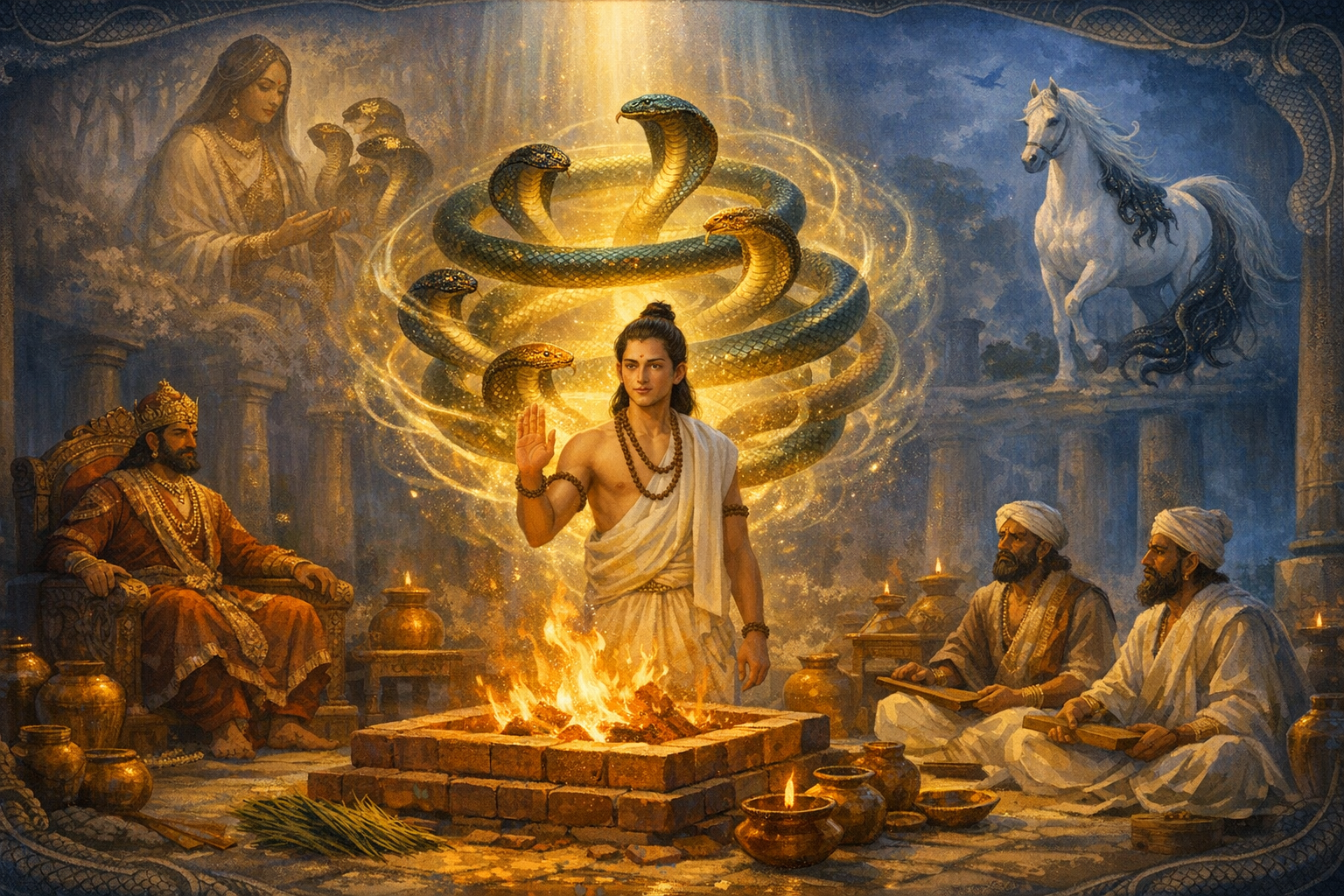
Among the densely layered narratives of the Mahabharata’s Adi Parva, the episode of Kadru cursing her sons and the later conflagration of Janamejaya’s Sarpasattra forms a single, intricate arc. It interweaves maternal ambition and filial defiance, ritual power and ethical restraint, prophetic destiny and human choice. Read as a whole, the story explains not only why a mother would condemn her own children but also how a vast sacrificial machinery was set in motionand mercifully checkedso that cosmic balance and Dharma might prevail.
The narrative opens with the genealogy of the serpentine race (Nagas). Prajapati Kashyapa’s consorts, Kadru and Vinata, become the matriarchs of two intertwined lineages: Kadru births the Nagasamong them Shesha, Vasuki, and Takshakawhile Vinata brings forth Aruna and the peerless Garuda. From this familial origin emerges a contest, a moral test, and a curse with far-reaching consequences for humans, devas, and serpents alike.
The immediate catalyst is the wager on the color of the celestial horse Uchchaihshravas, born of the Samudra Manthan. Kadru wagers that the horse’s tail is black, while Vinata affirms it is white. Determined to win by any means, Kadru instructs her Naga sons to coil around the tail to make it appear dark. A number of them refuse, invoking Dharma and the impropriety of deception; others obey. Enraged at this defiance, Kadru pronounces a terrible curse: the disobedient will perish in the blazing rite of a future kingJanamejaya’s Sarpasattra. With a single maternal utterance, the story’s end is folded back into its beginning.
Assessing Kadru’s act through the Mahabharata’s ethical lens reveals layered tensions. Maternal authority possesses undeniable power in the epic world; a mother’s blessing or curse is never casual speech. Yet Dharma does not license untruth or coercion. The Nagas who resist deceit model a rigorously dharmic stance: truth matters even when loyalty is pressured. The epic’s moral geometry thus frames Kadru’s vāk (speech) as effective and binding, but not unambiguously righteous.
The text then follows a chain of causes through generations. The curse does not remain a private family tragedy; it foreshadows a civilizational crisis. Parsimony of narrative ensures that other episodes knit themselves to this thread: the fateful death of King Parikshit by the serpent Takshaka, the solemn vow of his son Janamejaya to avenge that death, and the mustering of sacrificial specialists to conduct a sattra designed to draw every serpent into the sacrificial fire. A domestic deception blooms into a public rite with cosmic reach.
Before the Sarpasattra begins, the Adi Parva details another preparatory movement toward restoration. The sage Jaratkaru, admonished by his Pitrs (ancestors) to marry and ensure their continuity, seeks a spouse who shares his name. In a carefully balanced reciprocity, the Nagas offer a maidenalso named Jaratkaruso that the Brahmana and Naga lines might join. From this union is born Astika, whose very nameaffirmation, “it is”signals the reassertion of order and truth within a world shaken by oaths and curses.
The Sarpasattra itself is technically and theologically significant. As a sattra (an extended Vedic session), it exemplifies the Brahmanical mastery of mantra and rite. Priests assemble a vedi (altar), enkindle the agni, and recite specific incantations designed to compel serpents from every realm to fall helplessly into the fire. The rite unfolds with the flawless logic of ritual science: if sound and sacrifice coordinate with Rta (cosmic order), even venomous chaos will be drawn into law and light.
The narrative, however, refuses to reduce Dharma to mere procedural correctness. Janamejaya’s grief is real and justifiedhis father Parikshit died from Takshaka’s bite after an earlier curse by a seer’s son. Yet proportionality and motive matter. The sacrifice, urged on by voices of vengeance and sanctioned by exacting liturgy, grows perilously absolute: not just the guilty serpent, but all Nagas are to be annihilated. As the mantric pull intensifies, even Takshaka’s refuge with Indra threatens to fail, and the rite momentarily menaces the bonds between worlds.
At this critical juncture, Astika arrives. His presence bridges lines long estrangedBrahmana and Naga, human kingship and serpentine sovereignty. He addresses the king with measured praise and philosophical clarity, neither minimizing the wrong done to Parikshit nor ignoring the disproportion of the response. The king, bound by royal generosity to grant a boon, offers Astika a wish. Astika asks that the Sarpasattra be stopped. In that hesitationdevoted son, vengeful king, just rulerJanamejaya’s character is tested for the last time.
After counsel and contestation with priests and courtiers, Janamejaya concedes. The rite is halted. Many serpents have already perished, and Kadru’s curse has been partially fulfilled; yet the extinction of an entire species is averted, and with it the collapse of a living cosmos in which each being, even the feared Naga, has a dharmic station. The narrative restores balance without erasing the cost of imbalance.
Philosophically, the episode probes the relationship between destiny and agency. Kadru’s curse seems inexorable, yet its outcome is neither total nor unmediated. Ritual power proves potent but not sovereign; compassion, truth-speech, and right restraintexemplified by Astikaimpose higher conditions upon efficacy. Dharma in the Mahabharata is not mechanical adherence but wise calibration: satya (truth), ahimsa (non-harm), daya (compassion), and kshama (forbearance) stand in necessary tension with danda (punitive order) and yajna (sacrificial action).
The serpents themselves symbolize energy and ambivalence in the Indic imagination. Shesha, through tapas and humility, becomes Vishnu’s steadfast support, bearing the Earth and transforming serpentine power into cosmic stability. Vasuki serves in the churning of the ocean. Even Takshaka, agent of Parikshit’s death, functions within a web of cause and consequence rather than isolated malice. The story, therefore, critiques the simplification of enemies and insists on relational ethics.
Read ritually, the Sarpasattra demonstrates that Vedic sacrifice articulates a grammar of transformation rather than a mandate of destruction. When directed by vengeance alone, that grammar can amplify harm; when corrected by insight and compassion, it becomes a vehicle for restoration. The Mahabharata thus situates ritual not above morality but within itan instrument answerable to Dharma.
Read politically, Janamejaya’s decision models royal restraint. Sovereignty includes the power to punish, yet the epic ideal of rajadharma requires tempering force with wisdom. Kingship that heeds the counsel of sages and the suffering of subjectshuman and non-humanconfers lasting legitimacy and prevents cyclical retaliation.
Read ethically, the episode affirms that means and ends cannot be severed. Kadru’s victory through deceit is no victory at all; it merely displaces the cost onto future generations. The refusal of her sons to participate in falsehood is a rare instance of filial civil courage. Their destruction in fire is tragic; their moral stance is luminous. The Mahabharata makes room for both verdict and valuation, insisting that what burns need not be what is blameworthy, and what survives need not be what is right.
For contemporary readers, the story invites a reflection on collective anger. Injury demands redress, but unbounded retribution consumes more than it cleanses. The balance achieved by Astika’s interventionacknowledging harm, halting excessresembles the difficult work of reconciliation: naming the wrong, limiting the spiral, and preserving the conditions for shared life.
This dharmic vision resonates across Indic traditions. Ahimsa, central to Jainism, is not mere abstention from violence but a disciplined refusal to allow outrage to become extermination. Buddhism’s analyses of anger and dependent origination parallel the epic’s caution: harm arises in networks of causes; insight interrupts the chain. Sikh teachings that emphasize daya (compassion), nimrata (humility), and sarbat da bhala (the welfare of all) complement the Mahabharata’s insistence that strength answer to ethics. Within Hindu thought, Dharma is not a single rule but a harmonized order; the episode’s resolution exemplifies that harmony in practice.
In cultural memory, serpents remain objects of veneration as well as fear. Practices such as Naga Panchami and the honouring of serpent shrines across regions affirm a recognition that danger and sanctity can cohabit symbols. This is not contradiction but discernment: power is given a seat at the table of order, not left to the margins where it festers. The Adi Parva’s serpentine archive maintains that lesson with mythic clarity.
From a narrative-technical standpoint, the Mahabharata’s composition places the Sarpasattra early to articulate a program for the entire epic. Speech (vāk) creates realities; vows and curses have half-lives across time; rituals are kinetic and must be guided; kingship is tested against grief; and sages act as moral stabilizers. Each motif will reappear in later books with renewed complexity. In microcosm, the Kadru–Janamejaya arc is the Mahabharata’s theory of history.
The episode also demonstrates the epic’s pedagogy of consequences. A single deception coils through generations, surfacing wherever power meets injury. The path back is never purely juridical; it is also aesthetic and relational. Astika’s approachpraise before petition, recognition before rebukemodels a rhetoric of restoration. He does not embarrass the king into virtue; he calls him into magnanimity.
Importantly, the partial fulfillment of Kadru’s curse safeguards moral complexity. Absolute closure would tempt a moralism the epic resists. By allowing some Nagas to perish and others to be saved, the text maintains both the gravity of deceit and the necessity of mercy. Fate has force; freedom still matters.
Considered as sacred history (itihasa), the story calibrates memory to meaning. It answers why serpents and humans stand in wary relation, why rituals require wise brakes as well as strong engines, and why truth and compassion cannot be outsourced to procedure. It asks rulers to be more than avengers, mothers to be more than victors, and sages to be more than technicians of mantra.
In sum, the Mahabharata presents the Sarpasattra not as a repudiation of ritual, nor as a triumph of sentimentality, but as a luminous case study in dharmic governance. The right to act is not the same as the obligation to complete an act once its telos is called into question by higher virtues. Astika’s boon-seeking speech, Janamejaya’s disciplined assent, and the reprieve granted to the serpents together illuminate a foundational axiom: power guided by Dharma sustains worlds; power unharnessed consumes them.
The episode’s enduring significance for dharmic communities is clear. In a plural world where Hindu, Buddhist, Jain, and Sikh paths meet, its teaching encourages shared ethical commitments: curb wrath, honour truth, constrain harm, and preserve the living balance upon which all practice depends. The fire that refines need not be the fire that annihilates; and the word that binds should finally be the word that heals.
Inspired by this post on Hindu Blog.
