
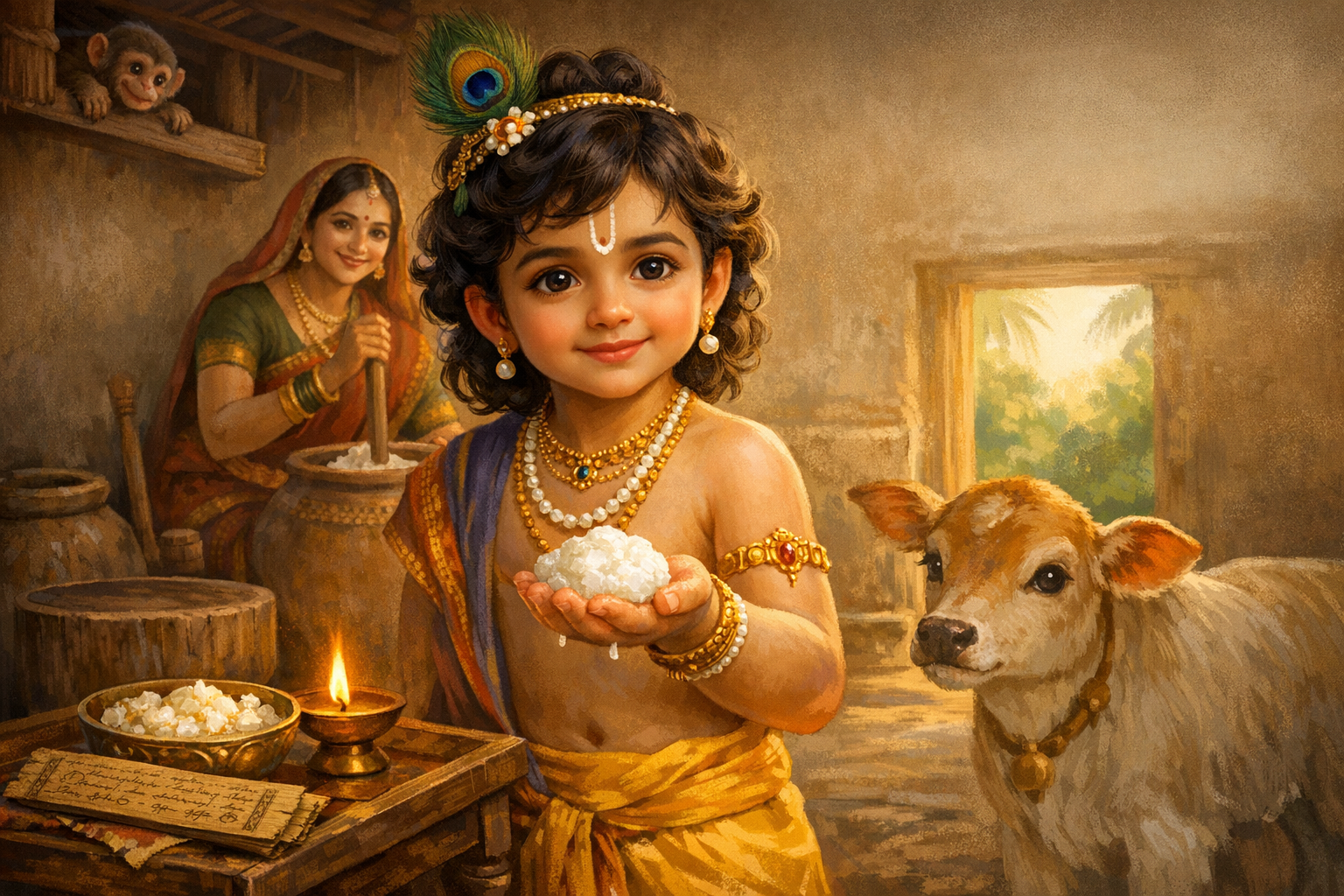
Among the innumerable epithets of Bhagavan Sri Krishna, the name Navneet Priya possesses a singular tenderness that illuminates the heart of bhakti. Literally, Navneet (from Sanskrit navanīta) denotes fresh butter newly churned from curds, while Priya signifies what is beloved or dear. Together, Navneet Priya conveys He who holds fresh butter most dear. Far from a quaint domestic image, this name opens a window into Krishna’s bāla-līlā (childhood pastimes), the theology of vatsalya-rasa (the devotional mood of parental affection), and the lived ritual culture that continues to shape communities across the dharmic world.
Etymologically, navanīta combines nava (new) with nīta (led forth, extracted), capturing the precise act by which essence is drawn out from curds. That precision matters. Butter is not merely milk; it is milk that has been cultured, churned, and clarifiedan allegory the classical tradition repeatedly applies to spiritual life. Priya, meanwhile, is a word of affect and intimacy found throughout Sanskrit literature. The pairing in Navneet Priya therefore does more than name an object of delight; it articulates a relationship of sweetness between the Divine Child and the extracted essence signifying purity, nourishment, and love.
Scriptural narratives place this sweetness at the center of Krishna’s early life in Vraja. Śrīmad-Bhāgavatam Book 10 describes how the Gopīs complain that the child Gopāla steals their navanīta, distributes it to friends and even to monkeys, and charms away their reprimands with irresistible playfulness. The Damodara-līlā (Bhāgavatam 10.9) recounts Yaśodā’s churning of curd, Krishna’s mischief, the breaking of the butter pot, and the iconic episode in which Mother Yaśodā binds the Supreme with a rope of maternal lovehence the name Dāmodara. In these scenes, butter is not a prop; it is the tactile medium through which a cosmic Lord enters the affectionate, everyday world of a rural household.
In theological terms, this is the locus of vatsalya-rasa, the devotional flavor in which Bhagavan receives care as a child rather than as a sovereign. In this rasa, Krishna’s delight in navanīta mirrors the devotee’s offering of the heart’s own essence. Later rasika literature, especially as systematized in the bhakti-śāstra tradition (e.g., Rūpa Gosvāmi’s bhakti-rasa analysis), interprets such līlās as pedagogy: divine play instructs without didacticism, allowing devotee-communities to internalize spiritual truths through affection and ritualized memory.
Butter’s symbolic grammar is rich. Fresh butter is the fruit of manthanachurning. Sādhana, too, is a form of churning: practices of japa, kīrtana, and meditation culture the mind (like milk cultured into curd), which is then churned by discipline until an inner essenceprema, steadfast loveemerges. The name Navneet Priya therefore encodes a claim: Krishna cherishes the devotee’s extracted essence, not merely external abundance. In many commentarial streams, navanīta is further likened to the purified insight that remains when agitation subsides and clarity rises, just as clarified butter (ghṛta) sustains the sacrificial fire.
Ritual practice reflects this hermeneutic. Across Janmāṣṭamī observances and daily temple-sevā, devotees offer makkhan-miśrī (butter and rock sugar), panjīrī, kṣīra preparations, and ghṛta lamps. In the Pushtimarg of Vallabhacharya, the sevā of Bāla-Kṛṣṇa (notably at Śrīnāthjī, Nathdwara) prominently features butter offerings as an expression of “pusti”divine gracenourishing the reciprocal delight between the Lord and devotee. In the Gauḍīya Vaiṣṇava tradition (including ISKCON), the Kārtika month highlights the Damodarāṣṭakamverses venerating Dāmodarasung before ghee lamps, where the narrative of butter mischief and maternal binding is contemplatively relived.
Folk and civic celebrations extend these themes into embodied community memory. The Dahi Handi festivalespecially vibrant in Maharashtra and parts of western Indiareenacts the navanīta-leelās through human pyramids formed by “Govindas” to reach and break suspended curd pots. While festive, the act performs a subtle hermeneutic: divine joy invites communal coordination, courage, and trust, showing how scriptural memory can cultivate social virtues.
Iconographically, the name Navneet Priya informs a recognizable visual vocabulary. Sculpture and painting traditionsHoysala friezes in Karnataka, Chola bronzes in Tamilakam, Tanjore panels, and Pahari-Kangra miniatures in the Himalayan foothillsdepict the infant Krishna grasping a butter churn, reaching into a handi, or sharing butter with calves and monkeys. The visual accent on navanīta foregrounds sweetness (mādhurya) and intimacy as core attributes of the Divine, inviting devotees to approach with tenderness rather than awe alone.
From a cultural-linguistic perspective, the motif travels effortlessly. “Makkhan-chor” (butter thief) resonates in Hindi kīrtans; Tamil devotional literature affectionately hails the Lord who loves “vennai”; Telugu and Kannada bhakti songs likewise celebrate the bāl-līlā centered on butter. The appellation Navneet Priya thus bridges Sanskritic register and regional vernaculars, shaping a shared devotional imagination across India and the diaspora.
Philosophically, the image of churning and essence extraction is a dharmic commonplace, with analogues across Hindu, Buddhist, Jain, and Sikh thought worlds. While Krishna’s bāl-līlā is uniquely Vaiṣṇava, the broader metaphorrefining the mind-heart to reveal a compassionate corealigns with the Buddhist emphasis on karuṇā, the Jain discipline of ahiṃsā and inner purity, and the Sikh ethic of sevā grounded in humility. Read in this inclusive lens, Navneet Priya becomes a cultural-signifying name that affirms a shared civilizational pursuit: softening the heart to make love, care, and truth immediately actionable.
Ethically, the dairy symbolism invites reflection on stewardship and responsibility. Traditional Hindu praxis treats cows and dairy with reverence, emphasizing non-cruelty and mindful consumption. When framed through the name Navneet Priya, offerings of navanīta signify not indulgence but sanctified careturning daily foodways into occasions for gratitude, moderation, and ecological sensitivity consistent with dharmic ideals.
Theologically, Navneet Priya also balances transcendence and immanence. The same Lord who reveals the viśvarūpa (cosmic form) in Yaśodā’s vision (Bhāgavatam 10.11) also allows Himself to be fed, scolded, and adorned by His mother. The butter that melts in the hand becomes a sign of a God who “melts” before love. In this, the epithet acts as a hermeneutic key to Krishna-bhakti: ultimate reality is accessible not only through metaphysical abstraction but through humane, familial affection sanctified by devotion.
Historically, the name Navanīta-priya and its close twin Navanīta-chora appear in litany traditions (aṣṭottara-śatanāmāvalīs) and kīrtana repertoires, reinforcing memory through rhythmic recitation. The persistence of these names in temple liturgy and domestic worship demonstrates how condensed epithets function as portable theologyeach name a seed carrying narrative, doctrine, and practice together.
In contemporary pedagogy and community life, Navneet Priya continues to teach without polemics. Parents narrate the bāl-līlās to children, cultivating empathy and devotion; congregations sing the Damodarāṣṭakam in Kārtika, ritually reinhabiting the interplay of love and accountability; festivals like Dahi Handi transform urban skylines into improvised theaters of cooperative courage. Across these contexts, the name is both a lesson and a living ritual frame.
Read through the lenses of language, scripture, theology, iconography, and social practice, Navneet Priya is far more than a charming sobriquet. It is a compact doctrine of essence (navanīta) and love (priya): the Divine cherishes what is most carefully cultured within the devoteeclarity, tenderness, and unwavering affection. In honoring this name, communities reaffirm a shared dharmic aspiration that unites Hindu, Buddhist, Jain, and Sikh valuesrefining the self, serving with compassion, and allowing the heart’s butter to be joyfully received by the Beloved.
Inspired by this post on Hindu Blog.
