
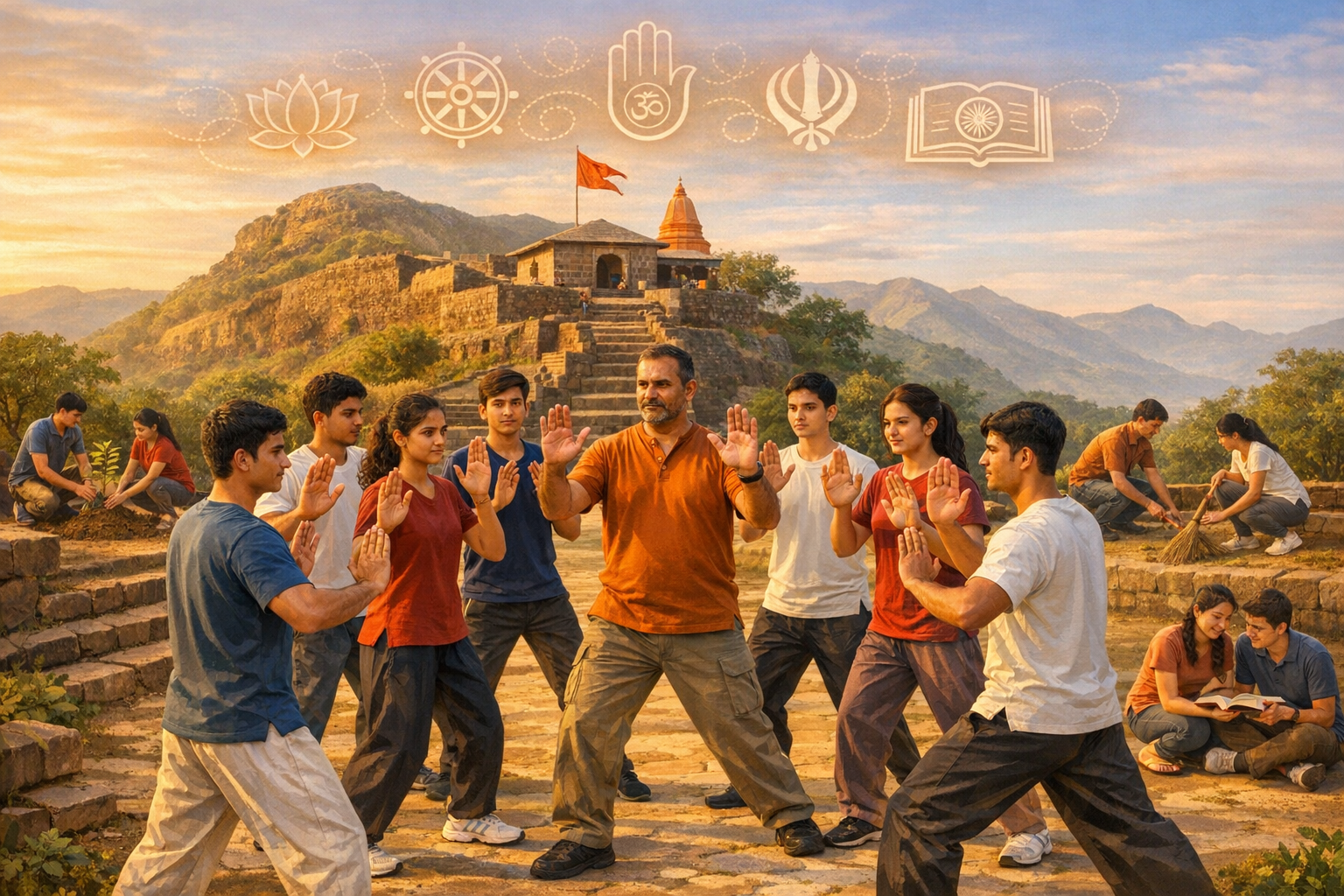
At Sajjangad near Satara, Maharashtra, more than seventy young participants convened for a Hindu Dharma Sanskar Camp designed to cultivate character, civic responsibility, and service-minded leadership. The program concentrated on four complementary streams of learning: Dharma education, practical self-defence, nation-building, and the civilizational governance ideal often described as Ram Rajya. Framed as a disciplined, values-first immersion, the camp offered youths a coherent way to translate inner conviction into constructive social action.
Sajjangad carries singular historical gravity as the seat associated with Samarth Ramdas (1608–1681), whose teachings highlight a synthesis of devotion, discipline, and public virtue. In this setting, the camp’s focus on ethical action felt continuous with a long tradition of integrating bhakti with kshatra (courage) and seva (service). The site’s legacy, including texts such as Dasbodh and Manache Shlok, provided cultural context for reflections on personal restraint, duty, and the pursuit of the common good.
In the camp’s Dharma strand, facilitators presented Dharma not as dogma but as a living, action-guiding ethic that anchors decision-making in truthfulness, compassion, self-restraint, and responsibility. These shared dharmic virtues resonate across Hinduism, Buddhism, Jainism, and Sikhism: satya and daya (truth and compassion), ahimsa and aparigraha (non-violence and non-acquisitiveness), and seva (selfless service) are foundational to the broader Bharatiya civilizational ethos. By engaging canonical narratives and reflective discussions, youths explored how ancient insights remain operationally relevant to school life, digital behavior, peer relations, and community engagement.
The self-defence component emphasized a safety-first, de-escalation-forward approach consistent with ahimsa while preparing participants for real-world contingencies. Instruction prioritized situational awareness, boundary-setting, voice and posture, coordinated teamwork for safe exit strategies, and last-resort techniques aligned with the principle of proportionality. Legal literacy around the right of private defence under Indian law (e.g., the Indian Penal Code’s provisions on private defence) framed the training within ethical and lawful conduct, ensuring that courage remains tempered by responsibility.
Nation-building sessions translated Dharma into civic practice. Discussions highlighted constitutional values, the spirit of Article 51A’s fundamental duties, local problem-solving, and service projects that strengthen social trust. Themes such as environmental stewardship, respect for elders, gender dignity, volunteerism, and digital citizenship showed how everyday choices contribute to a resilient social fabric. The emphasis remained on actionable micro-contributionscleanliness drives, tutoring support, responsible media usethat cumulatively advance collective well-being.
Engagement with Ram Rajya ideals centered on justice, rule of law, accessible welfare, and integrity in public life. Clarifying frequent misconceptions, presenters framed Ram Rajya not as theocracy but as dharma-guided good governance where every individual’s dignity and rights are safeguarded. Parallels with dhamma-raja in Buddhist thought, rajadharma in Jain literature, and the Sikh synthesis of Miri-Piri underscored how inclusive, ethical statecraft is a civilizational aspiration shared across dharmic traditions. In this lens, Ram Rajya becomes a results-oriented benchmark: fairness in institutions, compassion for the vulnerable, and harmony with nature.
Pedagogically, the camp balanced conceptual clarity with applied practice. Satsang-style dialogues, case-based discussions, and scenario walkthroughs were paired with mindfulness and basic physical drills to integrate head, heart, and hand. Reflection periods allowed participants to internalize principles, articulate personal commitments, and plan small, trackable acts of service. This blend of shraddha (reverence) and yukti (reasoned inquiry) helped convert inspiration into disciplined habit.
Unity across the dharmic family was a defining throughline. By explicitly recognizing convergences among Hinduism, Buddhism, Jainism, and Sikhismahimsa, karuna (compassion), aparigraha, satya, and sevathe program encouraged mutual respect and collaboration. The result was not homogenization but harmony: diverse practices and lineages were honored as complementary paths committed to inner growth and social uplift.
Participants commonly describe a dual transformation: inward steadiness and outward initiative. Parents and mentors often observe increased punctuality, polite speech, and willingness to help at home and in the neighborhood. Youths report stronger focus in studies, healthier peer boundaries, and a clearer sense of purpose anchored in seva. These qualitative shifts, while personal, translate into public benefit when sustained over time.
The setting itself aided learning. Sajjangad’s contemplative atmosphere fostered quiet attention, while the cohort sizejust over seventywas conducive to individual mentoring and peer support. The intimacy of scale encouraged open questions, constructive feedback, and accountability, helping participants test ideas safely before applying them in real-world contexts.
To help communities replicate the model, the camp’s approach can be abstracted into a simple blueprint: define clear learning outcomes (character, courage, service); integrate Dharma ethics with legal and safety literacy; pair reflective study with field-tested routines; ensure trained mentors and a transparent code of conduct; culminate in small, locally relevant service actions; and sustain momentum through post-camp circles where youths continue to practice and measure progress.
Impact evaluation can remain straightforward yet rigorous. Pre- and post-camp self-assessments on habits and attitudes, short knowledge checks on civic and legal topics, logs of volunteer hours, and mentor observations together create a balanced scorecard. Tracking a few community indicatorscleanliness of public spaces, tutoring continuity, or participation in local initiativescan reveal how individual growth scales to community resilience.
Ethical safeguards are integral. The program’s emphasis on non-violence, proportionality, and legal boundaries prevents the misuse of self-defence skills, while respectful dialogue norms protect viewpoint diversity within the dharmic family. Age-appropriate instruction, gender inclusion, and attention to emotional well-being ensure that the camp uplifts without overwhelming, building confidence alongside compassion.
In sum, the Hindu Dharma Sanskar Camp at Sajjangad demonstrated how Dharma education, self-defence literacy, nation-building, and Ram Rajya ideals can be woven into a single, coherent pathway for youth empowerment. Rooted in Maharashtra’s living heritage and aligned with the shared values of Hinduism, Buddhism, Jainism, and Sikhism, the program offered a practical grammar of citizenship: think clearly, act lawfully, serve selflessly, and lead with integrity. Such initiatives, replicated thoughtfully, can strengthen social trust and help translate civilizational wisdom into everyday public good.
Inspired by this post on Hindu Jagruti Samiti.
