
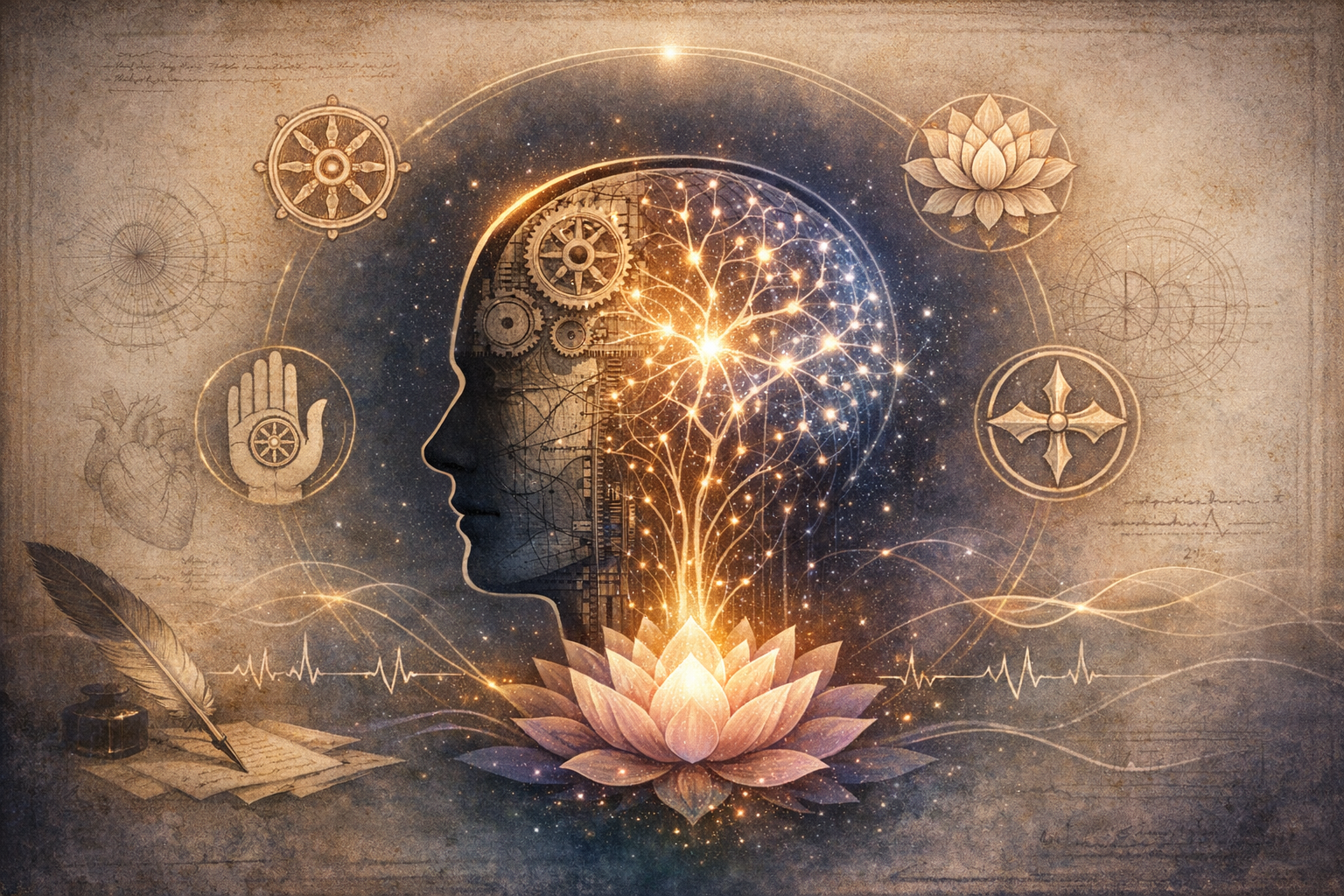
“A person is not considered a great sage unless he disagrees with another sage.” Set against the ferment of the Enlightenment, this maxim aptly frames the life and work of Julien Offray de La Mettrie (1709–1751), the French physician-philosopher whose radical materialism ignited controversy while quietly shaping later debates in medicine, psychiatry, neurology, and psychology.
La Mettrie’s most incendiary text, L’Homme Machine (Man a Machine, 1747), contended that human thought, emotion, and what many called the soul emerge from the finely organized operations of the body. In an age still shadowed by Cartesian dualism, he argued that physiciansprecisely because they examine how bodily states alter mental lifeare uniquely positioned to speak about the soul. The thesis scandalized Paris and Holland, precipitating exile; yet Frederick the Great later granted him refuge in Prussia even while voicing reservations about the spiritual tranquility of those who read him. The paradox captured the era: repudiation in public, influence in private.
Viewed historically, Man a Machine distilled a current of iatromechanism already present in the Enlightenmentan effort to interpret living systems with the clarity of physics and the precision of anatomy. La Mettrie extended mechanistic continuity beyond the animal body to the human mind, claiming that differences of intellect and temperament follow from differences in constitution, training, and environment rather than any immaterial essence standing outside nature.
Modern neuroscience and psychiatry confirm much that La Mettrie intuited from clinical practice: anesthesia can instantaneously extinguish conscious experience; cerebral lesions may dissolve language or memory; neuropharmacology reliably modulates mood, attention, and perception; and neuroimaging correlates shifting patterns of neural activity with subjective states. Across disciplines, the mind–body connection has become a research anchor rather than a metaphysical scandal.
Yet the maturation of the science of mind has also exposed the limits of strict reductionism. Contemporary theories such as Global Neuronal Workspace, Integrated Information Theory, predictive processing, and enactivism argue that consciousness depends not only on neural components but also on their large-scale, dynamic integration with body and environment. Neurophenomenologythe careful pairing of first-person reports with brain measurementsshows that disciplined mental training (for example, meditation) can produce distinctive, replicable neurocognitive signatures. Correlation has multiplied, but the “hard problem” of why certain neural processes feel like anything at all remains an open question.
This dual movementtoward deeper mechanism and toward explanatory humilitycreates fertile ground for a constructive dialogue with the dharmic traditions of Hinduism, Buddhism, Jainism, and Sikhism. All four traditions offer precise taxonomies of mind, rigorous disciplines of mental cultivation, and ethical frameworks that resist the dehumanizing drift that a crude “man as machine” slogan might invite, even while acknowledging that mental states arise dependently through conditions.
In Hindu philosophy, layered models of personhoodsthūla śarīra (gross body), sūkṣma śarīra (subtle body), and kāraṇa śarīra (causal body)coexist with analyses of the antaḥkaraṇa (manas, buddhi, ahaṅkāra) and the pañca kośas (annamaya, prāṇamaya, manomaya, vijñānamaya, ānandamaya). These frameworks neither deny physiology nor collapse consciousness into it. Rather, they articulate a graded ontology where biological processes, vital energies (prāṇa), and cognition form interdependent strata. Practices such as prāṇāyāma and dhyāna, long described in Yoga and Ayurveda, now show measurable effects on autonomic regulation, attention, and affectbridging traditional soteriology with contemporary psychophysiology.
Buddhism’s analysis of anātman (no-self) and the five skandhas (rūpa, vedanā, saṃjñā, saṃskāra, vijñāna) resonates with process views in cognitive science: what is called “self” is a flux of conditioned aggregates, not a fixed substance. Dependent origination offers a causal grammar for mental life that aligns with the empirical stance of psychiatry and psychology, yet it does so while orienting practice toward compassion (karuṇā) and insight (prajñā). Intensive meditation research has documented changes in large-scale brain networks (for example, reduced default-mode activity during non-discursive awareness), underscoring how contemplative training systematically shapes cognition and well-being.
Jainism presents a meticulous account of jīva (soul) and ajīva (non-soul), with karmic matter binding to the soul in precise, law-like ways that influence cognition and conduct. While distinct from materialism, this doctrine still treats mental life as causally structured and ethically tractable. The emphasis on ahiṃsā (non-violence) and vigilant self-observation dovetails with the therapeutic ethos of modern behavioral and mindfulness-based interventions that address harmful patterns (saṃskāras) through disciplined awareness and restraint.
Sikh thought affirms Ik Oṅkār (the unity of the Divine), framing body and mind as integral instruments for remembrance (simran) and service (seva). Ego (haumai) obscures this unity; embodied practice within community purifies perception and action. Rather than opposing physiology and spirituality, Sikhism enjoins their harmonious integrationan insight increasingly echoed in biopsychosocial models of health that connect nervous system regulation, meaning, and social belonging.
Taken together, the dharmic traditions acknowledge that mental phenomena are conditionedby the nervous system, habits of attention, moral intention, and communitywhile maintaining that dignity, liberation, and virtue are not reducible to machinery. They propose that understanding mechanism is necessary for skillful means but insufficient for ultimate aims. In this way, they both complement and challenge La Mettrie’s most sweeping assertions.
Even La Mettrie’s historically provocative claimthat physicians have a privileged vantage on the soulcan be reframed today as a call for collaboration rather than exclusivity. Physicians and neuroscientists contribute indispensable knowledge about brain and body; philosophers clarify concepts and arguments; contemplatives from Hindu, Buddhist, Jain, and Sikh lineages provide finely calibrated first-person data and ethical guidance; and patients offer lived expertise. Interdisciplinary dialogue makes the inquiry humane and complete.
Consider familiar, relatable experiences. Those who have watched a loved one slip under general anesthesia have seen consciousness vanish within seconds, only to return with memories interrupted as if time itself had fractured. Those who have practiced breath regulation or mantra meditation have often noticed calmer heart rhythms and steadier attention. Those who have grieved know how the body aches with sorrow. These episodes exemplify the mind–body connection that Enlightenment medicine glimpsed and contemporary science now measuresyet they also point beyond reduction, toward meaning, value, and transcendence emphasized in the dharmic paths.
Clinically, integrative care increasingly unites pharmacotherapy, psychotherapy, and contemplative practices: meditation to train attention and emotional regulation, Yoga-based movement and prāṇāyāma for autonomic balance, and ethical cultivation (yama–niyama, śīla) to stabilize conduct. Evidence from randomized trials and neuroimaging supports benefits for stress reactivity, anxiety, depression, and relapse prevention, while reminding clinicians to personalize protocols to culture, capacity, and consent.
Ethically, a purely mechanistic anthropology risks instrumentalizing persons. Dharmic frameworks counter this drift by grounding action in ahiṃsā, karuṇā, satya, and sevavalues that direct scientific power toward compassion and justice. Framed this way, even a spirited disagreement with La Mettrie becomes an opportunity to enrich the philosophy of mind with moral seriousness and spiritual depth.
Historically, La Mettrie’s notoriety overshadowed how prescient some of his clinical observations were. After exile from France and Holland, his Prussian phase under Frederick the Great ensured a brief but productive period of writing and debate. His influence flowed into later materialists such as Cabanis and d’Holbach and, more distantly, into traditions of neuropsychiatry that regard mental disorder as bodily disorder. The Enlightenment’s crucible thus forged a conversation still unfolding in today’s laboratories, clinics, and contemplative halls.
The most constructive reading of Man a Machine is not as a metaphysical decree but as a methodological provocation: investigate how living structure shapes living experience. Dharmic thought accepts the challengethen widens it. Structure matters; so do attention, ethics, and community; and, for many, consciousness may be more fundamental than any current mechanism reveals. An integrative model can honor all these insights: physiology as reliable substrate, mind as emergent pattern and subject of training, and consciousness as either foundational reality or, at minimum, an irreducible datum of experience.
In that spirit, disagreement between sageswhether Enlightenment physicians or dharmic āchāryasbecomes a disciplined dance rather than a duel. When approached with rigor and mutual respect, it deepens knowledge, refines practice, and advances unity across Hinduism, Buddhism, Jainism, and Sikhism. The enduring task is to hold mechanism and meaning together: to let medicine and neuroscience illuminate the pathways of the mind while allowing dharma to guide their purpose toward wisdom and compassion.
Inspired by this post on Dandavats.
