
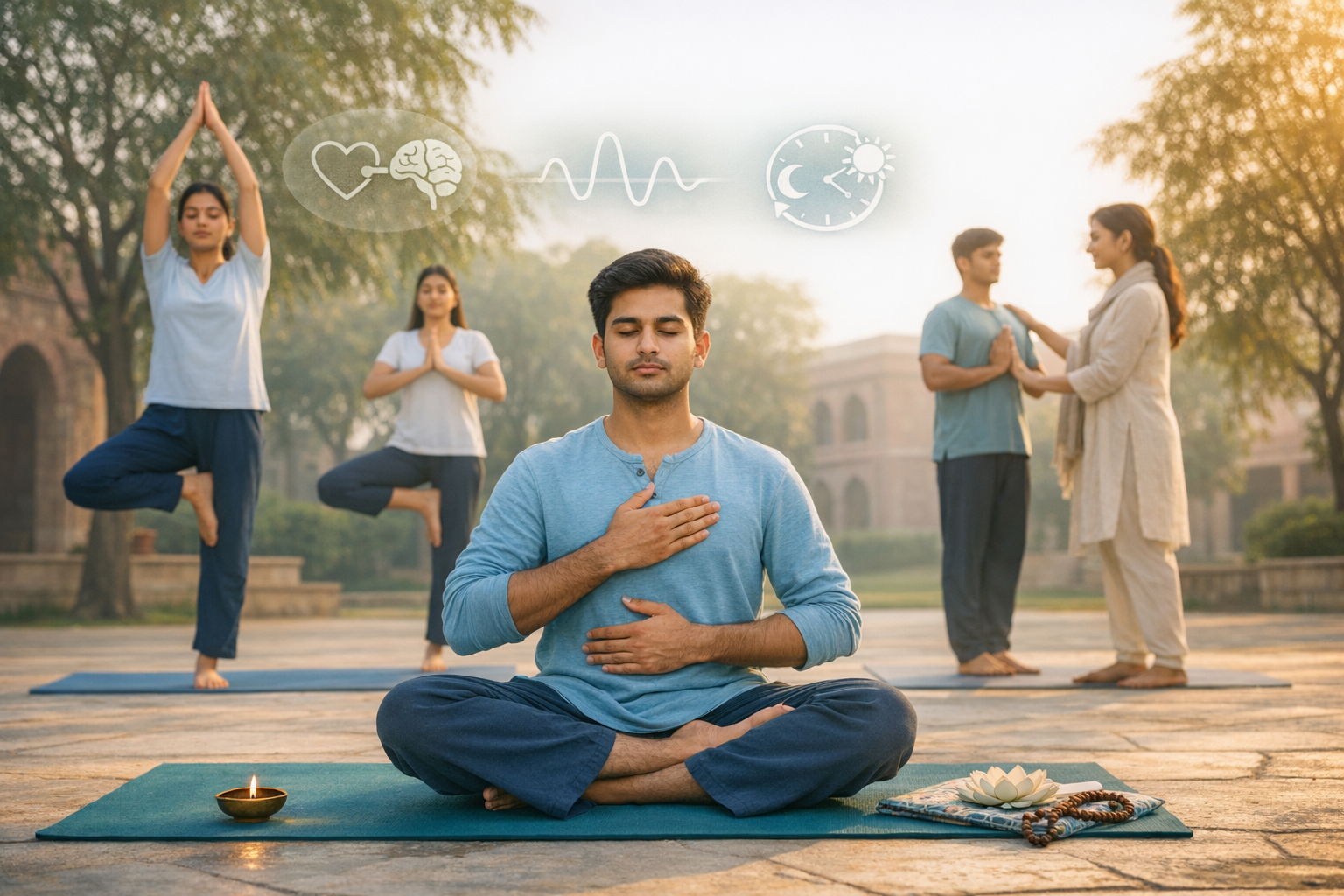
At a student guidance programme in Palwal, Haryana, organised by Hindu Janajagruti Samiti (HJS), Sadguru Dr. Charudatta Pingale underscored the value of a disciplined daily routine (dinacharya), yoga, pranayama and sadhana as practical, evidence‑aligned tools for stress management and the cultivation of self-confidence among students.
The focus on student stress is timely. Across Indian classrooms, academic pressure, competitive examinations, digital distractions, sleep irregularity and social expectations often converge to produce chronic sympathetic arousalcharacterised by restlessness, worry and diminished concentration. An integrative approach that stabilises circadian rhythms, calms the autonomic nervous system and nurtures meaning and purpose can markedly improve emotional balance and learning readiness.
Routine functions as the scaffold for resilience. Regular sleep-wake timing, morning light exposure, balanced study breaks, mindful nutrition and screen hygiene support the hypothalamic–pituitary–adrenal (HPA) axis and optimise the cortisol awakening response. When students anchor the day with predictable cueswaking at a consistent time, hydrating, a brief mobility sequence and unhurried breath awareness before opening bookscognitive endurance improves and reactivity declines. Even small adjustments, such as finishing the final digital screen at least sixty minutes before bedtime and setting a brief evening review with a next‑day plan (sankalpa), can consolidate memory while lowering anticipatory anxiety.
Yoga, applied judiciously for adolescents and young adults, integrates postural stability with interoceptive awareness. Simple sequences emphasising Tadasana, Vrikshasana, Bhujangasana, Setu Bandhasana, Balasana and a moderated Surya Namaskara rhythmically recruit large muscle groups, slow respiration and enhance proprioception. Over 20–30 minutes, this combination supports parasympathetic dominance, improves heart rate variability (HRV) and restores attentional control. Safety-first instructionneutral spine, joint-aligned loading, avoidance of end‑range extremes and thoughtful progressionsensures accessibility across fitness levels.
Pranayama provides a precise lever for autonomic regulation. Slow diaphragmatic breathing increases vagal tone via baroreflex pathways, reduces respiratory sinus arrhythmia variance and attenuates amygdala-driven threat appraisal. Accessible methods for students include Nadi Shodhana (alternate‑nostril breathing) without strain, Bhramari (humming exhalation) to lengthen the out‑breath, and gentle equal‑ratio breathing such as 4‑4 or 4‑2‑6 patterns. For novices, breath holds are best minimised; the emphasis remains on smooth, silent nasal breathing, relaxed abdomen and an exhalation slightly longer than inhalation. Five to ten minutes before study sessions often suffices to down‑shift arousal and prime working memory.
Sadhanadisciplined inner practiceextends beyond posture and breath to cultivate steadiness of mind and character. Within the shared dharmic heritage of Hinduism, Buddhism, Jainism and Sikhism, students can connect with forms consonant with family and school contexts: japa or mantra remembrance, simran, metta (loving‑kindness) contemplation, or a brief samayik for equanimity. Though diverse in expression, the intention is unified: to refine attention, temper reactivity and align daily conduct with ethical clarity. Ten quiet minutes of sadhana, morning or evening, consistently strengthens self-regulation.
Self-confidence emerges when competence, autonomy and relatedness develop together. Practices presented in Palwal align with these needs. Structured routines and yoga build somatic competence; pranayama and sadhana restore a sense of inner authorship; shared practice in classrooms or peer circles nurtures belonging. Micro‑winssuch as completing a three‑pose flow, maintaining a week of consistent sleep times or logging five minutes of Nadi Shodhana dailycompound into self‑efficacy. Reflective journaling that notes effort rather than only outcomes supports a growth mindset under examination pressure.
Schools and colleges in Haryana and beyond can operationalise this approach through brief, repeatable modules. A feasible template includes a morning centering of two minutes of breath awareness, a ten‑minute mobility and asana sequence, and three minutes of Bhramari or Nadi Shodhana before the first academic period. Teachers can be oriented to basic safety and referral pathways, while students can track perceived stress using simple scales alongside study quality and sleep regularity. Where resources permit, HRV spot checks and quiet rooms for decompression add objective and experiential support.
Safety remains paramount. Students with acute or chronic health concerns should consult healthcare professionals, and advanced breath retentions or forceful techniques are unnecessary in academic settings. Language that is inclusive and voluntary respects plural identities; the same core skills can be framed as “breath education,” “attention training,” or “mind–body recovery,” while honouring the practices’ dharmic roots and their shared spirit of compassion and self‑discipline across traditions.
The Palwal programme’s emphasisarticulated by Sadguru Dr. Charudatta Pingale and facilitated by Hindu Janajagruti Samiti (HJS)is locally relevant and broadly scalable. Haryana’s students, who balance demanding commutes, co‑curricular commitments and family responsibilities, stand to benefit from compact, high‑yield practices that are culturally familiar and easy to integrate. When practiced consistently, routine, yoga, pranayama and sadhana reduce baseline stress, stabilise attention and gently elevate confidence without pharmacological dependence.
Framed academically and applied compassionately, this quartet of practices offers a coherent, science‑aligned and tradition‑honouring pathway for student well‑being. The Palwal initiative demonstrates how schools and communities can unite around practical dharmic wisdom to support mental health, learning outcomes and social harmonygoals shared across Hindu, Buddhist, Jain and Sikh lineages, and essential to the flourishing of India’s youth.
Inspired by this post on Hindu Jagruti Samiti.
