
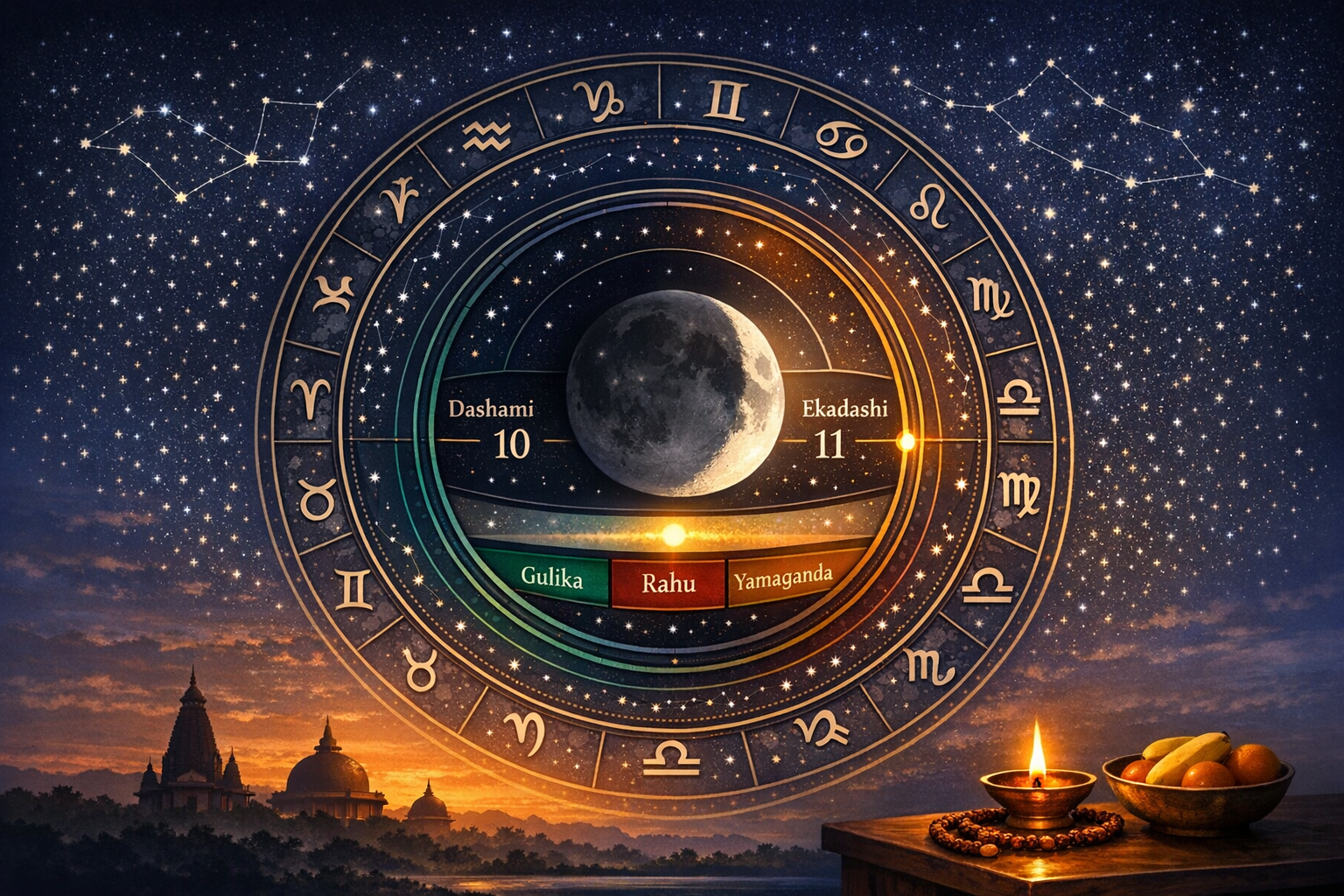
On Wednesday, June 10, 2026, the Hindu calendar (Panchang) in most regions marks Krishna Paksha Dashami (the tenth lunar day of the waning fortnight) at sunrise. This tithi continues until 7:34 PM, after which Krishna Paksha Ekadashi commences. Local observance can vary slightly by longitude, latitude, and almanac tradition, but the Dashami-to-Ekadashi transition on this date is consistent across most regional Panchangs.
In Panchanga computation, a tithi is defined by the angular separation between the Moon and the Sun. Each tithi spans 12° of relative ecliptic longitude, so the shift from Dashami to Ekadashi occurs as the Moon–Sun elongation crosses 120° to 132°. This astronomically anchored measure explains why tithi boundaries rarely align with midnight and can change at any hour of the civil day.
Krishna Paksha denotes the waning half of the lunar month, a period associated with introspection, simplification, and inward spiritual focus across dharmic traditions. Many households recognize these days as especially supportive for scriptural study, japa, dhyana, and gentle disciplines that refine attention and cultivate composure.
Spiritually, Dashami is often treated as a preparatory day ahead of Ekadashi. It lends itself to lightening the schedule, completing essential tasks early, and adopting a sattvika routinechoices that make the transition into Ekadashi steadier. Practitioners frequently report that a calm Dashami evening, reduced screen time, and mindful meals help establish the equanimity that Ekadashi invites.
Ekadashi holds special significance in Vaiṣṇava practice as a day for upavāsa, kīrtana, smaraṇa, and compassionate self-restraint. In many Jain communities, Ekadashi (often called Agyaras) is observed as a fasting or semi-fasting day consonant with ahiṁsā and aparigraha. Buddhist Uposatha observances similarly align spiritual discipline with the lunar cycle, while Sikh teachings center Naam Simran, seva, and ethical living over ritual fasting; across these paths, the shared ethos is inner clarity, devotion, and service to all. Such convergences underscore the unity of dharmic traditions while respecting their distinct methods.
Because Ekadashi on June 10 begins after sunset, most Smārta and Vaiṣṇava guidelines schedule the Ekadashi vrata for the following civil day, when Ekadashi prevails at sunrise (June 11, 2026, in most regions). This follows a widely accepted rule: the fasting day is the civil date on which Ekadashi is operative at local sunrise. Devotees should confirm any sampradāya-specific nuances with their community’s almanac.
Parāṇa (fast-breaking) is performed on Dvādaśī, after sunrise and within the recommended window before the tithi ends. Traditional manuals advise avoiding the initial part of Dvādaśī called Hari Vāsara (the first quarter of the tithi) for breaking the fast. Exact windows vary by locality; therefore, it is prudent to consult a reliable local Panchang for precise parāṇa timing.
Śubh Muhurat selection relies on a full Panchang settithi, nakshatra, yoga, karaṇa, and weekdaytempered by regional rules. Two commonly referenced elements for everyday planning are Abhijit Muhurat and the avoidance of Rahu Kālam, Yamaganda, and Gulika Kāla. Because all four depend on sunrise and sunset at a given place, their exact spans must be computed for the observer’s city.
Abhijit Muhurat straddles local solar midday and is sometimes used for initiatives that cannot be easily scheduled elsewhere. Its acceptance varies by lineage: some use it universally for auspicious starts, while others reserve it for select activities. The prudent approach is to apply Abhijit as a supportive, but not sole, criterion alongside the day’s tithi, nakshatra, and personal considerations.
For Rahu Kālam, Yamaganda, and Gulika Kāla, the daylight interval from sunrise to sunset is divided into eight equal parts. Each weekday assigns specific segments to these inauspicious periods. On Wednesdays, the standard mapping places Rahu Kālam in the 5th segment, Yamaganda in the 6th, and Gulika Kāla in the 4th. As an illustrative example only, if sunrise is at 6:00 and sunset at 18:00, the Wednesday segments yield Gulika Kāla roughly 10:30–12:00, Rahu Kālam 12:00–13:30, and Yamaganda 13:30–15:00. Different sunrise and sunset times will shift these windows accordingly.
Nakshatra analysis depends on the Moon’s ecliptic longitude. The 27 nakshatras each span 13°20′, and the day’s operative nakshatraparticularly at sunriseis integral to muhūrta selection, personal observances, and vrata planning. Because the Moon moves swiftly, nakshatra often changes during the day; a reliable Panchang or ephemeris should be consulted for location-specific detail.
Moon Rāshi denotes the sign (30° sector) occupied by the Moon and is a primary factor in daily rāśi phala and gochara interpretations. The day’s lunar sign offers a broad emotional-weather index for many practitioners, though traditional counsel emphasizes using rāshi contextually and ethically rather than deterministically.
Two additional Panchang limbs, yoga and karaṇa, refine muhūrta judgments. Yoga is derived from the sum of the Moon’s and Sun’s longitudes and can amplify or moderate tendencies implied by tithi and nakshatra. Karaṇa, representing half a tithi, is frequently used for task-level refinement and for prescribing or avoiding micro-intervals during the day.
Within households, a widely embraced, experience-based practice is to keep the Dashami evening intentionally simple. A light, sāttvika dinner and an early night can make the following Ekadashi vrata more easeful. Many find that gentle japa, a short reading from the Bhagavad-Gita or the Dhammapada, and a few minutes of dhyāna before sleep help orient the mind toward clarity and compassion.
Food choices on and around Ekadashi reflect a wider dharmic ethic of mindful, non-harmful consumption. Even for those not undertaking a complete fast, a simple menufree from stimulants and unnecessary complexitysupports steadiness. Jain and Buddhist approaches to restraint, as well as Sikh emphasis on service and remembrance, all point to the same center: living conscientiously for the welfare of all beings.
For personal and family planning, the practical sequence around this date is straightforward. June 10 begins with Krishna Paksha Dashami and transitions to Ekadashi in the evening, so most Ekadashi vratas will be observed on June 11, with parāṇa on Dvādaśī (June 12) after sunrise, within the prescribed window. Those coordinating temple visits, seva, or community activities can use these anchors while fitting precise times to their city’s Panchang.
This date also invites a broader meditation on unity within diversity. While practices differfasting in one lineage, increased seva or meditation in anotherthe intention remains shared: to refine conduct, elevate awareness, and extend maitrī and karuṇā to all. Approaching June 10 and its Ekadashi transition in this spirit strengthens the living bonds among Hinduism, Buddhism, Jainism, and Sikhism.
Because Panchang values are inherently astronomical, authoritative guidance requires local parameters. Readers are encouraged to apply the principles outlined heretithi-based vrata rules, the Wednesday pattern for Rahu Kālam, Yamaganda, and Gulika Kāla, and the sunrise-anchored logic of muhūrtatogether with a locality-specific almanac or app to finalize exact timings. This blends timeless wisdom with precise, place-based accuracy.
In summary, Wednesday, June 10, 2026, begins with Krishna Paksha Dashami and turns to Ekadashi at 7:34 PM in most regions. Ekadashi vrata thus falls on June 11 for most traditions, with parāṇa on Dvādaśī. Observed thoughtfully, this sequence becomes an opportunity to harmonize discipline with compassion, personal practice with community service, and regional variety with the deep unity of dharmic paths.
Inspired by this post on Hindu Blog.
