
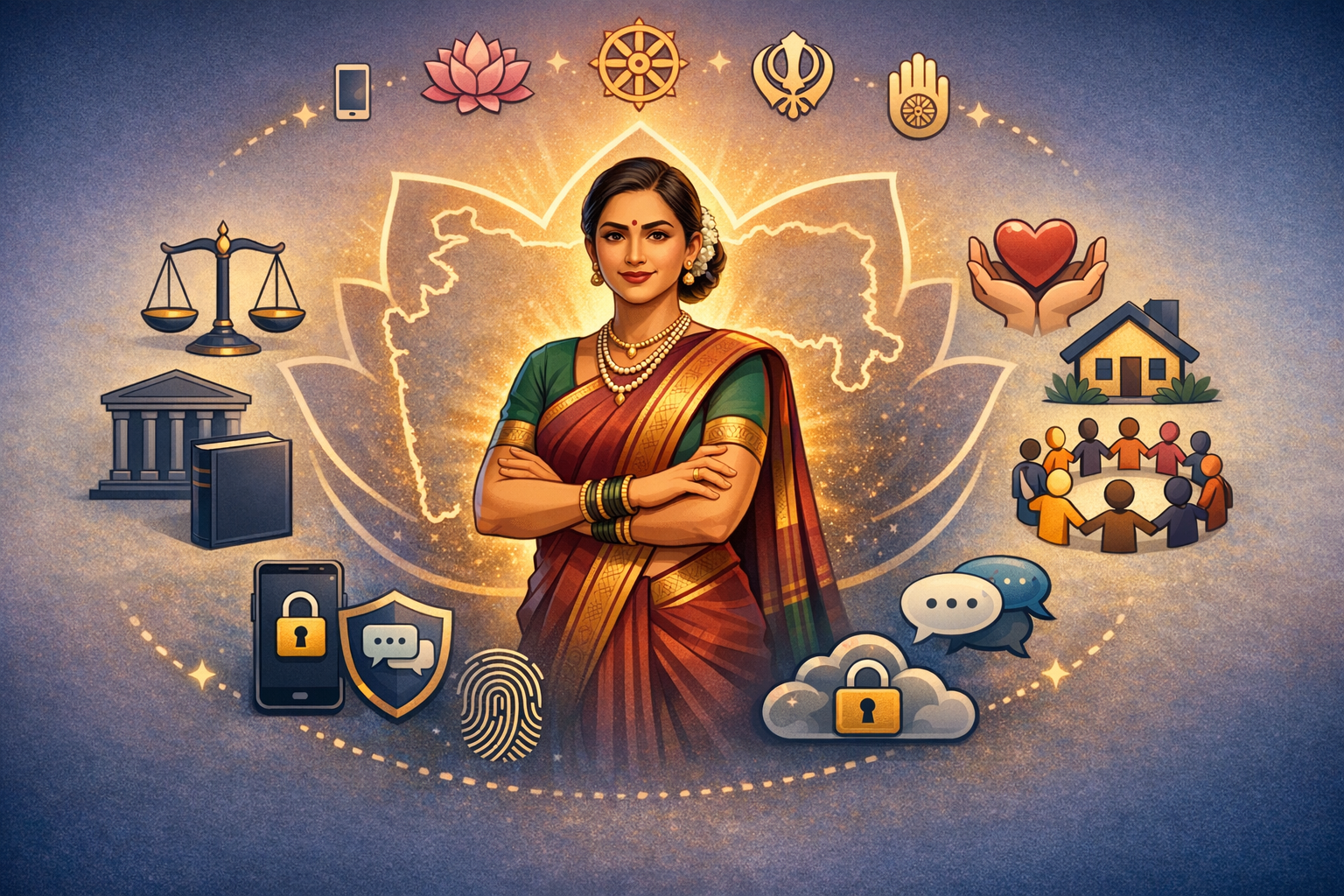
Rajya Sabha MP from Maharashtra, Dr. Medha Kulkarni, announced the launch of Operation Durga, a support-oriented campaign intended to assist women who report coercion, deception, or exploitation in intimate relationshipsconcerns that are sometimes described in public discourse as “love jihad.” The stated purpose is survivor safety and women’s empowerment, with attention to lawful redress, psychosocial care, and community-based prevention in Maharashtra.
The phrase “love jihad” is contested in India’s public conversation. While advocates describe it as a pattern of deception leading to forced conversion or exploitation, critics argue that the term risks stereotyping and communal polarization. Any initiative in this domain therefore requires an evidence-led, survivor-centric, and non-discriminatory approach. Operation Durga, to be both effective and socially constructive, must focus on the underlying harmsfraud, coercion, intimidation, isolation, trafficking, and violenceirrespective of the identities of those involved.
A rights-based frame positions the campaign within India’s constitutional guarantees and women’s autonomy. In practice, coercion and deceit in relationships overlap with recognized categories of crime: cheating, intimidation, abduction, sexual assault, trafficking, and cyber-harms. National Crime Records Bureau statistics track these offences under penal provisions rather than under any single umbrella label, underscoring that the legal system targets conduct, not creed. Within this framework, precision in definitions and case documentation is essential, both to protect survivors and to preserve due process.
The Indian legal architecture already provides several pathways for redress. Offences historically captured under the Indian Penal Code (now largely replaced by the Bharatiya Nyaya Sanhita) include cheating, criminal intimidation, abduction, and sexual offences; the Protection of Children from Sexual Offences (POCSO) Act safeguards minors; the Information Technology Act addresses cyber-stalking, non-consensual imagery, and online grooming; and the Protection of Women from Domestic Violence Act provides civil remedies, residence orders, and protection orders. Where financial exploitation or identity fraud is alleged, relevant provisions on forgery and cheating apply. In parallel, the Immoral Traffic (Prevention) Act may be engaged if trafficking indicators arise.
Interfaith marriages founded on informed, uncoerced consent remain fully protected in law. The Special Marriage Act, 1954, enables interfaith unions without religious conversion and should be more widely known as a tool of legal awareness. The Supreme Court in Shafin Jahan v. Asokan K.M. (2018) affirmed that an adult’s right to choose a spouse is a facet of liberty and privacy. For Operation Durga to advance women’s empowerment without chilling legitimate relationships, screening must distinguish coercion from consensual choice and must comply with constitutional protections of autonomy and equality.
Maharashtra has witnessed policy debates around a Freedom of Religion Bill; in such discussions, it is crucial to center safeguards against forced conversion alongside robust protections for consenting adults. If future legislation is considered (for example, under the umbrella of the “Maharashtra Freedom of Religion Bill 2026”), clarity of definitions, strong due-process provisions, and penalties for false complaints are indispensable to ensure both survivor protection and civil liberties.
An effective architecture for Operation Durga can be conceptualized as an integrated chain of care. At the entry point, confidential intakethrough a state-wide helpline, police referral, One Stop Centres (OSCs), or civil-society partnersshould use standardized risk assessment tools to triage emergencies, high-risk situations, and legal inquiries. Case managers can coordinate immediate safety planning, medical care, and shelter where needed, while legal support units guide First Information Reports, statement recording, and applications for protection orders.
Given the prevalence of digital grooming and deception, specialized cyber response is essential. Survivors benefit when trained personnel assist with preserving electronic evidence (metadata, chat logs, call records, geolocation information) and liaise with the National Cyber Crime Reporting Portal and the 1930 cyber helpline. Chain-of-custody protocols should be followed meticulously so that digital artefacts are admissible in court. Privacy-by-design practicesincluding data minimization, role-based access, and encryptionguard against secondary victimization.
Survivor-centric psychosocial care complements legal action. Trauma-informed counselling, safety planning, and peer-support circles reduce isolation and enhance resilience. This care must be culturally sensitive and inclusive of Maharashtra’s diverse communities across Hindu, Buddhist, Jain, and Sikh traditions, emphasizing shared dharmic values of compassion, dignity, and non-harm. Many survivors describe the emotional arc from shock and fear to clarity and choice; consistent, non-judgmental support helps transform crisis into agency.
Community engagement is equally critical. Legal awareness sessions in colleges and neighbourhood associations can demystify the Special Marriage Act, consent, digital safety, and the process for filing complaints, while discouraging vigilantism. Faith-based and community leaders from dharmic traditions can jointly convey that coercion, deception, and violence are inconsistent with Dharma and that interfaith respect and harmony are foundational to social cohesion in Maharashtra.
Safeguards against misuse must be institutionalized. Internal review boards, clear documentation standards, and supervisory audits reduce the risk of profiling or communal targeting. Complaint mechanisms for aggrieved parties and mandatory training on non-discrimination preserve trust. The focus should remain on conductfraud, force, fearrather than identity. This balanced posture supports women’s empowerment while upholding the rule of law.
Risk indicators often reported in deception-led exploitation include identity misrepresentation, secrecy around personal background, sudden isolation from family or friends, pressure to conceal communications, accelerated demands for conversion or marriage, and threatsemotional, financial, or physical. These indicators are not proof by themselves and must not be used to stereotype communities. However, early, non-confrontational conversations, verification through lawful means, and recourse to professional counselling can prevent escalation and keep choices informed.
Operational partnerships improve outcomes. Collaboration with the Maharashtra Police, the Department of Women and Child Development, the State Legal Services Authority, OSCs, and credible NGOs enables smooth referrals, court accompaniment, and rehabilitation. Existing national resourcesthe 181 Women Helpline, 1930 cyber helpline, and OSC networkscan be leveraged immediately. Nirbhaya Fund channels and Corporate Social Responsibility programs may support scaling survivor services, technology stacks for case management, and training.
Rigorous monitoring and evaluation convert intent into measurable impact. Baselines (calls received, cases triaged), outputs (FIRs facilitated, protection orders obtained), and outcomes (survivor safety stabilized at 90/180/365 days; case disposal rates) enable course correction. Periodic, anonymized transparency reportssubject to data protectionbuild public confidence and allow external experts to recommend improvements.
Details of Operation Durga will likely evolve as implementation proceeds. Publishing clear standard operating procedures, referral maps, and rights advisories in Marathi and English can set expectations for all stakeholders. Public feedback loopsthrough community dialogues and academic reviewsensure the campaign remains evidence-led, lawful, and humane.
The name “Durga” evokes Shakti, the protective power that upholds Dharma. Anchoring this campaign in that ethos means championing women’s autonomy, rejecting coercion and deceit unequivocally, and strengthening unity among dharmic traditions. When the metrics of success are survivor safety, legally sound outcomes, and social harmony, Operation Durga can become a model for Maharashtrasupportive, constitutional, and unifying.
Inspired by this post on Hindu Jagruti Samiti.
