
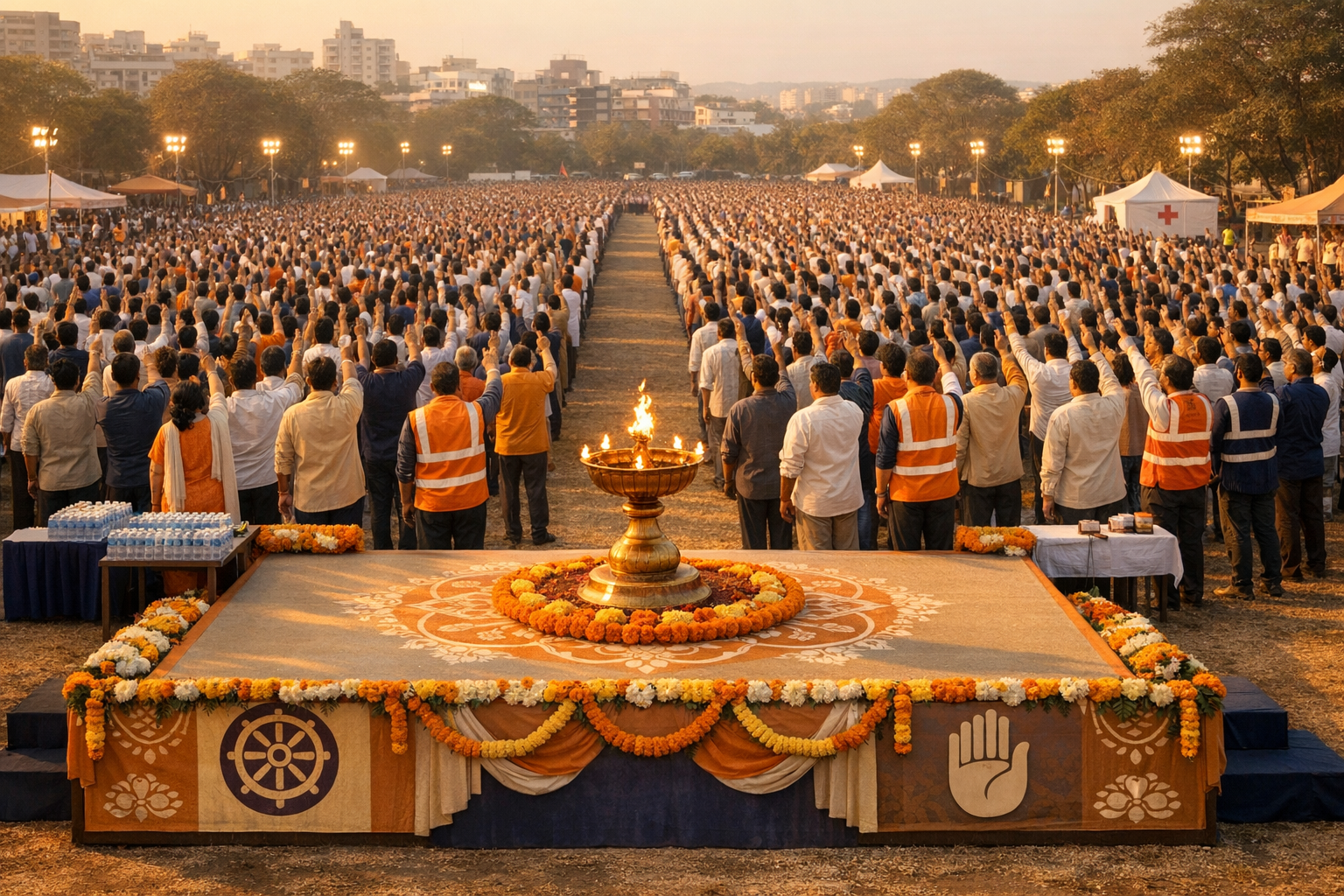
More than 11,000 Hindus assembled in Hadapsar, Pune, for the Hindu Rashtra-Jagruti Sabha, where participants took a solemn collective pledge for the protection of Dharma. The scale of attendance, the visible orderliness, and the prominence of a shared sankalpa (vow) signaled a reaffirmation of civic solidarity and ethical responsibility among participants. As a community milestone, the gathering stood out not merely for numbers but for the clarity of its normative message: safeguarding Dharma through peaceful, lawful, and service-oriented conduct. In the contemporary Indian public sphere, such congregations illustrate how faith-based civil society mobilizes around values, not against communities, thereby emphasizing social cohesion over confrontation. The Hadapsar event thus becomes an instructive case for understanding how religiously informed citizenship articulates itself within constitutional frameworks and plural social settings.
Dharma, in this context, is not reducible to confessional identity; it denotes an ethical order that upholds truth (satya), compassion (daya), self-discipline (samyama), and service (seva). While the term has a rich civilizational lineage in Hindu thought, its normative core resonates across the dharmic traditions of Buddhism, Jainism, and Sikhism. In Buddhism, ethical precepts and the cultivation of wisdom and compassion anchor individual and collective conduct; in Jainism, anuvrata (small vows), ahimsa, and aparigraha formalize moral restraint; and in Sikhism, the daily ardas and the aspiration for sarbat da bhala (welfare of all) embody social responsibility. Read through this broader lens, a pledge to protect Dharma affirms a commitment to non-violence, ethical growth, and public-spirited action that benefits the larger community without negating the dignity of any other faith. Such a framing aligns a local event in Pune with civilizational principles that are intrinsically inclusive and dialogical.
Historically, sabhaspublic assemblies convened for deliberation and collective resolvehave served as crucibles of social learning and value transmission in the subcontinent. The term “janajagruti” (public awakening) underscores the pedagogical intent: creating awareness, aligning conduct with shared ethics, and catalyzing community service. Contemporary “Hindu Rashtra-Jagruti Sabha” platforms, including those convened by civil society networks, typically seek to articulate a civilizational vision centered on duties, rights, and cultural continuity. For many participants, “Hindu Rashtra” is interpreted as a cultural-ethical ethos that prizes constitutionalism, pluralism, and public orderrather than as a theocratic construct. Situated within Pune’s long intellectual and civic legacy, the Hadapsar assembly thus exemplifies a values-forward, constitution-compatible mode of social mobilization.
The practice of taking a collective sankalpa has recognizable structural features that recur across dharmic traditions. In Hindu ritual culture, sankalpa names intent, location, and duty, thereby sacralizing responsibility; in Sikh praxis, ardas culminates in a universalist aspiration that expands the moral horizon beyond self-interest; in Buddhist communities, the reaffirmation of the five precepts deepens ethical attentiveness; and in Jain observance, anuvrata formalizes practical, scalable vows for householders. A public pledge for Dharma therefore serves as an anchor for disciplined citizenship, creating a bridge between inner conviction and outer action. When voiced in unison by thousands, the vow also functions as a social signalreducing ambiguity about shared norms and establishing a community-wide baseline for lawful and compassionate conduct.
From a social-scientific perspective, large-scale value-affirming assemblies are associated with durable civic effects. Collective intentionality, once expressed in public, tends to increase follow-through on service, philanthropy, and rule-abiding behavior due to reputational and identity mechanisms. The phenomenon aligns with established theories of social identity and collective effervescence: synchronized participation heightens prosocial salience and reduces free-riding. At the same time, responsible conveners invariably emphasize normative guardrailsnon-violence, respect for law, and inter-community civilityto prevent echo-chambers from hardening into antagonism. The Hadapsar pledge, foregrounding Dharma as ethical duty rather than antagonistic identity, reflects this responsible equilibrium.
Public assemblies in India operate within a robust constitutional framework. Article 19(1)(a) and 19(1)(b) of the Constitution safeguard freedom of speech and the right to assemble peaceably without arms, subject to reasonable restrictions in the interests of public order and safety. Articles 25–28 protect freedom of conscience and the right to freely profess, practice, and propagate religion, while also recognizing the state’s role in ensuring public order, morality, and health. When large religious gatherings are conducted with requisite permissions, crowd management plans, and adherence to local regulations, they exemplify a mature synergy between faith-based civil society and democratic governance. The civic discipline evident in the Hadapsar congregation highlights how constitutional rights can be exercised in ways that strengthen public trust and social stability.
An inclusive reading of Dharma naturally invites collaboration across the dharmic familyHindu, Buddhist, Jain, and Sikh communitiesaround shared ethical and service commitments. Future iterations of such sabhas in Maharashtra and beyond can deepen unity by featuring multi-tradition panels on ahimsa, seva, mindfulness, and stewardship of heritage and ecology. Such design choices broaden ownership of outcomes, reduce the risk of perceived exclusivity, and model the civilizational pluralism that has long characterized the subcontinent. Inclusivity is not a tactical add-on; it is integral to the moral grammar of Dharma.
Translating a pledge into measurable public good requires structured pathways. Community organizers commonly adopt a “seva portfolio,” channeling volunteer energy into environmental restoration (riverbank clean-ups, native tree planting), educational support (after-school tutoring, scholarships), healthcare outreach (blood donation drives, preventive health camps), and heritage conservation (documentation, maintenance, and accessibility improvements in temples and community spaces). Cross-dharmic teams can jointly plan and execute these initiatives, reinforcing unity through shared work. Such service-forward approaches convert symbolic resonance into tangible benefits for neighborhoods across Pune and the wider Maharashtra region.
Sound governance practices underpin safe and dignified large gatherings. Recommended protocols include advance safety audits, clear ingress–egress design, trained volunteer marshals, medical aid stations, hydration points, accessible facilities for elders and people with disabilities, and environmentally responsible waste management. Transparent codes of conductprohibiting hate speech, affirming non-violence, and encouraging respectful discoursealign event culture with constitutional principles. When coupled with accurate public communication and liaison with civic authorities, such measures protect both participant dignity and the surrounding community’s routine life.
In the digital era, narrative hygiene is as critical as on-ground logistics. Organizers and participants alike benefit from media literacy practices: verifying claims before amplification, distinguishing opinion from verified fact, and avoiding inflammatory framings that mischaracterize other faiths or communities. Positive, accurate documentationprogram summaries, keynote themes centered on ethics, and data on service outcomeshelps shape a fair public record. This approach mitigates polarization, preserves the moral clarity of the pledge, and situates sabhas like the one in Hadapsar within a broader, constructive discourse on civic virtue.
Sustainability considerations strengthen the ethical integrity of religious gatherings. Low-waste designs, biodegradable materials, efficient public transport guidance, and noise-level compliance reflect care for shared spaces and the health of neighbors. Environmental seva, widely affirmed across dharmic philosophies, is a natural extension of a Dharma pledge; aligning ritual and logistics with ecological responsibility demonstrates that cultural devotion and environmental stewardship are mutually reinforcing.
Youth and women’s participation is pivotal for continuity and innovation. Skill-building opportunities in event management, first aid, communications, and data stewardship can be integrated into sabha ecosystems, offering pathways for leadership development. Intergenerational mentorshipelders imparting scriptural and ethical insights while younger volunteers contribute organizational and digital expertisecreates a resilient community fabric. Such capacity-building ensures that the ethical momentum generated in Hadapsar is not episodic but cumulative.
To assess long-run impact, communities may track practical indicators aligned with the pledge: volunteer-hours logged, number of inter-tradition service collaborations, educational outcomes supported, heritage sites maintained, and environmental metrics (such as trees planted or kilograms of waste diverted from landfills). Periodic public reporting, even at a modest scale, fosters accountability and encourages iterative improvement. Measured in this way, a single day’s pledge in Pune can catalyze a year-long arc of civic achievement.
The Hindu Rashtra-Jagruti Sabha in Hadapsar, Pune, where more than 11,000 Hindus gathered to pledge protection of Dharma, demonstrates how collective ethical resolve can be articulated in a manner that is constitutional, inclusive, and service-oriented. By rooting the pledge in the shared vocabulary of dharmic traditions and translating intent into measurable public good, such gatherings strengthen social harmony and civic resilience. The event’s true significance lies not only in its impressive turnout but in its potential to inspire cross-dharmic cooperation, deepen everyday ethics, and enhance public trust. When responsibly convened and inclusively framed, assemblies of this nature serve as living laboratories for the practice of Dharma in a diverse democracy.
Inspired by this post on Hindu Jagruti Samiti.
