
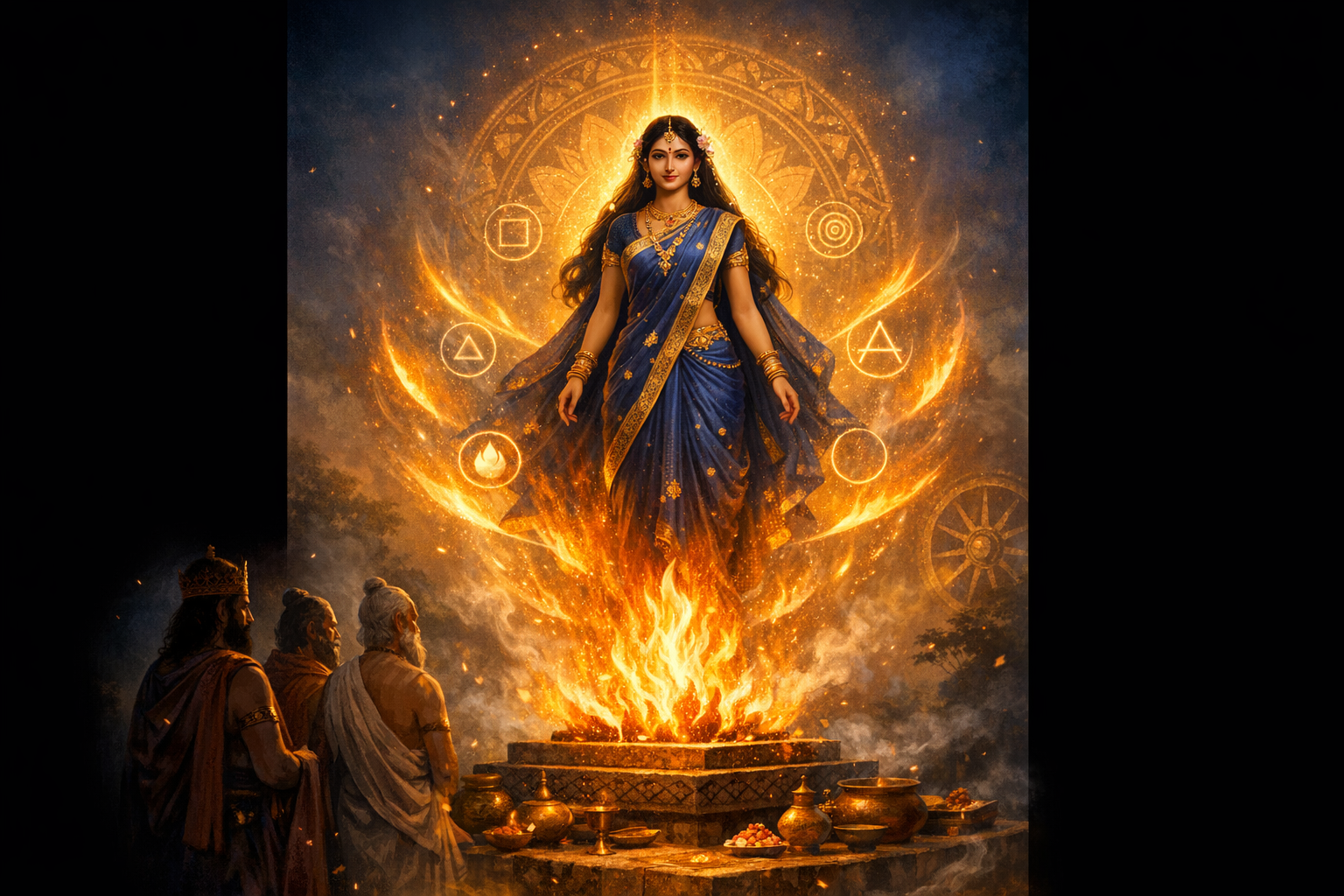
Draupadi’s birth from the yajna fire in the Mahabharata occupies a singular place in Indian epic literature, where ritual, destiny, and moral causality converge with rare clarity. The episode is not merely a miracle; it is a carefully structured narrative device that reveals how human intention (kāma) and cosmic order (ṛta) intersect, often in unsettling yet ultimately purposeful ways. Read closely, it offers a multi-layered exploration of Vedic ritualism, Agni symbolism, and the ethical architecture of dharma-yuddha that culminates in the Kurukshetra War.
King Drupada of Panchala, once bound by childhood camaraderie to Droṇa, suffered public humiliation after a dispute over friendship and kingship. That ruptureso memorably staged through Droṇa’s victory and Drupada’s loss of sovereigntyplanted the seeds of vengeance and set the stage for a ritual solution to a political and personal wound. Determined to restore honor and rectify imbalance, Drupada turned to the most solemn Vedic instrument available: a yajna designed to realign the seen order with the unseen justice of the cosmos.
Classical retellings describe Drupada approaching the sages Yaja and Upayaja. Although versions differ in nuance, the thrust is consistent: intention matters. One account emphasizes Upayaja’s initial reluctance to preside over a rite propelled by vengeance, while another presents a sequence in which the brothers ultimately consent, integrating ritual precision with ethical gravity. This narrative tensionbetween the king’s rājasic motive and the priests’ concern for sattvic alignmentprepares the reader for what follows from the fire itself.
From the blazing altar emerged two luminous figures whose births reconfigured the moral topography of the epic. First appeared Dhṛṣṭadyumna, accompanied by a divine proclamation that he would be the instrument of Droṇa’s fall. Then arose a resplendent maiden of striking complexion and fragrance, whose presence altered the course of history: Draupadi. Later tradition preserves her epithets with careDraupadī (daughter of Drupada), Pāñcālī (of Panchala), Kṛṣṇā (dark-hued), and Yajñasenī (born of sacrifice)each name indexing a facet of her origin, identity, and destiny.
The choice of fire as the generative matrix is not incidental. In Vedic thought, Agni is the “purohita” of the gods, the mouth through which offerings ascend and the medium by which intention is transmuted into consequence. Birth from Agni signals an ayonija statusunwombed, ritually generated, and therefore symbolically unbound by ordinary social genealogies. It encodes a theological proposition: when the social order falters, yajna can recalibrate it by invoking a higher adjudication, and the beings who arise from that crucible carry a mandate reflective of that correction.
The Bhagavad Gita’s taxonomy of sacrifice (sāttvika, rājasa, tāmasa) sharpens the ethical lens through which this episode can be read. Drupada’s objective was tinged with rajashonor, ambition, and reprisalyet the cosmic outcome refuses a one-dimensional moral arc. The fire yields both a warrior destined to slay a teacher and a queen destined to become the moral center of a civilizational reckoning. In other words, the ritual does not simply gratify personal desire; it renders a more encompassing corrective that the human agent neither fully controls nor fully foresees.
Draupadi’s subsequent life affirms the complexity signaled at her birth. Her marriage to the five PāṇḍavasYudhiṣṭhira, Bhīma, Arjuna, Nakula, and Sahadevastands at the confluence of law, prophecy, and societal norm. Many Purāṇic strands recall a former-life boon in which she asked for five virtues and thereby five husbands. Read symbolically, the union can be taken to represent integration across the pañca-mahābhūtas (five elements) or the coordination of the five faculties toward a singular moral aim. As Pāñcālī, born of the altar-fire, she embodies the heat, luminosity, and transformative power required to knit plurality into purposeful unity.
Agni’s role as witness (sakṣi) pervades Vedic ritesmost recognizably in vivāha (marriage), where the sacred flame ratifies relational dharma. That Draupadi is both born of fire and situated within fire-attested bonds amplifies the impression that her life is framed by sacramental accountability. When the Kuru court later violates ethical norms, the narrative makes palpable what the yajna at her origin implied: cosmic order will demand redress, and the witness will not be silent.
This fire symbolism resonates across dharmic traditions in ways that invite unity rather than division. In Hindu practice, homa and havan use the flame to purify intention and offer gratitude. In Buddhist contextsparticularly Vajrayāna and East Asian transmissionshoma-like rites (goma) serve contemplative and purificatory ends. Jain and Sikh traditions emphasize non-violence and ethical clarity, with the sacred light (jyot) and lamp rituals evoking purity, insight, and remembrance. Across these kindred paths, the flame signals transformation, moral witnessing, and the aspiration to align conduct with truth.
Viewed literarily, the birth-from-fire scene is one of Vyāsa’s most elegant foreshadowings. The epic positions Draupadi at the juncture where private humiliation yields public consequence. Her swayamvara forges an alliance between Panchala and the Pāṇḍavas, recalibrating the geopolitical field against Hastināpura. Later, her humiliation in the Kuru hall crystallizes the justification for dharma-yuddha, not because she seeks war, but because her dignity becomes the test case for whether power will be bound by law and conscience.
It is strikingemotionally as much as intellectuallythat the very element that kindled her existence also becomes the metaphor for her presence throughout the narrative: clarifying, searing, and ultimately transformative. Readers encountering the trauma and resolve that thread through Draupadi’s story often report a sense of being accompanied by a steady light, one that refuses collapse into fatalism or fury. That affective resonance is precisely what the yajna fire encodes: steadfast heat without wanton destruction, illumination without spectacle.
From a philosophical vantage, Draupadi’s origin invites reflection on the relationship between ritual technology and moral teleology. Yajna is not magic; it is a disciplined interface with order, in which procedure, intention, and offering converge to invite an answer. The answer may exceed the petitioner’s horizon. Drupada sought a son to avenge an insult; the cosmos responded with a son and a queen whose lives would help restore an entire moral world. In that surplus lies the epic’s enduring wisdom.
For contemporary readers across Hinduism, Buddhism, Jainism, and Sikhism, the takeaway is constructive: when intention is heated in the crucible of ethical discipline, it becomes capable of serving a larger good. The sacred flamewhether envisioned as Agni, contemplated as purifying light, or approached as a symbol of inner clarityreminds all seekers that transformation is possible without coercion, and that unity is forged not by erasing difference but by aligning diverse strengths toward a shared commitment to truth and compassion.
In sum, Draupadi’s divine birth from the yajna fire is a study in how Vedic ritual, narrative structure, and dharmic ethics cohere. It demonstrates that destiny in the Mahabharata is neither arbitrary nor mechanistic; it is responsive to intention, yet sovereign in scope. That sovereignty takes the form of a woman whose life bears the heat of witness and the light of guidance, making her not merely an instrument of fate but a luminous axis for the epic’s exploration of justice.
Inspired by this post on Hindu Blog.
