
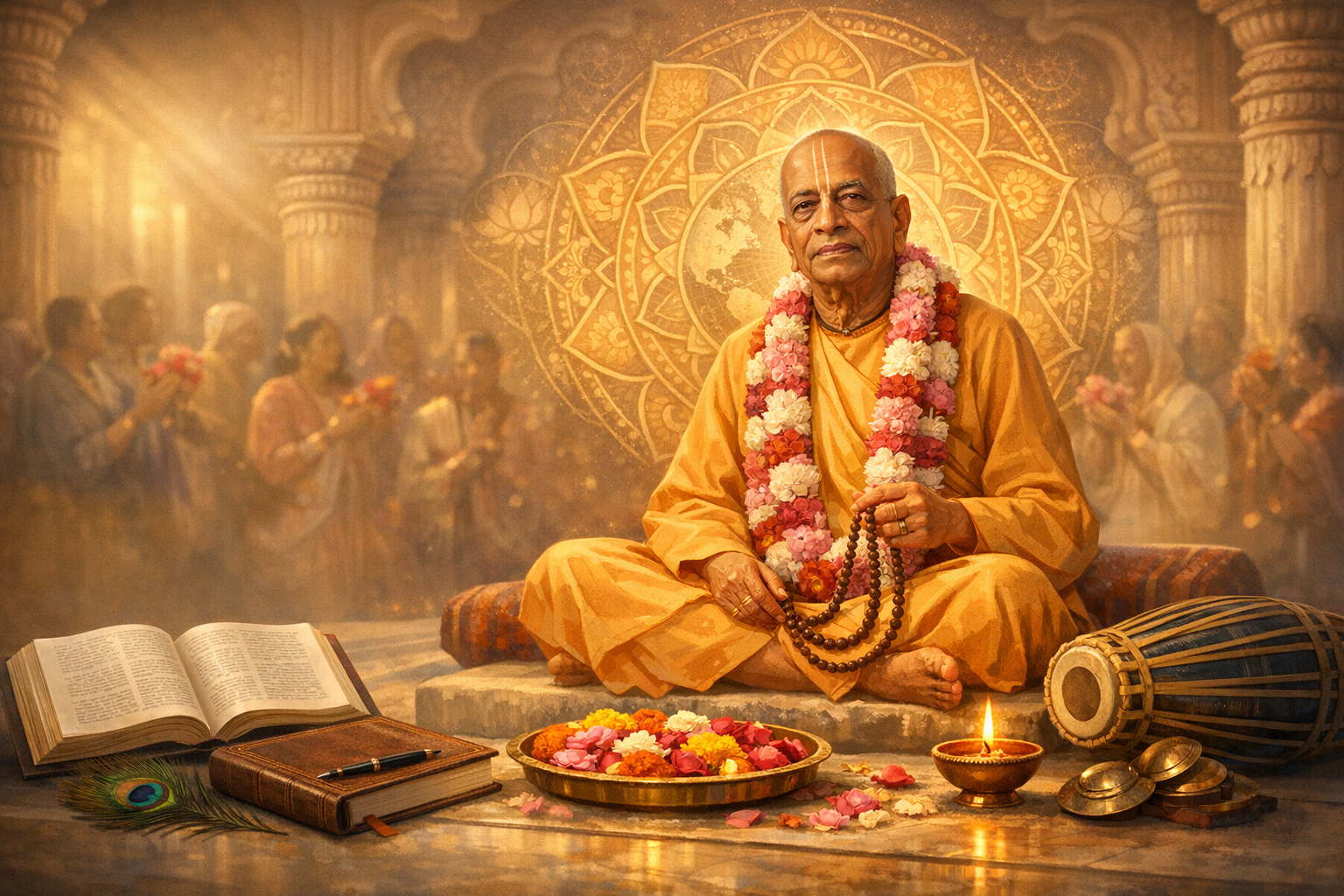
Across the global ISKCON (International Society For Krishna Consciousness) community, the approach of Srila Prabhupada’s 2026 Vyasa-puja is widely regarded as one of the most cherished spiritual milestones of the year. More than a commemoration, Vyasa-puja is a rigorous, tradition-grounded affirmation of the guru’s role as the living conduit of Vedic wisdom. As the celebration dedicated to Bhagavan Veda Vyasathe archetypal compiler of the Vedic corpus and the Mahabharataand, by extension, to the bona fide ācārya in the paramparā, it coherently unites devotion (bhakti), scholarship, and community remembrance in a single observance.
In the Gaudiya Vaishnava lineage, Vyasa-puja for A.C. Bhaktivedanta Swami Prabhupada (Srila Prabhupada) is observed annually on his appearance day, which in the Vaishnava calendar coincides with Nandotsava, the day following Sri Krishna Janmashtami. Local observance follows traditional tithi reckoning, and calendars may vary slightly by geography. The liturgical and cultural intent, however, remains constant: to honor the guru as the transparent via media of scripture and to renew collective commitment to the teachings preserved and propagated through the guru-śiṣya (teacher–disciple) relationship.
Srila Prabhupada’s historical contribution is well documented: the founding of ISKCON in 1966; systematic English translations and commentaries on Bhagavad Gita (Bhagavad-gita As It Is), Srimad-Bhagavatam, and Sri Caitanya-caritamrita; the re-centering of hari-nāma-saṅkīrtana as a daily spiritual practice; and the establishment of communities, temples, and educational initiatives across continents. In the context of Vyasa-puja, these achievements are not merely remembered; they are interpreted as living instructionexamples of how bhakti can be both textually precise and universally accessible.
The Vyasa-puja bookan annual compendium of written homagesis therefore best understood as a cultural and spiritual archive. It functions as a curated record of gratitude, doctrinal reflection, and lived transformation. From the perspective of cultural heritage, such volumes preserve the intangible dimensions of devotion and pedagogyvoice, memory, lineage, and methodensuring that future generations encounter not only ideas but the ethos with which those ideas were embodied and transmitted.
The theology that undergirds Vyasa-puja is explicit in Vedic literature. Bhagavad-gita (4.2) describes paramparā as the authentic channel of transmission, while 4.34 outlines the etiquette of inquiryapproach with humility (praṇipāta), render service (sevā), and ask relevant questions (paripraśna). Srimad-Bhagavatam, especially in the dialogues of Nārada and Vyāsa (e.g., 1.5), frames the teacher’s mandate as guiding society from mere scholarship to realized devotion. Honoring the guru at Vyasa-puja is thus a commitment to safeguard both message and method: fidelity to śāstra coupled with compassion in practice.
While Vyasa-puja is specific to the Vedic and Vaishnava context, its core ethos resonates across the dharmic family. Hindu traditions emphasize Guru Purnima as a festival of learning and gratitude; many Buddhists observe Asalha Puja as a commemoration of the Buddha’s first discourse and the beginning of the saṅgha; Jains venerate ācāryas as custodians of right knowledge (samyag-jñāna) and conduct; and Sikhs center spiritual authority in the line of Gurus and the Guru Granth Sahib. This shared reverence for the teacher and the teaching constitutes a profound point of unity in spiritual diversity, aligning Vyasa-puja with a broader civilizational practice of honoring knowledge and those who transmit it.
Practitioners often report that the emotional tenor of Vyasa-puja combines gratitude with introspection. The day’s liturgy, kīrtana, and communal readings from the Vyasa-puja book tend to draw out memories of first contact with the mahā-mantra, turning points in sādhana, and encounters with Srila Prabhupada’s books that reshaped personal ethics and priorities. These narratives are not incidental; they are pedagogical tools that illustrate how śāstra becomes śikṣāhow scripture becomes instructionwithin the living body of a community.
For contributors preparing written homages, a clear structure enhances both readability and theological precision. Many find it effective to begin with respectful praṇāms to Srila Prabhupada, followed by a concise recollection of how his teachings touched their life. A second section can articulate scriptural anchorsconcepts from Bhagavad Gita or Srimad-Bhagavatam that explain why the guru is honored at Vyasa-puja. A third section can address concrete transformation: what habits, values, or services (seva) were strengthened in the past year. A concluding section may outline practical, time-bound commitments for the year ahead, reinforcing the linkage between gratitude and disciplined growth.
Academic rigor in devotional writing is both possible and desirable. Factual statementsdates, places, and milestones in Srila Prabhupada’s missionshould be cross-checked against authoritative ISKCON biographies and primary publications. When quoting Sanskrit or Bengali, standard transliteration (IAST) with diacritics improves clarity; where diacritics are impractical, plain-English transliteration is acceptable if used consistently. Citations to canonical texts can be given by book, canto/chapter/verse (e.g., Bhagavad-gita 4.34; Srimad-Bhagavatam 1.2.13), avoiding paraphrases that could blur doctrinal meaning.
Stylistically, precise language, moderate sentence length, and a warm but formal tone make homages accessible across generations and cultures. Sectarian comparisons should be avoided; unity in spiritual diversity is best served by focusing on what was givendevotion, discipline, and a method of realizing the self through servicerather than on what others may lack. Respectful, inclusive language reflects both the bhakti tradition and the broader dharmic commitment to harmony.
Writers composing in regional languages may include a brief English synopsis to aid editorial consistency in the Vyasa-puja book. Where possible, scriptural quotations can be provided in the source language with an accurate translation. This bilingual approach preserves cultural texture while ensuring that insights remain broadly accessible.
From a cultural-historical perspective, the annual Vyasa-puja book also functions as an ethnography of devotion. It documents how a transnational movement retains fidelity to Vedic tradition while adapting to local contextsfestive cuisines, music styles, and community service projectswithout diluting core siddhānta. For researchers of religion, the collection becomes valuable data on how scriptural canons inform everyday ethics and social organization.
In many ISKCON communities, the day’s observances typically include guru-pūjā for Srila Prabhupada, collective offerings of flowers (puṣpāñjali), readings from the Vyasa-puja book, and prasāda distribution. These practices align with the bhakti tradition’s emphasis on integrating body, speech, and mindritual, reflection, and serviceso that devotion matures as steady character rather than fleeting sentiment.
To support coherence and quality in the written offerings, a simple editorial checklist is useful: verify quotations, standardize names (e.g., “Srila Prabhupada,” “Veda Vyasa”), ensure respectful capitalization for sacred names, and maintain consistent transliteration for recurring terms (e.g., paramparā, sādhana, sevā). Editing should improve clarity without flattening the writer’s authentic devotional voice.
Personal narratives are most impactful when anchored in śāstra. For example, a commitment to deepen japa aligns with the Gita’s call for steadiness in practice; increased service to community reflects the bhakti tradition’s integration of devotion and responsibility; and growth in humility resonates with the classical guidance to approach knowledge through praṇipāta and sevā. Such linkages ensure that homages are more than memoir; they become applied theology.
Equally important is a conscious embrace of pluralism within dharmic civilization. Vyasa-puja can be presented as a celebration of the guru principle that empowers all sincere spiritual endeavor. Acknowledging shared valuesnonviolence, truthfulness, self-discipline, compassion, and reverence for teachersstrengthens social harmony and models how robust conviction and genuine respect can co-exist without contradiction.
The 2026 observance offers an especially timely opportunity to foreground unity in spiritual diversity. In a world of accelerated information and fragmented discourse, the paramparā model stands out as a stable architecture for knowledge: it prizes lineage, accountability, and transformation over novelty. Homages that illuminate how Srila Prabhupada connected timeless śāstra to modern lifethrough accessible language, congregational kīrtana, and practical sādhanāserve both as tribute and as roadmap.
Finally, the enduring value of Vyasa-puja lies in its capacity to turn gratitude into disciplined action. When offerings conclude with clear commitmentsstudy cycles for Bhagavad Gita or Srimad-Bhagavatam, service plans in local temples, or measurable improvements in daily sādhanathe celebration becomes a catalyst for the next year of spiritual growth. In this sense, the Vyasa-puja book is not an endpoint but a living contract with the tradition: to receive responsibly, to practice sincerely, and to share generously.
Approached in this waydevotionally, intellectually, and inclusivelySrila Prabhupada’s 2026 Vyasa-puja can continue to inspire the ISKCON community and the broader dharmic world. It honors the teacher, safeguards the teaching, and invites all who value wisdom to participate in a culture where knowledge is lived, lineage is cherished, and unity arises naturally from shared pursuit of truth.
Inspired by this post on Dandavats.
