
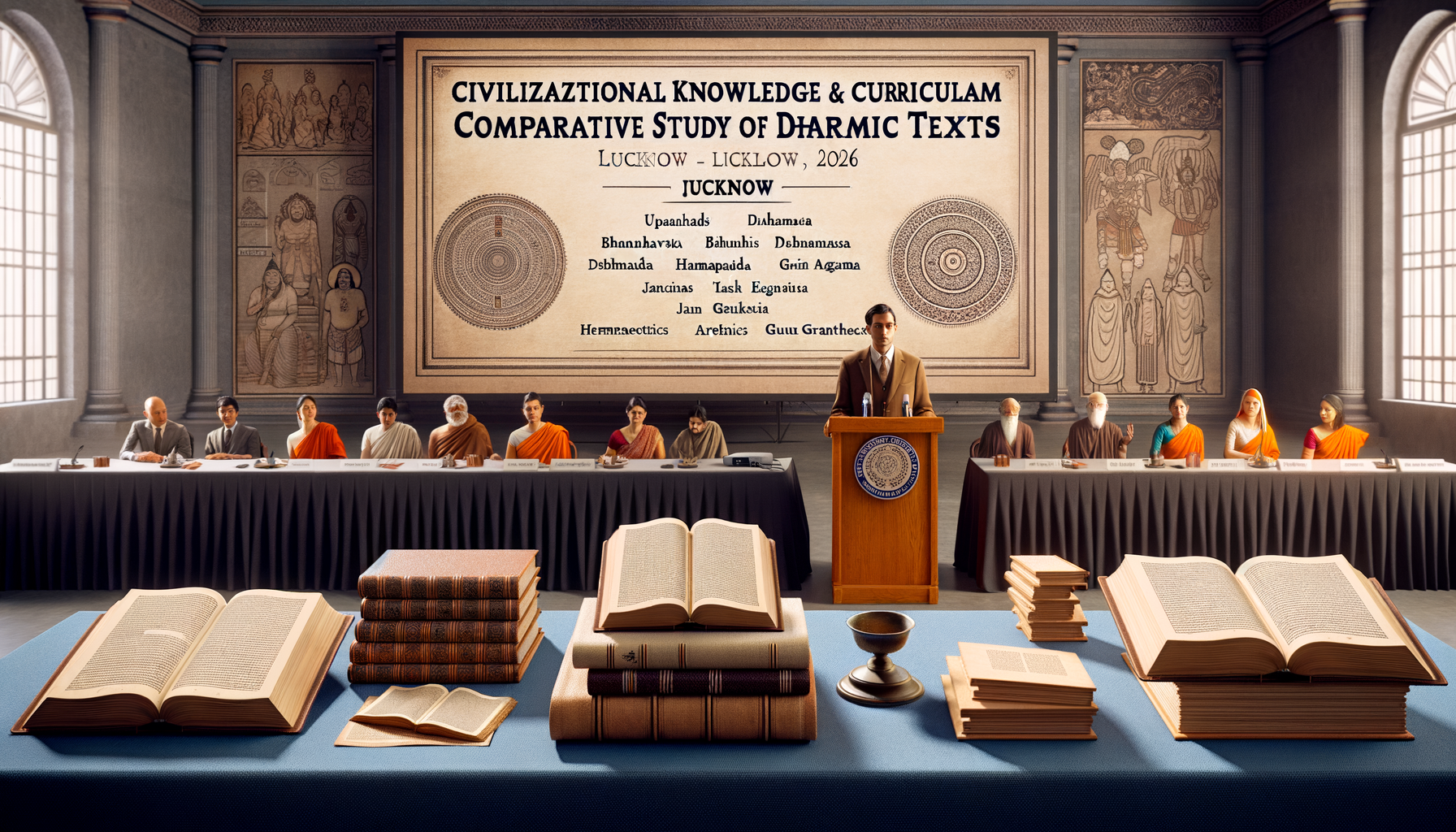
At Lucknow University on 20 January 2026, a one-day national conference on the relevance of Hindutva examined how India’s civilizational knowledge can be studied in modern classrooms. The discussions centered on proposals to introduce structured study of Hindu texts within higher education curricula, with an emphasis on scholarly rigor, comparative inquiry, and the inclusive unity of dharmic traditionsHinduism, Buddhism, Jainism, and Sikhism.
Presented in an academic frame, Hindutva was engaged as a civilizational and cultural lens rather than a partisan construct, inviting participants to consider how primary sources and commentarial traditions can illuminate ethics, philosophy, aesthetics, legal thought, and social organization across the subcontinent. The call to include Hindu textssuch as the Upanishads, the Bhagavad Gita, classical Smriti literature, and regional bhakti compositionswas paired with encouragement to place them in dialogue with Buddhist, Jain, and Sikh writings to foster comparative understanding and civilizational literacy.
Several pedagogical pathways were highlighted for Indian universities: elective modules on comparative religion and philosophy; reading seminars focused on hermeneutics and philology; and interdisciplinary courses linking Sanskrit and regional-language sources to history, law, political thought, and the arts. Participants emphasized that the study of dharmic texts should cultivate critical thinking, textual analysis, and historical context, situating ideas within diverse regional and linguistic milieus.
Safeguards to uphold academic integrity received equal attention. Recommendations included peer-reviewed syllabi, transparent learning outcomes, multilingual access through high-quality translations, and assessments that reward objective analysis over rote learning. Presenters also underscored alignment with constitutional values and the importance of voluntary or elective participation, ensuring that curricular enrichment expands choice without constraining academic freedom.
For many students and educators, reconnecting with primary sources can be formative, offering a sense of continuity with living traditions while sharpening scholarly discipline. In classrooms, such engagement often translates into deeper curiosity, stronger analytical writing, and a more grounded understanding of India’s plural heritage. The conference setting in Lucknowlong a center of learningreinforced the emotional resonance of studying texts in a city where scholarship and culture have historically intersected.
The implementation roadmap discussed was pragmatic: begin with pilot electives; invest in faculty development and workshops on textual methods; create digital repositories and open-access reading lists; and build partnerships among departments of Sanskrit, philosophy, history, and comparative literature. Cross-institution collaborations and student research colloquia were proposed to stimulate inquiry and produce new translations and commentaries across dharmic traditions.
Crucially, the proposals framed inclusion as integrative, not exclusionary. Reading Hindu texts alongside Buddhist, Jain, and Sikh sources was positioned as a pathway to unity in spiritual pluralityclarifying differences while recognizing shared ethical and philosophical concerns. This approach situates the curriculum within a broader humanistic education that respects diversity, encourages dialogue, and prepares graduates for thoughtful participation in public discourse.
By foregrounding academic standards and inter-dharmic harmony, the Lucknow University conference advanced an education model that is both rooted and contemporary. The conversation affirmed that studying primary texts through critical, comparative, and multilingual methods can enrich higher education, strengthen cultural understanding, and deepen scholarly engagement with India’s civilizational heritage.
Inspired by this post on Struggle for Hindu Existence.
