
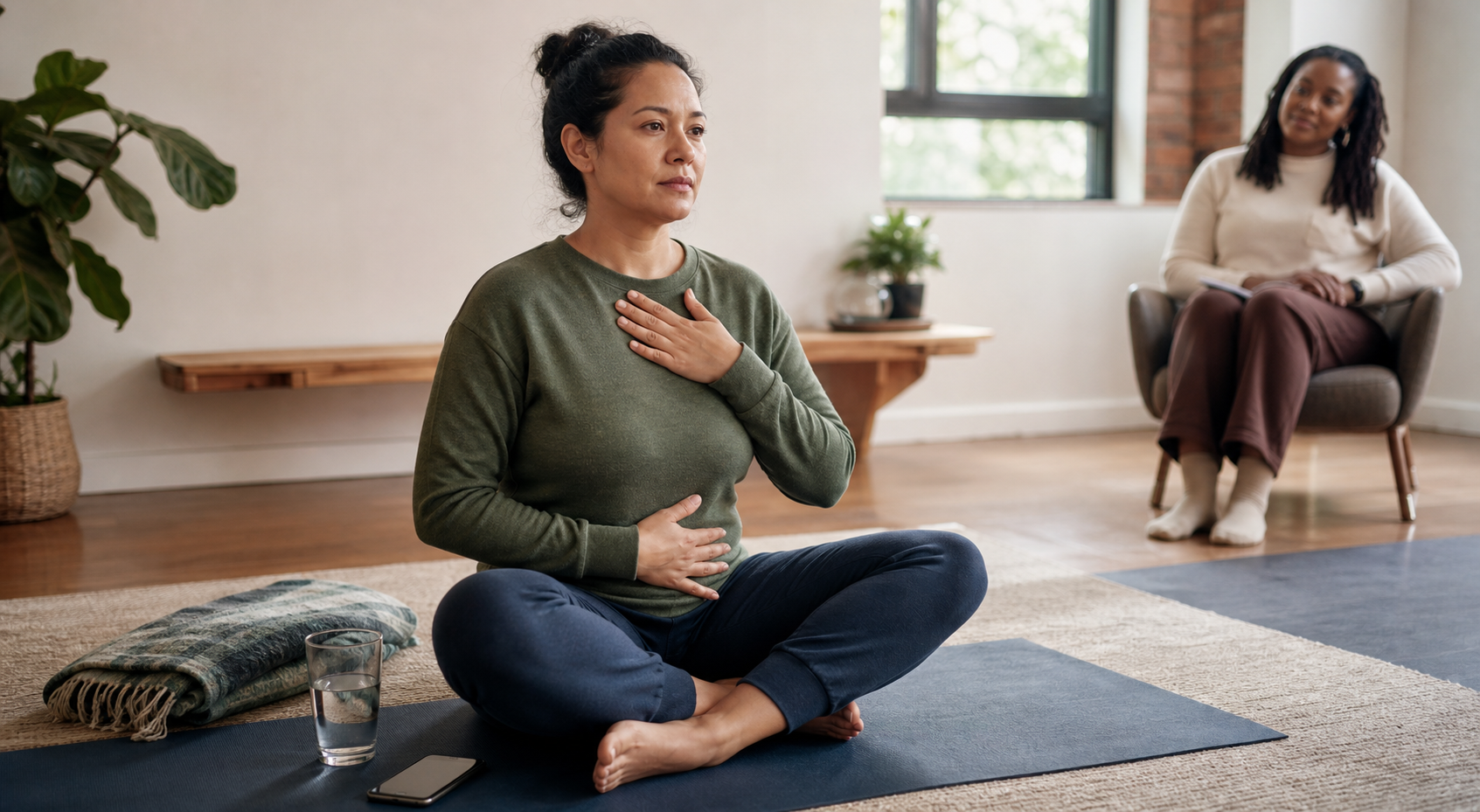
When a craving arrives, telling yourself to be stronger may be the least usable instruction you can receive. Your jaw is tight, your breathing is shallow, your thoughts are accelerating, and the part of you that remembers consequences may feel very far away.
Yoga and breathwork can help you interrupt that sequence at the level of the body. They do not detox you, erase the reasons you use a substance, or replace addiction treatment. Their practical value is smaller and more important: they can help create enough space between a trigger and your next action for you to choose support instead of acting automatically.
What yoga can do in recovery, and what it cannot
Addiction is not simply a failure to make good decisions. A person may understand the consequences perfectly and still find that fear, agitation, shame, pain, or exhaustion pushes the body toward a familiar form of relief. Reasoning with yourself is difficult when your whole system is behaving as though immediate escape is necessary.
Slow movement and paced breathing can offer a body-level pause between trigger and reaction. The craving may still be present, but it is no longer the only sensation in awareness. You can also feel your feet, the support beneath you, the movement of your ribs, and the completion of an exhale. That wider field of attention gives your recovery plan a chance to become usable.
The aim is not to force yourself into calmness. Trying to control every sensation can turn breathwork into another test you believe you are failing. A more realistic aim is to become steady enough to take the next safe action: call someone, leave a triggering environment, follow your treatment plan, attend a meeting, eat, rest, or ask for medical help.
Yoga can also help you practise remaining present with manageable discomfort. A tense shoulder, restless leg, or wave of emotion can be noticed without immediately obeying the urge to escape it. Over time, that repeated experience can weaken the assumption that every uncomfortable sensation is an emergency.
There is an essential boundary. Breathwork cannot safely manage dangerous withdrawal, and yoga cannot replace medical care, prescribed medication, psychotherapy, rehabilitation, peer support, or a relapse-prevention plan. Some withdrawal states can become life-threatening. If you have severe shaking, confusion, hallucinations, a seizure, fainting, chest pain, severe vomiting, or difficulty breathing, seek urgent medical care rather than trying to breathe through it. If you may be in withdrawal and are unsure of the risk, contact a medical professional or addiction service before practising alone.
Key takeaways
- Use breathwork to create a pause, not to prove that you can control a craving by yourself.
- Choose gentle, predictable practices. More intensity does not mean more healing.
- Make the breath lead to a recovery action such as calling support, changing location, or following your care plan.
- Skip breath retention whenever it causes dizziness, panic, strain, or a sense of being trapped.
- Treat signs of withdrawal or medical instability as medical concerns, not as obstacles to a yoga session.
Use a craving protocol before you need it
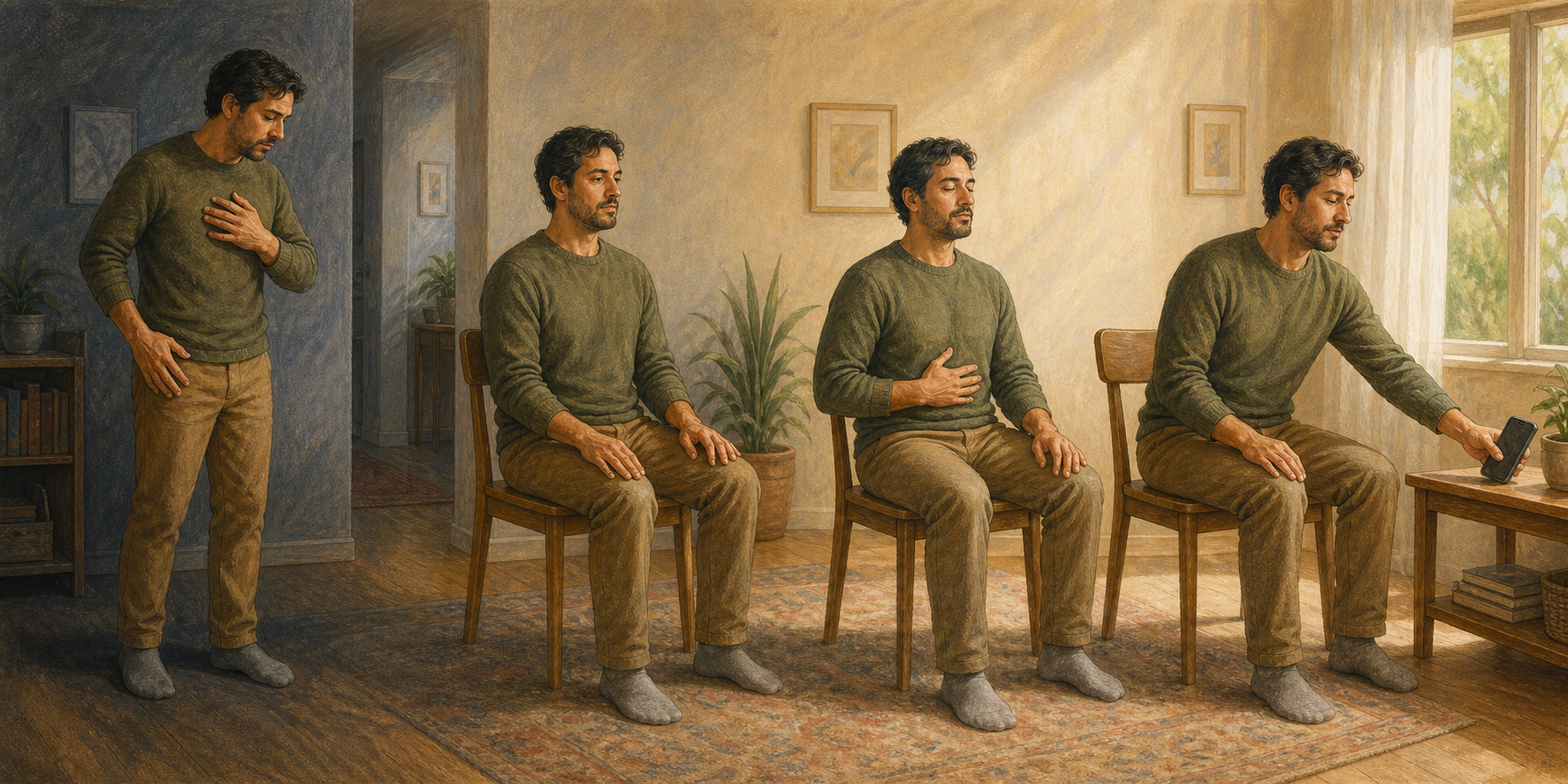
A breathing technique is much harder to remember when a craving has already narrowed your attention. Practise your response while relatively settled, then keep the instructions beside the name and number of a trusted support person. The breath is the opening step, not the entire plan.
- Check immediate safety. If you have serious withdrawal symptoms, may overdose, have already taken something, or might harm yourself or another person, contact emergency services or urgent medical support. Do not drive if you may be impaired.
- Reduce physical demand. Sit with your back supported and both feet on the floor, or lie on your side or back if that is safer. If you are shaking or unsteady, do not begin with standing postures.
- Orient to the present. Look around and name a few ordinary things you can see. Feel the chair, floor, or bed supporting your weight. This helps distinguish what is happening now from the fear of what might happen next.
- Choose one gentle breath. Three-Part Breath is usually the simplest option when retention feels uncomfortable. Take five unforced rounds, allowing the exhale to lengthen only as far as it remains smooth.
- Take the planned recovery action. Call your support person, move away from access to the substance, enter a supervised setting, attend scheduled care, or use the next step already agreed with your clinician or recovery group.
- Reassess honestly. If the urge is escalating, you cannot maintain safety, or you are beginning to bargain with the plan, move from solo coping to human help. A breathing exercise is not a reason to delay that call.
This sequence changes the job of breathwork. You are not waiting for a craving to disappear. You are using a brief period of regulation to cross from isolation into support.
Choose a breathing practice that matches your state
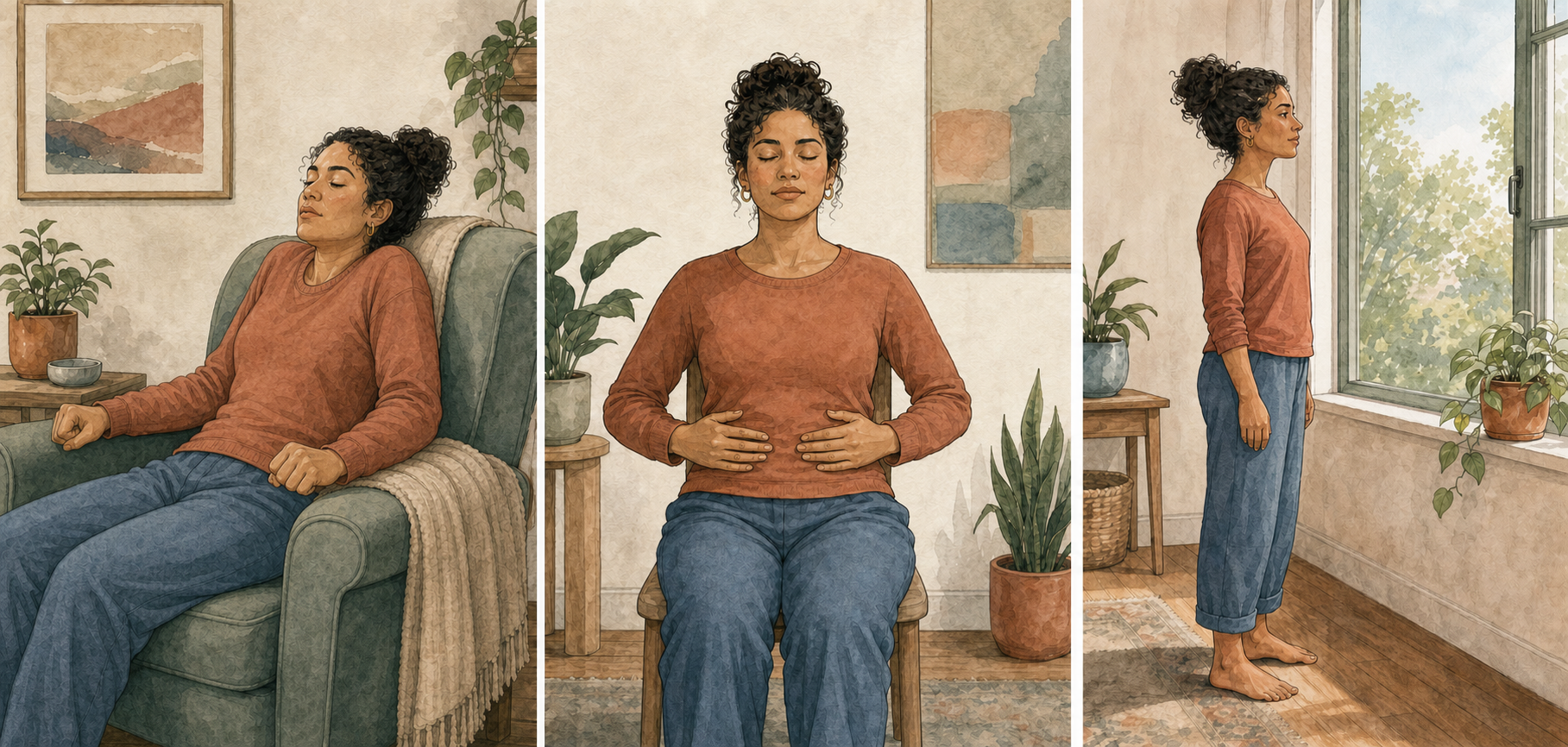
The best technique is the one you can perform without force. Counts are guides, not achievements. Keep the breath quiet and comfortable, and return to normal breathing if you become dizzy, tingly, breathless, panicked, or more agitated. Practise seated or lying down, never while driving, in water, or anywhere a moment of light-headedness could put you at risk.
Three-Part Breath for agitation and shallow breathing
Dirgha Pranayama, or Three-Part Breath, directs attention through the belly, ribs, and upper chest. It is a useful starting practice because it does not require breath retention.
- Sit with support or lie down. Place one hand over the belly and the other over the chest.
- Inhale through the nose, allowing the belly to expand, then the ribs, then the upper chest. Keep the movement easy; you do not need to fill yourself to maximum capacity.
- Exhale in reverse: upper chest, ribs, then belly.
- If it remains comfortable, inhale for a count of three and exhale for a count of six. If that ratio creates strain, shorten it and let the exhale be only slightly longer than the inhale.
- Repeat for at least five rounds, then breathe normally and notice whether you are ready to take the next recovery action.
A long exhale should feel like release, not deprivation. If you find yourself gasping at the next inhale, the count is too long for your present state.
Box Breathing for racing thoughts
Sama Vritti gives the mind a symmetrical pattern to follow. The counting can be especially useful when thoughts are circling, but its pauses are not suitable for everyone.
- Inhale gently through the nose for four counts.
- Hold for four counts without closing the throat or bracing the body.
- Exhale smoothly for four counts.
- Remain empty for four counts.
- Continue for several rounds or several minutes while the pattern stays comfortable.
Do not extend the count to six or eight merely because you can. Longer is not inherently better. If either pause increases anxiety, use an equal inhale and exhale without holding, or switch to Three-Part Breath. Anyone who has been advised to avoid breath retention should follow that medical guidance.
Alternate Nostril Breathing for a quiet, coordinated practice
Anulom Vilom can gather scattered attention by asking you to coordinate the hand, nostrils, breath, and count. Use it when you are seated safely and able to follow the sequence without frustration.
- Sit comfortably with the spine upright but not rigid. Relax the shoulders.
- Close the right nostril with the thumb and inhale through the left for four counts.
- Close both nostrils and hold for four counts, but only if retention is comfortable.
- Open the right nostril and exhale through it for eight counts.
- Inhale through the right for four, close both nostrils and hold for four, then open the left and exhale through it for eight.
- This completes one round. Continue gently for up to five rounds.
If the eight-count exhale is too long, use a shorter natural exhale. If retention feels unsafe or distressing, omit it. Nasal congestion, coordination difficulties, or irritation are also good reasons to choose a simpler practice. The purpose is steadiness, not technical perfection.
When you are unsure which practice to use, begin with Three-Part Breath. Choose Box Breathing when counting feels containing and pauses feel easy. Use Alternate Nostril Breathing when you want a more deliberate seated ritual and can coordinate it comfortably.
Build a yoga practice that survives a difficult week
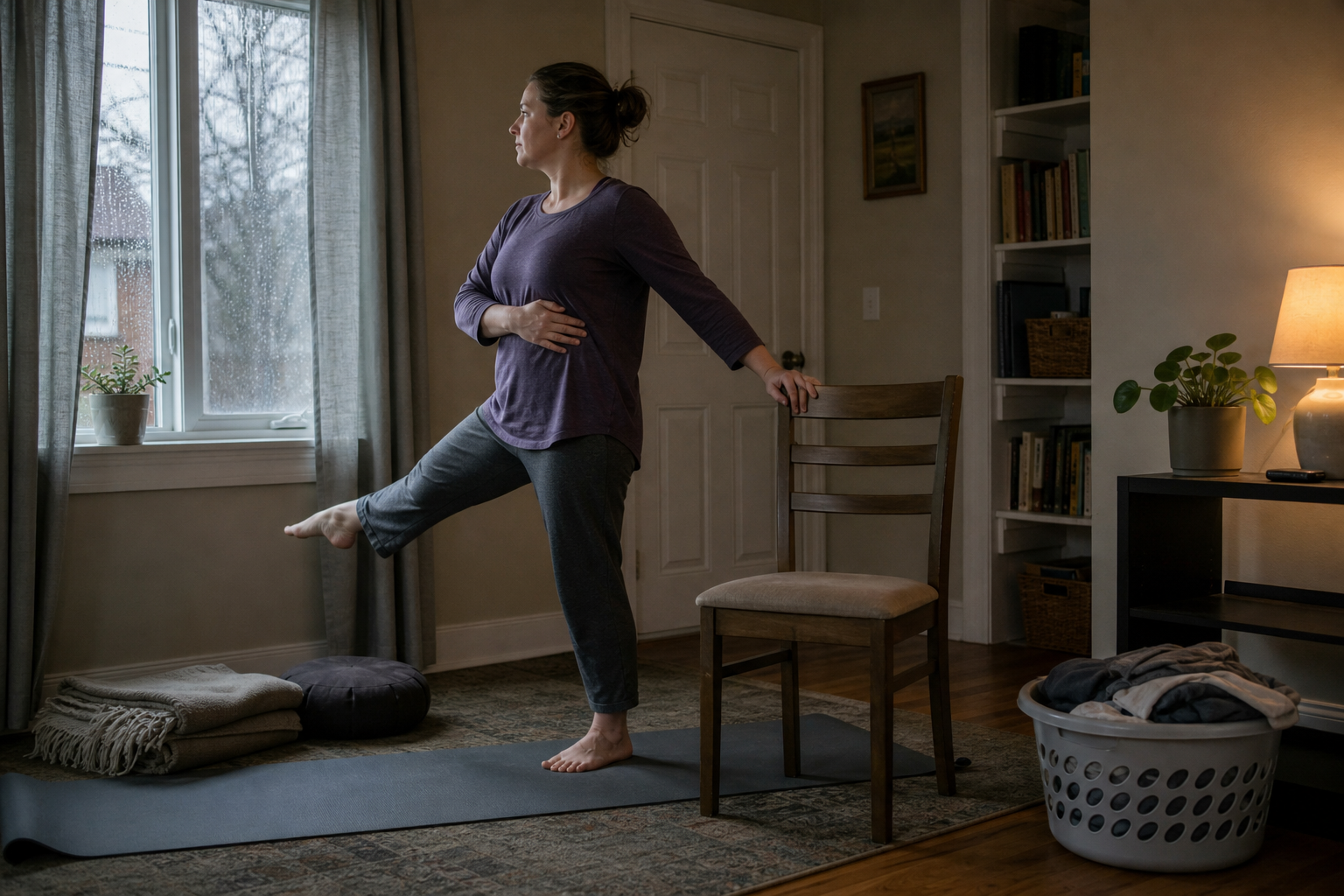
A demanding class may feel meaningful on a good day and become impossible during poor sleep, anxiety, or early recovery. Build your foundation from movements you can still do when your energy and concentration are low. Consistency matters more than range, depth, sweat, or appearance.
A short chair-supported sequence can begin with both feet pressing into the floor. Let the shoulders roll slowly, move through a gentle seated cat-cow with the breath, and make an easy side bend without forcing the ribs. Stand only if you are steady, using the chair for support. Finish seated or lying down with five rounds of Three-Part Breath. If standing is unsafe, the entire practice can remain seated.
Link this sequence to something already present in your recovery routine: waking, taking prescribed medication, returning from a meeting, or preparing for sleep. Practising only during a crisis can make the technique feel like an emergency tool. Practising while settled teaches the sequence before stress reduces your ability to remember it.
Keep a simple record after practice. Note the trigger, the strongest body sensation, the technique you used, and the recovery action that followed. You are not grading how calm you became. You are looking for patterns: which situations produce shallow breathing, which movements help you remain present, and when you need another person’s help sooner.
Choose classes carefully. A recovery-supportive or trauma-informed teacher should allow you to keep your eyes open, change positions, rest, face the door, decline touch, and leave a posture without explanation. Be cautious around anyone promising that a posture will detox addiction, release every trauma, or replace treatment.
Emotion or memory may surface during stillness or long-held postures. That does not prove that a particular tissue contained a memory, and it is not a reason to push deeper. If you feel flooded, numb, detached from your surroundings, or trapped, open your eyes, look around, feel the floor, return to ordinary breathing, and stop the posture. Bring repeated or intense reactions to a qualified mental-health professional who understands trauma and addiction.
Plan for imperfect days. Your minimum practice might be sitting down, feeling your feet, taking five unforced breaths, and making one support call. Keeping that small promise is more useful than abandoning the practice because a full session is unavailable.
Let the dharmic frame deepen recovery without replacing care

Dharmic practice offers a different measure of strength from sheer suppression. Ahimsa asks you not to turn pain into further harm, including harm directed toward your own body. Abhyasa values steady return. Applied to recovery, that means returning to the breath, the treatment plan, and trustworthy community without requiring yourself to feel pure, fearless, or spiritually accomplished first.
This matters because shame can disguise itself as discipline. Forcing a posture through pain, hiding a relapse, refusing medication to prove spiritual strength, or isolating until you can appear composed are not signs of mastery. A dharmic response begins with truthful awareness of the present condition and the least harmful next action.
The traditions should not be flattened into one generic breathing system. Hindu yoga develops pranayama as a discipline of breath regulation. Buddhist Anapanasati cultivates mindfulness of breathing. Jain Preksha meditation uses attentive observation of body and inner experience. Sikh simran may be aligned with the rhythm of breath as remembrance is sustained. Their methods and theological settings differ, but each can orient a practitioner toward attention, restraint, and compassionate self-governance.
Spiritual practice becomes most useful when it supports honesty. Let a breath remind you to make the call you were avoiding. Let a posture reveal tension without turning the tension into a moral defect. Let community reduce secrecy. Recovery is not proof that you have conquered the body; it is the repeated decision not to abandon yourself when the body is distressed.
Start while you are relatively steady. Choose the gentlest breathing method, write its steps beside a trusted person’s number, and practise it before the next craving. When difficulty rises, use the breath to find the pause, then use the pause to reach care.
References
