
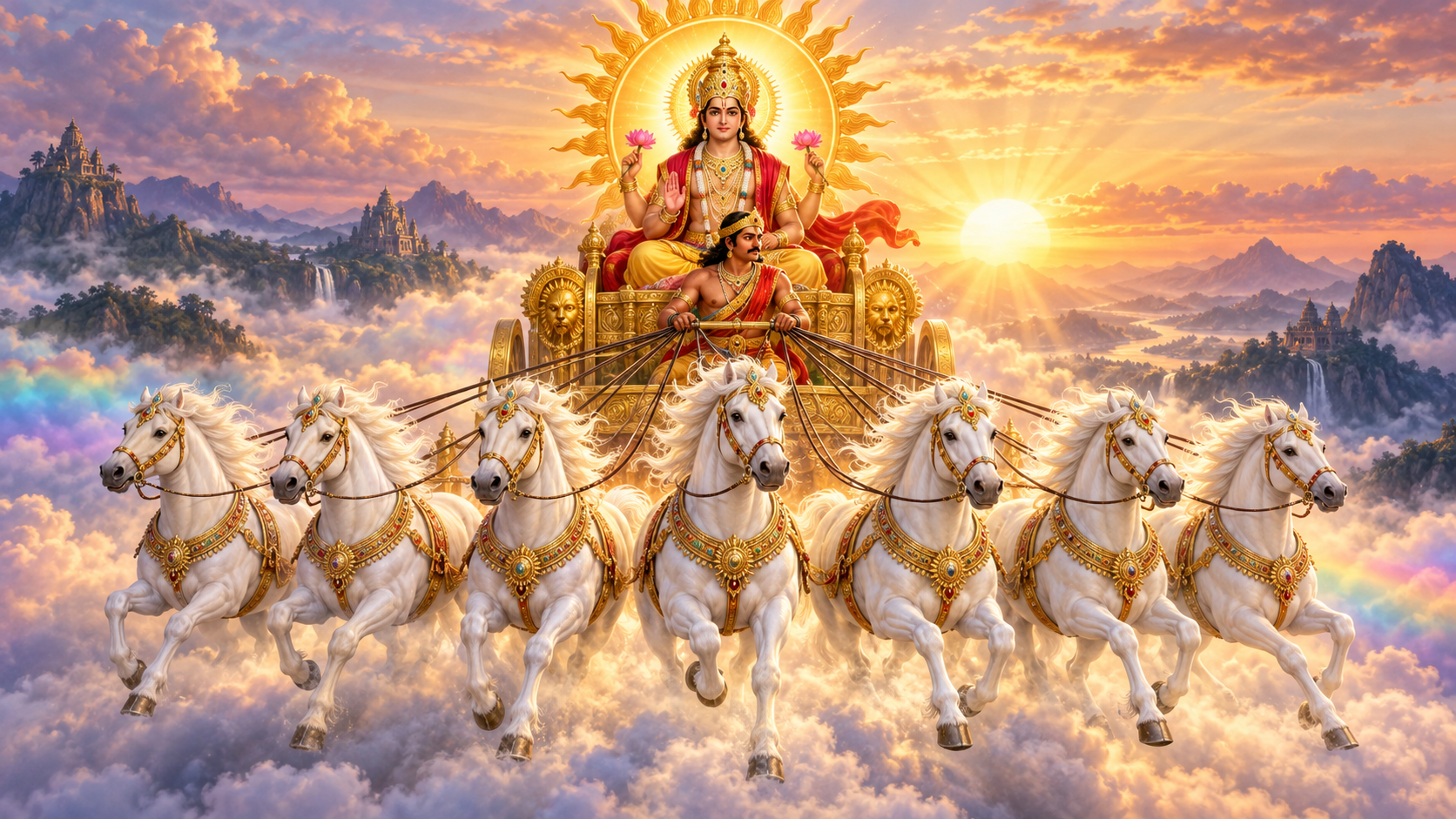
If you have heard that Surya’s seven horses represent the seven chakras, the useful question is not whether every horse has a secret chakra label. It is whether the image can help you bring your instincts, desires, will, emotions, speech, discernment, and spiritual purpose into one dharmic direction.
It can, provided you treat the connection as a contemplative correspondence rather than a literal diagram of the body or a doctrine accepted in exactly the same form by every Hindu tradition. Read this way, Surya’s chariot gives you a practical test: are your inner powers working together, or is one of them pulling the rest of your life off course?
What the seven-horse image can and cannot mean
Surya Bhagavan can be contemplated as the physical sun and the visible manifestation of divine light. That double significance makes an inward reading possible. The sun illuminates the world outside us; awareness reveals motives, attachments, duties, and possibilities within us.
The seven horses can therefore be read as seven powers of embodied consciousness. The familiar seven-chakra sequence supplies a disciplined way to examine those powers. Yet this is not the only possible meaning of Surya’s horses, nor is the seven-centre system the only chakra arrangement found across yoga and tantra. Different traditions organize subtle-body teachings in different ways.
The safest formulation is precise: the seven-horse chariot and the seven-chakra system can be placed beside one another as mutually illuminating symbols. That is different from claiming that an ancient text assigns one named horse to Muladhara, another to Svadhishthana, and so on. Unless a particular lineage explicitly teaches such an assignment, do not present it as a universal scriptural catalogue.
The fact that the horses form a team is more important than any attempt to identify them individually. Desire may be powerful, speech may be eloquent, and will may be intense, but none of those strengths is beneficial when it breaks formation. Will without compassion becomes domination. Compassion without discernment becomes sentimentality. Speech without truth scatters energy. Insight without responsibility becomes escape.
A careful correspondence with the seven chakras
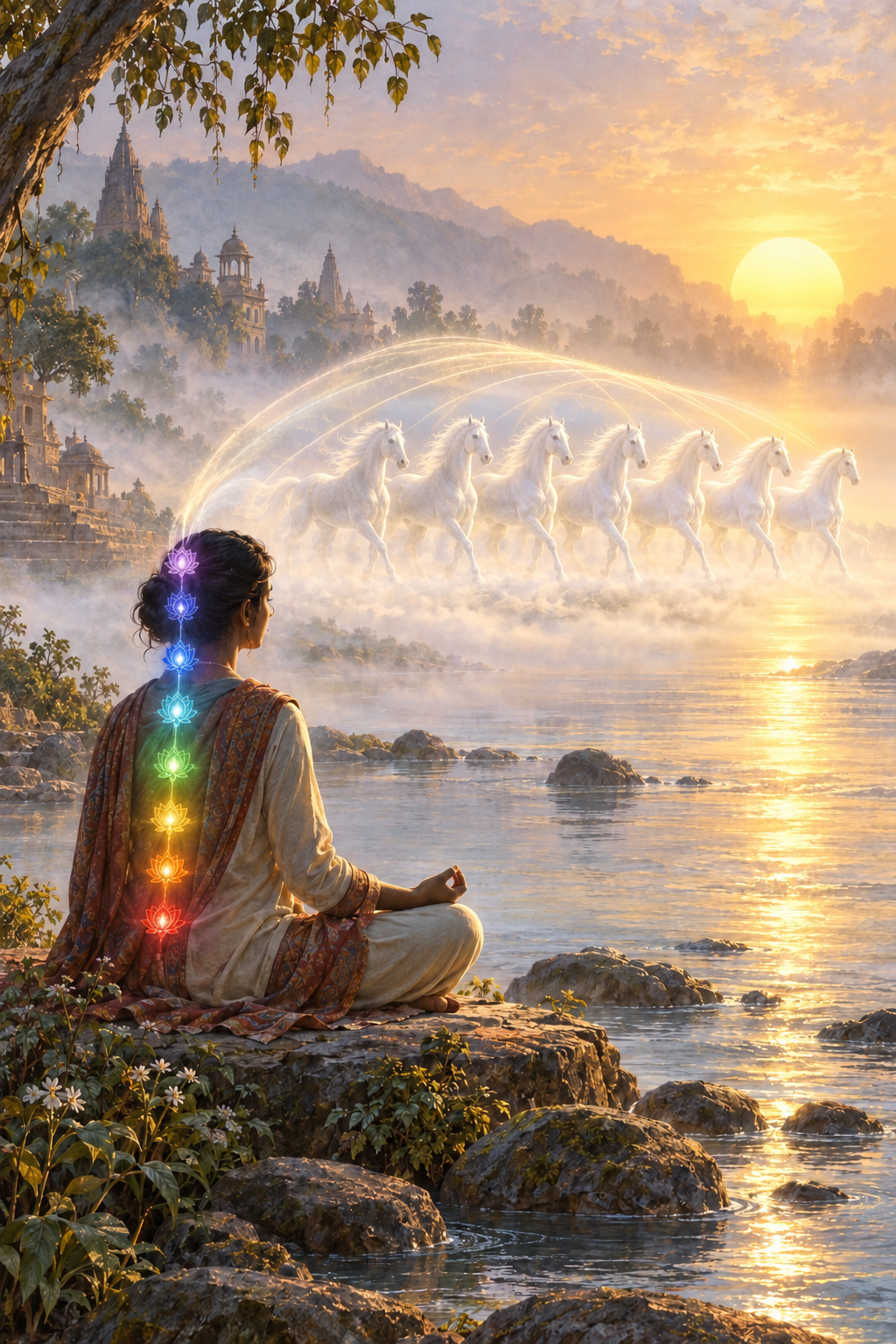
The table below is a practical framework for self-examination. It is not a claim that each horse possesses one fixed name, colour, personality, or anatomical location. Use the chakra names as stations of attention and the questions as tests of alignment.
| Centre | Question to ask | Solar discipline |
|---|---|---|
| Muladhara | What must be stable before I can act well? | Keep basic duties, promises, and practical responsibilities in order. |
| Svadhishthana | Which desire or emotion is pulling me? | Acknowledge pleasure, aversion, and creativity without allowing compulsion to choose your direction. |
| Manipura | Is my will serving the work, or merely defending my status? | Act firmly on what is yours to do without trying to dominate everyone around you. |
| Anahata | Who will bear the human consequences of my decision? | Join strength with goodwill, dignity, and appropriate boundaries. |
| Vishuddha | Are my words true, necessary, and properly timed? | Speak clearly, remove exaggeration, and refuse needless noise. |
| Ajna | What motive is actually steering me? | Distinguish duty from fear, resentment, vanity, and the desire for approval. |
| Sahasrara | To what larger purpose is this action offered? | Place personal ambition beneath dharma and remember that the individual is not the final centre of reality. |
Do not turn this sequence into a ladder on which the lower centres are bad and the upper centres are good. A chariot cannot move by despising the ground. Stability, desire, will, affection, expression, insight, and transcendence all have legitimate places. The problem is not that a power exists; the problem is that it becomes disordered, compulsive, dishonest, or disconnected from the whole.
You also do not need to analyze all seven centres every time you face a decision. Start where the conflict is visible. If you know what duty requires but keep postponing it, examine desire and will. If you are ready to act but likely to wound someone unnecessarily, examine the heart and speech. If your reasoning sounds impressive but keeps changing to protect your ego, examine motive and spiritual orientation.
A seven-stage Surya contemplation you can actually use

This practice is a structured reflection built from the symbolism. It does not require unusual breathing, forced concentration, solar gazing, or an attempt to provoke Kundalini experiences. Sit or stand steadily, keep your breathing natural, and use an image of Surya or a simple awareness of light. If you practice near sunrise, you can keep your eyes closed or lowered; looking directly at the sun is not part of the exercise.
- Establish the ground at Muladhara. Notice the support beneath your body. Name one duty that must remain firm today: a promise, a responsibility, a boundary, or a piece of necessary work.
- Recognize the pull at Svadhishthana. Name the desire, attraction, discomfort, or emotion most likely to influence your choice. Do not condemn it and do not obey it automatically. Simply make it visible.
- Gather the will at Manipura. Identify the next action that is genuinely within your control. Remove fantasies about controlling another person’s response, winning universal approval, or arranging the entire future.
- Include the human consequence at Anahata. Ask who will be affected and whether your intended action preserves dignity. Compassion may soften your manner, but it need not erase a necessary boundary.
- Purify expression at Vishuddha. Put your intention into one plain sentence. Remove accusation, ornament, strategic ambiguity, and any claim you cannot honestly defend.
- Inspect the driver at Ajna. Look beneath your stated reason. Are duty and discernment steering, or have fear, pride, resentment, and hunger for praise taken the reins? Revise the action if its hidden motive contradicts its noble language.
- Offer the action at Sahasrara. Ask whether the decision can be offered to dharma rather than to personal self-importance. Hold the seven powers as one team, release the visualization, and carry out the chosen action.
The last part matters. Do not use contemplation to postpone the duty that contemplation has clarified. If the practice reveals that you owe an apology, make it. If it reveals that a boundary must be stated, state it without cruelty. If it reveals that your plan is driven by vanity, reduce it to the honest work that remains.
Four misreadings that weaken the symbolism

- Turning correspondence into exclusive doctrine. A contemplative association may be profound without being the only correct explanation of Surya’s seven horses. State the level of the claim honestly.
- Treating the lower centres as spiritual defects. Material responsibility, desire, and personal strength are not eliminated by mature practice. They are disciplined and placed in service of dharma.
- Using sensations as proof of advancement. Heat, tingling, emotion, imagery, or their complete absence does not by itself establish spiritual attainment. The more reliable question is whether your next decision becomes steadier, clearer, and less self-deceptive.
- Collecting correspondences while avoiding conduct. Colours, sounds, mantras, and diagrams can support practice, but an elaborate system that leaves your speech dishonest or your duties neglected has missed the chariot’s central lesson: coordinated movement toward a worthy end.
These tests protect both tradition and practice. They allow you to receive the image reverently without forcing every layer of Hindu symbolism into a single modern chart.
Questions readers often bring to this symbolism
Are Surya’s seven horses literally the seven chakras?
They are best treated as a meaningful symbolic correspondence, not as seven physical objects inside the body or a universally binding one-to-one equation. The connection becomes useful when the horses represent inner powers that must move together under the illumination of consciousness.
Must each chakra be assigned a rainbow colour?
No. Colour visualization can be part of a particular teaching method, but it is not required for this contemplation. If debating an exact shade distracts you from examining duty, desire, speech, and motive, leave the colours aside.
What if I feel no energy moving?
Nothing has gone wrong. This practice does not depend on producing a sensation. Its immediate result should be a more honest view of what is pulling you and a more coherent next action.
Do I have to practice at sunrise?
No. Dawn naturally supports Surya contemplation because the transition from darkness to light embodies the symbolism, but the reflective method can be used before any decision. The essential movement is from unexamined impulse to illuminated, coordinated action.
The next time you see Surya’s chariot, do not begin by asking which horse hides which chakra. Ask what within you is pulling out of line. Bring that force back into a common direction, choose one dharmic act, and let your conduct show whether the symbolism has become practice.
References

Leave a Reply
You must be logged in to post a comment.