

You may understand exactly why you react as you do, yet still feel your breath shorten, your stomach contract, or your whole system go quiet when something resembles an old danger. Insight matters, but it can be deeply discouraging when insight alone does not make your body feel safe.
Embodied healing gives you another way to work. Instead of demanding that the mind explain everything or that the body calm down on command, you build enough safety, choice, and steadiness to meet what is happening now. Post-traumatic growth can emerge from that practice, but it is not a return to the person you were before trauma. It is a more deliberate way of living with the life, body, relationships, and dharma you have now.
Why understanding trauma may not settle your body

Trauma can divide life into a before and an after. In moments of rupture, the body may register shock before the mind can assemble meaning. Later, a harmless sound, silence, place, sensation, or interruption can evoke part of that bodily response even when you know that the original event is over.
This is why knowledge is not the same as regulation. You can understand grief, psychology, or spiritual philosophy and still live with persistent trauma symptoms. Conceptual knowledge does not by itself restore a nervous system’s sense of safety. That is not a failure of intelligence, faith, or will.
Embodied healing works with what is directly present: breath, posture, muscle tension, movement, stillness, contact with the ground, and the felt sense of having a choice. Its immediate aim is not a dramatic release. The useful question is simpler: can you notice what is happening without either overpowering yourself or disappearing from the experience?
Post-traumatic growth should not be confused with declaring trauma beneficial. You do not have to call a violation, bereavement, betrayal, or disaster a gift. Growth means that suffering no longer has exclusive authority over your identity. Grief may remain while agency, compassion, purpose, and connection become more available.
Body-based practices can sometimes bring distressing sensations or memories closer to awareness. If you experience recurring flashbacks, self-harm urges, severe panic, episodes of losing time, or difficulty keeping yourself safe, work with a licensed mental-health professional who is trained in trauma care. A yoga, meditation, breathwork, or spiritual teacher is not automatically qualified to provide that care. If you are in immediate danger, contact local emergency or crisis services. Embodied and Dharmic practices can accompany appropriate treatment; they should not be presented as substitutes for it.
A body-based sequence that preserves choice

The most important feature of a trauma-aware practice is agency. A technique that ignores your body’s refusal can reproduce the pattern of being overruled, even when the technique is called healing. Use the following sequence gently, and treat stopping as a valid completion rather than a defeat.
- Ask for consent from yourself. Before beginning, notice whether you have enough capacity to make contact with bodily sensation. You may choose the full sequence, a smaller version, or no practice at all. That choice is part of the healing.
- Orient to the present environment. Let your eyes move naturally around the room. Notice the exits, the quality of light, familiar shapes, and the surfaces supporting you. Keep some attention outside the body rather than plunging immediately into an internal scan.
- Find neutral or tolerable contact. Feel your feet against the floor, your back against a chair, or your hands resting on a stable surface. You do not need to focus on the part of the body carrying the strongest distress.
- Observe the breath before changing it. Notice whether it is shallow, held, uneven, or easy. If it feels comfortable, allow the exhalation to soften. Avoid forcing a large inhalation, breath retention, or an intense rhythm merely because you think a proper practice should feel powerful.
- Add a small, voluntary movement. Press your feet gently into the ground, roll your shoulders, move your hands, sway, walk, or enter a familiar restorative posture. Choose a movement you can stop immediately. The experience of directing and ending the movement matters more than its range.
- Close deliberately. Notice whether anything changed, including the possibility that nothing changed. Then choose an ordinary next action: wash a cup, fold a garment, step outside, rest, or contact someone trustworthy. This helps place the practice inside daily life rather than turning it into an isolated performance.
If breath or movement makes you dizzy, panicked, faint, numb, flooded, or more disconnected, stop trying to alter the breath. Open your eyes if they were closed, look around, feel a stable surface, and let breathing find its own pattern. Seek qualified support if the reaction does not settle or keeps recurring. There is no healing prize for enduring a technique that makes you less present.
Familiarity is usually more useful here than intensity. Repeating a low-demand sequence allows you to notice your responses and make choices without constantly confronting novelty. Breath awareness, bodywork, yoga, and restorative practices can become forms of consistent embodied care, but only when they respect capacity and do not turn catharsis into a requirement.
Give embodied practice a Dharmic ethical foundation
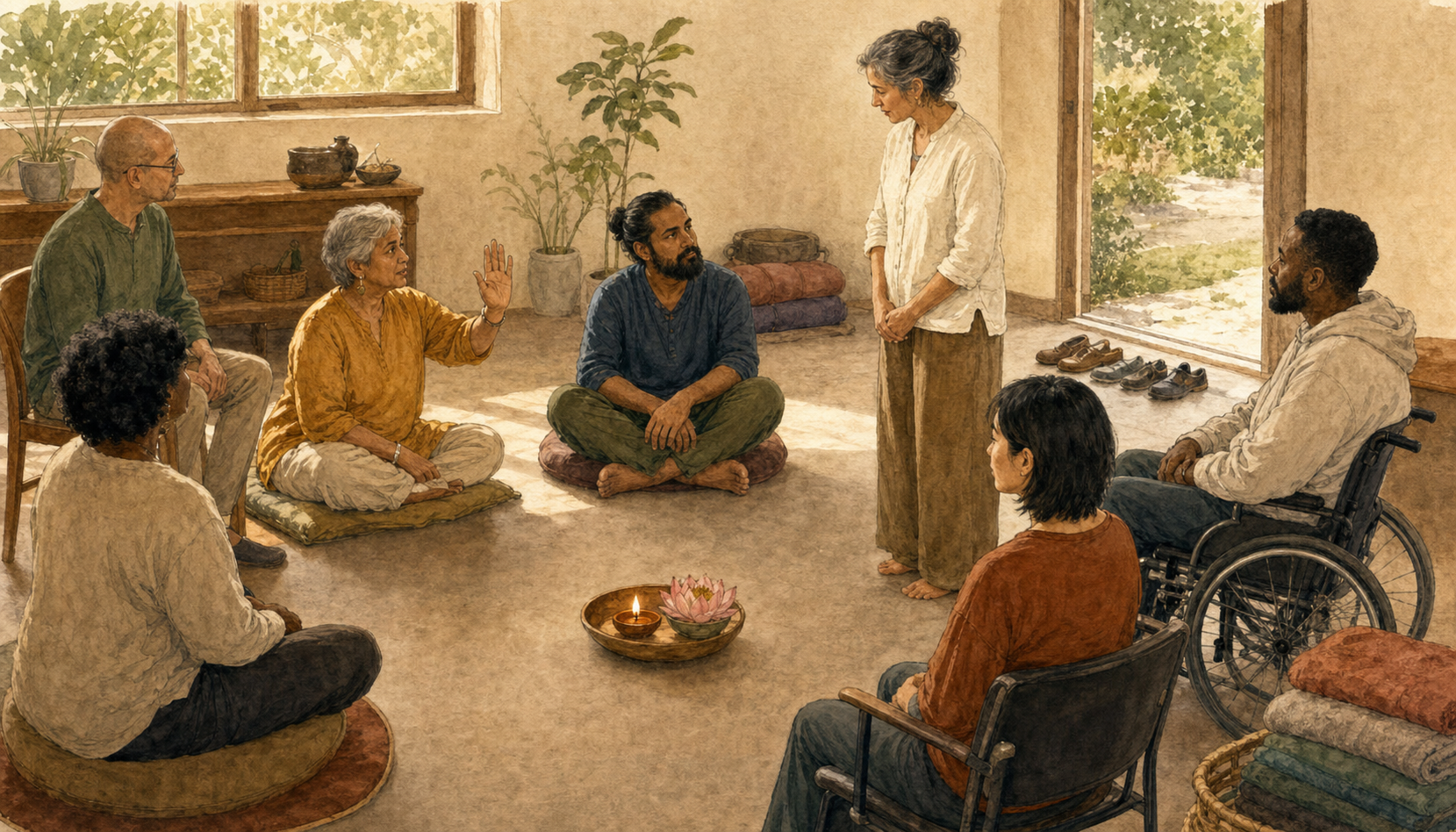
Hindu, Buddhist, Jain, and Sikh traditions are distinct paths, not interchangeable collections of wellness techniques. Yet ahimsa, aparigraha, mindfulness, seva, simran, meditation, yoga, and pranayama offer complementary ways to shape a healing life. Their value is not limited to producing a pleasant state. They help determine how you relate to pain, effort, identity, and other people.
Let ahimsa govern the pace
Ahimsa begins close to home. If you attack yourself for having symptoms, force your body through distress, or use discipline as punishment, the form may look spiritual while the relationship remains violent.
Apply ahimsa by changing the question. Instead of asking why you are not over the trauma, ask what contact with this experience is possible without abandoning yourself. Instead of treating rest as weakness, ask whether rest is the action that prevents further harm. Gentleness does not mean avoiding every difficulty. It means refusing to make self-aggression the price of progress.
Use aparigraha to loosen the recovery deadline
Trauma often creates a painful attachment to the imagined person you would have been if the event had never happened. That question deserves compassion, but it cannot become the standard against which every present day is judged.
Aparigraha invites you to loosen your grip on a fixed recovery story: the old identity you must reconstruct, the timetable you must meet, or the flawless spiritual state you must display. This is not surrendering memory, justice, boundaries, or accountability. It is releasing the demand that life prove its worth by restoring an irretrievable past.
Separate sensation, meaning, and action through mindfulness or simran
When you are activated, bodily sensation and interpretation can arrive as one unquestionable reality. Mindful attention creates useful distinctions. Name the sensation you can actually detect. Name the meaning your mind is giving it. Then identify the kindest workable action available now. A tight stomach is a sensation; the conviction that everything is about to collapse is an interpretation; placing your feet on the floor and delaying a difficult reply is an action.
Simran can provide a steady thread of sacred remembrance when unstructured inner attention feels too exposed. Use a familiar name or recitation in the manner taught within your tradition. If silent meditation intensifies distress, keep your eyes open, recite aloud, walk, or practise in supportive company. A modified practice is still a practice.
Keep yoga, pranayama, and restoration responsive
Yoga can help restore a relationship with the body when it is approached as attentive participation rather than performance. Choose predictable postures and movements that preserve your ability to pause, look around, and leave the position. The same principle applies to pranayama: awareness of breathing may be grounding, but forceful control is not inherently more healing.
Restorative and Ayurvedic practices can also support steadiness through repeatable rhythms of care. Keep the claim proportionate. A routine may help you feel supported without curing PTSD, depression, anxiety, or another health condition. Seek an appropriately qualified clinician for diagnosis or treatment, and tell every practitioner when a technique increases distress.
Let seva reconnect you without consuming you
Service can turn private pain toward relationship and purpose. It can also become a way to avoid receiving care or to prove that your suffering made you useful. Before saying yes, notice whether the act arises from choice, fear, guilt, or the need to earn worth.
Use a practical boundary: after serving, can you still meet your basic responsibilities and remain connected to your body? If seva repeatedly leaves you depleted, resentful, exposed to harm, or unable to care for yourself, reduce the commitment. Your worth is not measured by how completely you disappear into someone else’s need.
Connection also does not require unrestricted disclosure. You can tell a trusted person what support would help without recounting your entire history. Share from a place where you retain choice over what is told, to whom, and for what purpose. A scar can guide compassionate service without becoming public property.
Look for growth in ordinary choices, not peak experiences

Post-traumatic growth is easy to miss if you expect a permanent feeling of transcendence. It is more often visible in the ordinary moments where an old pattern no longer makes every decision.
- You notice contraction or shutdown before automatically agreeing to something.
- You ask for help without first constructing a case for why you deserve it.
- You treat clutter, unfinished tasks, financial mistakes, or wrinkled clothes as problems to address rather than evidence that you are worthless.
- You recover from a trigger without adding the further injury of shame.
- You remain honest in a relationship instead of choosing either total concealment or uncontrolled disclosure.
- You serve because the action expresses your values, not because usefulness is the condition of belonging.
- You can hold grief and a meaningful present without forcing either one to cancel the other.
To make these shifts visible, keep a low-pressure record after difficult moments. Note what happened, what you felt in the body, what you did next, and what helped or worsened the experience. Do not use the record to grade yourself. Use it to identify patterns: which environments support presence, which practices feel coercive, which people respect boundaries, and which early signals tell you to slow down.
Growth and continuing symptoms can exist together. A hard day does not erase the capacity you have built, just as a calm meditation does not prove that trauma has been resolved. If symptoms continue to disrupt sleep, work, relationships, or basic care, that is a reason to seek or revisit professional support, not a reason to intensify spiritual practice on your own.
Be especially cautious of spiritual narratives that make visible suffering seem inferior. Dharma is not a demand to pretend that pain has vanished. Nor does healing require you to become grateful for what harmed you. Integrity may look like accepting the reality of a wound while refusing to let shame define the person who carries it.
Key takeaways
- Understanding trauma is valuable, but the body may also need repeated experiences of safety, choice, movement, rest, and connection.
- Choose agency over intensity. A practice you can pause or modify is more appropriate than one that demands surrender to distress.
- Use ahimsa to prevent self-punishment, aparigraha to loosen rigid recovery expectations, mindfulness or simran to steady attention, and seva to reconnect with purpose.
- Judge growth by ordinary changes in boundaries, self-talk, relationships, and recovery from difficult moments, not by dramatic emotional releases.
- Use embodied and spiritual practices alongside qualified trauma care when symptoms are severe, persistent, or unsafe.
Begin with one repeatable act that your body does not have to fight: looking around the room, feeling the floor, observing an unforced breath, making a small movement, or contacting a trusted person. When your body signals that it has had enough, stop and honour the boundary. That response is not outside the path. It is the practice of ahimsa within the path.
Your scars do not have to be hidden, displayed, romanticised, or erased. Let them become information about what requires care and what kind of life you now choose to build. Growth begins wherever you can make that next choice without abandoning yourself.
References
