
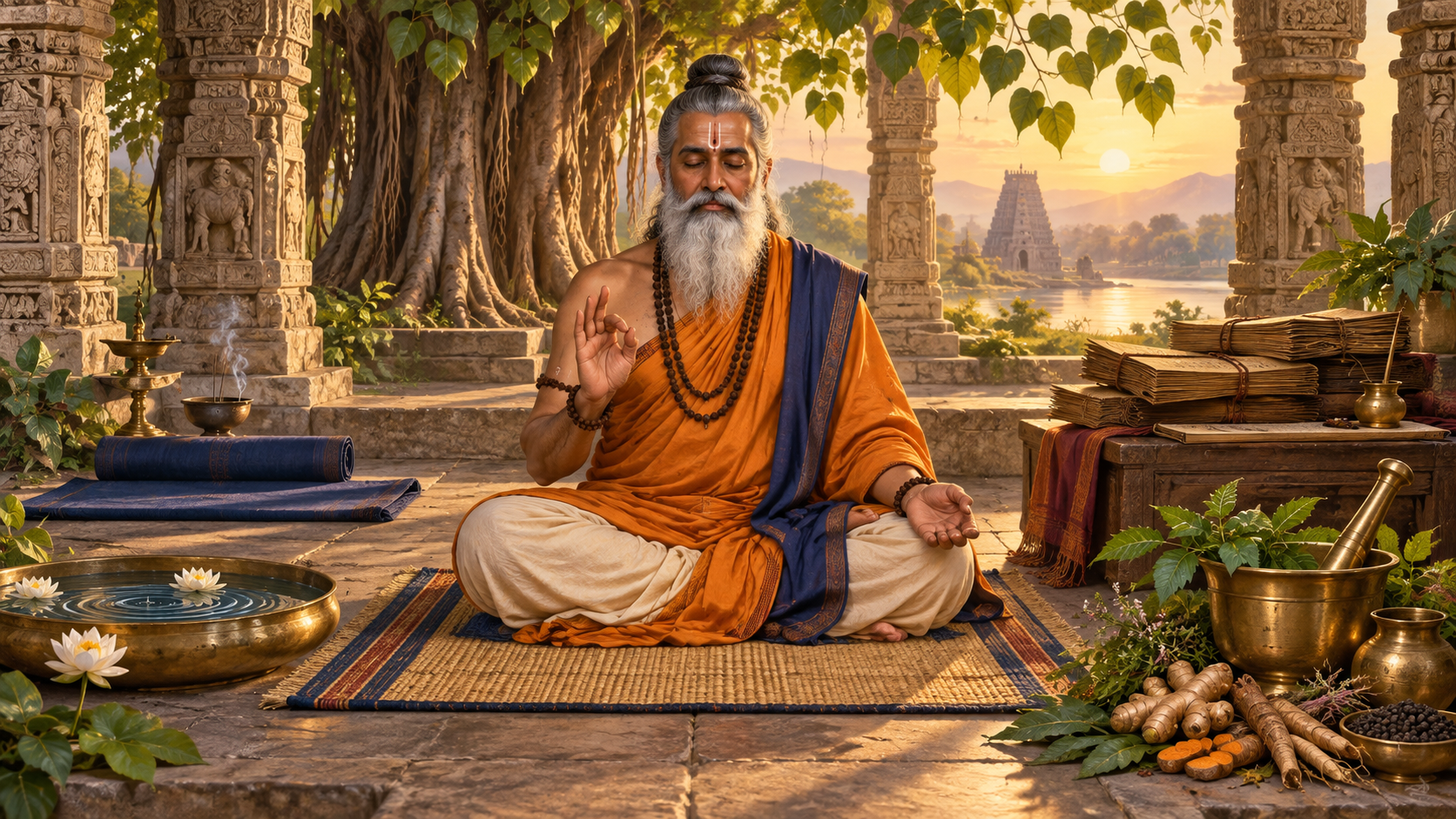
If you came here wondering whether the Patanjali of the Yoga Sutra also wrote about Sanskrit grammar and medicine, the shortest honest answer is this: Hindu tradition remembers one sage whose teaching purifies mind, speech, and body, while historical authorship is more complicated than that devotional portrait implies.
You do not have to choose between reverence and accuracy. You can understand what each discipline contributes, practise what is relevant to you, and speak carefully about what tradition preserves and what historical inquiry can establish.
Body, speech, and mind form a single map
The traditional image of Patanjali is compelling because it does not divide the human being into unrelated departments. Yoga disciplines the mind. Grammar disciplines speech. Ayurveda cares for the body. Together, they describe a person learning to see clearly, speak precisely, and live through a well-tended physical instrument.
This is the key to understanding why the three fields belong together in Dharmic memory. Knowledge is not merely information stored in the intellect. It should change how you attend, communicate, and act. The traditional portrait places the revered sage around the second century BCE and associates him with the purification of body, speech, and mind, although the precise historical identity behind all three associations remains disputed.
| Discipline | Work or attribution | Faculty being trained | Question to bring to it |
|---|---|---|---|
| Yoga | Yoga Sutra, traditionally attributed to Patanjali | Mind and attention | What habit of perception or conduct must change? |
| Grammar | Mahabhashya | Speech and linguistic judgment | What distinction is needed to preserve meaning? |
| Medicine | An Ayurvedic contribution attributed to Patanjali in tradition | Embodied life | Am I discussing spiritual memory, textual history, or clinical practice? |
In this setting, purification does not mean fashionable detoxification or rejection of the body. It means reducing the confusion that prevents a faculty from doing its proper work. A distracted mind cannot sustain contemplation. Careless language cannot reliably convey meaning. An unhealthy body can obstruct study, duty, and practice.
The Yoga Sutra trains far more than posture

If your knowledge of yoga begins and ends with asana, Patanjali immediately widens the field. The Yoga Sutra presents an integrated discipline involving ethical restraints, personal observances, posture, regulation of breath, withdrawal of the senses, concentration, meditation, and absorption. Posture matters, but it is one member of a much larger path.
The sutra form is deliberately compressed. A line that looks simple in translation may contain a technical term whose meaning changes across contexts and commentarial traditions. Treating a translated sentence as a self-contained inspirational quotation can therefore produce confidence without understanding.
Use a more disciplined reading method:
- Read the sutra together with the lines immediately before and after it. Its function often depends on that sequence.
- Mark the central Sanskrit term instead of assuming that one English equivalent exhausts its meaning.
- Ask whether the passage describes an obstacle, a practice, a result, or a state of awareness. Do not turn every statement into an instruction.
- Consult a traditional commentary or a translation that explains its interpretive choices.
- Convert the teaching into a bounded observation. If the subject is concentration, notice the chosen object, the moment attention wanders, and the act of returning. Do not begin by making grand claims about enlightenment.
This approach makes the Yoga Sutra practical without shrinking it into self-help. It also protects you from a common mistake: using Patanjali’s vocabulary to give ordinary preferences a sacred appearance. The test of study is not how many Sanskrit terms you can repeat. It is whether your attention, restraint, and discernment become steadier.
The Mahabhashya shows why disciplined speech matters
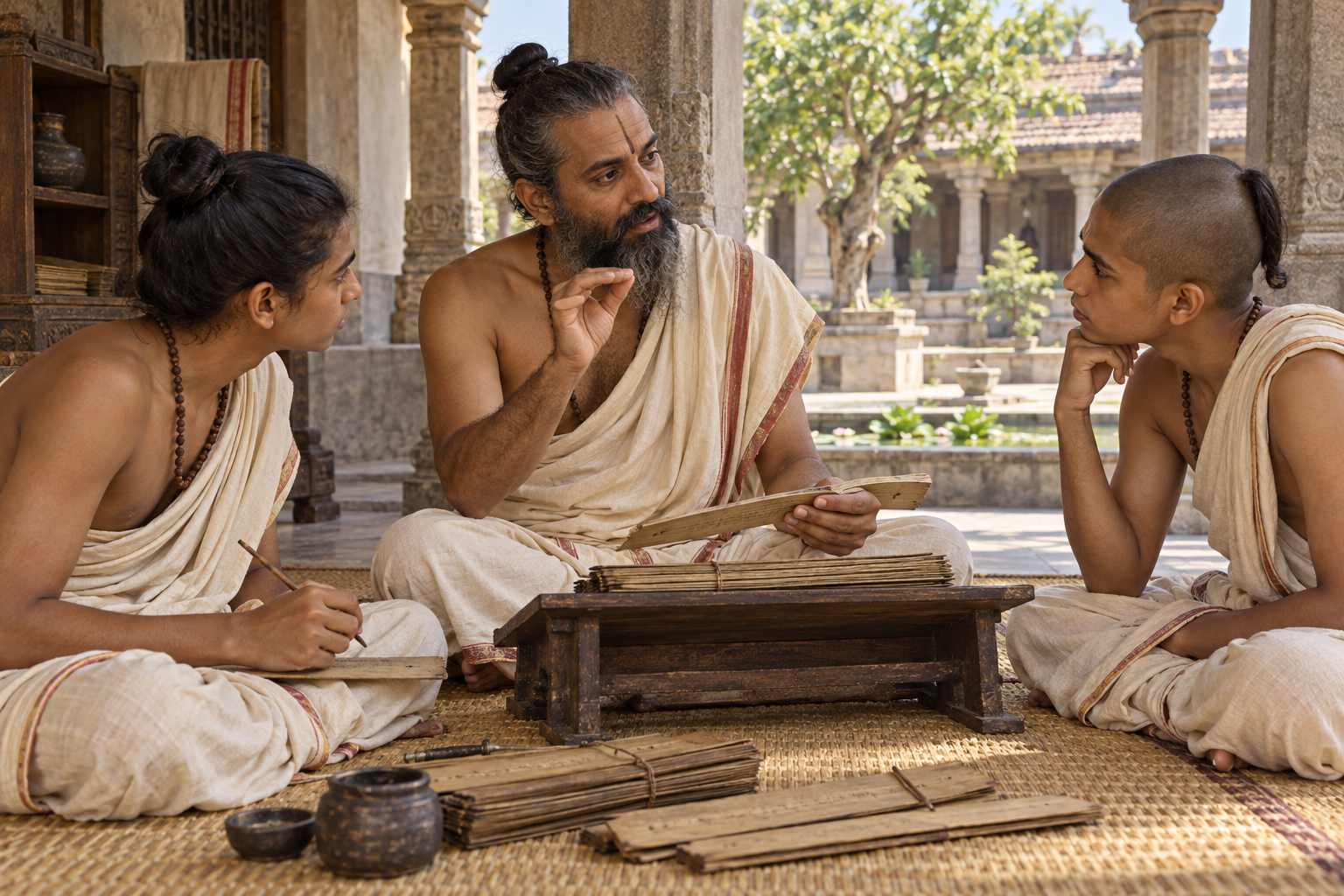
Patanjali’s Mahabhashya, or Great Commentary, belongs to the Sanskrit grammatical tradition associated with Panini. It is not a modern beginner’s grammar and should not be approached as a list of forms to memorise. It examines rules, examples, objections, exceptions, and the reasoning required to decide how language works.
That method matters beyond specialist linguistics. A grammatical distinction protects a distinction in meaning. A rule must explain real usage without becoming so broad that it explains everything and therefore nothing. An objection is not a hostile interruption; it tests whether a proposed explanation can survive a difficult case.
You can borrow this discipline whenever you read or discuss a Dharmic text:
- Identify the exact word carrying the disagreement.
- Separate the word’s grammatical function from the theological conclusion drawn from it.
- Check whether an interpretation fits the whole sentence rather than an isolated fragment.
- Distinguish a rule from an example of the rule.
- State the strongest objection before settling on your preferred reading.
This is especially useful when English translations make two different Sanskrit terms look identical, or when one Sanskrit word is rendered differently across translations. Before arguing over doctrine, check whether the disagreement began as a problem of grammar, context, or translation.
The traditional link between yoga and grammar therefore has a practical force. Yoga asks you to notice disorder in attention. Grammar asks you to notice disorder in expression. Both demand restraint before reaction. We should not pretend that this ethical lesson is the stated thesis of every grammatical passage, but it explains why disciplined speech belongs naturally beside disciplined consciousness in the remembered image of Patanjali.
The medical attribution requires both respect and restraint

The Ayurvedic association is the easiest part of Patanjali’s legacy to overstate. Traditional remembrance honours him as a healer of bodily impurity, but repeating that remembrance does not by itself establish that the grammarian, the compiler or author associated with the Yoga Sutra, and the medical authority were one historical person.
Two different questions are often being asked. Devotional tradition asks what a revered teacher represents within a coherent vision of human cultivation. Historical inquiry asks about dates, vocabulary, manuscript transmission, citations, and whether works attributed to one name belong to the same author. An answer to one question does not automatically settle the other.
Use precise language when you discuss the issue. Say that tradition attributes achievements in yoga, grammar, and medicine to Patanjali. Name the Yoga Sutra and Mahabhashya when those are the works under discussion. For the medical leg, identify a specific text, edition, and scholarly case before claiming direct authorship. If you do not have that evidence in front of you, call it a traditional Ayurvedic attribution.
The same restraint applies to health decisions. A historical association with Ayurveda is not a prescription, and a spiritual teaching is not a substitute for diagnosis or treatment. Do not start, stop, or alter medication because of a claim made about an ancient author. Take an individual medical question to an appropriately qualified healthcare professional; study the traditional medical material as history and philosophy unless you also have competent clinical guidance.
A practical way to study Patanjali’s threefold legacy

You will learn more by following one clear question through the three disciplines than by collecting disconnected quotations. Choose a concern that genuinely affects your conduct: distraction, imprecise speech, or neglect of bodily conditions that support practice. Then work through it in this order:
- Begin with the relevant domain. Use the Yoga Sutra for a question about attention and practice, the Mahabhashya for grammatical reasoning, and responsibly taught Ayurvedic material for the traditional understanding of embodied health.
- Label the status of each claim. Mark it as a statement from a named text, a commentarial interpretation, a traditional attribution, or a modern historical judgment.
- Keep a term ledger. Record the Sanskrit term, the translation being used, its immediate context, and any alternative rendering that materially changes the point.
- Separate understanding from application. First determine what the passage is saying. Only then decide what it asks you to notice or change.
- Test the result in conduct. Look for a specific effect: steadier attention, a more exact sentence, or a more responsible decision about bodily care.
Key takeaways
- Patanjali’s threefold legacy addresses mind through yoga, speech through grammar, and body through Ayurveda.
- The Yoga Sutra cannot be reduced to posture; its discipline extends from ethical conduct to concentrated awareness.
- The Mahabhashya trains reasoning about language, including rules, examples, objections, and contextual meaning.
- Traditional unity and single historical authorship are different claims. You can honour the first without pretending the second is settled.
- Medical attribution should never be converted into personal treatment advice without qualified clinical guidance.
Start where your own discipline is weakest. If attention is scattered, read the Yoga Sutra with commentary and practise observing one mental habit. If your debates repeatedly turn on translated words, study the grammatical context before making a doctrinal claim. If bodily health is the concern, keep historical reverence separate from clinical judgment. That is a more faithful tribute to Patanjali than certainty borrowed from a slogan.
References

Leave a Reply
You must be logged in to post a comment.