

You finish a meal, sit for japa, meditation, svadhyaya, or evening puja, and discover that the body wants only sleep. On another day, you try to correct the problem by eating too little, then spend the next several hours thinking about food. Both experiences point to the same issue: appetite is setting the terms of your practice.
Mitahara offers a steadier response. It trains you to eat enough for health and duty without allowing taste, habit, haste, or excess to govern the meal. You do not need a severe diet to begin. You need one ordinary meal, a clear intention, and enough attention to notice when nourishment turns into momentum.
Mitahara measures your relationship with food
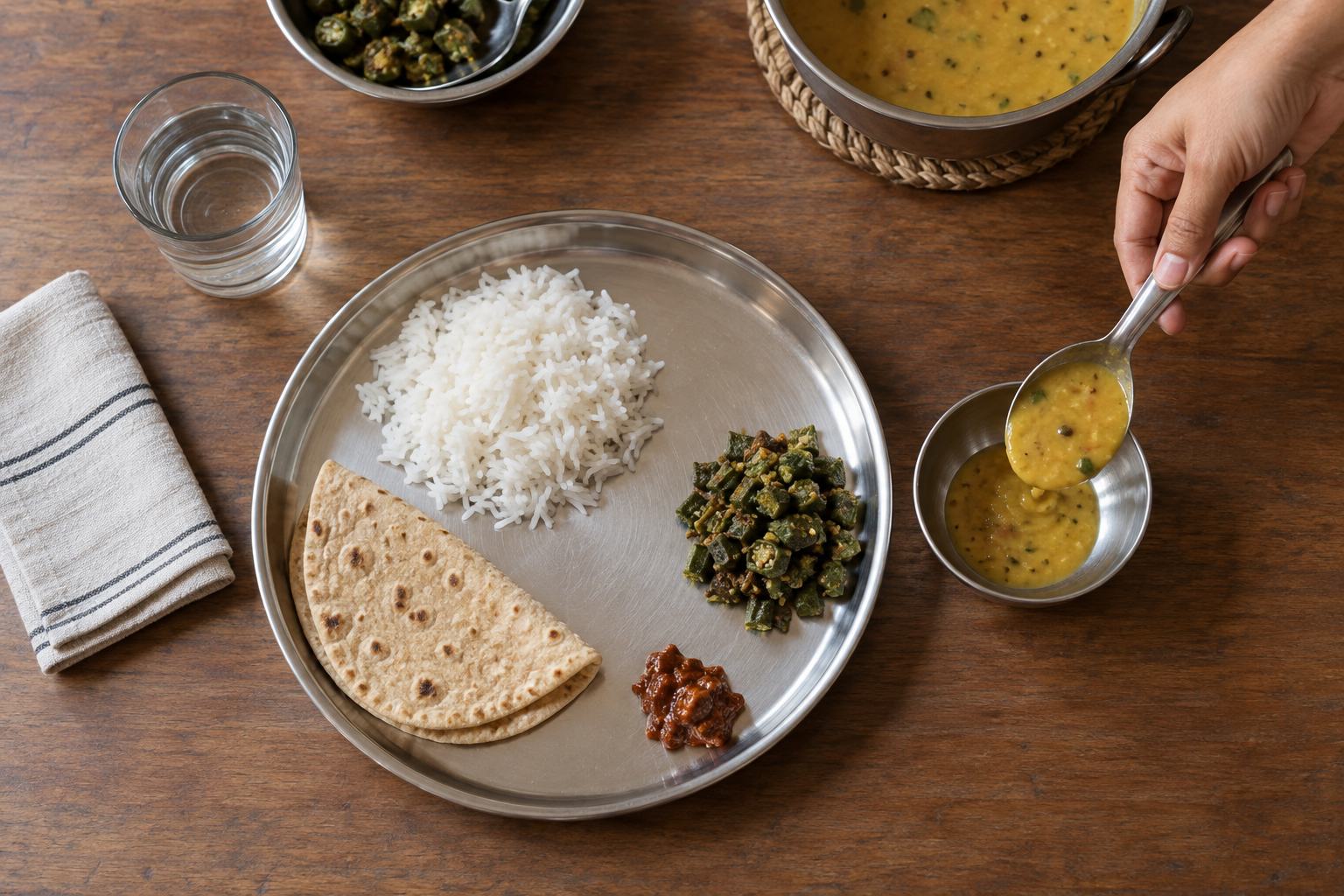
Mitahara is the discipline of measured eating. The measure is not merely the physical size of a portion. It includes what you eat, why you reach for it, how you receive it, how much you take, and what the meal does to your ability to live according to dharma.
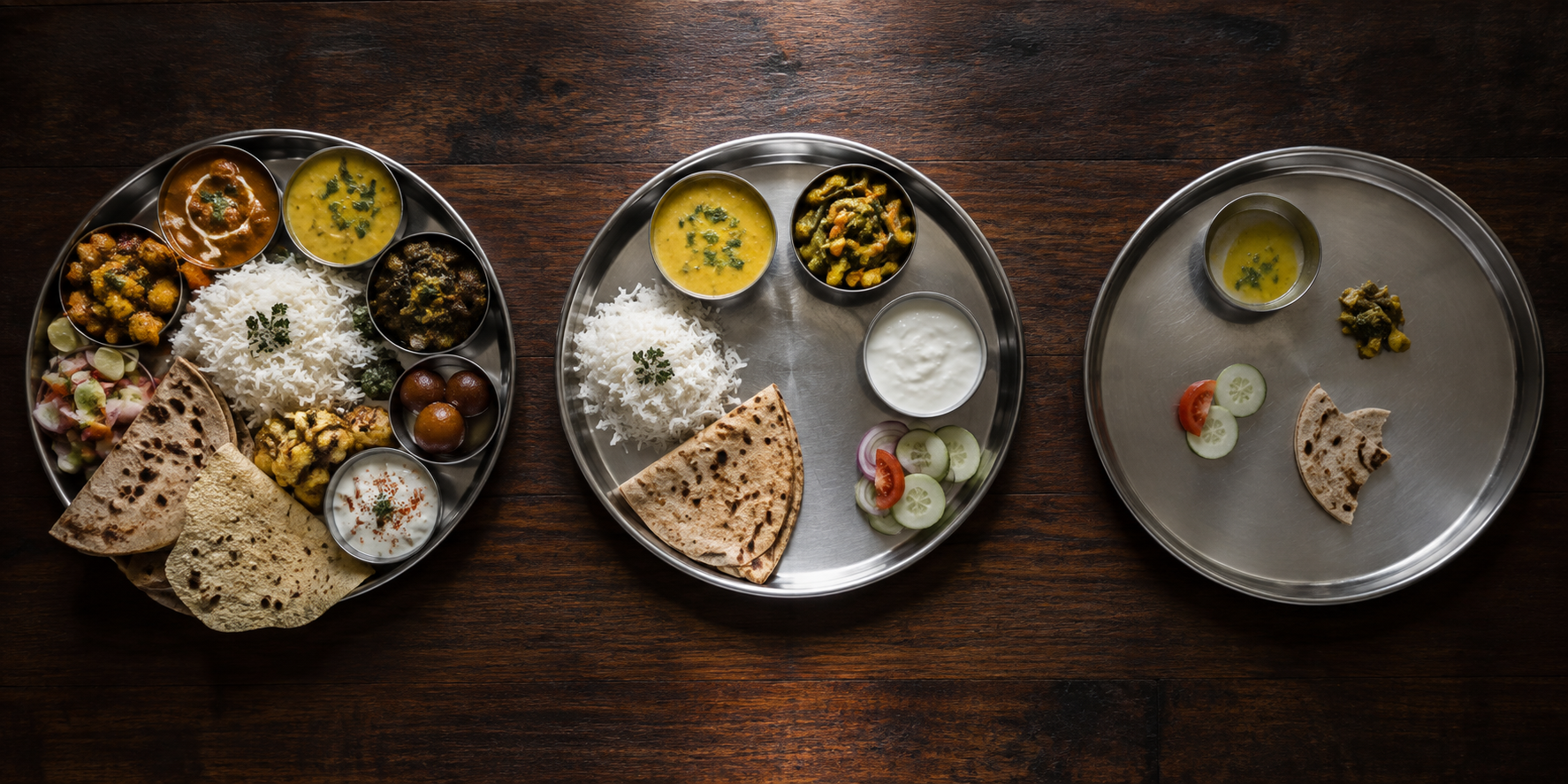
This is why mitahara should not be reduced to eating as little as possible. Too little food can make the mind preoccupied, the body weak, and ordinary duties harder. Too much can produce discomfort, dullness, and inertia. The discipline lies in finding sufficiency without turning sufficiency into indulgence.
A useful way to examine a meal is through five measures:
- Suitability: Does the food respect your health needs, family or sampradaya commitments, vrata, and ethical convictions?
- Quantity: Are you serving what will nourish you, or what habit and visual abundance encourage you to take?
- Motive: Are you responding to hunger, or trying to prolong pleasure, avoid an emotion, please someone, or relieve boredom?
- Manner: Are you seated and attentive, or eating while scrolling, standing, driving, arguing, or working?
- Consequence: Does the meal leave you capable of your next duty and spiritual practice?
These measures also give practical meaning to ahara shuddhi, the purification or ordering of intake. Clean eating in a Dharmic sense cannot be only a claim about ingredients. Acquisition, preparation, gratitude, attention, quantity, and effect all matter. Food that conforms to a rule but is consumed greedily, wastefully, or with contempt for others has not solved the deeper problem.
Dietary boundaries differ among Hindu lineages, regions, households, vows, and life circumstances. Mitahara does not erase those distinctions or install one universal menu. It supplies a discipline that can operate within them. Follow the food rules proper to your tradition while also asking whether your conduct around food is becoming calmer, freer, and more truthful.
The spiritual purpose is not to earn liberation by assembling a perfect plate. The daily encounter with appetite reveals attachment in a form you can actually observe. Each meal gives you a small opportunity to distinguish need from impulse and to let discernment, rather than compulsion, make the decision.
Build the discipline over seven ordinary meals
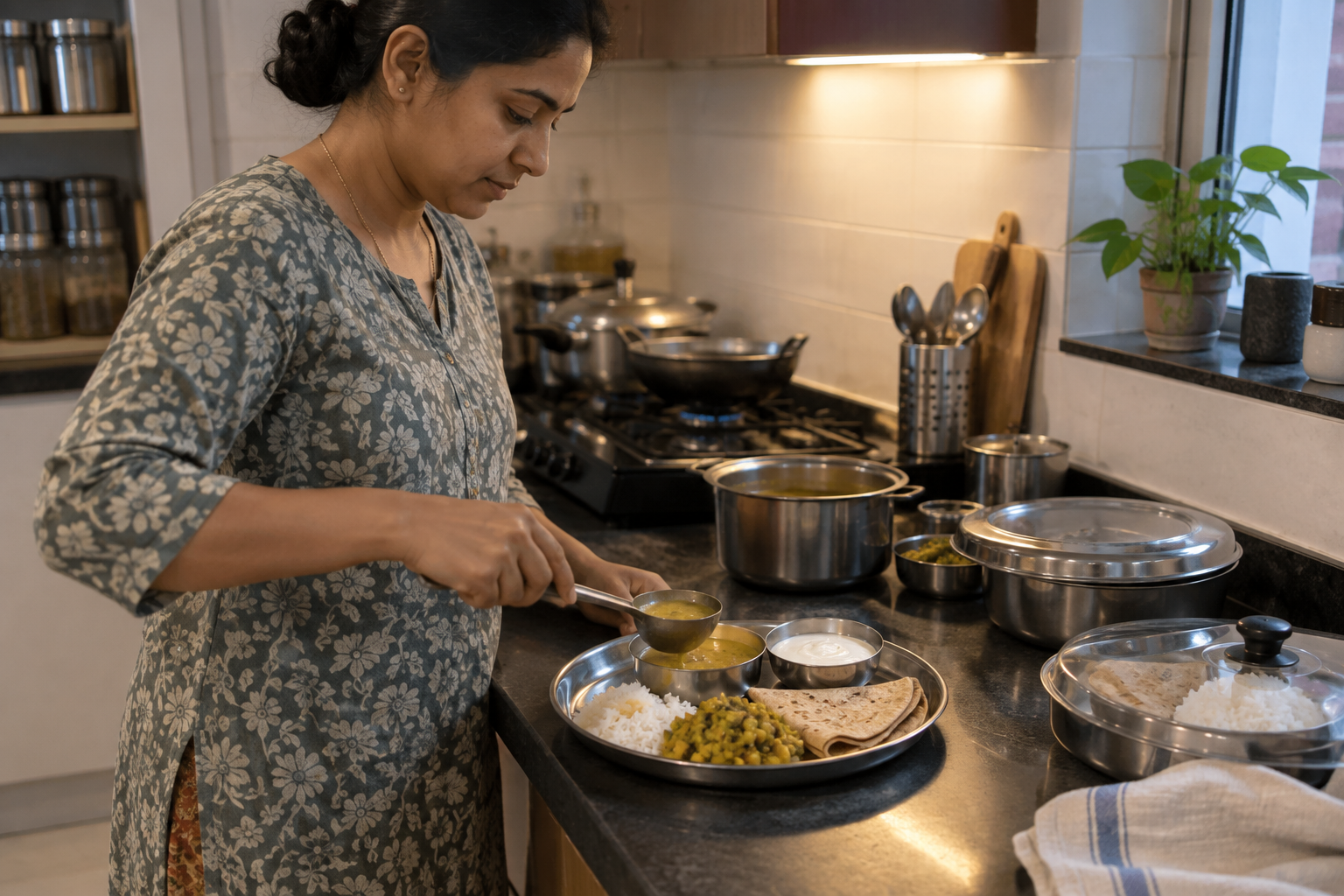
Do not redesign your entire diet on the first day. Choose one meal that occurs under reasonably predictable conditions, such as breakfast at home or the evening meal. Work with that same meal for seven occasions. A narrow experiment makes it easier to see what is actually changing.
- Set a sankalpa before serving. Resolve to eat enough to support the body and your duties, without using the meal to chase excess pleasure. Keep the intention brief and specific.
- Remove one source of inattention. Put away the phone, close the laptop, or move away from the television. If a fully quiet meal is not realistic in your household, give the food your attention between necessary conversations.
- Make the first serving deliberate. Serve what appears sufficient rather than automatically filling every available space. This is not a ban on second helpings. It is a way to separate the first decision from the momentum of eating.
- Begin with remembrance. Use the prayer, offering, or expression of gratitude proper to your home and lineage. The pause marks a change from acquisition to reception: the meal is no longer an object to seize but nourishment to receive responsibly.
- Notice transitions while eating. Taste is vivid at the beginning. Hunger then starts to settle, while the hand may continue through habit. Notice the point at which eating changes from meeting a need to extending an experience.
- Pause before taking more. Ask whether hunger remains or whether the wish for more comes from momentum, distraction, social pressure, or reluctance to let the taste end. If you remain hungry, take more without treating that choice as failure.
- Record one honest line afterward. Note your hunger before the meal, your condition after it, and whether the meal supported or obstructed the next duty. Do not calculate a spiritual score. Look for a pattern.
After seven meals, change only one variable. You might reduce distraction, make the first serving more deliberate, slow the transition between helpings, or alter a food that repeatedly leaves you uncomfortable. If you change the menu, portion, meal time, and eating environment together, you will not know which change mattered.
This method also works in a shared household. Ask for a smaller first serving and accept more if needed. When receiving prasada, take an amount you can consume reverently without waste. At a festival or community meal, choose consciously, enjoy what you accept, and let the next meal return to its usual rhythm. Discipline that survives hospitality is more useful than discipline that exists only under private, controlled conditions.
Use the effects of a meal as feedback, not punishment

The body is an instrument of dharma, not an enemy to be defeated. Pay attention to it without making every passing sensation authoritative. One heavy afternoon does not prove that a food is spiritually unsuitable, just as one light meal does not prove that you have found the ideal diet. Sleep, illness, stress, activity, preparation, and meal composition can all affect how you feel.
Repeated patterns are more informative than isolated reactions. After your chosen meal, ask three practical questions:
- Did the meal settle hunger, or am I still preoccupied with food because I did not eat enough?
- Can I perform the next ordinary duty with reasonable steadiness, or am I uncomfortably full and sluggish?
- When nourishment seemed complete, what kept me eating: remaining hunger, enjoyment, distraction, waste avoidance, courtesy, or simple habit?
The third question is especially useful because it exposes the mechanism. If distraction is the problem, shrinking the meal may only produce hunger while leaving distraction untouched. If social pressure is the problem, silently resolving to exercise more will not help at the next family gathering. Correct the cause you actually observe.
Avoid turning normal enjoyment into guilt. Hindu discipline does not require hostility toward taste. The question is whether enjoyment is received with gratitude and proportion, or whether it repeatedly overrules judgement. You are training freedom in the presence of something pleasant, not pretending that pleasure does not exist.
Mitahara is a spiritual discipline, not a substitute for medical nutrition, eating-disorder care, or treatment. Do not use generic restraint to override a clinician’s instructions if you have a condition affected by meal timing or quantity, take medication with food, are pregnant, are recovering from illness, or have other specialised nutritional needs. Persistent dizziness, fainting, pain, purging, bingeing, obsessive restriction, or unexplained weight change warrants qualified medical help rather than a stricter personal rule.
Avoid the common imitations of disciplined eating
Austerity used as punishment
Eating the smallest possible amount is not automatically mitahara. If a self-imposed restriction leaves you weak, resentful, obsessed with the next meal, or prone to compensatory overeating, the method is defeating its purpose. Replace dramatic reduction with a stable first serving, an attentive pause, and permission to take more when genuine hunger remains.
Purity used as social rank
Food observance can become a means of displaying superiority. That turns discipline outward, toward judging another person’s kitchen, caste, region, or family practice, when its proper field is your own conduct. Maintain genuine religious boundaries without contempt. Ask about ingredients when necessary, explain a vow simply, decline respectfully, and avoid making another person the object of your sadhana.
Fasting used as a shortcut
Vrata and upavasa can have their own sacred purposes, but an occasional fast does not repair habitual distraction and excess at ordinary meals. Mitahara is tested on the unremarkable day when no festival, vow, or public observance is supplying extra motivation. If you fast, follow the requirements of your tradition and the limits of your health; do not improvise severe restriction to compensate for overeating.
Counting mistaken for consciousness
Numbers can be useful when a qualified professional gives you a nutritional target or when measurement helps with a defined health goal. They cannot, by themselves, show whether you ate with gratitude, concealed greed behind a technical allowance, ignored hunger to protect a number, or wasted food. Use metrics where they have a legitimate function, but do not confuse numerical control with mastery of the senses.
The same caution applies after a celebration. One abundant meal need not become an excuse for abandoning restraint, nor does it require punishment the next day. Resume your ordinary practice at the next meal. The capacity to return calmly is a better sign of discipline than alternating indulgence with severity.
Key takeaways
- Mitahara means measured eating, not the pursuit of the smallest possible portion.
- Measure suitability, quantity, motive, manner, and consequence rather than focusing on ingredients alone.
- Begin with one repeatable meal and change one variable at a time.
- Make the first serving deliberate, pause before taking more, and eat more if genuine hunger remains.
- Judge patterns by whether meals support health, duty, and sadhana, not by guilt after a single meal.
- Keep the dietary rules of your lineage without turning food purity into judgement of other people.
- Medical requirements and qualified clinical guidance take priority over generic restriction.
At your next ordinary meal, put away one distraction and set one intention before serving. When the desire for more arrives, pause long enough to identify what is asking: the body’s need or the mind’s momentum. Then respond honestly. That small interval between impulse and action is where mitahara begins to become sadhana.
References

Leave a Reply
You must be logged in to post a comment.