
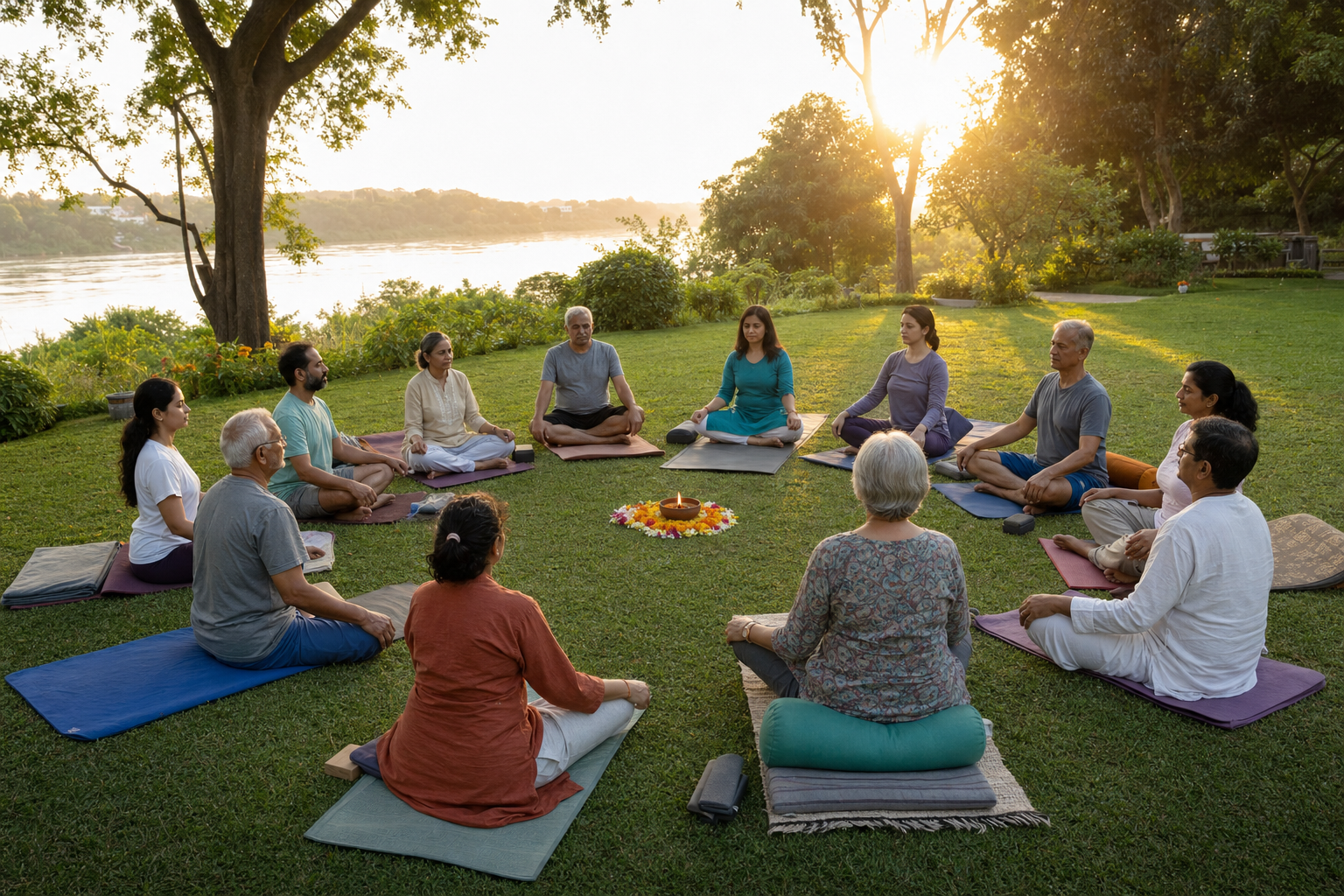
If you are deciding how to mark International Yoga Day on 21 June, the real choice is not between a large public event and a private practice. It is between a passing display and an observance that changes how people relate to their bodies, their traditions, and one another.
You can build the second kind of observance without pretending that Hinduism, Buddhism, Jainism, and Sikhism are identical. The practical path is rooted universalism: name yoga’s Bharatiya inheritance honestly, protect each tradition’s distinct voice, offer a safe shared discipline, and turn the ethical meaning of the day into seva.
Dharmic unity begins where sameness ends
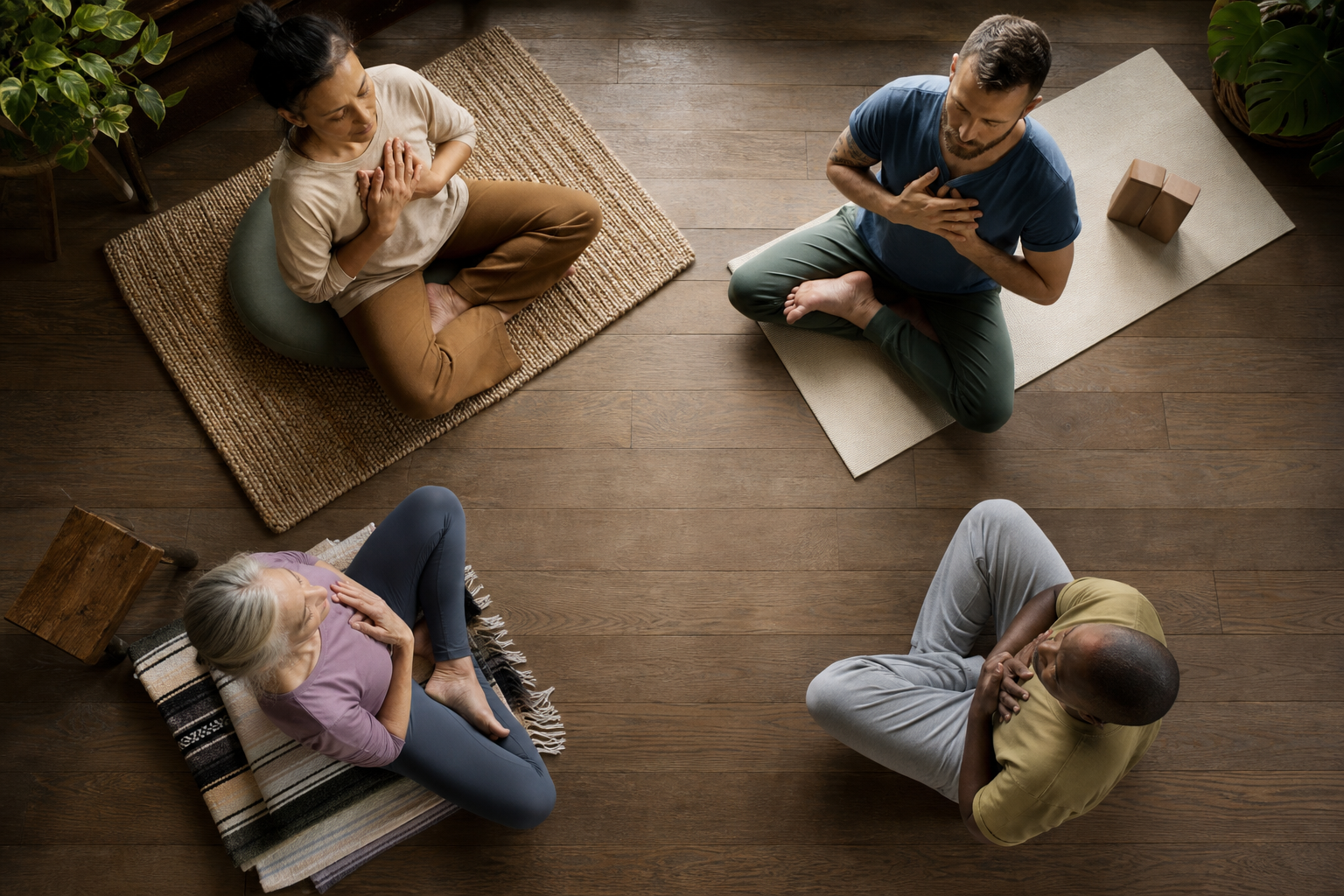
International Yoga Day was established by United Nations General Assembly resolution 69/131 on 11 December 2014. Its annual date, 21 June, falls near the Northern Hemisphere’s summer solstice and naturally evokes Surya, light, rhythm, and renewal. Those symbols give an observance depth, but they should not become a claim that every Dharmic path approaches spiritual practice in the same way.
Within Hindu traditions, yoga includes Patanjali’s eight-limbed discipline and diverse Hatha Yoga lineages. The eight limbs are yama, niyama, asana, pranayama, pratyahara, dharana, dhyana, and samadhi. That sequence immediately corrects a common modern misunderstanding: posture is part of yoga, not the whole of yoga.
Buddhist traditions cultivate mindfulness, breath awareness, ethical discipline, and non-reactivity. Jain practice brings the equanimity of Samayik and the demanding ethical orientation of the Mahavratas. Sikh life gives central place to simran, remembrance of the Divine, and seva, selfless service. These practices can meet in disciplined attention, restraint, compassion, and service without being relabelled as versions of one doctrine.
This distinction matters because unity built by erasing difference is fragile. A Sikh should not have to call simran Patanjalian meditation to participate. A Jain should not have to detach ahimsa from the rigor of Jain ethics. A Buddhist should not have to accept yogic subtle anatomy as Buddhist metaphysics. A Hindu should not be asked to hide yoga’s Hindu philosophical vocabulary so that the event can be called universal.
Before approving an event programme, ask four direct questions:
- Does the invitation name yoga’s Bharatiya and Hindu roots without implying that participation requires Hindu belief?
- Can Hindu, Buddhist, Jain, and Sikh participants describe their own disciplines in their own language?
- Is the common ground defined through practices and virtues rather than a claim that all doctrines are the same?
- Does the gathering lead to an ethical action after the photographs are taken?
The yamas offer a useful starting point: ahimsa, satya, asteya, brahmacharya understood as wise use of energy, and aparigraha. They have meaningful points of contact with Buddhist sila, Jain vows, and Sikh seva, though the concepts do not map onto one another word for word. Choose one shared theme, such as non-harm or service, and let each community explain how it lives that value. Then attach the theme to a concrete act: a food collection, care for elders, support for a local need, or an environmental cleanup.
Vasudhaiva Kutumbakam is strongest here as an ethic rather than a slogan. A global family does not require its members to become indistinguishable. It requires them to approach one another with truth, restraint, hospitality, and responsibility.
Use a 20-minute practice as the common doorway
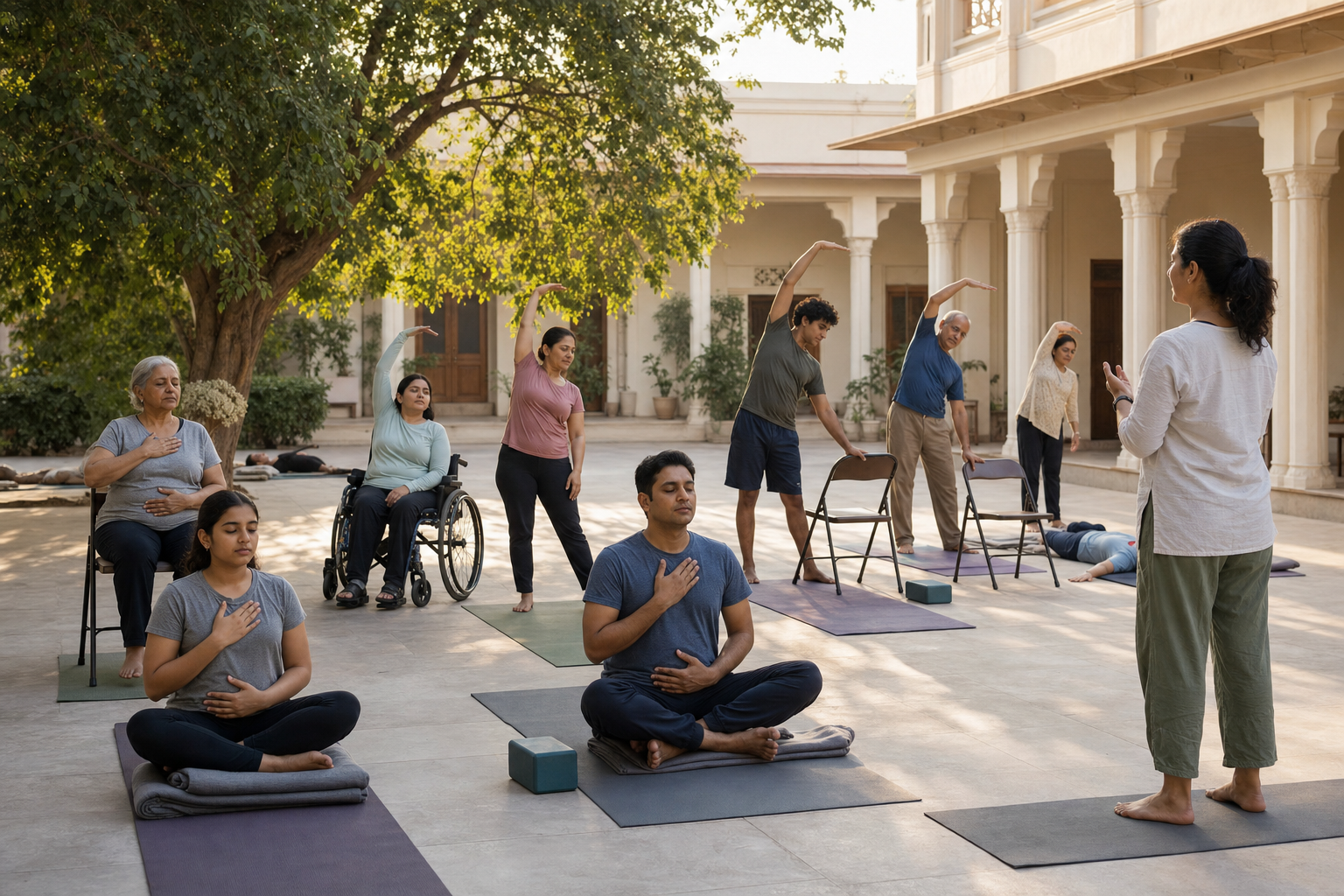
A shared session should be short enough for a beginner to enter and substantial enough to demonstrate that yoga joins posture, breath, attention, and rest. The following 20-minute beginner framework works as a personal practice or the central portion of a community gathering:
- Settle for two minutes. Sit comfortably and observe natural breathing. Do not begin by forcing the breath or demanding mental silence. The first task is simply to notice the body’s present condition.
- Move through three to five gentle rounds of Surya Namaskara. Keep the pace conversational and the breath unstrained. Anyone who cannot comfortably bear weight through the wrists, knees, or shoulders should be offered a supported, chair-based, or stationary alternative.
- Spend five to seven minutes on foundational postures. A sequence may draw on Tadasana, a comfortable form of Bhujangasana, and a supported Setu Bandha Sarvangasana. Use ranges of motion that remain free of sharp or escalating pain.
- Practise slow breathing for three to five minutes. Equal, comfortable inhalation and exhalation is easier to supervise in a mixed group than breath retention. Keep the breath quiet and unforced.
- Close with two to three minutes of guided relaxation. A simple body scan gives participants time to notice the effect of the practice before they stand, speak, or reach for a phone.
A traditional Surya Namaskara cycle coordinates 12 positions with breathing, moving through spinal flexion and extension, lunging, weight-bearing transitions, and a gentle backbend. It is adaptable, but it is not automatically easy. Even weight through the hands and feet, a neutral neck, a stable centre during transitions, and an unforced range matter more than speed or visual perfection. Blocks, shorter stances, lowered knees, wall support, and fewer rounds can preserve the purpose of the sequence while reducing joint strain.
Surya Arghya may be offered as a devotional option before the movement practice. Explain what the offering means, then leave room for participants to offer water, stand in quiet respect, meditate, or simply observe. An invitation preserves both the sacred character of the act and the freedom of the participant; making it a test of belonging damages both.
If you cannot attend a formal observance, use the same architecture at home: settle, move, breathe, and rest. On a demanding workday, even a two-to-five-minute pause with comfortable nasal breathing and gentle seated spinal movement can interrupt accumulated tension. Repetition across ordinary days will teach you more than one exhausting annual session.
Speak honestly about science without shrinking the tradition

You do not need miracle claims to defend yoga. Yoga-based programmes are associated with relaxation, improved flexibility and posture, better breath control, and gains in mental well-being. Across trials, the reported effects on stress, anxiety, depressive symptoms, mobility, and quality of life are commonly small to moderate rather than absolute. That is useful evidence, but it is not a promise that one sequence will cure a medical condition.
Slow diaphragmatic breathing helps explain part of the effect. When the cadence remains comfortable, it can support vagal activity and heart-rate variability, influence baroreflex function, and reduce sympathetic arousal. In everyday language, the practitioner is training the body to move out of constant alarm more readily. Breath strain defeats that purpose, which is why longer exhalations and breath holds should never become competitions.
Asana contributes through a different route. Pain-free movement combines dynamic and isometric loading, joint control, and attention to alignment. With steady practice, this can improve mobility, postural endurance, coordination, and confidence in daily movement. The operative words are steady and pain-free. More intensity is not automatically more therapeutic.
Yoga may also support blood pressure, glucose regulation, lipid profiles, body composition, sleep, and persistent musculoskeletal pain when it is appropriately adapted. It remains a complement to medical or psychological care, not a substitute for it. Anyone managing hypertension, metabolic disease, chronic pain, or significant mental-health symptoms should treat yoga as one part of a broader plan made with qualified professionals.
Keep the experiential and biomedical maps distinct
Prana, nadis, and chakras provide a traditional map for directing attention and interpreting inner experience. Ida, pingala, and sushumna belong to that yogic vocabulary. Biomedical language describes structures and measurable physiological processes through another framework. You can respect both without claiming that a chakra is literally a gland or that a nadi has been established as a nerve.
This intellectual discipline protects credibility. State traditional concepts as traditional concepts. State observed health associations with their proper limits. Where you want to assess personal progress, keep a simple log of practice frequency, duration, perceived effort, and mood before and after. Also notice functional changes: sleep continuity, morning stiffness, afternoon energy, and how quickly you recover from daily conflict. Those markers are more informative than a dramatic posture performed once.
Build an event where flexibility is not the price of entry
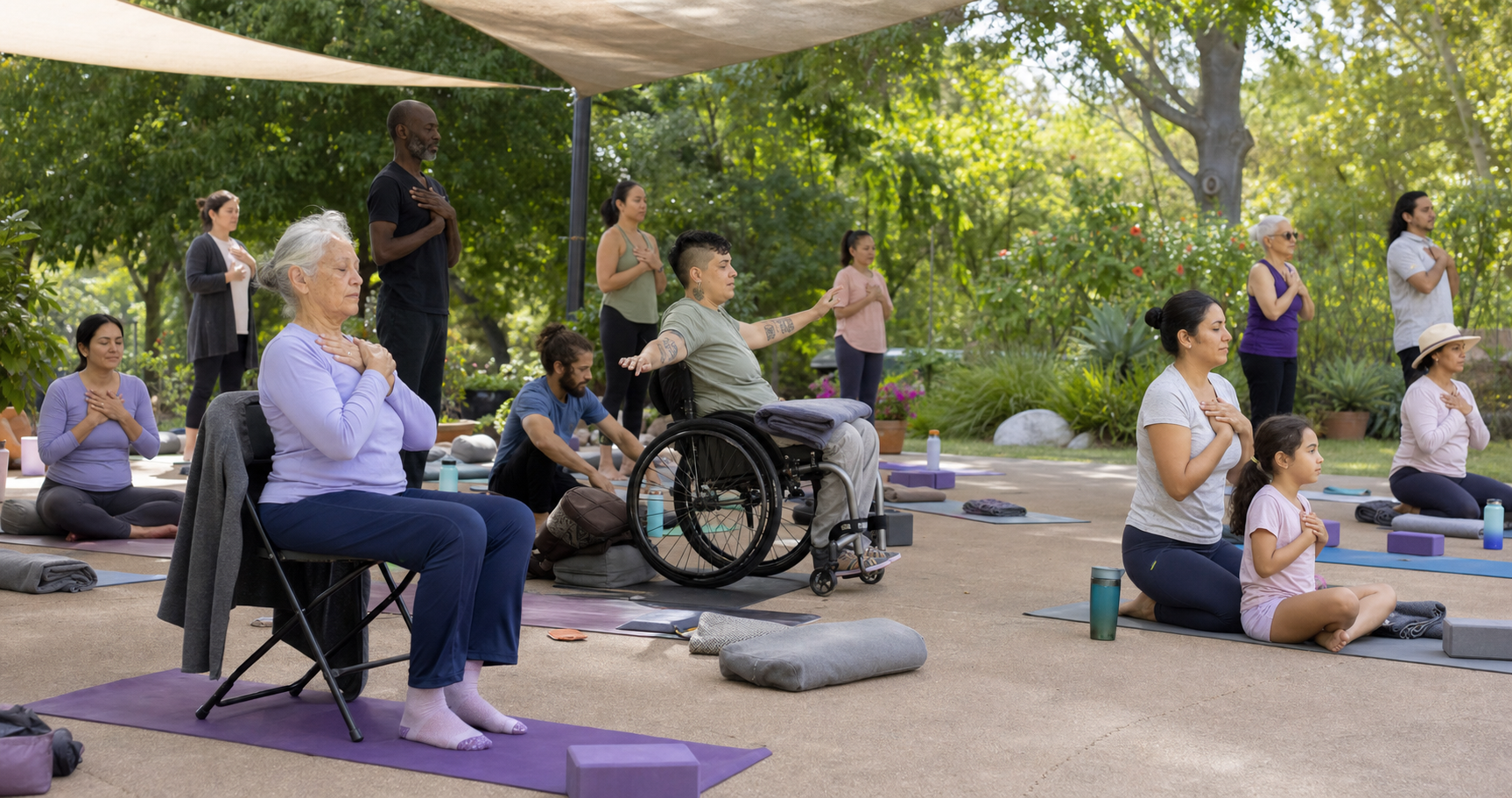
An inclusive event does not merely say that everyone is welcome. Its design makes participation possible for the person who cannot sit on the floor, does not know Sanskrit, has never entered a yoga studio, or belongs to a Dharmic tradition with a different contemplative vocabulary.
You can use the Common Yoga Protocol as a practical scaffold, then make the choices around it explicit:
- Write a clear invitation. A useful line is: Rooted in Bharatiya yoga traditions, open to all, with every posture optional and chair-supported participation welcome.
- Explain unfamiliar terms briefly. Say what Surya Namaskara, pranayama, ahimsa, simran, Samayik, and seva mean in context. Do not assume that every Dharmic participant shares the same vocabulary.
- Make alternatives visible from the beginning. Place chairs and blocks before the session starts, demonstrate the smaller range first, and preserve the option to remain still. Nobody should have to disclose a medical condition publicly to receive a modification.
- Use age-appropriate formats. Children often engage better through playful balance and animal-themed movements. Older adults may need chair support, slower transitions, and more time to orient after changing position.
- Let traditions speak for themselves. Invite Hindu, Buddhist, Jain, and Sikh participants to describe a practice or virtue in their own terms. A multilingual guided meditation can widen access without forcing doctrinal agreement.
- End with a next action. Announce the seva activity, the person coordinating it, and how participants can join. Otherwise, unity remains an emotion confined to the event.
Safety needs the same clarity. People who are pregnant, recovering from injury or surgery, or managing cardiovascular, blood-pressure, or ocular concerns such as glaucoma may need to avoid extreme postures, prolonged inversions, and breath retention. They should consult an appropriately qualified health professional and a competent instructor rather than relying on a general group cue.
During practice, breath strain, dizziness, or joint pain is a signal to stop and reassess, not a barrier to push through. Hands-on adjustment should require consent. The instructor should be able to reduce load, range, and speed without treating the modified practice as inferior. If a gathering cannot provide that basic level of care, offer meditation, natural breathing, or observation instead of pressuring people into the physical sequence.
The longest day symbolism of 21 June makes outdoor morning practice attractive, but the setting should serve the people rather than the photograph. Choose a stable surface, make seating available, and preserve an accessible route into and out of the practice area. The meaning of Surya is not enhanced by avoidable discomfort.
Key takeaways for 21 June
- Honour yoga’s roots openly; universality does not require cultural amnesia.
- Build unity around disciplined attention, ethical living, compassion, and seva while allowing each Dharmic tradition to retain its own doctrine and vocabulary.
- Use a brief sequence that includes settling, adaptable movement, comfortable breathing, and relaxation rather than treating difficult postures as the centre of the day.
- Describe health benefits in proportion to the evidence: yoga can support well-being and function, but it does not replace professional care.
- Judge inclusion by whether beginners, children, older adults, and people needing modifications can participate without embarrassment.
- Give the gathering a consequence by connecting its ethical theme to one specific act of service.
Before you publish an invitation, write down four things: how you will name the roots, how you will protect voluntary participation, which safe practice you will offer, and what seva will follow. If those four answers are clear, International Yoga Day can become more than a yearly performance. It can become a disciplined encounter with Dharma and with one another.
References
